
Electric Vehicle (EV) Battery Cell And Pack Materials Market Report 2026
Global Outlook – By Vehicle Electrification Type (Battery Electric Vehicles (BEVs), Hybrid Electric Vehicles (HEVs), Plug-in Hybrid Electric Vehicles (PHEVs)), By Cell Material Type (Lithium-Ion Batteries, Lithium Iron Phosphate (LFP) Batteries, Nickel Manganese Cobalt (NMC) Batteries, Nickel Cobalt Aluminum (NCA) Batteries, Nickel-Metal Hydride (NiMH) Batteries, Sodium-Ion Batteries, Solid-State Batteries), By Battery Pack Material Type (Cathode Materials, Anode Materials, Electrolytes, Separators, Current Collectors, Battery Casings & Enclosures, Thermal Management Materials), By Application (Electric Passenger Vehicles, Electric Commercial Vehicles, Electric Two-Wheelers & Three-Wheelers) – Market Size, Trends, Strategies, and Forecast to 2030
Electric Vehicle (EV) Battery Cell And Pack Materials Market Overview
• Electric Vehicle (EV) Battery Cell And Pack Materials market size has reached to $19.14 billion in 2025 • Expected to grow to $38.02 billion in 2030 at a compound annual growth rate (CAGR) of 14.7% • Growth Driver: Surge In Global Automobile Production Driving The Growth Of The Materials Market Due To Rising Consumer Demand And Technological Advancements • Market Trend: Advancement In LFP Technology Enhances EV Charging Speed And Battery Performance • Asia-Pacific was the largest region in 2025.What Is Covered Under Electric Vehicle (EV) Battery Cell And Pack Materials Market?
Electric vehicle (EV) battery cell and pack materials refer to the various components and materials used in producing battery cells and packs that power electric vehicles. These materials are critical for ensuring the battery system's performance, energy efficiency, and safety, which is essential for driving an electric vehicle. The main battery types of electric vehicle (EV) battery cell and pack materials include battery electric vehicle (BEV), hybrid electric vehicle (HEV), plug-in hybrid electric vehicle (PHEV), and fuel cell electric vehicle (FCEV). A Battery Electric Vehicle (BEV) is a type of electric vehicle (EV) that operates solely on electricity, using a rechargeable battery pack to power an electric motor. The various cell materials include lithium-ion battery, lead-acid battery, nickel-metal hydride battery, ultracapacitors, and sodium-ion battery and are used by several applications such as electric vehicles, energy storage, consumer electronics, and industrial applications.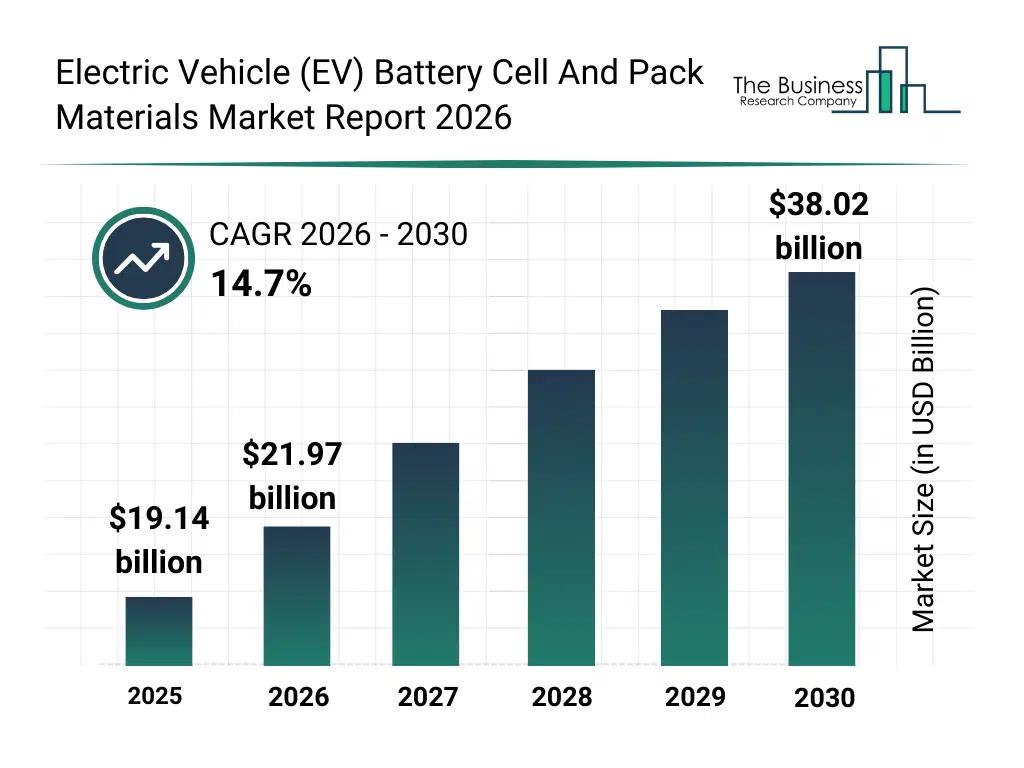
What Is The Electric Vehicle (EV) Battery Cell And Pack Materials Market Size and Share 2026?
The electric vehicle (EV) battery cell and pack materials market size has grown rapidly in recent years. It will grow from $19.14 billion in 2025 to $21.97 billion in 2026 at a compound annual growth rate (CAGR) of 14.8%. The growth in the historic period can be attributed to ev adoption growth, lithium-ion dominance, demand for longer driving range, early battery gigafactory investments, consumer electronics crossover.What Is The Electric Vehicle (EV) Battery Cell And Pack Materials Market Growth Forecast?
The electric vehicle (EV) battery cell and pack materials market size is expected to see rapid growth in the next few years. It will grow to $38.02 billion in 2030 at a compound annual growth rate (CAGR) of 14.7%. The growth in the forecast period can be attributed to solid-state battery commercialization, raw material diversification, battery cost reduction, recycling mandates, domestic battery manufacturing incentives. Major trends in the forecast period include shift toward advanced battery chemistries, rising demand for high-energy-density cells, localization of battery supply chains, growth of solid-state research, expansion of ev battery recycling.
Global Electric Vehicle (EV) Battery Cell And Pack Materials Market Segmentation
1) By Vehicle Electrification Type: Battery Electric Vehicles (BEVs), Hybrid Electric Vehicles (HEVs), Plug-in Hybrid Electric Vehicles (PHEVs) 2) By Cell Material Type: Lithium-Ion Batteries, Lithium Iron Phosphate (LFP) Batteries, Nickel Manganese Cobalt (NMC) Batteries, Nickel Cobalt Aluminum (NCA) Batteries, Nickel-Metal Hydride (NiMH) Batteries, Sodium-Ion Batteries, Solid-State Batteries 3) By Battery Pack Material Type: Cathode Materials, Anode Materials, Electrolytes, Separators, Current Collectors, Battery Casings & Enclosures, Thermal Management Materials 4) By Application: Electric Passenger Vehicles, Electric Commercial Vehicles, Electric Two-Wheelers & Three-Wheelers Subsegments: 1) By Battery Electric Vehicles (BEVs): Lithium Iron Phosphate (LFP) Battery Cells, Nickel Manganese Cobalt (NMC) Battery Cells, Nickel Cobalt Aluminum (NCA) Battery Cells, Solid-State Battery Cells 2) By Hybrid Electric Vehicles (HEVs): Nickel-Metal Hydride (NiMH) Battery Cells, Lithium-Ion Battery Cells 3) By Plug-in Hybrid Electric Vehicles (PHEVs): Lithium-Ion Battery Cells, Nickel Manganese Cobalt (NMC) Battery Cells, Lithium Polymer (Li-Po) Battery CellsWhat Is The Driver Of The Electric Vehicle (EV) Battery Cell And Pack Materials Market?
The upsurge in automobile production is expected to drive the growth of the electric vehicle (EV) battery cell and pack materials market going forward. Automobile production refers to the process of designing, manufacturing, and assembling motor vehicles, including passenger cars, commercial trucks, and other transport vehicles. The rise in automotive production is due to rising global consumer demand, rapid technological advancements in manufacturing processes, and supportive government policies and incentives. As more people gain the ability to afford vehicles, the growing consumer demand prompts manufacturers to increase production to satisfy the expanding market, thereby driving up overall automobile production. The rise in EV production encourages innovation in battery technologies, and manufacturers invest in better, more efficient battery materials to meet the higher energy demands of EVs. For instance, in 2023, according to the Organisation Internationale des Constructeurs d'Automobiles (OICA), a France-based international association of automobile manufacturers, in 2023, the global automotive industry witnessed substantial growth in 2023, with vehicle production rising to 93.55 million units, up from 85.02 million units in 2022. Therefore, the upsurge in automobile production is driving the growth of the electric vehicle (EV) battery cell and pack materials industry.Key Players In The Global Electric Vehicle (EV) Battery Cell And Pack Materials Market
Major companies operating in the electric vehicle (ev) battery cell and pack materials market report include Ford Motor Company, BYD Company Limited, Panasonic Industry Co. Ltd., SK Innovation Co. Ltd., Contemporary Amperex Technology Co. Ltd., LG Chem Ltd., EVE Energy Co. Ltd., Gotion High-Tech Co. Ltd., Envision AESC Group Ltd., Samsung SDI Co. Ltd., Northvolt AB, QuantumScape Corporation, Farasis Energy (Ganzhou) Co. Ltd., Microvast Holdings Inc., ProLogium Technology Co. Ltd., Grepow Battery Co. Ltd., China Aviation Lithium Battery Co. Ltd., Solid Power Inc., StoreDot Ltd., Imperium3 (iM3) Consortium, Amperex Technology Limited (ATL), SVOLT Energy Technology Co. Ltd.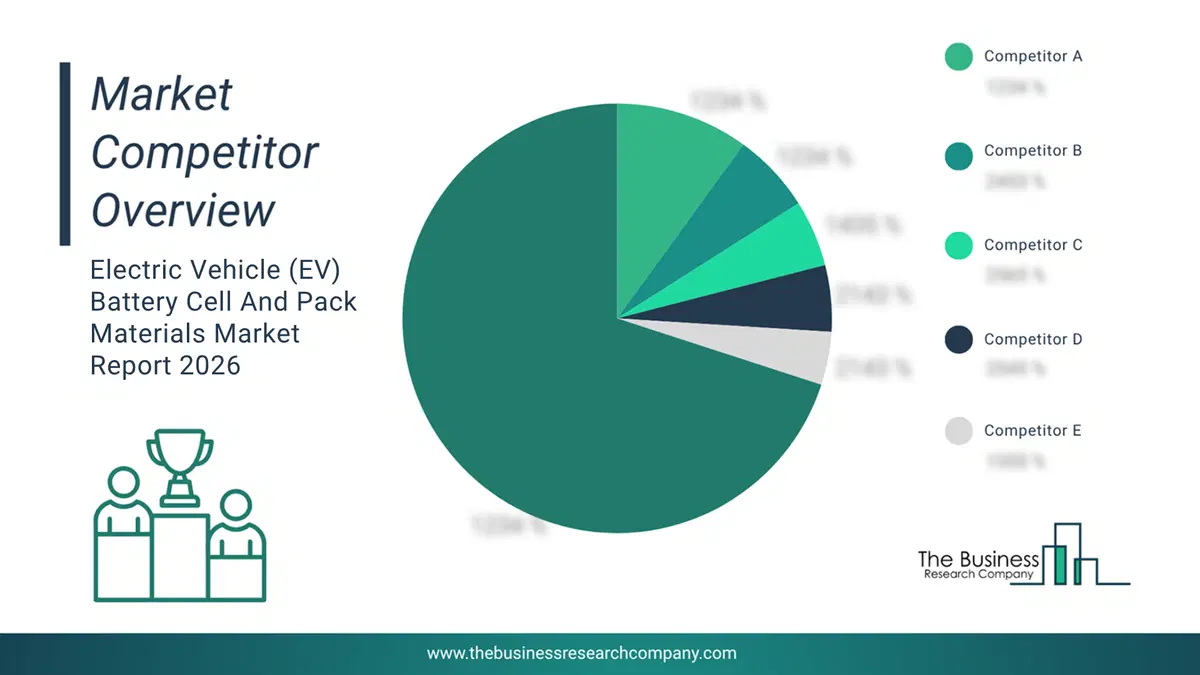
This chart is for illustrative purposes; the full report includes a detailed competitor analysis and comprehensive overview of the top 10 companies in the market.
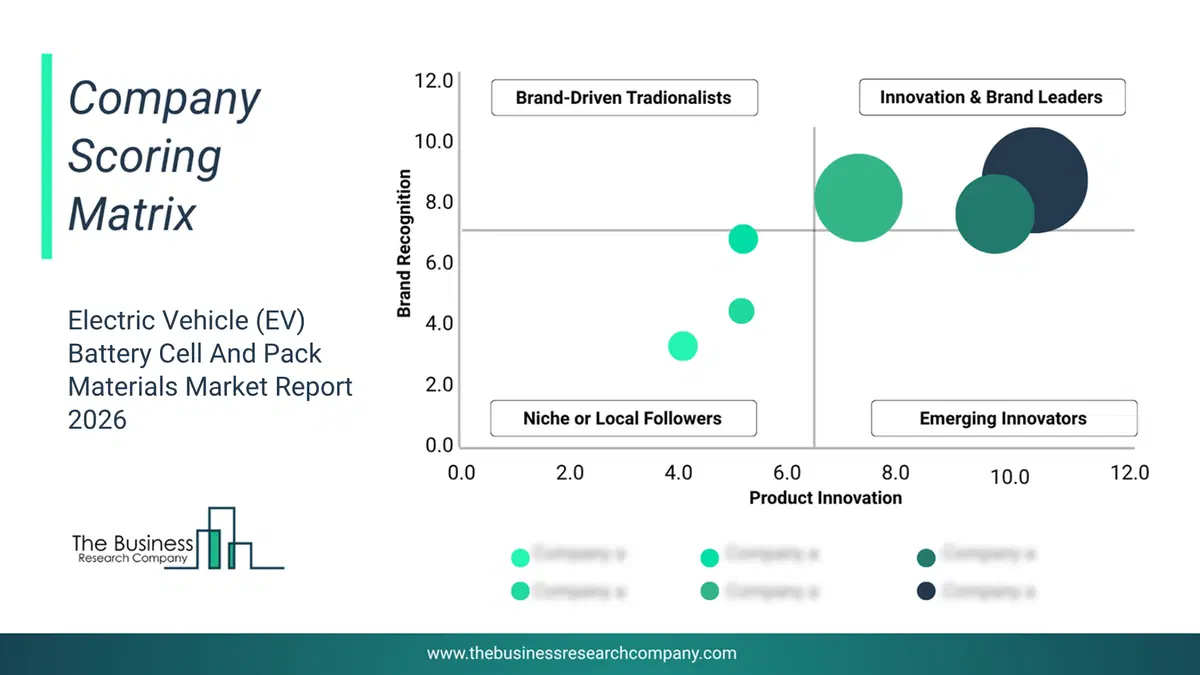
This chart maps companies by product innovation and brand strength, with bubble size indicating relative revenue, helping identify market leaders, challengers, and niche players. This is an illustrative chart; the full report provides a complete and accurate competitive analysis.
Global Electric Vehicle (EV) Battery Cell And Pack Materials Market Trends and Insights
Major companies operating in the electric vehicle (EV) battery cell and pack materials market are focusing on developing innovative technologies, such as LFP technology, to enhance battery safety, longevity, and cost-effectiveness. LFP (lithium iron phosphate) technology is a battery chemistry known for its high safety, long lifespan, thermal stability, and cost-effectiveness in electric vehicles and energy storage. For instance, in August 2023, Contemporary Amperex Technology Co. Limited (CATL), a China-based battery manufacturer and technology company, introduced Shenxing, the world’s first 4C superfast charging lithium iron phosphate (LFP) battery. This battery allows electric vehicles to gain a 400 km driving range with just a 10-minute charge and offers over 700 km on a full charge. It is designed to eliminate charging speed concerns, making EVs more practical for daily use. Shenxing incorporates advanced LFP technology to enhance safety, efficiency, and longevity. This breakthrough marks a significant step forward in fast-charging solutions for the electric vehicle industry.What Are Latest Mergers And Acquisitions In The Electric Vehicle (EV) Battery Cell And Pack Materials Market?
In February 2024, Volvo Group, a Sweden-based automotive & transport manufacturing and infrastructure solutions company, acquired Proterra Inc.’s battery business for USD 210 million. With this acquisition, Volvo aimed to accelerate its battery-electric vehicle roadmap by integrating advanced EV-battery module and pack development capabilities. Proterra Inc., a U.S.-based electric vehicle and EV-battery technology company, specialized in designing and manufacturing battery systems (modules and packs) for heavy-duty commercial vehicles.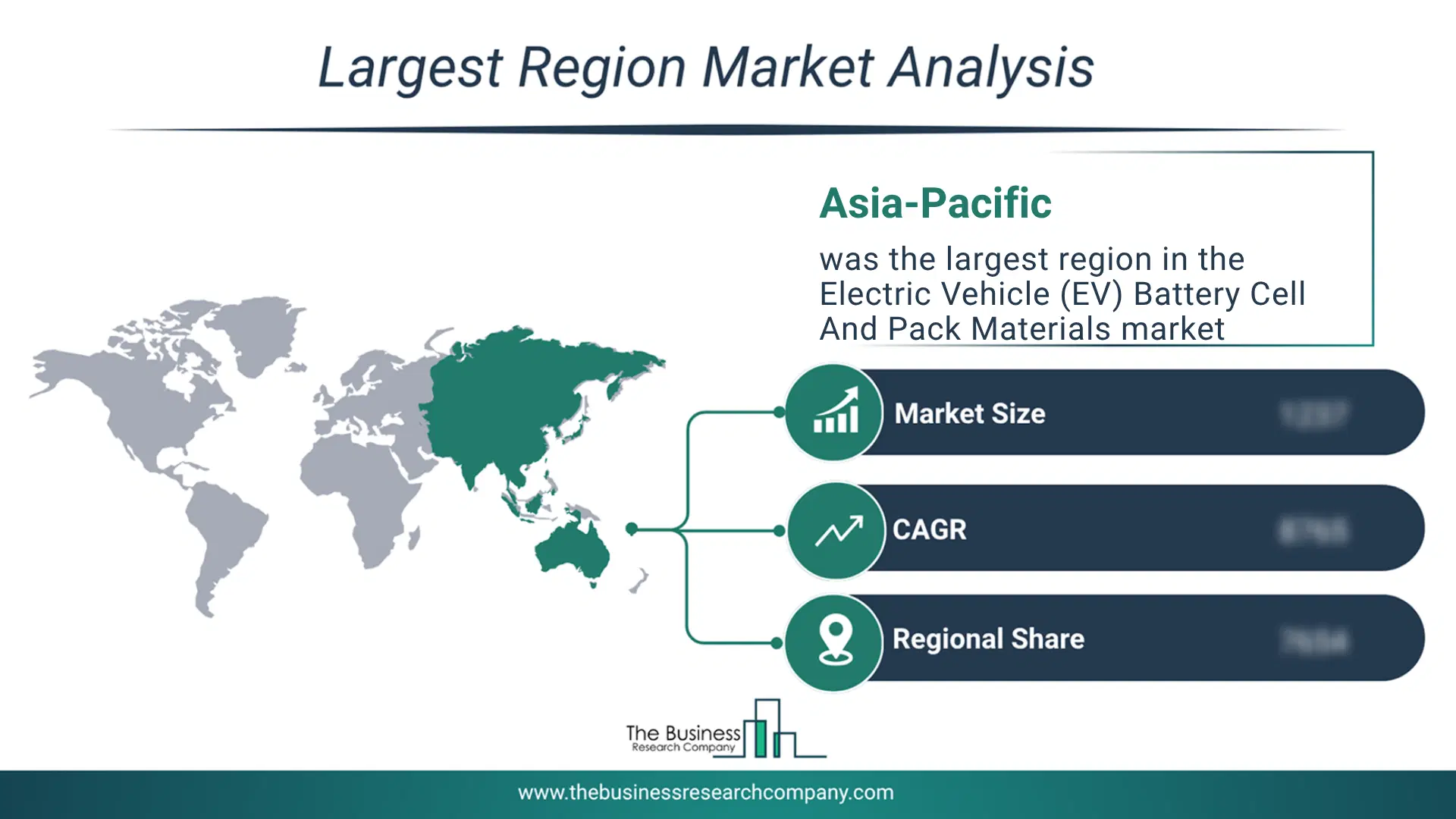
Regional Outlook
Asia-Pacific was the largest region in the electric vehicle (EV) battery cell and pack materials market in 2025. The regions covered in this market report include Asia-Pacific, South East Asia, Western Europe, Eastern Europe, North America, South America, Middle East, Africa. The countries covered in this market report include Australia, Brazil, China, France, Germany, India, Indonesia, Japan, Taiwan, Russia, South Korea, UK, USA, Canada, Italy, SpainWhat Defines the Electric Vehicle (EV) Battery Cell And Pack Materials Market?
The electric vehicle (EV) battery cell and pack materials market consists of sales of cathode materials, anode materials, electrolytes, separators, casings, and battery management components. Values in this market are ‘factory gate’ values, that is the value of goods sold by the manufacturers or creators of the goods, whether to other entities (including downstream manufacturers, wholesalers, distributors and retailers) or directly to end customers. The value of goods in this market includes related services sold by the creators of the goods.How is Market Value Defined and Measured?
The market value is defined as the revenues that enterprises gain from the sale of goods and/or services within the specified market and geography through sales, grants, or donations in terms of the currency (in USD unless otherwise specified). The revenues for a specified geography are consumption values that are revenues generated by organizations in the specified geography within the market, irrespective of where they are produced. It does not include revenues from resales along the supply chain, either further along the supply chain or as part of other products.
This chart presents market attractiveness based on a quantitative evaluation of growth, competition, strategic alignment, and risk, offering a clear view of opportunity areas for decision-making. This chart is for illustrative purposes; the full report contains the complete analysis.

This chart highlights the Total Addressable Market (TAM) by estimating the maximum revenue opportunity using an assumption-driven approach, supporting strategic planning and opportunity sizing across markets. The chart is illustrative; the full report provides a more comprehensive analysis.
What Key Data and Analysis Are Included in the Electric Vehicle (EV) Battery Cell And Pack Materials Market Report 2026?
The electric vehicle (ev) battery cell and pack materials market research report is one of a series of new reports from The Business Research Company that provides market statistics, including industry global market size, regional shares, competitors with the market share, detailed market segments, market trends and opportunities, and any further data you may need to thrive in the electric vehicle (ev) battery cell and pack materials industry. The market research report delivers a complete perspective of everything you need, with an in-depth analysis of the current and future state of the industry.Electric Vehicle (EV) Battery Cell And Pack Materials Market Report Forecast Analysis
| Report Attribute | Details |
|---|---|
| Market Size Value In 2026 | $21.97 billion |
| Revenue Forecast In 2030 | $38.02 billion |
| Growth Rate | CAGR of 14.8% from 2026 to 2030 |
| Base Year For Estimation | 2025 |
| Actual Estimates/Historical Data | 2020-2025 |
| Forecast Period | 2026 - 2030 - 2030 |
| Market Representation | Revenue in USD Billion and CAGR from 2026 to 2030 |
| Segments Covered | Vehicle Electrification Type, Cell Material Type, Battery Pack Material Type, Application |
| Regional Scope | Asia-Pacific, Western Europe, Eastern Europe, North America, South America, Middle East, Africa |
| Country Scope | The countries covered in the report are Australia, Brazil, China, France, Germany, India, Indonesia, Japan, Taiwan, Russia, South Korea, UK, USA, Canada, Italy, Spain. |
| Key Companies Profiled | Ford Motor Company, BYD Company Limited, Panasonic Industry Co. Ltd., SK Innovation Co. Ltd., Contemporary Amperex Technology Co. Ltd., LG Chem Ltd., EVE Energy Co. Ltd., Gotion High-Tech Co. Ltd., Envision AESC Group Ltd., Samsung SDI Co. Ltd., Northvolt AB, QuantumScape Corporation, Farasis Energy (Ganzhou) Co. Ltd., Microvast Holdings Inc., ProLogium Technology Co. Ltd., Grepow Battery Co. Ltd., China Aviation Lithium Battery Co. Ltd., Solid Power Inc., StoreDot Ltd., Imperium3 (iM3) Consortium, Amperex Technology Limited (ATL), SVOLT Energy Technology Co. Ltd. |
| Customization Scope | Request for Customization |
| Pricing And Purchase Options | Explore Purchase Options |