
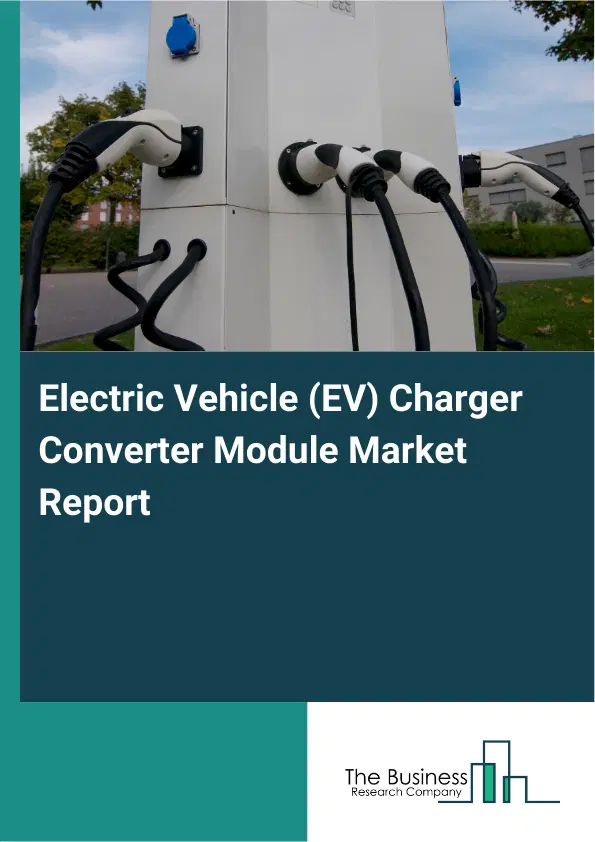
Electric Vehicle (EV) Charger Converter Module Market Report 2026
Global Outlook – By Product Type ( Direct Current to Direct Current Converter (DC/DC), Alternating Current to Direct Current Converter (AC/DC)), By Power Rating ( 30 to 60 kW, 60 to 120 kW, 120 to 240 kW, 240 to 400 kW), By End-user ( Residential, Commercial, Public) – Market Size, Trends, Strategies, and Forecast to 2030
Electric Vehicle (EV) Charger Converter Module Market Overview
• Electric Vehicle (EV) Charger Converter Module market size has reached to $4.48 billion in 2025 • Expected to grow to $11.4 billion in 2030 at a compound annual growth rate (CAGR) of 20.1% • Growth Driver: Rising Electric Vehicle Adoption Driving The Market Growth Due To Increasing Environmental Concerns And Government Incentives • Market Trend: Technological Advancements Driving Scalable And Efficient EV Fast Charging • Asia-Pacific was the largest region in 2025.What Is Covered Under Electric Vehicle (EV) Charger Converter Module Market?
Electric Vehicle (EV) charger converter module is a critical component in the charging infrastructure of electric vehicles. It converts the electrical power from the charging station to a form suitable for charging the EV's battery, ensuring efficient and safe energy transfer. The EV charger converter module plays a crucial role in the electric vehicle charging ecosystem by converting, regulating, and ensuring the efficient transfer of power from the grid to the vehicle's battery. The main product types of electric vehicle (EV) charger converter modules include direct current to direct current converters (DC/DC) and alternating current to direct current converters (AC/DC). A direct current to direct current converter (DC/DC) is an electronic device that transforms one direct current (DC) voltage level to another, essential in electric vehicle (EV) charging as they adapt the high-voltage battery power to the lower voltages required for various vehicle components. The power rating is categorized into 30 to 60 kW, 60 to 120 kW, 120 to 240 kW, and 240 to 400 kW, and end users include residential, commercial, and public.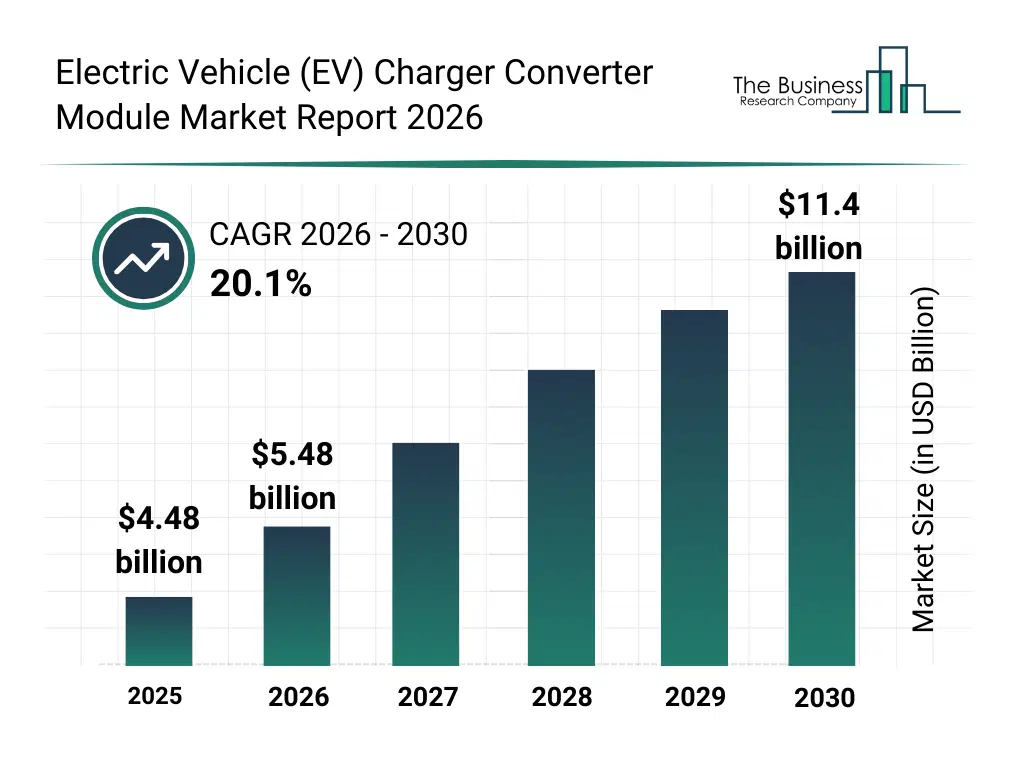
What Is The Electric Vehicle (EV) Charger Converter Module Market Size 2026 And Growth Rate?
The electric vehicle (EV) charger converter module market size has grown exponentially in recent years. It will grow from $4.48 billion in 2025 to $5.48 billion in 2026 at a compound annual growth rate (CAGR) of 22.5%. The growth in the historic period can be attributed to early adoption of electric vehicles, government incentives for ev charging infrastructure, increasing fuel cost volatility, initial rollout of public charging networks, advancements in power electronics design.What Is The Electric Vehicle (EV) Charger Converter Module Market Growth Forecast?
The electric vehicle (EV) charger converter module market size is expected to see exponential growth in the next few years. It will grow to $11.4 billion in 2030 at a compound annual growth rate (CAGR) of 20.1%. The growth in the forecast period can be attributed to rapid expansion of fast charging corridors, rising penetration of electric vehicles, growth of vehicle to grid applications, increasing investments in smart grid infrastructure, advancements in silicon carbide and gan technologies. Major trends in the forecast period include growing adoption of high power fast charging converter modules, increasing demand for bidirectional converter modules for v2g, rising integration of modular and scalable charger architectures, expansion of wide bandgap semiconductor based converter designs, increasing focus on high efficiency and thermal management.
Global Electric Vehicle (EV) Charger Converter Module Market Segmentation
1) By Product Type: Direct Current to Direct Current Converter (DC/DC), Alternating Current to Direct Current Converter (AC/DC) 2) By Power Rating: 30 to 60 kW, 60 to 120 kW, 120 to 240 kW, 240 to 400 kW 3) By End-user: Residential, Commercial, Public Subsegments: 1) By Direct Current To Direct Current Converter (DC/DC): On-Board DC/DC Converters, Off-Board DC/DC Converters, High-Power DC/DC Converters For Fast Charging, Low-Power DC/DC Converters For Auxiliary Systems 2) By Alternating Current to Direct Current Converter (AC/DC): Level 1 AC/DC Converters (Slow Charging), Level 2 AC/DC Converters (Residential and Commercial Use), Level 3 AC/DC Converters (Fast Charging), Bidirectional AC/DC Converters (for Vehicle-to-Grid Applications)What Is The Driver Of The Electric Vehicle (EV) Charger Converter Module Market?
The growing electric vehicle adoption is expected to propel the growth of the electric vehicle (EV) charger converter module market going forward. An electric vehicle (EV) is a vehicle that primarily runs on electricity stored in batteries and powered by electric motors, rather than relying mainly on a traditional internal combustion engine. The increase in electric vehicle adoption is being driven by heightened environmental awareness and government policies designed to lower emissions and encourage cleaner modes of transportation. The electric vehicle (EV) charger converter module supports electric vehicles by transforming grid electricity into the required voltage and current, enabling safe and efficient battery charging while safeguarding the system against overvoltage or overheating. For instance, in 2024, according to the International Energy Agency (IEA), a France-based autonomous intergovernmental organization, sales of electric cars in 2023 were 3.5 million higher than in 2022, reflecting a 35% year-on-year growth. Therefore, the growing electric vehicle adoption is driving the growth of the electric vehicle (EV) charger converter module industry.Key Players In The Global Electric Vehicle (EV) Charger Converter Module Market
Major companies operating in the electric vehicle (EV) charger converter module market are Robert Bosch GmbH, Siemens AG, Denso Corporation, Schneider Electric SE, ABB Ltd., Toyota Industries Corporation, Eaton Corporation, TE Connectivity Ltd., TDK Corporation, Infineon Technologies AG, Delta Electronics Inc., BorgWarner Inc., PHOENIX Contact GmbH & Co. KG, Bharat Heavy Electricals Limited, Leviton Manufacturing Co. Inc., Vicor Corporation, Kempower Oy, Tritium Pty Ltd, Axiom Energy Conversion Pvt. Ltd., IES Synergy, BRUSA Elektronik AG, Nuteck Power Solutions Private Limited, Mida EV Power Co. Ltd., Dana TM4 Inc., Mass-Tech Controls Pvt. Ltd.
This chart is for illustrative purposes; the full report includes a detailed competitor analysis and comprehensive overview of the top 10 companies in the market.
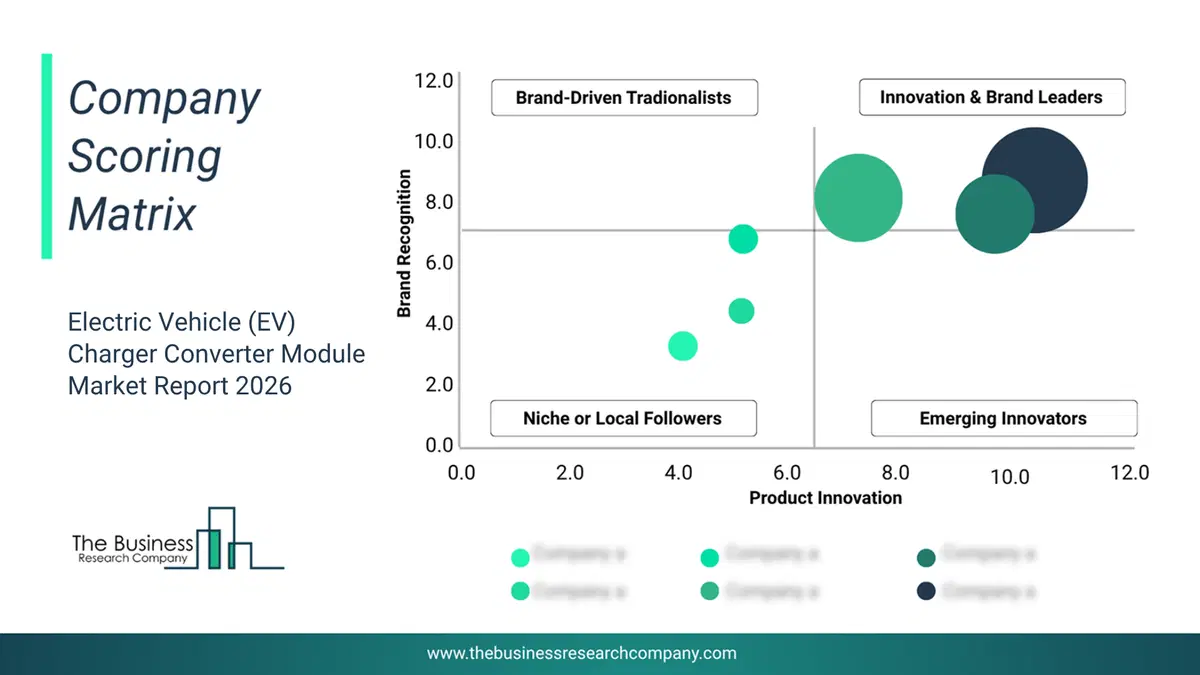
This chart maps companies by product innovation and brand strength, with bubble size indicating relative revenue, helping identify market leaders, challengers, and niche players. This is an illustrative chart; the full report provides a complete and accurate competitive analysis.
Global Electric Vehicle (EV) Charger Converter Module Market Trends and Insights
Major companies operating in the electric vehicle charger converter module market are focusing on developing technological advancements such as modular, high efficiency AC–DC converter stacks to enable scalable, high power DC fast charging infrastructure for electric vehicles. AC–DC converter modules convert grid electricity to the appropriate voltage and current required by EV batteries, ensuring safe, efficient, and rapid charging. For instance, in October 2025, Ador Powertron Ltd., an India-based power electronics company, launched a 30 kW AC–DC power module designed for EV fast chargers. The module offers ~96 % peak efficiency, power factor ≥0.99, and stackable design to combine multiple units for higher capacity chargers, supporting scalable EV charging infrastructure. This innovation helps reduce import dependency, supports local manufacturing, and meets the growing demand for fast, reliable, and modular EV charging solutions.What Are Latest Mergers And Acquisitions In The Electric Vehicle (EV) Charger Converter Module Market?
In January 2024, Siemens AG, a Germany-based technology company, acquired Heliox Energy for an undisclosed amount. This acquisition enhances Siemens' eMobility charging portfolio by integrating products and solutions ranging from 40 kilowatts (kW) to megawatt charging solutions, catering to depot and en-route charging needs. Additionally, Heliox's portfolio broadens Siemens' market presence, particularly in Europe and North America, while augmenting its capabilities in power electronics. Heliox Energy is a US-based provider of rapid charging solutions such as power electronic modules that serve electric vehicles.
Regional Outlook
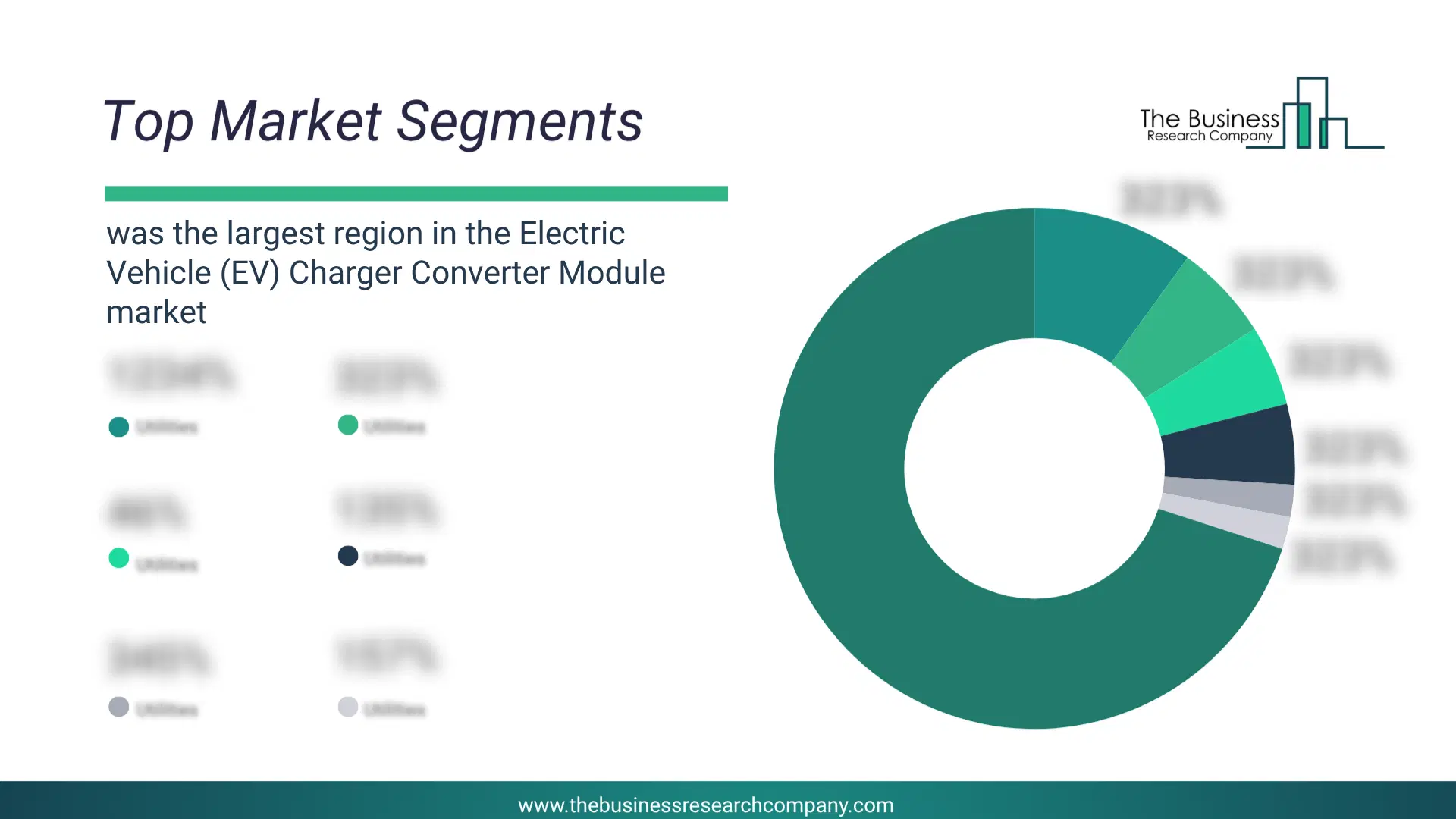
Asia-Pacific was the largest region in the electric vehicle (EV) charger converter module market in 2025. The regions covered in this market report are Asia-Pacific, South East Asia, Western Europe, Eastern Europe, North America, South America, Middle East, Africa. The countries covered in this market report are Australia, Brazil, China, France, Germany, India, Indonesia, Japan, Taiwan, Russia, South Korea, UK, USA, Canada, Italy, Spain.What Defines the Electric Vehicle (EV) Charger Converter Module Market?
The electric vehicle (EV) charger converter module market consists of sales of converter modules, power semiconductor modules, and control units. Values in this market are ‘factory gate’ values, that is, the value of goods sold by the manufacturers or creators of the goods, whether to other entities (including downstream manufacturers, wholesalers, distributors, and retailers) or directly to end customers. The value of goods in this market includes related services sold by the creators of the goods.How is Market Value Defined and Measured?
The market value is defined as the revenues that enterprises gain from the sale of goods and/or services within the specified market and geography through sales, grants, or donations in terms of the currency (in USD unless otherwise specified). The revenues for a specified geography are consumption values that are revenues generated by organizations in the specified geography within the market, irrespective of where they are produced. It does not include revenues from resales along the supply chain, either further along the supply chain or as part of other products.
This chart presents market attractiveness based on a quantitative evaluation of growth, competition, strategic alignment, and risk, offering a clear view of opportunity areas for decision-making. This chart is for illustrative purposes; the full report contains the complete analysis.

This chart highlights the Total Addressable Market (TAM) by estimating the maximum revenue opportunity using an assumption-driven approach, supporting strategic planning and opportunity sizing across markets. The chart is illustrative; the full report provides a more comprehensive analysis.
What Key Data and Analysis Are Included in the Electric Vehicle (EV) Charger Converter Module Market Report 2026?
The electric vehicle (ev) charger converter module market research report is one of a series of new reports from The Business Research Company that provides market statistics, including industry global market size, regional shares, competitors with the market share, detailed market segments, market trends and opportunities, and any further data you may need to thrive in the electric vehicle (ev) charger converter module industry. The market research report delivers a complete perspective of everything you need, with an in-depth analysis of the current and future state of the industry.Electric Vehicle (EV) Charger Converter Module Market Report Forecast Analysis
| Report Attribute | Details |
|---|---|
| Market Size Value In 2026 | $5.48 billion |
| Revenue Forecast In 2030 | $11.4 billion |
| Growth Rate | CAGR of 20.1% from 2026 to 2030 |
| Base Year For Estimation | 2025 |
| Actual Estimates/Historical Data | 2020-2025 |
| Forecast Period | 2026 - 2030 |
| Market Representation | Revenue in USD Billion and CAGR from 2026 to 2030 |
| Segments Covered | Product Type, Power Rating, End-user |
| Regional Scope | Asia-Pacific, Western Europe, Eastern Europe, North America, South America, Middle East, Africa |
| Country Scope | The countries covered in the report are Australia, Brazil, China, France, Germany, India, Indonesia, Japan, Taiwan, Russia, South Korea, UK, USA, Canada, Italy, Spain. |
| Key Companies Profiled | Robert Bosch GmbH, Siemens AG, Denso Corporation, Schneider Electric SE, ABB Ltd., Toyota Industries Corporation, Eaton Corporation, TE Connectivity Ltd., TDK Corporation, Infineon Technologies AG, Delta Electronics Inc., BorgWarner Inc., PHOENIX Contact GmbH & Co. KG, Bharat Heavy Electricals Limited, Leviton Manufacturing Co. Inc., Vicor Corporation, Kempower Oy, Tritium Pty Ltd, Axiom Energy Conversion Pvt. Ltd., IES Synergy, BRUSA Elektronik AG, Nuteck Power Solutions Private Limited, Mida EV Power Co. Ltd., Dana TM4 Inc., Mass-Tech Controls Pvt. Ltd. |
| Customization Scope | Request for Customization |
| Pricing And Purchase Options | Explore Purchase Options |