
Electric Vehicle (EV) Charging Cable Market Report 2026
Global Outlook – By Type (Normal, High-Power, Liquid-Cooled High-Power), By Connector Type (Type 1, Type 2, Combined Charging System (CCS–, Combined Charging System (CCS, CHAdeMO, GB Or T, North American Tesla Connector Standard (NACS) Or TESLA Connectors), By Length (Below 5 Meters, 6 Meter To 10 Meter, Above 10 Meters), By Shape (Straight, Coiled), By Application (Private Charging, Public Charging) – Market Size, Trends, Strategies, and Forecast to 2030
Electric Vehicle (EV) Charging Cable Market Overview
• Electric Vehicle (EV) Charging Cable market size has reached to $1.23 billion in 2025 • Expected to grow to $2.41 billion in 2030 at a compound annual growth rate (CAGR) of 14% • Growth Driver: The Surge in Electric Vehicles Fuels Electric Vehicles (EV) Charging Cable Market • Market Trend: Innovative Solutions In The Electric Vehicle Charging Cable Market • Asia-Pacific was the largest region in 2025.What Is Covered Under Electric Vehicle (EV) Charging Cable Market?
An electric vehicle (EV) charging cable is a specialized cable used to connect an electric vehicle to a charging station or power source, facilitating the transfer of electrical energy to the vehicle's battery. These cables come in various types and power ratings, each designed for different charging speeds and compatibility with specific EV models. The main types of electric vehicle (EV) charging cables are normal, high-power, and liquid-cooled high-power. Normal EV charging cables are typically standard power cables used for everyday charging needs, often found in residential settings or public charging stations for regular electric vehicles. Various connectors are used, mainly type 1, type 2, combined charging system (CCS1), combined charging system (CCS2), CHAdeMO, GB/T, North American Tesla connector standard (NACS), or TESLA connectors, and come in various lengths, such as below 5 meters, 6 meters, to 10 meters, and above 10 meters. These chargers come in various shapes, mainly straight and coiled, and are used for private charging and public charging applications.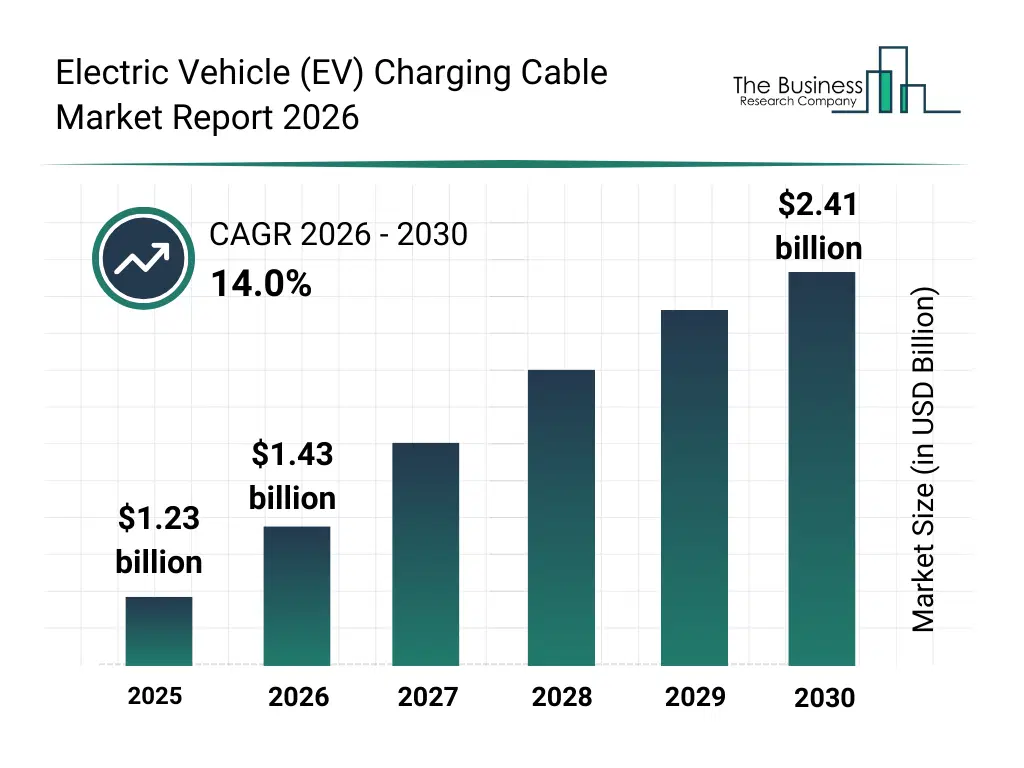
What Is The Electric Vehicle (EV) Charging Cable Market Size and Share 2026?
The electric vehicle (EV) charging cable market size has grown rapidly in recent years. It will grow from $1.23 billion in 2025 to $1.43 billion in 2026 at a compound annual growth rate (CAGR) of 15.6%. The growth in the historic period can be attributed to ev adoption growth, expansion of charging stations, government incentives for evs, development of level 2 charging, urban electrification projects.What Is The Electric Vehicle (EV) Charging Cable Market Growth Forecast?
The electric vehicle (EV) charging cable market size is expected to see rapid growth in the next few years. It will grow to $2.41 billion in 2030 at a compound annual growth rate (CAGR) of 14.0%. The growth in the forecast period can be attributed to ultra-fast charging rollout, smart grid integration, demand for durable cables, growth of commercial ev fleets, charging interoperability standards. Major trends in the forecast period include growth of fast charging infrastructure, rising demand for high-power cables, adoption of liquid-cooled cables, expansion of public charging networks, standardization of connector interfaces.
Global Electric Vehicle (EV) Charging Cable Market Segmentation
1) By Type: Normal, High-Power, Liquid-Cooled High-Power 2) By Connector Type: Type 1, Type 2, Combined Charging System (CCS1), Combined Charging System (CCS2), CHAdeMO, GB Or T, North American Tesla Connector Standard (NACS) Or TESLA Connectors 3) By Length: Below 5 Meters, 6 Meter To 10 Meter, Above 10 Meters 4) By Shape: Straight, Coiled 5) By Application: Private Charging, Public Charging Subsegments: 1) By Normal: Level 1 Charging Cables, Level 2 Charging Cables 2) By High-power: Dc Fast Charging Cables, Ac Fast Charging Cables 3) By Liquid-cooled High-Power: Liquid-Cooled Dc Fast Charging Cables, Liquid-Cooled Ac Fast Charging CablesWhat Is The Driver Of The Electric Vehicle (EV) Charging Cable Market?
The growing adoption of electric vehicles (EVs) is expected to propel the growth of the electric vehicle (EV) charging cable market going forward. Electric vehicles refer to automobiles that are powered either entirely or partially by electricity stored in rechargeable batteries rather than by internal combustion engines. The adoption of electric vehicles (EVs) is growing due to advancements in technology, environmental concerns, government incentives, and decreasing costs. Electric vehicle cables are used to connect the electric vehicles to a power source for charging their batteries. For instance, in April 2023, according to the International Energy Agency, a France-based autonomous intergovernmental organization, electric car sales exceeded 10 million in 2022 and are nearing 14 million in 2023, with firm objectives increasing to 35% by 2030. Therefore, the growing adoption of electric vehicles is driving the growth of the electric vehicle (EV) charging cable industry.Key Players In The Global Electric Vehicle (EV) Charging Cable Market
Major companies operating in the electric vehicle (ev) charging cable market report include Siemens AG, Schneider Electric SE, ABB Ltd., Aptiv Plc, Legrand S.A., Leoni AG, Phoenix Contact Ltd., Webasto Group, Huber+Suhner AG, Sinbon Electronics Co. Ltd., AeroVironment Inc., Mennekes Electrical Products, EVBox BV, Tritium DCFC Limited, Eland Cable Limited, The Besen Group, Circontrol SA, Coroplast Inc., Charge Amps AB, Dyden Corporation, AG Electrical Technology Co., Chengdu Khons Technology Co. Ltd., Teison EV, Brugg eConnect
This chart is for illustrative purposes; the full report includes a detailed competitor analysis and comprehensive overview of the top 10 companies in the market.
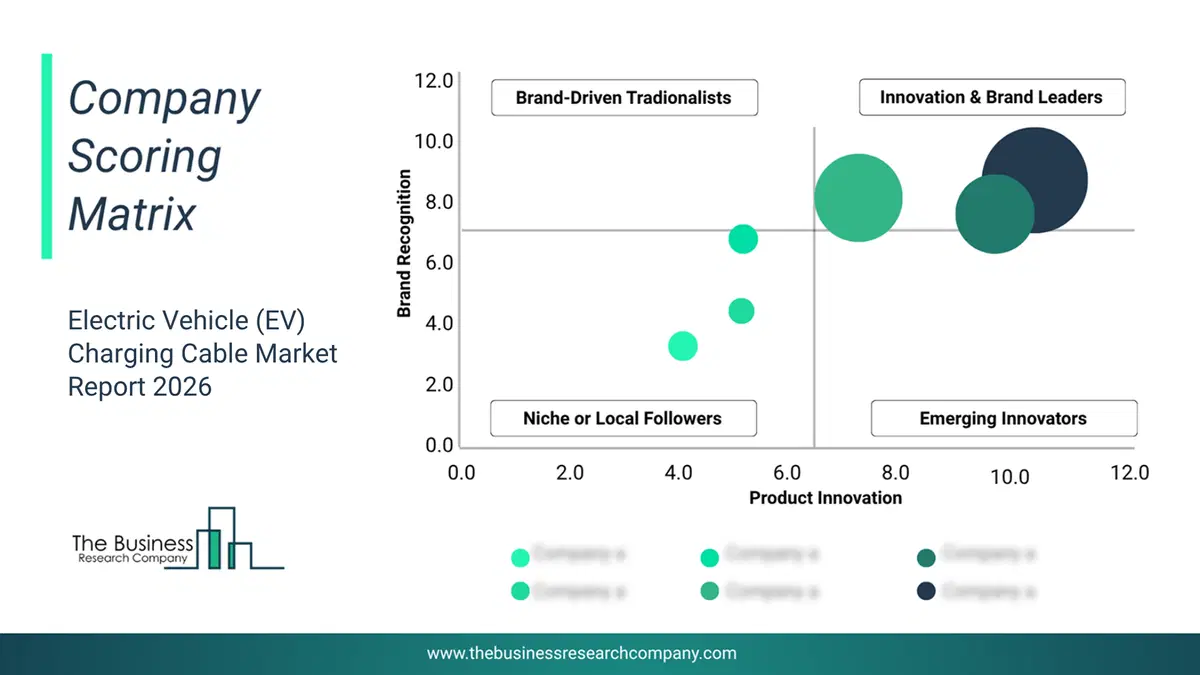
This chart maps companies by product innovation and brand strength, with bubble size indicating relative revenue, helping identify market leaders, challengers, and niche players. This is an illustrative chart; the full report provides a complete and accurate competitive analysis.
Global Electric Vehicle (EV) Charging Cable Market Trends and Insights
Major companies operating in the electric vehicle charging cable market are focused on developing innovative products, such as AC charger, to better serve customers with advanced features. An AC charger is a device that provides alternating current (AC) power to charge electric vehicles, where it is converted to direct current (DC) within the vehicle to charge the battery. For instance, in August 2023, Autel Energy, a US-based technology company launched the MaxiCharger AC Ultra, advance electric vehicle (EV) charger designed to meet the growing demand for efficient and reliable charging solutions in commercial settings. The MaxiCharger AC Ultra can deliver up to 22 kW of power simultaneously to two vehicles, allowing for rapid charging. This capability is particularly beneficial for businesses with high traffic, such as parking lots, shopping centers, and fleet operations. The charger is housed in an IP54-rated enclosure, which protects it from dust and water, making it suitable for outdoor installations. Its durable construction ensures longevity and reliability in various environmental conditions.What Are Latest Mergers And Acquisitions In The Electric Vehicle (EV) Charging Cable Market?
In October 2023, Wallbox, a Spain-based company specializing in electric vehicle (EV) charging solutions, acquired ABL for $16.11 million (€15 million). The acquisition accelerates Wallbox's commercial business plan by enhancing the product and certification portfolio, including German EV charging calibration laws (Eichrecht). It also reduces operational risk through reduced capital expenditure and research and development spending, leverages ABL's in-house component manufacturing, and enables the rapid scaling of new products to market. ABL GmbH is a Germany-based company, provides electric vehicle (EV) charging solutions.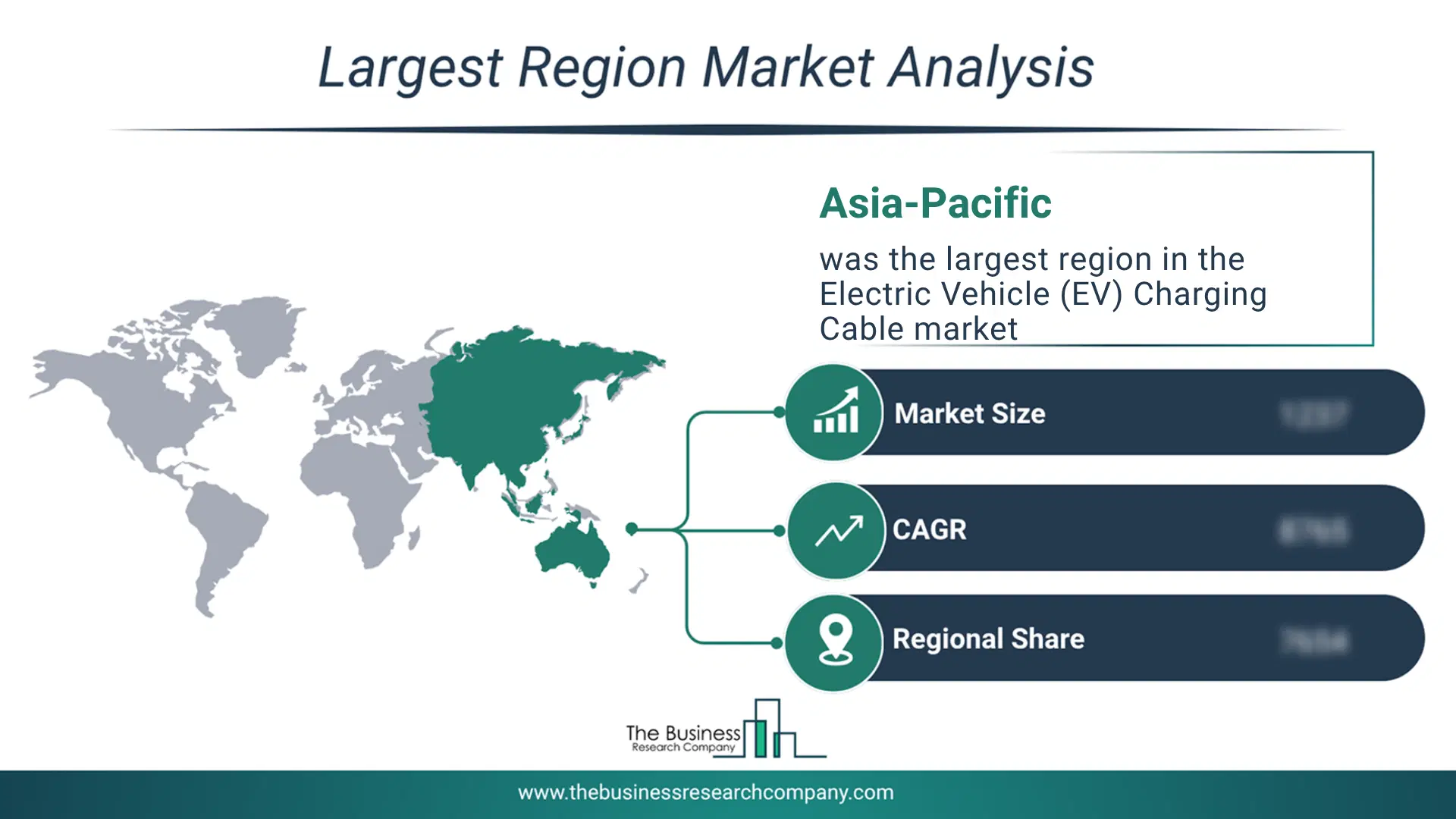
Regional Outlook
Asia-Pacific was the largest region in the electric vehicle (EV) charging cable market in 2025. The regions covered in this market report include Asia-Pacific, South East Asia, Western Europe, Eastern Europe, North America, South America, Middle East, Africa. The countries covered in this market report include Australia, Brazil, China, France, Germany, India, Indonesia, Japan, Taiwan, Russia, South Korea, UK, USA, Canada, Italy, SpainWhat Defines the Electric Vehicle (EV) Charging Cable Market?
The electric vehicle (EV) charging cable market consists of sales of direct current (DC) fast charging cables and smart charging cables. Values in this market are ‘factory gate’ values, that is the value of goods sold by the manufacturers or creators of the goods, whether to other entities (including downstream manufacturers, wholesalers, distributors and retailers) or directly to end customers. The value of goods in this market includes related services sold by the creators of the goods.How is Market Value Defined and Measured?
The market value is defined as the revenues that enterprises gain from the sale of goods and/or services within the specified market and geography through sales, grants, or donations in terms of the currency (in USD unless otherwise specified). The revenues for a specified geography are consumption values that are revenues generated by organizations in the specified geography within the market, irrespective of where they are produced. It does not include revenues from resales along the supply chain, either further along the supply chain or as part of other products.
This chart presents market attractiveness based on a quantitative evaluation of growth, competition, strategic alignment, and risk, offering a clear view of opportunity areas for decision-making. This chart is for illustrative purposes; the full report contains the complete analysis.

This chart highlights the Total Addressable Market (TAM) by estimating the maximum revenue opportunity using an assumption-driven approach, supporting strategic planning and opportunity sizing across markets. The chart is illustrative; the full report provides a more comprehensive analysis.
What Key Data and Analysis Are Included in the Electric Vehicle (EV) Charging Cable Market Report 2026?
The electric vehicle (ev) charging cable market research report is one of a series of new reports from The Business Research Company that provides market statistics, including industry global market size, regional shares, competitors with the market share, detailed market segments, market trends and opportunities, and any further data you may need to thrive in the electric vehicle (ev) charging cable industry. The market research report delivers a complete perspective of everything you need, with an in-depth analysis of the current and future state of the industry.Electric Vehicle (EV) Charging Cable Market Report Forecast Analysis
| Report Attribute | Details |
|---|---|
| Market Size Value In 2026 | $1.43 billion |
| Revenue Forecast In 2030 | $2.41 billion |
| Growth Rate | CAGR of 15.6% from 2026 to 2030 |
| Base Year For Estimation | 2025 |
| Actual Estimates/Historical Data | 2020-2025 |
| Forecast Period | 2026 - 2030 - 2030 |
| Market Representation | Revenue in USD Billion and CAGR from 2026 to 2030 |
| Segments Covered | Type, Connector Type, Length, Shape, Application |
| Regional Scope | Asia-Pacific, Western Europe, Eastern Europe, North America, South America, Middle East, Africa |
| Country Scope | The countries covered in the report are Australia, Brazil, China, France, Germany, India, Indonesia, Japan, Taiwan, Russia, South Korea, UK, USA, Canada, Italy, Spain. |
| Key Companies Profiled | Siemens AG, Schneider Electric SE, ABB Ltd., Aptiv Plc, Legrand S.A., Leoni AG, Phoenix Contact Ltd., Webasto Group, Huber+Suhner AG, Sinbon Electronics Co. Ltd., AeroVironment Inc., Mennekes Electrical Products, EVBox BV, Tritium DCFC Limited, Eland Cable Limited, The Besen Group, Circontrol SA, Coroplast Inc., Charge Amps AB, Dyden Corporation, AG Electrical Technology Co., Chengdu Khons Technology Co. Ltd., Teison EV, Brugg eConnect |
| Customization Scope | Request for Customization |
| Pricing And Purchase Options | Explore Purchase Options |