
Electric Vehicle (EV) Manufacturing Ecosystem Market Report 2026
Global Outlook – By Product Type (Battery Systems, Electric Motors, Power Electronics, Charging Infrastructure, Vehicle Control Units, Thermal Management Systems, Other Product Types), By Vehicle Type (Battery Electric Vehicles, Plug-In Hybrid Electric Vehicles, Fuel Cell Electric Vehicles), By Automation Level (Manual Manufacturing, Semi-Automated Manufacturing, Fully Automated Manufacturing), By Application (Battery Production, Powertrain Production, Vehicle Assembly, Component Manufacturing, Quality Control And Inspection, Supply Chain And Logistics), By End Use (Original Equipment Manufacturers, Tier-1 Suppliers, Tier-2 Suppliers, Aftermarket) – Market Size, Trends, Strategies, and Forecast to 2030
Electric Vehicle (EV) Manufacturing Ecosystem Market Overview
• Electric Vehicle (EV) Manufacturing Ecosystem market size has reached to $270.67 billion in 2025 • Expected to grow to $586.94 billion in 2030 at a compound annual growth rate (CAGR) of 16.8% • Growth Driver: Surge In Demand For Electric Vehicles Fueling The Growth Of The Market Due To Rising Environmental Concerns And Clean Mobility Adoption • Market Trend: Advanced Battery And Flash Charging Technologies Accelerating Innovation In Electric Mobility • Asia-Pacific was the largest region and fastest growing region.What Is Covered Under Electric Vehicle (EV) Manufacturing Ecosystem Market?
Electric vehicle (EV) manufacturing ecosystem refers to the integrated network of technologies, production processes, facilities, and supporting infrastructure involved in the design, development, assembly, and manufacture of electric vehicles. It enables the efficient production of electric vehicles through advanced manufacturing techniques, automation, digital engineering, and supply chain integration while supporting quality, scalability, and sustainable mobility. The main product types of the electric vehicle (EV) manufacturing ecosystem include battery systems, electric motors, power electronics, charging infrastructure, vehicle control units, thermal management systems, and other product types. Battery systems refer to integrated components that store and supply electrical energy to power electric vehicles. These products support battery electric vehicles, plug-in hybrid electric vehicles, and fuel cell electric vehicles and are manufactured through manual manufacturing, semi-automated manufacturing, and fully automated manufacturing processes. The key applications include battery production, powertrain production, vehicle assembly, component manufacturing, quality control and inspection, and supply chain and logistics, while the end-uses include original equipment manufacturers, tier-1 suppliers, tier-2 suppliers, and aftermarket.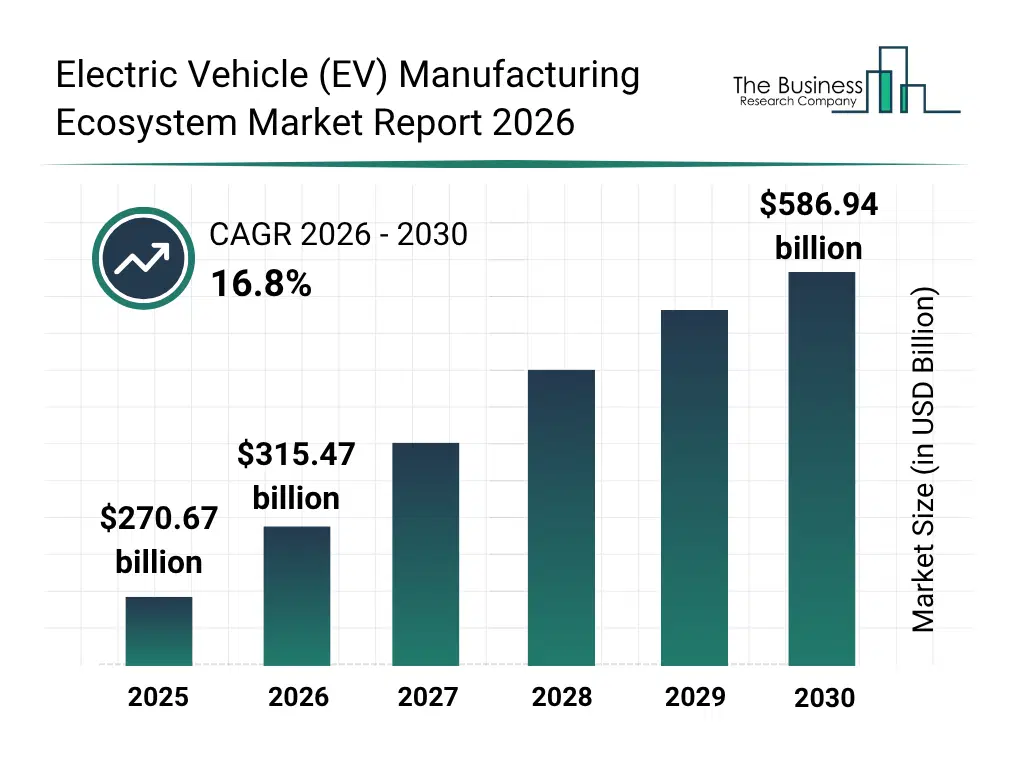
What Is The Electric Vehicle (EV) Manufacturing Ecosystem Market Size and Share 2026?
The electric vehicle (EV) manufacturing ecosystem market size has grown rapidly in recent years. It will grow from $270.67 billion in 2025 to $315.47 billion in 2026 at a compound annual growth rate (CAGR) of 16.6%. The growth in the historic period can be attributed to increasing adoption of electric vehicles, rising demand for EV manufacturing capacity, growing production of EV batteries and powertrain components, increasing establishment of dedicated EV manufacturing facilities, rising demand for efficient EV production processes.What Is The Electric Vehicle (EV) Manufacturing Ecosystem Market Growth Forecast?
The electric vehicle (EV) manufacturing ecosystem market size is expected to see rapid growth in the next few years. It will grow to $586.94 billion in 2030 at a compound annual growth rate (CAGR) of 16.8%. The growth in the forecast period can be attributed to increasing demand for scalable EV production ecosystems, rising localization of EV component supply chains, growing demand for high-volume battery manufacturing, increasing adoption of flexible EV assembly infrastructure, expanding production capacity for next-generation electric vehicles. Major trends in the forecast period include increasing adoption of integrated ev production lines, rising demand for battery manufacturing automation, growing use of flexible and scalable ev assembly systems, increasing demand for advanced ev component manufacturing, expanding development of localized ev supply chains.
Global Electric Vehicle (EV) Manufacturing Ecosystem Market Segmentation
1) By Product Type: Battery Systems, Electric Motors, Power Electronics, Charging Infrastructure, Vehicle Control Units, Thermal Management Systems, Other Product Types 2) By Vehicle Type: Battery Electric Vehicles, Plug-In Hybrid Electric Vehicles, Fuel Cell Electric Vehicles 3) By Automation Level: Manual Manufacturing, Semi-Automated Manufacturing, Fully Automated Manufacturing 4) By Application: Battery Production, Powertrain Production, Vehicle Assembly, Component Manufacturing, Quality Control And Inspection, Supply Chain And Logistics 5) By End Use: Original Equipment Manufacturers, Tier-1 Suppliers, Tier-2 Suppliers, Aftermarket Subsegments: 1) By Battery Systems: Lithium-Ion Battery Systems, Solid-State Battery Systems, Nickel-Metal Hydride Battery Systems, Lead-Acid Battery Systems, Other Battery Systems 2) By Electric Motors: Permanent Magnet Synchronous Motors, Induction Motors, Switched Reluctance Motors, Direct Current Motors, Other Electric Motors 3) By Power Electronics: Inverters, Converters, On-Board Chargers, Power Distribution Units, Other Power Electronics 4) By Charging Infrastructure: Charging Stations, Charging Connectors, Charging Management Systems, Charging Hardware Components, Other Charging Infrastructure 5) By Vehicle Control Units: Powertrain Control Units, Battery Management Units, Motor Control Units, Body Control Units, Other Vehicle Control Units 6) By Thermal Management Systems: Battery Thermal Management Systems, Powertrain Thermal Management Systems, Cabin Thermal Management Systems, Charging Thermal Management Systems, Other Thermal Management Systems 7) By Other Product Types: Electric Vehicle Sensors, Electric Vehicle Wiring Systems, Electric Vehicle Structural Components, Electric Vehicle Interior Components, Electric Vehicle Exterior ComponentsWhat Is The Driver Of The Electric Vehicle (EV) Manufacturing Ecosystem Market?
The increasing demand for electric vehicles is expected to propel the growth of the electric vehicle (EV) manufacturing ecosystem market going forward. Electric vehicles refer to automobiles that use electric power stored in batteries or other energy storage systems to drive electric motors instead of relying primarily on internal combustion engines. The demand for electric vehicles is due to growing environmental concerns, as they produce lower emissions compared to conventional vehicles and support the transition toward cleaner and more sustainable transportation. Electric vehicles drive the growth of the EV Manufacturing Ecosystem by increasing demand for batteries, electric powertrains, semiconductors, charging infrastructure, raw materials, and software solutions, accelerating investments across the value chain and advancing sustainable electric mobility. For instance, in January 2025, according to the Cox Automotive, a US-based system software company, new electric vehicle sales totaled 102,243 units, marking a 29.9% increase compared to the same period last year. Therefore, the increasing demand for electric vehicles is driving the growth of the electric vehicle (EV) manufacturing ecosystem industry.Key Players In The Global Electric Vehicle (EV) Manufacturing Ecosystem Market
Major companies operating in the electric vehicle (EV) manufacturing ecosystem market are Toyota Motor Corporation, Volkswagen Aktiengesellschaft, BYD Company Limited, Tesla Inc., Ford Motor Company, General Motors Company, Stellantis N.V., Hyundai Motor Company, Honda Motor Co. Ltd., Nissan Motor Co. Ltd., Mercedes-Benz Group AG, Bayerische Motoren Werke Aktiengesellschaft, SAIC Motor Corporation Limited, Zhejiang Geely Holding Group Co. Ltd., Contemporary Amperex Technology Co. Limited, LG Energy Solution Ltd., Renault S.A., Kia Corporation, Great Wall Motor Co. Ltd., Chery Automobile Co. Ltd., Chongqing Changan Automobile Co. Ltd., Panasonic Holdings Corporation, SK Innovation Co. Ltd., BorgWarner Inc., Li Auto Inc., NIO Inc., XPeng Inc., Rivian Automotive Inc., Lucid Group Inc.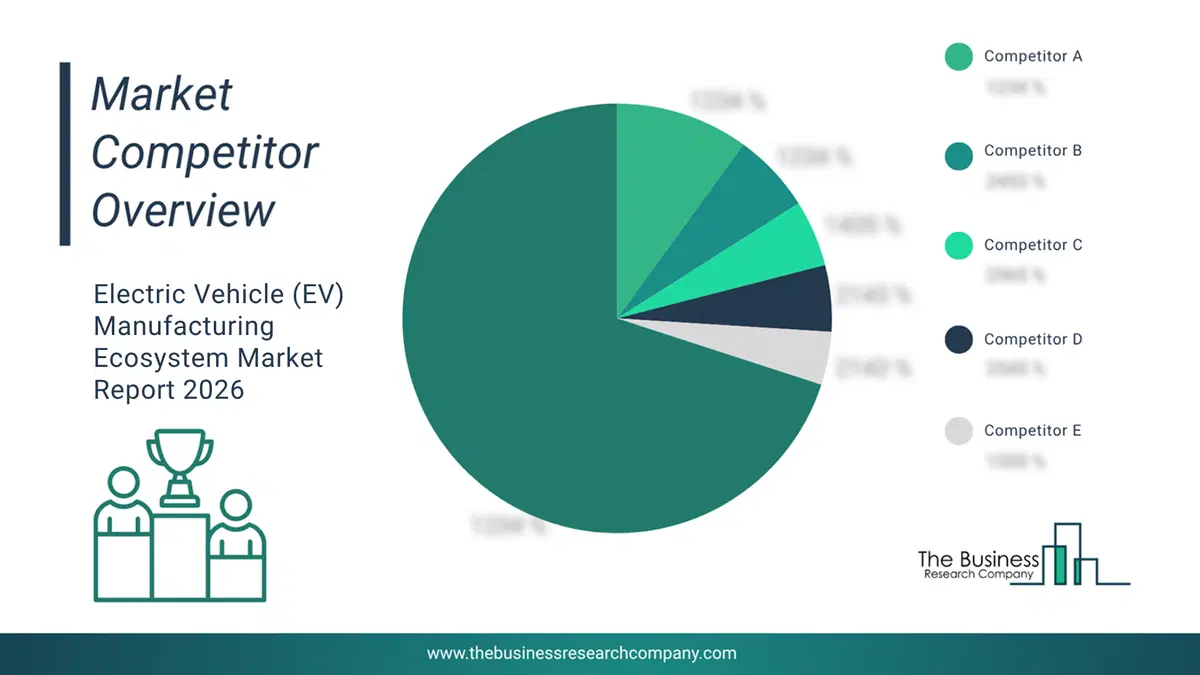
This chart is for illustrative purposes; the full report includes a detailed competitor analysis and comprehensive overview of the top 10 companies in the market.
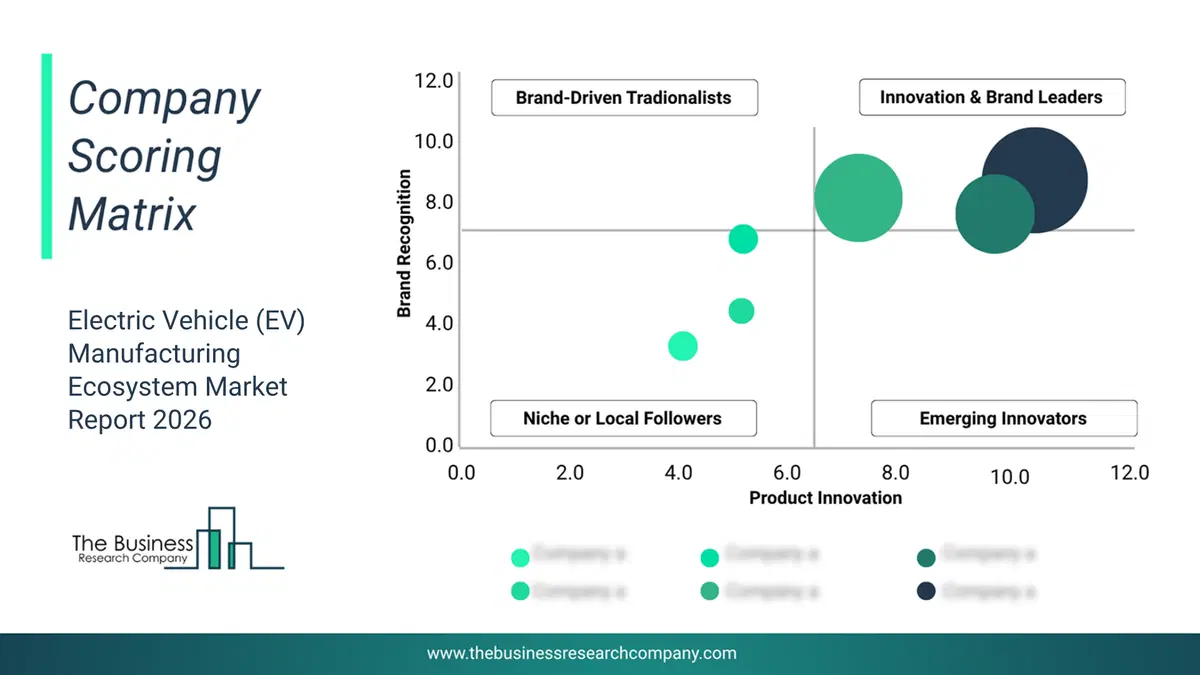
This chart maps companies by product innovation and brand strength, with bubble size indicating relative revenue, helping identify market leaders, challengers, and niche players. This is an illustrative chart; the full report provides a complete and accurate competitive analysis.
Global Electric Vehicle (EV) Manufacturing Ecosystem Market Trends and Insights
Major companies operating in the electric vehicle (EV) manufacturing ecosystem market are focusing on developing innovative solutions such as, next-generation blade battery and ultra-fast charging technologies to enhance EV range, charging efficiency, battery safety, and consumer adoption. Next-generation blade battery and ultra-fast charging technologies are advanced energy storage and charging systems designed to improve battery energy density, thermal management, and charging speed compared with conventional lithium-ion battery solutions, enabling longer driving ranges, faster energy replenishment, and improved performance under extreme conditions. For instance, in March 2026, BYD Auto Industry Co. Ltd., a China-based electric vehicle manufacturer, unveiled the 2nd Generation Blade Battery and FLASH Charging Technology as part of its efforts to overcome key EV challenges, including slow charging speeds and reduced low-temperature charging performance. The 2nd Generation Blade Battery incorporates a lithium-ion high-speed channel and a full-spectrum intelligent thermal management system to minimize heat generation, improve charging efficiency, and increase energy density by 5% compared with the first-generation battery. The technology enables vehicles equipped with the battery to achieve charging from 10% to 70% state of charge in five minutes and reach up to 97% charge in nine minutes, while maintaining improved performance at temperatures as low as -30°C. The accompanying FLASH Charging Technology uses a 1500 kW single-connector output charger and integrated energy storage system to provide high-speed charging while reducing stress on local power grids, supporting the expansion of EV infrastructure and accelerating global vehicle electrification.What Are Latest Mergers And Acquisitions In The Electric Vehicle (EV) Manufacturing Ecosystem Market?
In July 2023, Siemens Limited, an India-based technology and industrial solutions company, acquired Mass-Tech Controls Private Limited’s electric vehicle (EV) business division for an undisclosed amount. With this acquisition, Siemens Limited aimed to strengthen its e-mobility portfolio in India by integrating Mass-Tech Controls Private Limited’s EV charging technologies, expanding its electric vehicle charging infrastructure capabilities, enhancing its local market presence, and supporting the development of scalable EV solutions for Indian and export markets. Mass-Tech Controls Private Limited is an India-based electric vehicle charging technology company connected to the electric vehicle ecosystem through its EV division that designs, engineers, and manufactures EV chargers and charging systems.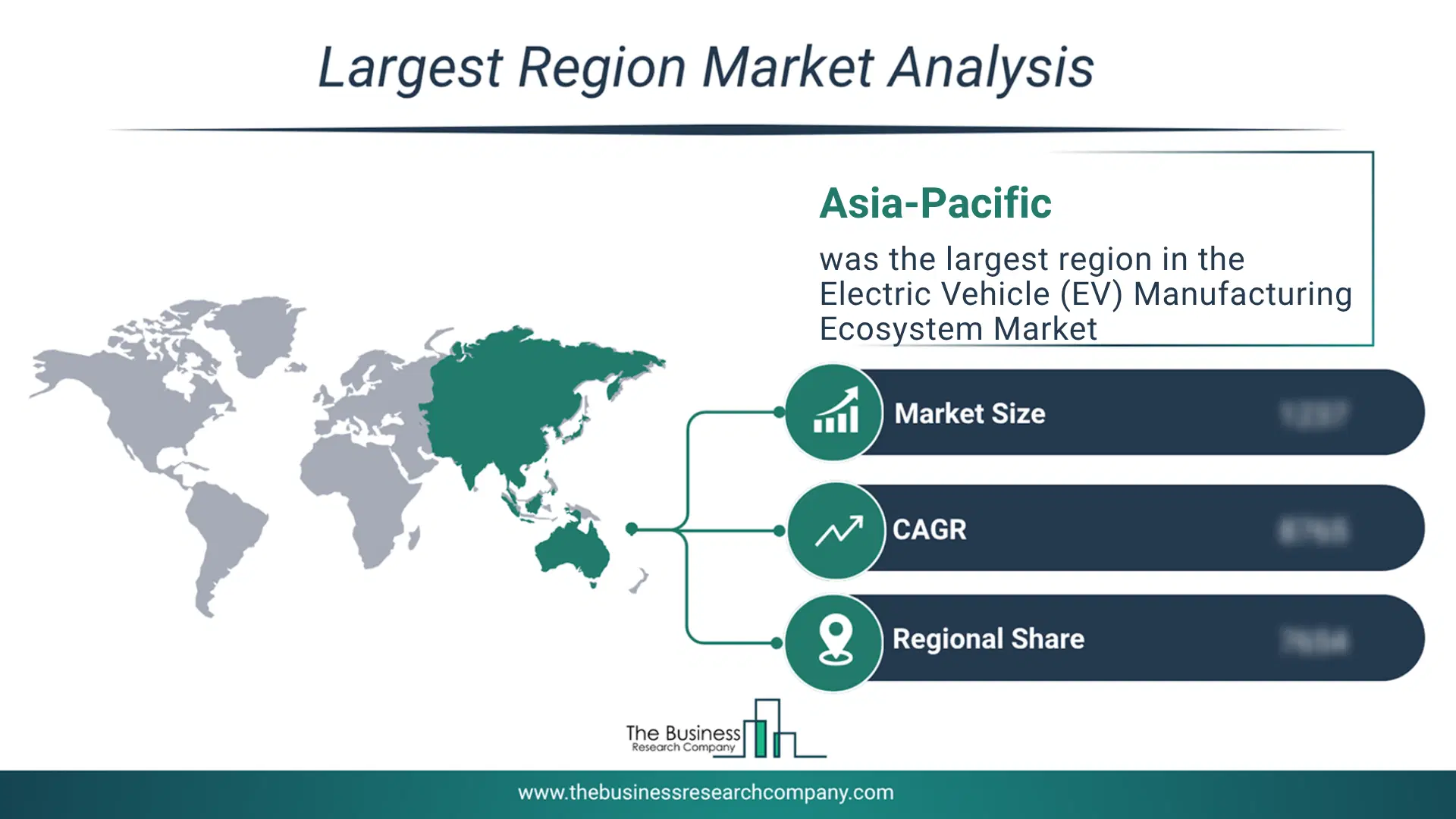
Regional Insights
Asia-Pacific was the largest region in the electric vehicle (EV) manufacturing ecosystem market in 2025. Asia-Pacific is expected to be the fastest-growing region in the forecast period. The regions covered in this market report are Asia-Pacific, South East Asia, Western Europe, Eastern Europe, North America, South America, Middle East, Africa. The countries covered in this market report are Australia, Brazil, China, France, Germany, India, Indonesia, Japan, Taiwan, Russia, South Korea, UK, USA, Canada, Italy, Spain.What Defines the Electric Vehicle (EV) Manufacturing Ecosystem Market?
The electric vehicle (EV) manufacturing ecosystem market consists of sales of EV manufacturing equipment, battery manufacturing equipment, vehicle assembly systems, robotic automation systems, production line machinery, testing and inspection equipment, stamping and welding systems, painting systems, and material handling equipment. Values in this market are ‘factory gate’ values, that is, the value of goods sold by the manufacturers or creators of the goods, whether to other entities (including downstream manufacturers, wholesalers, distributors, and retailers) or directly to end customers. The value of goods in this market includes related services sold by the creators of the goods.How is Market Value Defined and Measured?
The market value is defined as the revenues that enterprises gain from the sale of goods and/or services within the specified market and geography through sales, grants, or donations in terms of the currency (in USD unless otherwise specified). The revenues for a specified geography are consumption values that are revenues generated by organizations in the specified geography within the market, irrespective of where they are produced. It does not include revenues from resales along the supply chain, either further along the supply chain or as part of other products.
This chart presents market attractiveness based on a quantitative evaluation of growth, competition, strategic alignment, and risk, offering a clear view of opportunity areas for decision-making. This chart is for illustrative purposes; the full report contains the complete analysis.

This chart highlights the Total Addressable Market (TAM) by estimating the maximum revenue opportunity using an assumption-driven approach, supporting strategic planning and opportunity sizing across markets. The chart is illustrative; the full report provides a more comprehensive analysis.
What Key Data and Analysis Are Included in the Electric Vehicle (EV) Manufacturing Ecosystem Market Report 2026?
The electric vehicle (ev) manufacturing ecosystem market research report is one of a series of new reports from The Business Research Company that provides market statistics, including industry global market size, regional shares, competitors with the market share, detailed market segments, market trends and opportunities, and any further data you may need to thrive in the electric vehicle (ev) manufacturing ecosystem industry. The market research report delivers a complete perspective of everything you need, with an in-depth analysis of the current and future state of the industry.Electric Vehicle (EV) Manufacturing Ecosystem Market Report Forecast Analysis
| Report Attribute | Details |
|---|---|
| Market Size Value In 2026 | $315.47 billion |
| Revenue Forecast In 2030 | $586.94 billion |
| Growth Rate | CAGR of 16.8% from 2026 to 2030 |
| Base Year For Estimation | 2025 |
| Actual Estimates/Historical Data | 2020-2025 |
| Forecast Period | 2026 - 2030 |
| Market Representation | Revenue in USD Billion and CAGR from 2026 to 2030 |
| Segments Covered | Product Type, Vehicle Type, Automation Level, Application, End Use |
| Regional Scope | Asia-Pacific, Western Europe, Eastern Europe, North America, South America, Middle East, Africa |
| Country Scope | The countries covered in the report are Australia, Brazil, China, France, Germany, India, Indonesia, Japan, Taiwan, Russia, South Korea, UK, USA, Canada, Italy, Spain. |
| Key Companies Profiled | Toyota Motor Corporation, Volkswagen Aktiengesellschaft, BYD Company Limited, Tesla Inc., Ford Motor Company, General Motors Company, Stellantis N.V., Hyundai Motor Company, Honda Motor Co. Ltd., Nissan Motor Co. Ltd., Mercedes-Benz Group AG, Bayerische Motoren Werke Aktiengesellschaft, SAIC Motor Corporation Limited, Zhejiang Geely Holding Group Co. Ltd., Contemporary Amperex Technology Co. Limited, LG Energy Solution Ltd., Renault S.A., Kia Corporation, Great Wall Motor Co. Ltd., Chery Automobile Co. Ltd., Chongqing Changan Automobile Co. Ltd., Panasonic Holdings Corporation, SK Innovation Co. Ltd., BorgWarner Inc., Li Auto Inc., NIO Inc., XPeng Inc., Rivian Automotive Inc., Lucid Group Inc. |
| Customization Scope | Request for Customization |
| Pricing And Purchase Options | Explore Purchase Options |