
Electric Vehicle (EV) Transmission System Market Report 2026
Global Outlook – By Component (Transmission Control Unit, Gears, Clutches, Shafts, Other Components), By Transmission Type (Single Speed, Multi Speed), By Vehicle Type (Battery Electric Vehicles, Plug In Hybrid Electric Vehicles, Hybrid Electric Vehicles), By Drive Type (Front Wheel Drive, Rear Wheel Drive, All Wheel Drive), By End User (Original Equipment Manufacturers, Aftermarket, Fleet Operators) – Market Size, Trends, Strategies, and Forecast to 2035
Electric Vehicle (EV) Transmission System Market Overview
• Electric Vehicle (EV) Transmission System market size has reached to $13.13 billion in 2025 • Expected to grow to $25.91 billion in 2030 at a compound annual growth rate (CAGR) of 14.5% • Growth Driver: Rising Electric Vehicle Adoption Driving The Market Growth Due To Increasing Demand For Efficient Power Conversion And Energy Management • Market Trend: Advancements In Integrated Electric Drivetrains Support Efficient Commercial Vehicle Electrification • Asia-Pacific was the largest region and fastest growing region.What Is Covered Under Electric Vehicle (EV) Transmission System Market?
An electric vehicle (EV) transmission system is a mechanical drivetrain assembly that transfers and, where applicable, modifies the torque and rotational speed produced by an electric motor before delivering power to the vehicle's wheels. Most EVs use a single-speed reduction gearbox, while some applications use multi-speed transmissions to achieve specific performance, efficiency, towing, or high-speed requirements. The main components of electric vehicle (EV) transmission systems include transmission control units, gears, clutches, shafts, and other components. Transmission control units refer to electronic control modules that manage and coordinate transmission functions to optimize power delivery, shifting, efficiency, and vehicle performance. These systems use single speed and multi speed transmission types, and are used in battery electric vehicles, plug in hybrid electric vehicles, and hybrid electric vehicles. They incorporate front wheel drive, rear wheel drive, and all wheel drive configurations, and are used end users by original equipment manufacturers, aftermarket providers, and fleet operators.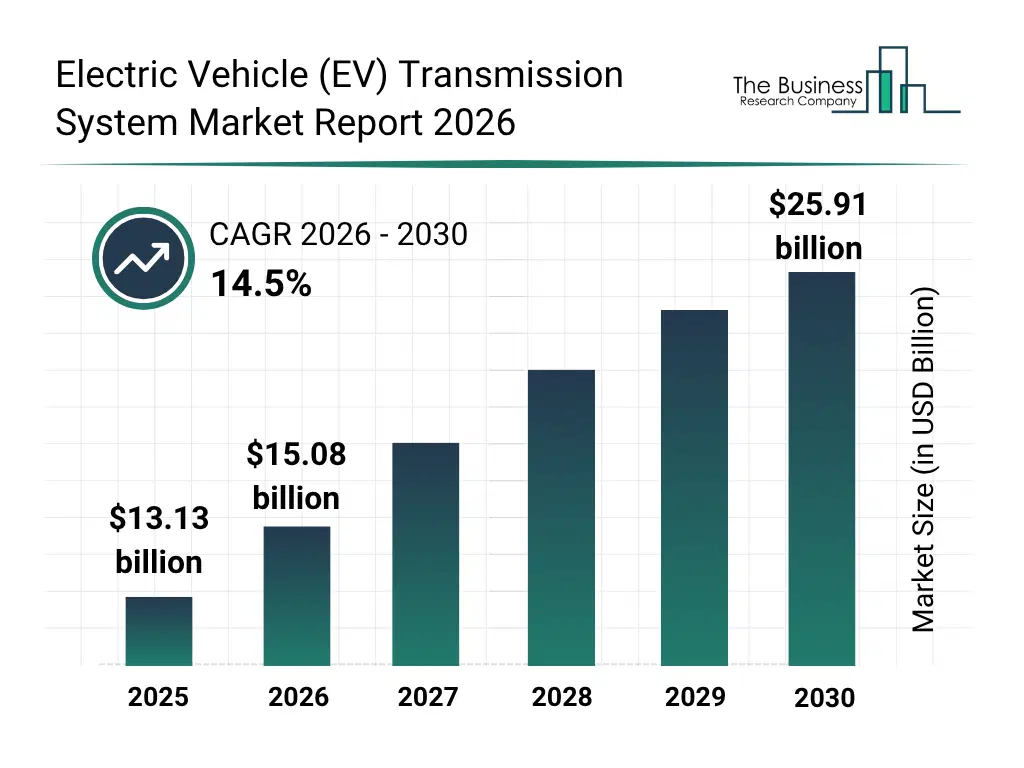
What Is The Electric Vehicle (EV) Transmission System Market Size and Share 2026?
The electric vehicle (EV) transmission system market size has grown rapidly in recent years. It will grow from $13.13 billion in 2025 to $15.08 billion in 2026 at a compound annual growth rate (CAGR) of 14.9%. The growth in the historic period can be attributed to increasing adoption of battery electric vehicles, rising demand for energy-efficient drivetrains, growing EV production volumes, increasing development of compact transmission systems, expansion of electric powertrain manufacturing capacity.What Is The Electric Vehicle (EV) Transmission System Market Growth Forecast?
The electric vehicle (EV) transmission system market size is expected to see rapid growth in the next few years. It will grow to $25.91 billion in 2030 at a compound annual growth rate (CAGR) of 14.5%. The growth in the forecast period can be attributed to rising demand for high-performance EVs, increasing adoption of multi-speed EV transmissions, growing demand for extended driving range, increasing integration of e-axle systems, rising demand for efficient electric powertrain components. Major trends in the forecast period include multi-speed EV transmission development, integrated e-axle transmission systems, high-efficiency transmission gear design, lightweight EV drivetrain components, advanced thermal management for EV transmissions.Tariff Impact On Electric Vehicle (EV) Transmission System Market
Tariffs are impacting the electric vehicle transmission system market by increasing the cost of imported gears, electronic control units, power electronics, bearings, and other drivetrain components. Transmission component manufacturers and OEMs are likely to face greater cost pressures in Asia-Pacific, North America, and Europe due to interconnected automotive supply chains and cross-border sourcing. These higher costs may increase EV production expenses and delay some transmission technology investments, while tariffs can also encourage localized manufacturing, regional sourcing, and domestic production of critical EV drivetrain components.
Global Electric Vehicle (EV) Transmission System Market Segmentation
2) By Transmission Type: Single Speed, Multi Speed 3) By Vehicle Type: Battery Electric Vehicles, Plug In Hybrid Electric Vehicles, Hybrid Electric Vehicles 4) By Drive Type: Front Wheel Drive, Rear Wheel Drive, All Wheel Drive 5) By End User: Original Equipment Manufacturers, Aftermarket, Fleet Operators Subsegments: 1) By Transmission Control Unit: Electronic Control Unit, Shift Control Module, Motor Control Interface, Power Electronics Controller, Sensor Integration Module 2) By Gears: Single Speed Reduction Gears, Multi Speed Gears, Planetary Gears, Helical Gears, Spur Gears 3) By Clutches: Wet Clutches, Dry Clutches, Multi Plate Clutches, Electromagnetic Clutches, Dual Clutches 4) By Shafts: Input Shafts, Output Shafts, Counter Shafts, Drive Shafts, Intermediate Shafts 5) By Other Components: Bearings, Synchronizers, Differential Assembly, Seals And Gaskets, HousingsWhat Is The Driver Of The Electric Vehicle (EV) Transmission System Market?
The rising adoption of electric vehicles (EVs) is expected to propel the growth of the electric vehicle (EV) transmission system market going forward. Electric vehicles are automobiles powered wholly or partially by electric motors using energy stored in rechargeable battery systems. The adoption of electric vehicles is increasing due to supportive government policies, advancements in battery technology, expanding charging infrastructure, and growing environmental concerns, which are encouraging consumers and businesses to shift toward cleaner and more sustainable transportation solutions. Rising adoption of electric vehicles is driving demand for advanced EV transmission systems, as every additional EV manufactured requires efficient power transmission solutions to optimize drivetrain performance, power delivery, and overall vehicle efficiency. For instance, in July 2026, according to the U.S. Energy Information Administration, a US-based government agency, combined sales of hybrid, plug-in hybrid, and battery electric vehicles (BEVs) reached 24% of total new light-duty vehicle sales in the second quarter of 2026 (2Q26), up from 22% in the second quarter of 2025 (2Q25). Therefore, the rising adoption of electric vehicles is driving the growth of the electric vehicle (EV) transmission system industry.Key Players In The Global Electric Vehicle (EV) Transmission System Market
Major companies operating in the electric vehicle (EV) transmission system market are Hyundai Transys Inc., Robert Bosch GmbH, Magna International Inc., AISIN Corporation, Eaton Corporation plc, Nidec Corporation, BorgWarner Inc., Dana Incorporated, Linamar Corporation, GKN Automotive Limited, AVL List GmbH, Xtrac Ltd., hofer powertrain GmbH, ZF Friedrichshafen AG, JATCO Ltd, Inmotive Inc., Fersa Bearings S.A.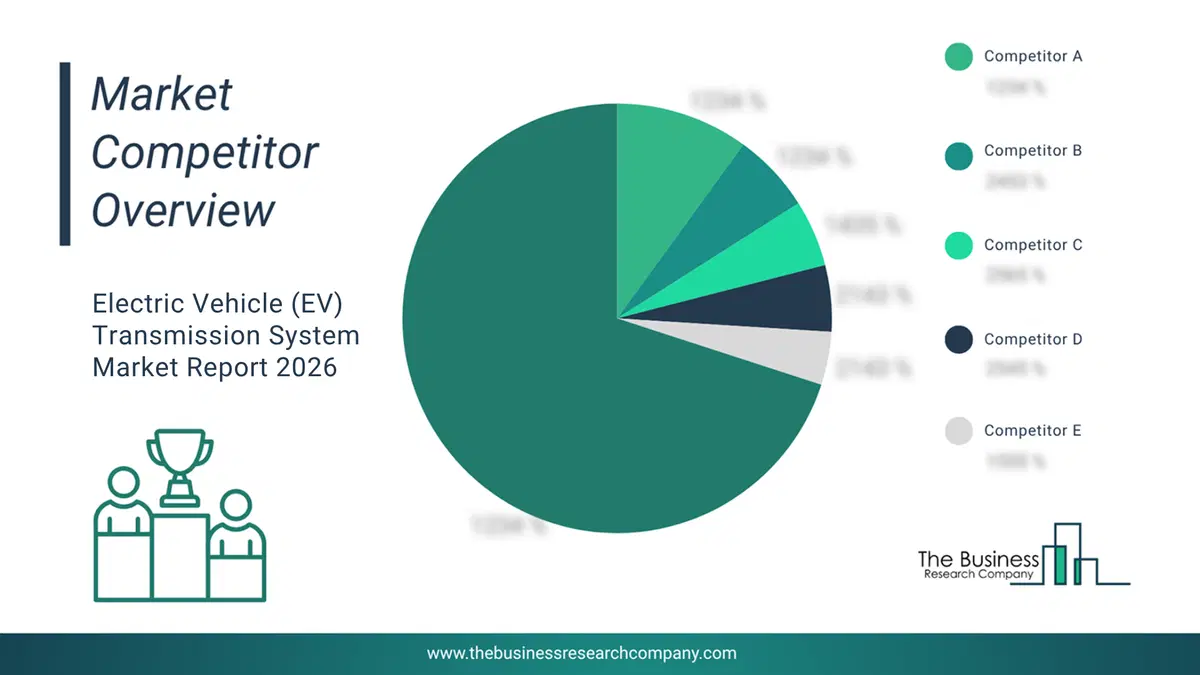
This chart is for illustrative purposes; the full report includes a detailed competitor analysis and comprehensive overview of the top 10 companies in the market.
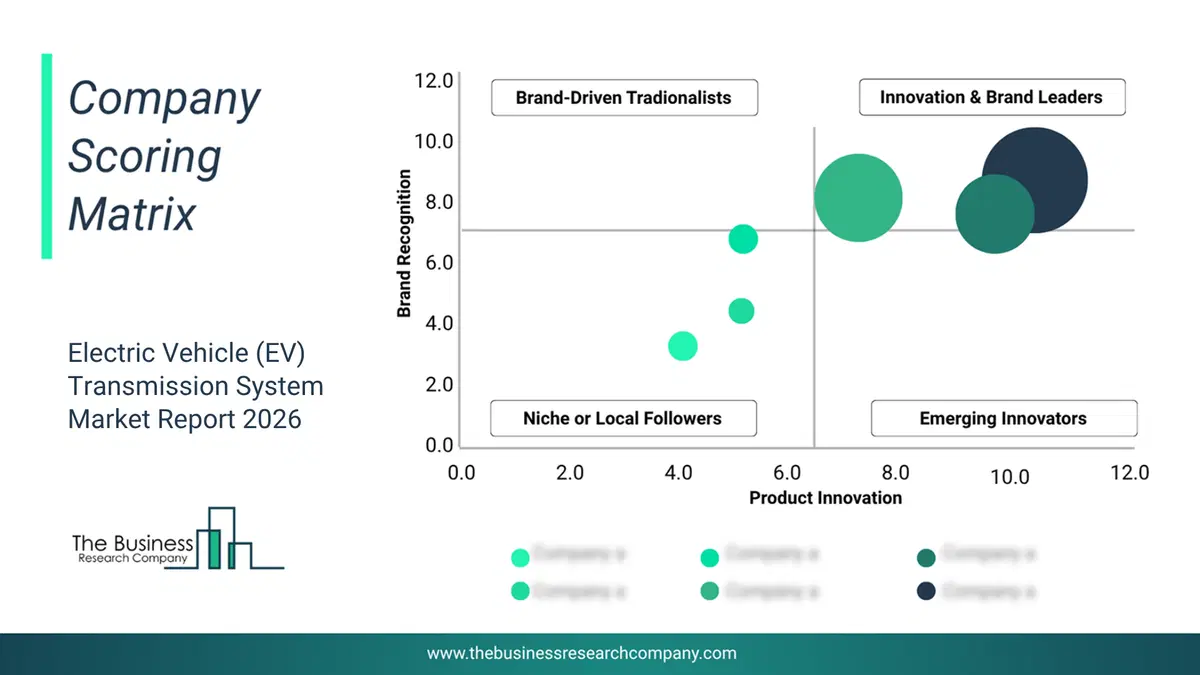
This chart maps companies by product innovation and brand strength, with bubble size indicating relative revenue, helping identify market leaders, challengers, and niche players. This is an illustrative chart; the full report provides a complete and accurate competitive analysis.
Global Electric Vehicle (EV) Transmission System Market Trends and Insights
Major companies operating in the electric vehicle (EV) transmission system market are focusing on developing innovative solutions, such as integrated electric drive systems, to improve drivetrain efficiency, reduce vehicle weight, simplify powertrain integration, and accelerate the adoption of electric commercial vehicles. Integrated electric drive systems combine key drivetrain elements, including the electric motor, inverter, and gearbox, into a compact assembly compared with traditional EV transmission architectures that use separately installed components connected through multiple mechanical and electrical interfaces. For instance, in July 2026, Driventic GmbH, a Germany-based electric mobility solutions provider, launched VEDS 2.2, an innovative integrated electric drive system designed for electric buses, coaches, medium-duty trucks, and retrofit applications. The VEDS 2.2 integrates three major components: a high-speed EVO 390 electric motor, a newly developed inverter, and a single-stage planetary gearbox within a compact drivetrain unit. The system features an electrically powered oil pump with an integrated oil filter to provide lubrication and cooling for both the motor and gearbox, improving operational efficiency and durability. With a lightweight design of approximately 275 kg, the system delivers an optimized torque-to-power ratio while reducing vehicle integration complexity.What Are Latest Mergers And Acquisitions In The Electric Vehicle (EV) Transmission System Market?
In February 2026, Dauch Corporation, a US-based automotive components manufacturer, acquired Dowlais Group plc for an undisclosed amount. With this acquisition, Dauch aims to expand its automotive component portfolio, strengthen its global manufacturing footprint, and create a leading driveline and metal forming supplier positioned to support evolving vehicle propulsion technologies. Dowlais Group plc is a UK-based automotive engineering company manufacturing EV transmission components and integrated drivetrain systems.
Regional Outlook/Insights
Asia-Pacific was the largest region in the electric vehicle (EV) transmission system market in 2025. Asia-Pacific is expected to be the fastest-growing region in the forecast period. The regions covered in this market report are Asia-Pacific, South East Asia, Western Europe, Eastern Europe, North America, South America, Middle East, Africa. The countries covered in this market report are Australia, Brazil, China, France, Germany, India, Indonesia, Japan, Taiwan, Russia, South Korea, UK, USA, Canada, Italy, Spain.What Defines the Electric Vehicle (EV) Transmission System Market?
The electric vehicle (EV) transmission system market consists of sales of single-speed transmission systems, multi-speed transmission systems, integrated e-axle transmission systems, and dual-motor transmission systems. Values in this market are ‘factory gate’ values, that is, the value of goods sold by the manufacturers or creators of the goods, whether to other entities (including downstream manufacturers, wholesalers, distributors, and retailers) or directly to end customers. The value of goods in this market includes related services sold by the creators of the goods.How is Market Value Defined and Measured?
The market value is defined as the revenues that enterprises gain from the sale of goods and/or services within the specified market and geography through sales, grants, or donations in terms of the currency (in USD unless otherwise specified). The revenues for a specified geography are consumption values that are revenues generated by organizations in the specified geography within the market, irrespective of where they are produced. It does not include revenues from resales along the supply chain, either further along the supply chain or as part of other products.
This chart presents market attractiveness based on a quantitative evaluation of growth, competition, strategic alignment, and risk, offering a clear view of opportunity areas for decision-making. This chart is for illustrative purposes; the full report contains the complete analysis.

This chart highlights the Total Addressable Market (TAM) by estimating the maximum revenue opportunity using an assumption-driven approach, supporting strategic planning and opportunity sizing across markets. The chart is illustrative; the full report provides a more comprehensive analysis.
What Key Data and Analysis Are Included in the Electric Vehicle (EV) Transmission System Market Report 2026?
The electric vehicle (ev) transmission system market research report is one of a series of new reports from The Business Research Company that provides market statistics, including industry global market size, regional shares, competitors with the market share, detailed market segments, market trends and opportunities, and any further data you may need to thrive in the electric vehicle (ev) transmission system industry. The market research report delivers a complete perspective of everything you need, with an in-depth analysis of the current and future state of the industry.Electric Vehicle (EV) Transmission System Market Report Forecast Analysis
| Report Attribute | Details |
|---|---|
| Market Size Value In 2026 | $15.08 billion |
| Revenue Forecast In 2030 | $25.91 billion |
| Growth Rate | CAGR of 14.5% from 2026 to 2035 |
| Base Year For Estimation | 2025 |
| Actual Estimates/Historical Data | 2020-2025 |
| Forecast Period | 2026 - 2030 |
| Market Representation | Revenue in USD Billion and CAGR from 2026 to 2030 |
| Segments Covered | Component, Transmission Type, Vehicle Type, Drive Type, End User |
| Regional Scope | Asia-Pacific, Western Europe, Eastern Europe, North America, South America, Middle East, Africa |
| Country Scope | The countries covered in the report are Australia, Brazil, China, France, Germany, India, Indonesia, Japan, Taiwan, Russia, South Korea, UK, USA, Canada, Italy, Spain. |
| Customization Scope | Request for Customization |
| Pricing And Purchase Options | Explore Purchase Options |