
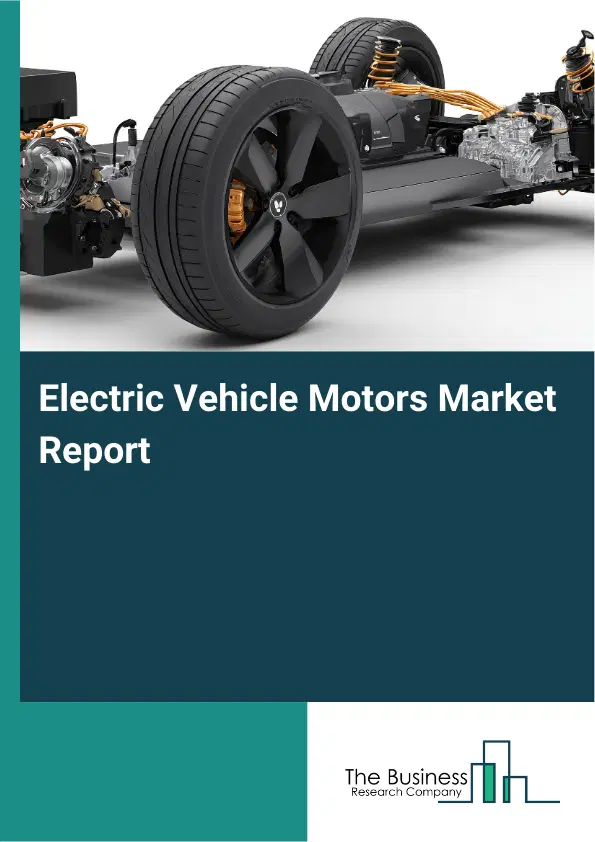
Electric Vehicle Motors Market Report 2026
Global Outlook – By Type (Alternating Current (AC) Motor, Direct Current (DC) Motor), By Component (Motor Stator, Rotor, Shaft And Bearing, Permanent Magnet, Casing, Wiring And Connectors), By Application (Electric Two-Wheeler, Electric Three-Wheeler, Electric Commercial Vehicles, Electric Passenger Cars), By End User (Transportation, Private, Business) – Market Size, Trends, Strategies, and Forecast to 2030
Electric Vehicle Motors Market Overview
• Electric Vehicle Motors market size has reached to $27.85 billion in 2025 • Expected to grow to $54.03 billion in 2030 at a compound annual growth rate (CAGR) of 14.1% • Growth Driver: Surge In Electric And Hybrid Vehicle Demand Fuels Growth In The Electric Vehicle Motors Market • Market Trend: Advancements In Electric Vehicle Motors For Enhanced Performance And Charging Capabilities • Asia-Pacific was the largest region in 2025.What Is Covered Under Electric Vehicle Motors Market?
Electric vehicle motors refer to the electrically powered components responsible for converting electrical energy from the vehicle's battery into mechanical energy to drive the wheels, enabling the vehicle to move. These motors are typically electrically efficient and contribute to the overall sustainability of electric transportation. The main types of electric vehicle motors are alternating current (AC) motors and direct current (DC) motors. An alternative current motor is a type of electric motor that operates on alternating current, converting electrical energy into mechanical motion and providing efficient and variable-speed propulsion by converting electrical energy from the vehicle's battery into rotational motion, powering the wheels. The components are categorized into motor stator, rotor, shaft and bearing, permanent magnet, casing, wiring, and connectors that are used in applications such as electric two-wheeler, electric three-wheeler, electric commercial vehicles, and electric passenger cars by end users such as agribusiness, transportation, private, and business.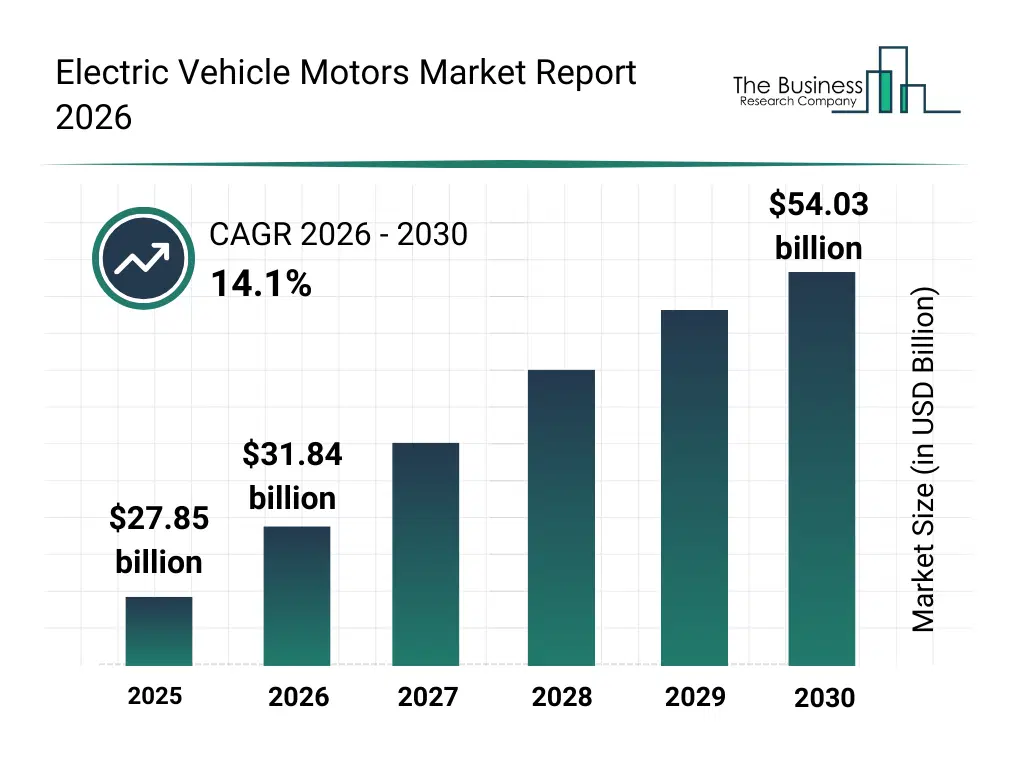
What Is The Electric Vehicle Motors Market Size and Share 2026?
The electric vehicle motors market size has grown rapidly in recent years. It will grow from $27.85 billion in 2025 to $31.84 billion in 2026 at a compound annual growth rate (CAGR) of 14.3%. The growth in the historic period can be attributed to ev adoption growth, improvements in electric drivetrains, demand for efficient propulsion, advances in motor design, battery-powered mobility expansion.What Is The Electric Vehicle Motors Market Growth Forecast?
The electric vehicle motors market size is expected to see rapid growth in the next few years. It will grow to $54.03 billion in 2030 at a compound annual growth rate (CAGR) of 14.1%. The growth in the forecast period can be attributed to higher range requirements, cost optimization of drivetrains, adoption of rare-earth alternatives, smart motor integration, scaling of ev production. Major trends in the forecast period include shift toward high-efficiency motors, adoption of permanent magnet motors, growth of integrated drive units, demand for compact motor designs, expansion of ev powertrain platforms.
Global Electric Vehicle Motors Market Segmentation
1) By Type: Alternating Current (AC) Motor, Direct Current (DC) Motor 2) By Component: Motor Stator, Rotor, Shaft And Bearing, Permanent Magnet, Casing, Wiring And Connectors 3) By Application: Electric Two-Wheeler, Electric Three-Wheeler, Electric Commercial Vehicles, Electric Passenger Cars 4) By End User: Transportation, Private, Business Subsegments: 1) By Alternating Current (AC) Motor: Synchronous AC Motors, Induction AC Motors (Asynchronous AC Motors) 2) By Direct Current (DC) Motor: Brushed DC Motors, Brushless DC Motors (BLDC)What Is The Driver Of The Electric Vehicle Motors Market?
The rise in demand for electric and hybrid vehicles is expected to propel the growth of the electric vehicle motor market going forward. Electric vehicles (EVs) and hybrid vehicles are types of automobiles that use electric power either exclusively (EVs) or in combination with an internal combustion engine (hybrids) for propulsion, reducing or eliminating reliance on traditional fossil fuels. The increasing demand for electric and hybrid vehicles is driven by a growing awareness of environmental sustainability, government incentives, technological advancements, and a desire to reduce dependence on traditional fossil fuels. Electric and hybrid vehicles utilize electric motors for propulsion, converting electrical energy into mechanical power for movement. For instance, in July 2023, according to the International Energy Agency, a France-based autonomous intergovernmental organization, the total sales of electric cars experienced significant growth, more than tripling over three years, rising from approximately 4% in 2020 to 14% in 2022. Further, in the first quarter of 2022, sales of electric cars surpassed 2.3 million units, reflecting a notable increase of about 25% compared to the corresponding period last year. It is expected to see 14 million sales by the end of 2023, representing 35% year-on-year. Furthermore, in February 2024, according to the Society of Motor Manufacturers and Traders (SMMT), a UK-based trade association, hybrid electric car sales saw a robust increase of 40.0%, while plug-in hybrid electric cars experienced a notable growth of 25.1%. Electrified vehicles accounted for 5.6% of the market, marking a rise from 4.0% in 2022. Therefore, the increase in demand for electric and hybrid vehicles is driving the growth of the electric vehicle motor industry.Key Players In The Global Electric Vehicle Motors Market
Major companies operating in the electric vehicle motors market report include Tesla Motors Inc., BYD Company Ltd., Robert Bosch GmbH, DENSO Corporation, Continental AG Magna International Inc., LG Magna e-Powertrain Co. Ltd, Mitsubishi Electric Corporation, Aisin Corporation, Nidec Motor Corporation, BorgWarner Inc., Mahle GmbH, Vitesco Technologies, GKN Automotive Ltd., Johnson Electric Holdings Limited, TECO Electric & Machinery Co. Ltd., Hitachi Astemo, Siemens AG, ABB Ltd., Toshiba Corporation, Parker Hannifin Corp., Delta Electronics Inc., Ametek Incorporation
This chart is for illustrative purposes; the full report includes a detailed competitor analysis and comprehensive overview of the top 10 companies in the market.
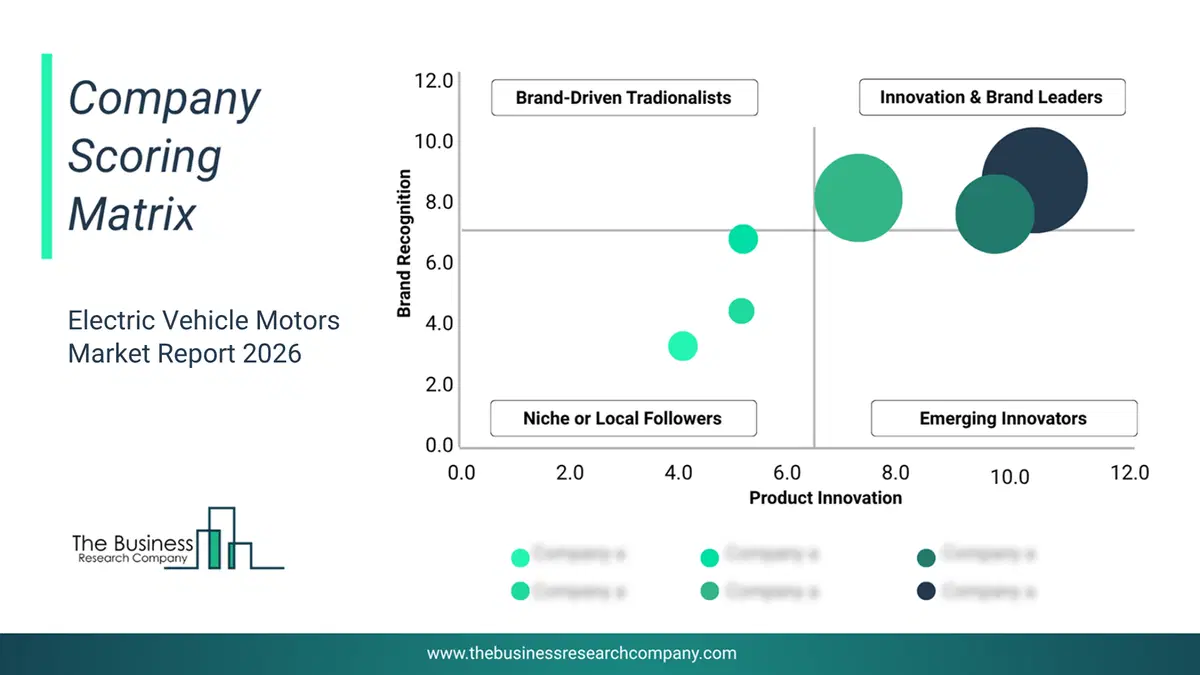
This chart maps companies by product innovation and brand strength, with bubble size indicating relative revenue, helping identify market leaders, challengers, and niche players. This is an illustrative chart; the full report provides a complete and accurate competitive analysis.
Global Electric Vehicle Motors Market Trends and Insights
Major companies operating in the electric vehicle motor market are focusing on developing advanced solutions, such as 800-volt technology, to enhance performance and charging capabilities. The technology in electric vehicle motors enables faster charging and higher power efficiency, improving overall performance and reducing charging times compared to traditional 400-volt systems. For instance, in August 2023, Robert Bosch GmbH, a Germany-based engineering and technology company, developed innovative powertrain solutions such as an 800V inverter, a motor for electric vehicles by utilizing 800-volt technology, enabling faster recharging and enhancing electromobility. The inverter for the 800-volt system incorporates silicon carbide semiconductors, boosting efficiency and extending the range. The electric motor's 800-volt version has increased power density, leading to reduced weight and a more compact design. Notably, the inverter features silicon carbide chips with enhanced electrical conductivity by introducing carbon atoms into the ultrapure silicon crystalline structure. This modification results in a 50% reduction in energy loss as heat in power electronics, contributing to an impressive 99% efficiency for the inverters.What Are Latest Mergers And Acquisitions In The Electric Vehicle Motors Market?
In January 2023, RattanIndia Enterprises Limited, an India-based company focused on businesses with cutting-edge technologies, acquired Revolt Motors for an undisclosed amount. Through this acquisition, RattanIndia Enterprises aims to substantially expand Revolt's progress and establish it as the leading electric two-wheeler company in the nation. Revolt Motors is an India-based manufacturer of electric motorcycles.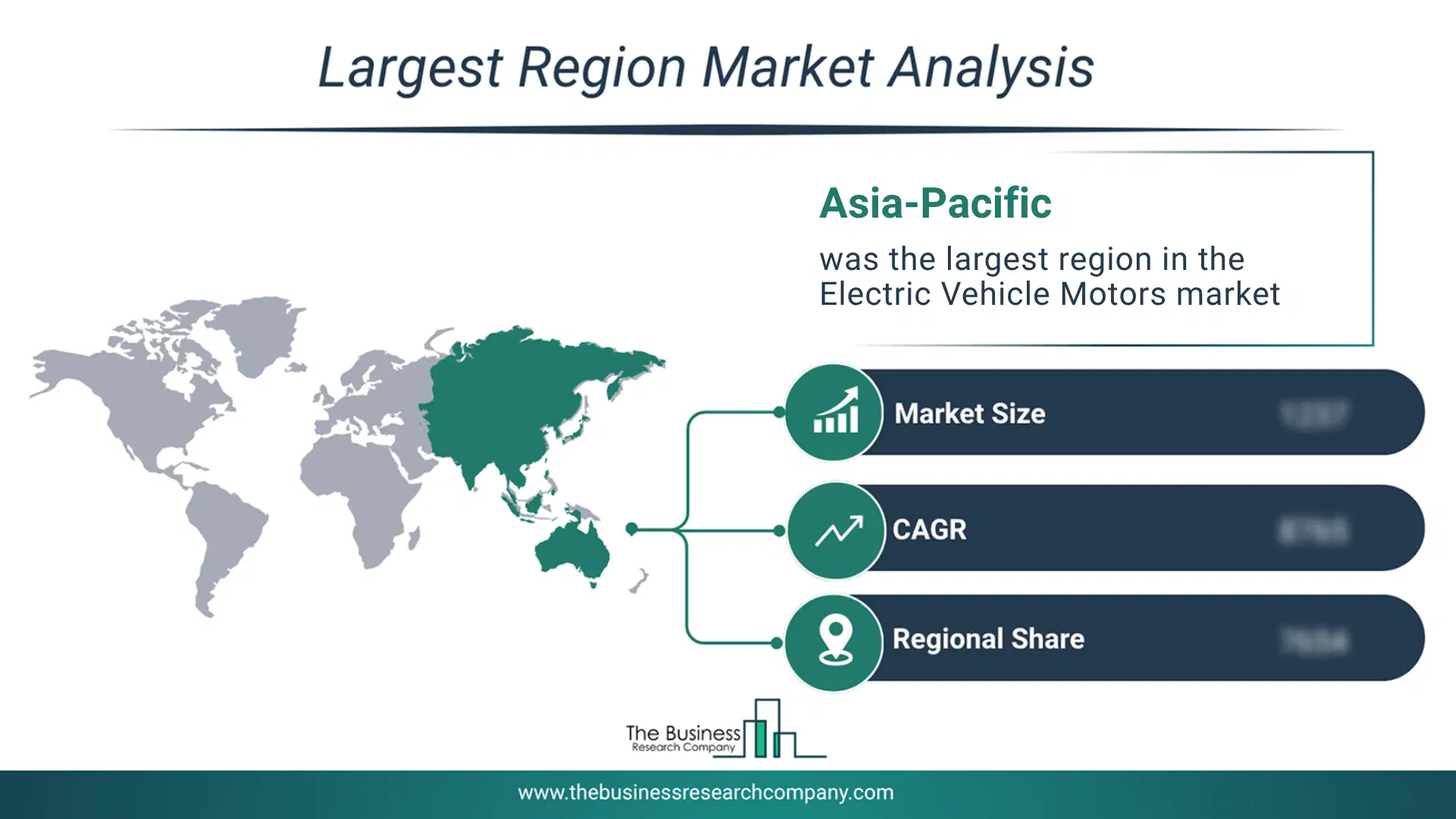
Regional Outlook
Asia-Pacific was the largest region in the electric vehicle motors market in 2025. The regions covered in this market report include Asia-Pacific, South East Asia, Western Europe, Eastern Europe, North America, South America, Middle East, Africa. The countries covered in this market report include Australia, Brazil, China, France, Germany, India, Indonesia, Japan, Taiwan, Russia, South Korea, UK, USA, Canada, Italy, SpainWhat Defines the Electric Vehicle Motors Market?
The electric vehicle motors market consists of sales of synchronous AC motors, induction AC motors, auxiliary motors, and motor controllers. values in this market are ‘factory gate’ values, that is the value of goods sold by the manufacturers or creators of the goods, whether to other entities (including downstream manufacturers, wholesalers, distributors and retailers) or directly to end customers. The value of goods in this market includes related services sold by the creators of the goods.How is Market Value Defined and Measured?
The market value is defined as the revenues that enterprises gain from the sale of goods and/or services within the specified market and geography through sales, grants, or donations in terms of the currency (in USD unless otherwise specified). The revenues for a specified geography are consumption values that are revenues generated by organizations in the specified geography within the market, irrespective of where they are produced. It does not include revenues from resales along the supply chain, either further along the supply chain or as part of other products.
This chart presents market attractiveness based on a quantitative evaluation of growth, competition, strategic alignment, and risk, offering a clear view of opportunity areas for decision-making. This chart is for illustrative purposes; the full report contains the complete analysis.

This chart highlights the Total Addressable Market (TAM) by estimating the maximum revenue opportunity using an assumption-driven approach, supporting strategic planning and opportunity sizing across markets. The chart is illustrative; the full report provides a more comprehensive analysis.
What Key Data and Analysis Are Included in the Electric Vehicle Motors Market Report 2026?
The electric vehicle motors market research report is one of a series of new reports from The Business Research Company that provides market statistics, including industry global market size, regional shares, competitors with the market share, detailed market segments, market trends and opportunities, and any further data you may need to thrive in the electric vehicle motors industry. The market research report delivers a complete perspective of everything you need, with an in-depth analysis of the current and future state of the industry.Electric Vehicle Motors Market Report Forecast Analysis
| Report Attribute | Details |
|---|---|
| Market Size Value In 2026 | $31.84 billion |
| Revenue Forecast In 2030 | $54.03 billion |
| Growth Rate | CAGR of 14.3% from 2026 to 2030 |
| Base Year For Estimation | 2025 |
| Actual Estimates/Historical Data | 2020-2025 |
| Forecast Period | 2026 - 2030 - 2030 |
| Market Representation | Revenue in USD Billion and CAGR from 2026 to 2030 |
| Segments Covered | Type, Component, Application, End User |
| Regional Scope | Asia-Pacific, Western Europe, Eastern Europe, North America, South America, Middle East, Africa |
| Country Scope | The countries covered in the report are Australia, Brazil, China, France, Germany, India, Indonesia, Japan, Taiwan, Russia, South Korea, UK, USA, Canada, Italy, Spain. |
| Key Companies Profiled | Tesla Motors Inc., BYD Company Ltd., Robert Bosch GmbH, DENSO Corporation, Continental AG Magna International Inc., LG Magna e-Powertrain Co. Ltd, Mitsubishi Electric Corporation, Aisin Corporation, Nidec Motor Corporation, BorgWarner Inc., Mahle GmbH, Vitesco Technologies, GKN Automotive Ltd., Johnson Electric Holdings Limited, TECO Electric & Machinery Co. Ltd., Hitachi Astemo, Siemens AG, ABB Ltd., Toshiba Corporation, Parker Hannifin Corp., Delta Electronics Inc., Ametek Incorporation |
| Customization Scope | Request for Customization |
| Pricing And Purchase Options | Explore Purchase Options |