
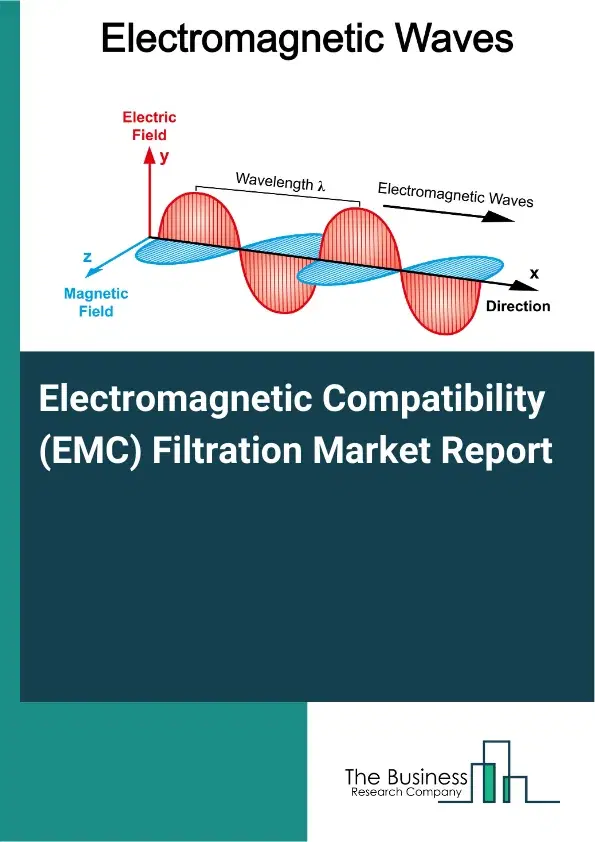
Electromagnetic Compatibility (EMC) Filtration Market Report 2026
Global Outlook – By Product Type (Power Line Filters, Signal Line Filters, Feedthrough Filters, Board-Level Filters, Shielding Components, Custom Electromagnetic Compatibility Modules), By Frequency Range (Low Frequency Filters, High Frequency Filters, Broadband Filters), By Technology Or Design (Passive Filter Networks, Active Electromagnetic Interference Filtering, Planar Magnetics, Integrated Connector Modules), By Application (Military And Aerospace), By End Use (Original Equipment Manufacturers, Electronics Manufacturing Services Or Printed Circuit Board Assemblers, Compliance Testing And Certification Laboratories, Aftermarket Or Retrofit Users) – Market Size, Trends, Strategies, and Forecast to 2035
Electromagnetic Compatibility (EMC) Filtration Market Overview
• Electromagnetic Compatibility (EMC) Filtration market size has reached to $1.31 billion in 2025 • Expected to grow to $1.82 billion in 2030 at a compound annual growth rate (CAGR) of 6.8% • Growth Driver: Rapid Adoption Of Electric Vehicles Fueling The Growth Of The Market Due To Increasing Demand For EMI Suppression And Signal Integrity Protection • Market Trend: Advancements In EMC Filtration With Palliative Solutions For Rapid EMI Suppression • North America was the largest region in 2025 and Asia-Pacific is the fastest growing region.What Is Covered Under Electromagnetic Compatibility (EMC) Filtration Market?
Electromagnetic compatibility (EMC) filtration refers to the use of filters and circuits designed to suppress or eliminate electromagnetic interference (EMI) in electronic systems. It ensures that electronic devices operate without causing or being affected by unwanted electromagnetic signals. It helps to maintain signal integrity, improve system reliability, and ensure compliance with regulatory EMC standards across various industries. The main types of electromagnetic compatibility filtration include power line filters, signal line filters, feedthrough filters, board-level filters, shielding components, and custom electromagnetic compatibility modules. Power line filters are designed to suppress conducted electromagnetic interference on electrical power lines, ensuring stable operation of electronic equipment and compliance with electromagnetic compatibility standards. These solutions are available across low frequency, high frequency, and broadband frequency ranges. Technologies include passive filter networks, active electromagnetic interference filtering, planar magnetics, and integrated connector modules. The various applications include military and aerospace, medical, automobile, commercial, industrial, consumer electronics, Renewable Energies, and telecommunications and are used by several end users such as original equipment manufacturers, electronics manufacturing services or printed circuit board assemblers, compliance testing and certification laboratories, and aftermarket or retrofit users.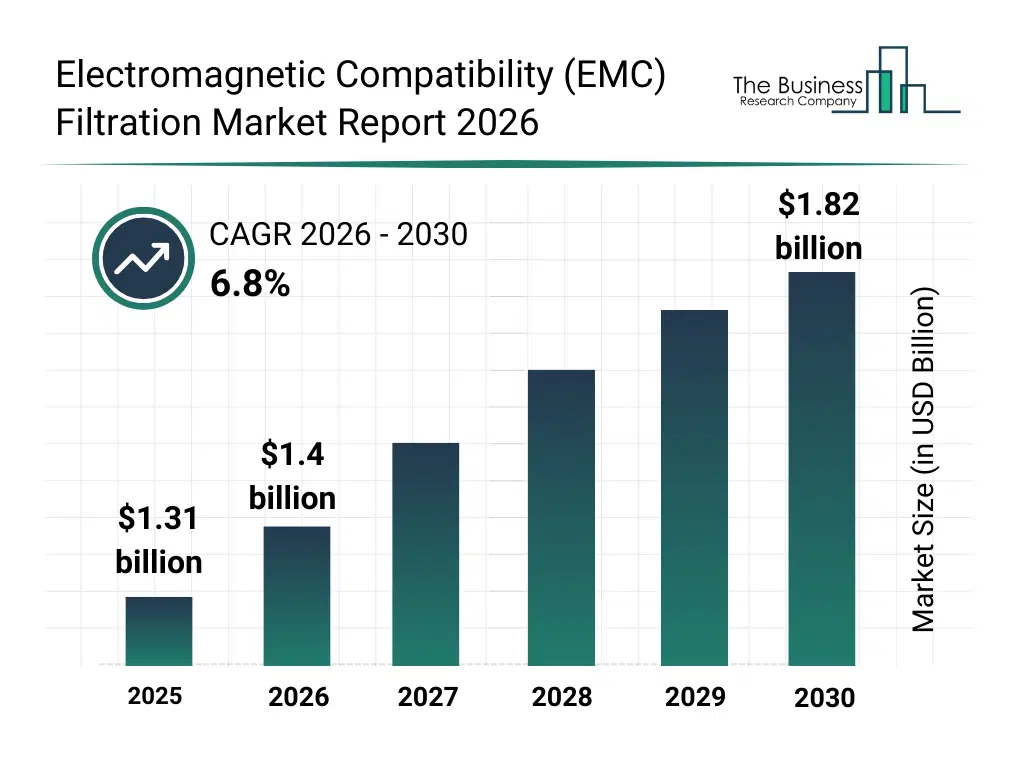
What Is The Electromagnetic Compatibility (EMC) Filtration Market Size and Share 2026?
The electromagnetic compatibility (emc) filtration market size has grown strongly in recent years. It will grow from $1.31 billion in 2025 to $1.4 billion in 2026 at a compound annual growth rate (CAGR) of 6.6%. The growth in the historic period can be attributed to increasing adoption of electronic systems in industrial applications, rising demand from automotive and consumer electronics, stringent regulatory emc compliance requirements, growth in telecommunications and it infrastructure, expansion of medical and aerospace electronics.What Is The Electromagnetic Compatibility (EMC) Filtration Market Growth Forecast?
The electromagnetic compatibility (emc) filtration market size is expected to see strong growth in the next few years. It will grow to $1.82 billion in 2030 at a compound annual growth rate (CAGR) of 6.8%. The growth in the forecast period can be attributed to emerging demand from electric vehicles and renewable energy sectors, increasing complexity of industrial automation, growth in iot-connected devices, rising adoption of high frequency and broadband filtering, technological advancements in hybrid and integrated emc modules. Major trends in the forecast period include miniaturization of filters, integration of hybrid emc modules, high frequency emi suppression, medical grade and safety-critical emc solutions, custom application-specific filtering.
Global Electromagnetic Compatibility (EMC) Filtration Market Segmentation
1) By Product Type: Power Line Filters, Signal Line Filters, Feedthrough Filters, Board-Level Filters, Shielding Components, Custom Electromagnetic Compatibility Modules 2) By Frequency Range: Low Frequency Filters, High Frequency Filters, Broadband Filters 3) By Technology Or Design: Passive Filter Networks, Active Electromagnetic Interference Filtering, Planar Magnetics, Integrated Connector Modules 4) By Application: Military And Aerospace, Medical, Automobile, Commercial, Industrial, Consumer Electronics, Renewable Energies, Telecommunications 5) By End Use: Original Equipment Manufacturers, Electronics Manufacturing Services Or Printed Circuit Board Assemblers, Compliance Testing And Certification Laboratories, Aftermarket Or Retrofit Users Subsegments: 1) By Power Line Filters: Single Phase Power Filters, Three Phase Power Filters, High Current Power Filters, Medical Grade Power Filters 2) By Signal Line Filters: Data Signal Filters, Communication Signal Filters, Control Signal Filters, Low Frequency Signal Filters 3) By Feedthrough Filters: Capacitor Feedthrough Filters, Pi Configuration Feedthrough Filters, High Voltage Feedthrough Filters, Hermetic Feedthrough Filters 4) By Board Level Filters: Surface Mounted Board Filters, Through Hole Board Filters, Integrated Circuit Board Filters, Miniaturized Board Filters 5) By Shielding Components: Conductive Shielding Enclosures, Shielding Gaskets, Absorptive Shielding Materials, Cable Shielding Accessories 6) By Custom Electromagnetic Compatibility Modules: Application Specific Filter Modules, Integrated Suppression Modules, Hybrid Filtering Assemblies, System Level Compatibility ModulesWhat Is The Driver Of The Electromagnetic Compatibility (EMC) Filtration Market?
The increasing adoption of electric vehicles is expected to propel the growth of the electromagnetic compatibility (EMC) filtration market going forward. Electric vehicles (EVs) refer to automobiles powered fully or partially by electricity, using electric motors, power electronics, battery management systems, and high-voltage components instead of conventional internal combustion engines. Electric vehicle adoption is rising due to stringent global emission regulations aimed at reducing carbon emissions and dependence on fossil fuels. EMC filtration solutions are witnessing increased demand as the rapid expansion of electric vehicles pushes automotive manufacturers to adopt advanced EMI suppression, noise reduction, and signal integrity protection solutions to ensure the safe and reliable operation of sensitive electronic systems. For instance, in January 2024, according to the International Energy Agency (IEA), a France-based intergovernmental organization, global electric car sales reached around 14 million units in 2023, representing over 35% growth compared to 2022, highlighting the accelerating shift toward vehicle electrification. Therefore, the increasing electric vehicle adoption is driving the growth of the electromagnetic compatibility (EMC) filtration industry.Key Players In The Global Electromagnetic Compatibility (EMC) Filtration Market
Major companies operating in the electromagnetic compatibility (emc) filtration market are Panasonic Holdings Corporation, Amphenol Corporation, TDK Corporation, Delta Electronics Inc., Bourns Inc., Littelfuse Inc., Vishay Intertechnology Inc., MORNSUN Guangzhou Science & Technology Co. Ltd., Murrelektronik GmbH, BLOCK Transformatoren-Elektronik GmbH, Cosel Co. Ltd., Astrodyne TDI Corporation, Ohmite Manufacturing Company, Sinexcel Electric Co. Ltd., MTE Corporation, Murata Manufacturing Co. Ltd., Curtis Industries, Electrocube Inc., Captor Corporation, REO AG, Total EMC Products Ltd.Global Electromagnetic Compatibility (EMC) Filtration Market Trends and Insights
Major companies operating in the electromagnetic compatibility (EMC) filtration market are focusing on developing advanced solutions, such as palliative filters, to quickly suppress EMI in existing systems without requiring major design changes. Palliative filters are EMC filters designed to reduce electromagnetic interference effects temporarily or partially without fully eliminating the source of the noise. For instance, in October 2025, Hypermotive Ltd., a UK-based engineering firm, launched H:FILTER, a family of electromagnetic compatibility (EMC) palliative solution for EVs. It is a configurable filter range built to assist engineers in achieving EMC compliance for EV charging systems. Its compact, adaptable design allows targeted suppression of specific frequencies, addressing late-stage EMC/EMI challenges. The filters are designed for easy fine-tuning to meet both performance and packaging requirements in fast-paced vehicle development. Offered in single- and three-phase versions, H:FILTER meets automotive environmental and mechanical standards and is produced with AECQ-qualified components to automotive volume quality.What Are Latest Mergers And Acquisitions In The Electromagnetic Compatibility (EMC) Filtration Market?
In December 2023, TE Connectivity Ltd., a Switzerland-based provider of connectivity and sensor solutions, acquired Schaffner Holding AG for $340 million. With this acquisition, TE Connectivity aimed to strengthen and expand its Electromagnetic Compatibility (EMC) filtration and electromagnetic solutions portfolio, enhancing its technological capabilities and market presence across industrial automation, electrification, and mobility applications. Schaffner Holding AG is a Switzerland-based provider of EMC or EMI filters, power quality solutions, chokes, and electromagnetic interference suppression components.Regional Outlook
North America was the largest region in the electromagnetic compatibility (EMC) filtration market in 2025. Asia-Pacific is expected to be the fastest-growing region in the forecast period. The regions covered in this market report are Asia-Pacific, South East Asia, Western Europe, Eastern Europe, North America, South America, Middle East, Africa. The countries covered in this market report are Australia, Brazil, China, France, Germany, India, Indonesia, Japan, Taiwan, Russia, South Korea, UK, USA, Canada, Italy, Spain.What Defines the Electromagnetic Compatibility (EMC) Filtration Market?
The electromagnetic compatibility (EMC) filtration market consists of sales of differential mode filters, signal line filters, capacitor-inductor (LC) filters, transient voltage suppressors, hybrid electromagnetic compatibility (EMC) filter modules, and radio frequency interference (RFI) suppression components. Values in this market are ‘factory gate’ values, that is the value of goods sold by the manufacturers or creators of the goods, whether to other entities (including downstream manufacturers, wholesalers, distributors and retailers) or directly to end customers. The value of goods in this market includes related services sold by the creators of the goods.How is Market Value Defined and Measured?
The market value is defined as the revenues that enterprises gain from the sale of goods and/or services within the specified market and geography through sales, grants, or donations in terms of the currency (in USD unless otherwise specified). The revenues for a specified geography are consumption values that are revenues generated by organizations in the specified geography within the market, irrespective of where they are produced. It does not include revenues from resales along the supply chain, either further along the supply chain or as part of other products.What Key Data and Analysis Are Included in the Electromagnetic Compatibility (EMC) Filtration Market Report 2026?
The electromagnetic compatibility (emc) filtration market research report is one of a series of new reports from The Business Research Company that provides market statistics, including industry global market size, regional shares, competitors with the market share, detailed market segments, market trends and opportunities, and any further data you may need to thrive in the electromagnetic compatibility (emc) filtration industry. The market research report delivers a complete perspective of everything you need, with an in-depth analysis of the current and future state of the industry.Electromagnetic Compatibility (EMC) Filtration Market Report Forecast Analysis
| Report Attribute | Details |
|---|---|
| Market Size Value In 2026 | $1.4 billion |
| Revenue Forecast In 2035 | $1.82 billion |
| Growth Rate | CAGR of 6.6% from 2026 to 2035 |
| Base Year For Estimation | 2025 |
| Actual Estimates/Historical Data | 2020-2025 |
| Forecast Period | 2026 - 2030 - 2035 |
| Market Representation | Revenue in USD Billion and CAGR from 2026 to 2035 |
| Segments Covered | Product Type, Frequency Range, Technology Or Design, Application, End Use |
| Regional Scope | Asia-Pacific, Western Europe, Eastern Europe, North America, South America, Middle East, Africa |
| Country Scope | The countries covered in the report are Australia, Brazil, China, France, Germany, India, ... |
| Key Companies Profiled | Panasonic Holdings Corporation, Amphenol Corporation, TDK Corporation, Delta Electronics Inc., Bourns Inc., Littelfuse Inc., Vishay Intertechnology Inc., MORNSUN Guangzhou Science & Technology Co. Ltd., Murrelektronik GmbH, BLOCK Transformatoren-Elektronik GmbH, Cosel Co. Ltd., Astrodyne TDI Corporation, Ohmite Manufacturing Company, Sinexcel Electric Co. Ltd., MTE Corporation, Murata Manufacturing Co. Ltd., Curtis Industries, Electrocube Inc., Captor Corporation, REO AG, Total EMC Products Ltd. |
| Customization Scope | Request for Customization |
| Pricing And Purchase Options | Explore Purchase Options |