

Electromagnetic Metamaterial Market 2026
By Type (Negative Index Metamaterials, Electromagnetic Bandgap Metamaterials, Photonic Metamaterials, Mechanical Metamaterials, Acoustic Metamaterials), By Material Composition (Conductive Metamaterials, Dielectric Metamaterials, Magnetic Metamaterials, Hybrid Metamaterials, Composite Metamaterials), By Distribution Channel (Direct Sales, Online Platforms, Distributors And Resellers), By Application (Telecommunications, Imaging Systems, Sensing Equipment, Solar Energy Collectors, Defense And Security), By End-User Industry (Aerospace And Defense, Consumer Electronics, Healthcare, Automotive, Industrial And Manufacturing), And By Region, Opportunities And Strategies – Global Forecast To 2035
Electromagnetic Metamaterial Market Definition
Electromagnetic metamaterials are artificially engineered materials designed to manipulate and control electromagnetic waves, such as light, radio, or microwaves in ways that are not possible with natural materials. Their unique properties, such as negative refractive index, cloaking, or enhanced absorption, arise from their structure and geometry rather than their chemical composition. The primary purpose of electromagnetic metamaterials is to enhance or alter electromagnetic wave behavior for advanced applications in telecommunications, imaging, sensing, stealth technology and antenna design. The electromagnetic metamaterial market consists of sales by entities (organizations, sole traders and partnerships) of electromagnetic metamaterial that are used in applications where enhanced wave control, reduced component size, improved antenna performance, imaging resolution, or electromagnetic shielding is critical. Complementary products include traditional electromagnetic components such as standard antennas, lenses, waveguides and electromagnetic shielding materials. Substitutes may include conventional engineered materials or advanced electronic design techniques that aim to mimic some of the performance advantages of metamaterials.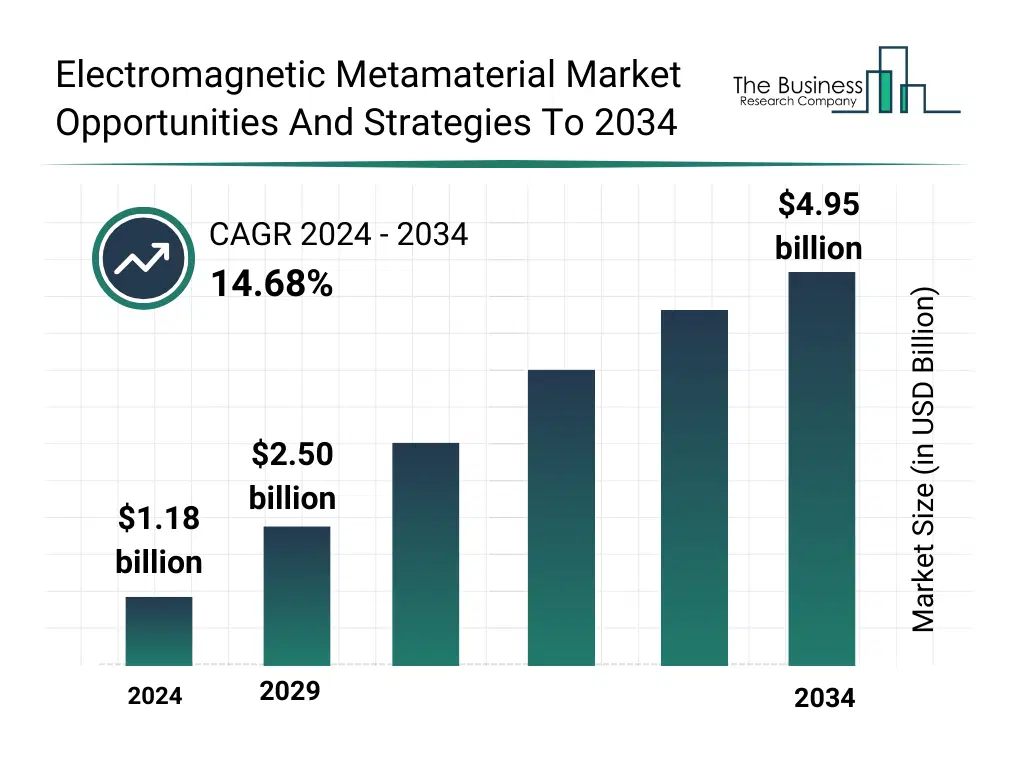
Electromagnetic Metamaterial Market Size
The global electromagnetic metamaterial market reached a value of nearly $1,178.65 million in 2024, having grown at a compound annual growth rate (CAGR) of 12.29% since 2019. The market is expected to grow from $1,178.65 million in 2024 to $2,495.80 million in 2029 at a rate of 16.19%. The market is then expected to grow at a CAGR of 14.68% from 2029 and reach $4,949.41 million in 2034. Growth in the historic period resulted from the rising demand in telecommunications, growth of aerospace sector, expansion of 5G And 6G wireless communication network and expansion into consumer electronics. Factors that negatively affected growth in the historic period were limited skilled work force and lack of standardization and regulatory frameworks. Going forward, the rise in industrial automation, growth in medical imaging and diagnostic, growth in wearable and IoT devices and rise of autonomous vehicles will drive the growth. Factors that could hinder the growth of the electromagnetic metamaterial market in the future include high manufacturing and fabrication costs, complex design and integration processes and impact of trade war and tariff.Electromagnetic Metamaterial Market Drivers
The key drivers of the electromagnetic metamaterial market include: Rise In Industrial Automation Rise in industrial automation is expected to be a key driver of the growth of the electromagnetic metamaterial market in the forecast period. As industries increasingly adopt automated and smart manufacturing systems, there is a growing need for advanced sensing, communication and signal control technologies that ensure high precision and reliability. Electromagnetic metamaterials, with their unique ability to manipulate electromagnetic waves, play a crucial role in enabling efficient data transmission, noise suppression and enhanced electromagnetic compatibility within automated environments. They contribute to the development of compact and high-performance sensors, wireless communication modules and radar-based monitoring systems that are vital for robotics, industrial IoT and process automation. The increasing complexity of automated systems requires materials that can handle high-frequency operations and electromagnetic interference effectively and metamaterials meet this demand by providing superior wave control and tunability. The rise in industrial automation growth contribution during the forecast period in 2024 is 2.00%.Electromagnetic Metamaterial Market Restraints
The key restraints on the electromagnetic metamaterial market include: High Manufacturing And Fabrication Costs High manufacturing and fabrication costs are restricting the growth of the electromagnetic metamaterial market during the forecast period. The production of metamaterials involves intricate micro- and nanoscale structuring processes that require advanced fabrication technologies, such as lithography, precision etching and additive manufacturing. These processes demand specialized equipment, high-purity raw materials and cleanroom facilities, all of which contribute to elevated production costs. Furthermore, maintaining the structural uniformity and precision of metamaterial components across large scales is technically challenging and cost intensive. This high-cost barrier limits the ability of small and medium enterprises to enter the market and slows the pace of mass commercialization. As a result, while research and prototyping continue to advance, scaling these materials for widespread industrial use remains financially difficult. Growth affected by high manufacturing and fabrication costs across regions during the forecast period in 2024 is -1.50%.Electromagnetic Metamaterial Market Trends
Major trends shaping the electromagnetic metamaterial market include: Development Of Tunable Negative Index Structures For Enhanced Wave Manipulation Companies operating in the electromagnetic metamaterial are increasingly developing tunable negative‐index structures to offer dynamic control over electromagnetic wave propagation, enabling on-demand bending, focusing or steering of waves. These innovations target the historic limitation of static refractive-index behavior in conventional negative-index metamaterials, allowing devices to shift between negative, zero and positive refractive index states via external stimuli. For example, in February 2025, NTT Corporation, a Japan-based telecommunications researchers from NTT and Lancaster University have theoretically demonstrated that negative refraction of light can occur in cooperatively interacting atoms confined within a laser-generated lattice. These atomic lattices present a promising alternative to traditional metamaterials, where negative refraction is often limited by material losses and fabrication defects. The lattice structure, consisting of atoms held in place by standing light waves (optical lattices), behaves like a uniform crystal with tunable properties that minimize imperfections. The cooperative, non-local response of the atoms enables robust negative refraction over a wide range of frequencies and incident angles. Expansion Of Plasmonic Metasurfaces To Boost Optical Communication Efficiency Major companies in the electromagnetic metamaterial market are increasingly bringing to market plasmonic and metasurface-based optical modules designed to replace bulky lenses and waveguides in high-speed communication and sensing systems. These innovations tackle the traditional limitations of size, weight and optical coupling losses, enabling thinner, lighter and higher-performance photonic subsystems. For example, in June 2023, Metalenz, a US-based company specializing in metasurface optics technology, announced the launch of its metasurface optics platform in mass production in partnership with foundry UMC (united microelectronics corporation) marking the first time metasurface optics were made widely available to OEMs (original equipment manufacturer) for consumer electronics and advanced sensing use cases.Opportunities And Recommendations In The Electromagnetic Metamaterial Market
Opportunities – The top opportunities in the electromagnetic metamaterial market segmented by type will arise in the electromagnetic bandgap metamaterials segment, which will gain $464.93 million of global annual sales by 2029. The top opportunities in the electromagnetic metamaterial market segmented by material composition will arise in the conductive metamaterials segment, which will gain $397.50 million of global annual sales by 2029. The top opportunities in the electromagnetic metamaterial market segmented by distribution channel will arise in the direct sales segment, which will gain $596.12 million of global annual sales by 2029. The top opportunities in the electromagnetic metamaterial market segmented by application will arise in the telecommunications segment, which will gain $748.86 million of global annual sales by 2029. The top opportunities in the electromagnetic metamaterial market segmented by end-user industry will arise in the aerospace and defense segment, which will gain $524.97 million of global annual sales by 2029. The electromagnetic metamaterial market size will gain the most in the USA at $360.50 million. Recommendations- To take advantage of the opportunities, The Business Research Company recommends the electromagnetic metamaterial companies to focus on tunable negative-index architectures for adaptive wave control, focus on plasmonic and metasurface optical modules for system miniaturization, focus on electromagnetic bandgap metamaterials for scalable growth, focus on hybrid metamaterials to capture the fastest growth, expand in emerging markets, continue to focus on developed markets, focus on value-aligned and tiered pricing strategies, focus on targeted technical communication and thought leadership, focus on integrated multi-channel and customer-centric promotion, focus on online platforms to accelerate market expansion, focus on solar energy collectors to capture high-growth demand, focus on healthcare to capture rapid market growth.
Electromagnetic Metamaterial Market Segmentation
The electromagnetic metamaterial market is segmented by type, by material composition, by distribution channel, by application and by end-user industry.By Type–
The electromagnetic metamaterial market is segmented by type into:
- a) Negative Index Metamaterials
- b) Electromagnetic Bandgap Metamaterials
- c) Photonic Metamaterials
- d) Mechanical Metamaterials
- e) Acoustic Metamaterials
By Material Composition –
The electromagnetic metamaterial market is segmented by material composition into:
- a) Conductive Metamaterials
- b) Dielectric Metamaterials
- c) Magnetic Metamaterials
- d) Hybrid Metamaterials
- e) Composite Metamaterials
By Distribution Channel –
The electromagnetic metamaterial market is segmented by distribution channel into:
- a) Direct Sales
- b) Online Platforms
- c) Distributors And Resellers
By Application –
The electromagnetic metamaterial market is segmented by application into:
- a) Telecommunications
- b) Imaging Systems
- c) Sensing Equipment
- d) Solar Energy Collectors
- e) Defense And Security
By End-User Industry–
The electromagnetic metamaterial market is segmented by end-user industry into:
- a) Aerospace And Defense
- b) Consumer Electronics
- c) Healthcare
- d) Automotive
- e) Industrial And Manufacturing
By Geography - The electromagnetic metamaterial market is segmented by geography into:
- • China
- • India
- • Japan
- • Australia
- • Indonesia
- • South Korea
- • USA
- • Canada
- • Brazil
- • France
- • Germany
- • UK
- • Italy
- • Spain
- • Russia
-
o Asia Pacific
o Africa