
Electromagnetic Sensor Market Report 2026
Global Outlook – By Type (Hall Effect Sensors, Electromagnetic Induction Sensors, Magnetoresistive Sensors, Current Sensing Sensors, Proximity Sensing Sensors), By Technology (Analog Sensors, Digital Sensors, Smart Sensors, Wireless Sensors), By Application (Consumer Electronics, Automotive, Aerospace And Defense, Industrial Automation, Healthcare), By End User Industry (Manufacturing, Telecommunications, Energy And Power, Transportation, Building Automation) – Market Size, Trends, Strategies, and Forecast to 2030
Electromagnetic Sensor Market Overview
• Electromagnetic Sensor market size has reached to $2.2 billion in 2025 • Expected to grow to $3.18 billion in 2030 at a compound annual growth rate (CAGR) of 7.7% • Growth Driver: Rising Industrial Automation Driving Demand For The Market Due To Increasing Adoption Of Automated Production Lines • Market Trend: Next-Generation Electromagnetic Flowmeter Innovations Enhance Industrial Measurement Accuracy And Process Efficiency • North America was the largest region in 2025 and Asia-Pacific is the fastest growing region.What Is Covered Under Electromagnetic Sensor Market?
An electromagnetic sensor is a device designed to detect and measure electromagnetic signals, magnetic fields, electric currents, or changes in electromagnetic energy within an environment. It converts these electromagnetic variations into measurable electrical signals for monitoring, analysis, and control applications. Electromagnetic sensors support accurate detection, positioning, motion sensing, current measurement, and object identification across various industries. The main types of electromagnetic sensors include hall effect sensors, electromagnetic induction sensors, magnetoresistive sensors, current sensing sensors, and proximity sensing sensors. Hall effect sensors refer to devices that detect and measure magnetic fields by generating a voltage proportional to the magnetic field strength. These sensors utilize technologies including analog sensors, digital sensors, smart sensors, and wireless sensors. The various applications involved are consumer electronics, automotive, aerospace and defense, industrial automation, and healthcare and they are utilized by end user industries including manufacturing, telecommunications, energy and power, transportation, and building automation.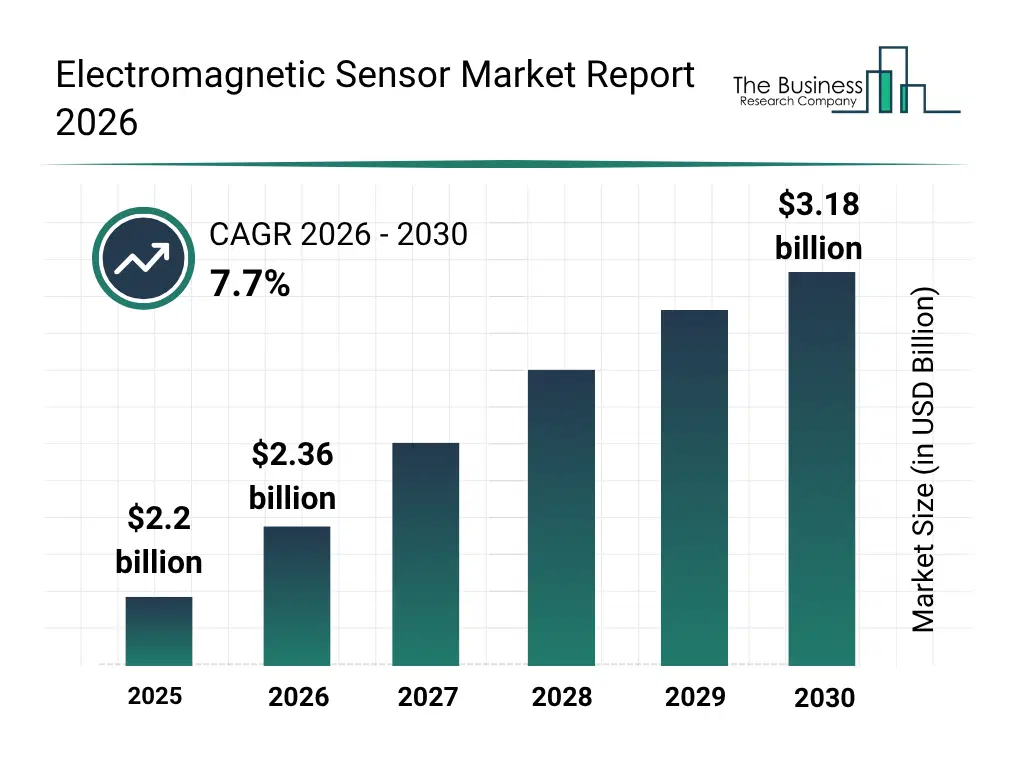
What Is The Electromagnetic Sensor Market Size and Share 2026?
The electromagnetic sensor market size has grown strongly in recent years. It will grow from $2.2 billion in 2025 to $2.36 billion in 2026 at a compound annual growth rate (CAGR) of 7.4%. The growth in the historic period can be attributed to growing adoption of automation technologies across manufacturing facilities, increasing demand for accurate position and motion sensing systems, rising utilization of sensors in automotive safety applications, expansion of industrial monitoring and control infrastructure, growing deployment of electronic devices requiring advanced sensing capabilities.What Is The Electromagnetic Sensor Market Growth Forecast?
The electromagnetic sensor market size is expected to see strong growth in the next few years. It will grow to $3.18 billion in 2030 at a compound annual growth rate (CAGR) of 7.7%. The growth in the forecast period can be attributed to increasing investments in smart infrastructure development, rising demand for advanced sensing solutions in electric vehicles, growing adoption of autonomous systems and robotics platforms, expanding deployment of intelligent industrial equipment, increasing need for real-time monitoring and predictive maintenance systems. Major trends in the forecast period include increasing demand for high precision electromagnetic sensing solutions for positioning and motion detection, growing adoption of contactless sensing technologies across industrial and commercial environments, rising use of current sensing sensors for power monitoring and equipment protection applications, expanding deployment of electromagnetic sensors for object detection and identification systems, increasing development of compact and energy efficient sensor designs for multi-industry applications.
Global Electromagnetic Sensor Market Segmentation
1) By Type: Hall Effect Sensors; Electromagnetic Induction Sensors; Magnetoresistive Sensors; Current Sensing Sensors; Proximity Sensing Sensors 2) By Technology: Analog Sensors; Digital Sensors; Smart Sensors; Wireless Sensors 3) By Application: Consumer Electronics; Automotive; Aerospace And Defense; Industrial Automation; Healthcare 4) By End User Industry: Manufacturing; Telecommunications; Energy And Power; Transportation; Building Automation Subsegments: 1) By Hall Effect Sensors: Linear Hall Effect Sensors; Digital Hall Effect Sensors; Bipolar Hall Effect Sensors; Unipolar Hall Effect Sensors; Latch Hall Effect Sensors 2) By Electromagnetic Induction Sensors: Variable Reluctance Sensors; Eddy Current Sensors; Inductive Position Sensors; Inductive Proximity Sensors; Transformer Based Sensors 3) By Magnetoresistive Sensors: Anisotropic Magnetoresistive Sensors; Giant Magnetoresistive Sensors; Tunnel Magnetoresistive Sensors; Spin Valve Magnetoresistive Sensors; Ballistic Magnetoresistive Sensors 4) By Current Sensing Sensors: Open Loop Current Sensors; Closed Loop Current Sensors; Integrated Current Sensors; Isolated Current Sensors; Non Isolated Current Sensors 5) By Proximity Sensing Sensors: Inductive Proximity Sensors; Magnetic Proximity Sensors; Photoelectric Proximity Sensors; Ultrasonic Proximity SensorsWhat Is The Driver Of The Electromagnetic Sensor Market?
The growing industrial automation is expected to propel the growth of the electromagnetic sensor market going forward. Industrial automation refers to the integration of machines, control systems, and digital technologies to perform manufacturing and production processes with little or no human involvement. Industrial automation is increasing due to labor cost pressure, as companies adopt automated systems to reduce dependence on human workers, lower operational expenses, and maintain consistent production output. Electromagnetic sensors support industrial automation by enabling accurate, contactless detection of position, motion, and electrical parameters in machines, which helps automated systems monitor and control processes in real time with high precision and reliability. For instance, in September 2024, according to the World Robotics 2024 report released by the International Federation of Robotics, a Germany-based organization, the global operational stock of industrial robots reached 4,281,585 units in factories worldwide, representing a 10% year-on-year increase, while annual installations exceeded 500,000 units for the third consecutive year, with Asia accounting for 70% of newly deployed robots in 2023, followed by Europe at 17% and the Americas at 10%. Therefore, growing industrial automation is driving the growth of the electromagnetic sensor industry.Key Players In The Global Electromagnetic Sensor Market
Major companies operating in the electromagnetic sensor market are Robert Bosch GmbH; Honeywell International Incorporated; Toshiba Corporation; ABB Limited; Infineon Technologies Aktiengesellschaft; TDK Corporation; Broadcom Inc.; STMicroelectronics N.V.; Murata Manufacturing Company Limited; TE Connectivity Public Limited Company; Analog Devices Inc.; Omron Corporation; KEYENCE Corporation; ams-OSRAM Aktiengesellschaft; SICK Aktiengesellschaft; Allegro MicroSystems Incorporated; NXP Semiconductors N.V.; Melexis N.V.; Littelfuse Inc.; TAMURA Corporation; LEM Holding Société Anonyme; Diodes Incorporated; VALLON GmbH; Megger Group Limited; Aeron Systems Private Limited; Micro Sensor Company LimitedGlobal Electromagnetic Sensor Market Trends and Insights
Major companies operating in the electromagnetic sensor market are focusing on developing advanced solutions, such as next-generation electromagnetic flowmeters, to improve measurement accuracy, enhance operational reliability, and support digital industrial automation. Electromagnetic flowmeters are sensor-based devices that use electromagnetic principles to measure the flow rate of conductive liquids with high precision and minimal maintenance requirements. For instance, in August 2024, ABB, a Switzerland-based automation and electrification technology company, unveiled ProcessMaster and AquaMaster, a next generation of electromagnetic flowmeters. It is designed to deliver enhanced accuracy, connectivity, and efficiency for industrial process applications. Advanced flowmeters feature intelligent sensing, digital diagnostics, and enhanced data integration capabilities for accurate real-time monitoring and efficient process control. These innovations improve operational performance and system reliability across industries such as water treatment, chemicals, and energy.What Are Latest Mergers And Acquisitions In The Electromagnetic Sensor Market?
In October 2023, Allegro MicroSystems Inc., a US-based semiconductor company, acquired Crocus Technology for an undisclosed amount. With this acquisition, Allegro MicroSystems aimed to strengthen its electromagnetic and magnetic sensing capabilities, expand tunnel magnetoresistance sensor technology offerings, and enhance its position in automotive, industrial, and consumer sensing applications. Crocus Technology is a US-based semiconductor company that specializes in providing integrated magnetic sensors.Regional Outlook
North America was the largest region in the electromagnetic sensor market in 2025. Asia-Pacific is expected to be the fastest-growing region in the forecast period. The regions covered in this market report are Asia-Pacific, South East Asia, Western Europe, Eastern Europe, North America, South America, Middle East, Africa. The countries covered in this market report are Australia, Brazil, China, France, Germany, India, Indonesia, Japan, Taiwan, Russia, South Korea, UK, USA, Canada, Italy, Spain.What Defines the Electromagnetic Sensor Market?
The electromagnetic sensor market consists of sales of eddy current sensors, fluxgate sensors, and inductive displacement sensors. Values in this market are ‘factory gate’ values, that is, the value of goods sold by the manufacturers or creators of the goods, whether to other entities (including downstream manufacturers, wholesalers, distributors, and retailers) or directly to end customers. The value of goods in this market includes related services sold by the creators of the goods.How is Market Value Defined and Measured?
The market value is defined as the revenues that enterprises gain from the sale of goods and/or services within the specified market and geography through sales, grants, or donations in terms of the currency (in USD unless otherwise specified). The revenues for a specified geography are consumption values that are revenues generated by organizations in the specified geography within the market, irrespective of where they are produced. It does not include revenues from resales along the supply chain, either further along the supply chain or as part of other products.What Key Data and Analysis Are Included in the Electromagnetic Sensor Market Report 2026?
The electromagnetic sensor market research report is one of a series of new reports from The Business Research Company that provides market statistics, including industry global market size, regional shares, competitors with the market share, detailed market segments, market trends and opportunities, and any further data you may need to thrive in the electromagnetic sensor industry. The market research report delivers a complete perspective of everything you need, with an in-depth analysis of the current and future state of the industry.Electromagnetic Sensor Market Report Forecast Analysis
| Report Attribute | Details |
|---|---|
| Market Size Value In 2026 | $2.36 billion |
| Revenue Forecast In 2030 | $3.18 billion |
| Growth Rate | CAGR of 7.7% from 2026 to 2030 |
| Base Year For Estimation | 2025 |
| Actual Estimates/Historical Data | 2020-2025 |
| Forecast Period | 2026 - 2030 |
| Market Representation | Revenue in USD Billion and CAGR from 2026 to 2030 |
| Segments Covered | Type, Technology, Application, End User Industry |
| Regional Scope | Asia-Pacific, Western Europe, Eastern Europe, North America, South America, Middle East, Africa |
| Country Scope | The countries covered in the report are Australia, Brazil, China, France, Germany, India, ... |
| Key Companies Profiled | Robert Bosch GmbH; Honeywell International Incorporated; Toshiba Corporation; ABB Limited; Infineon Technologies Aktiengesellschaft; TDK Corporation; Broadcom Inc.; STMicroelectronics N.V.; Murata Manufacturing Company Limited; TE Connectivity Public Limited Company; Analog Devices Inc.; Omron Corporation; KEYENCE Corporation; ams-OSRAM Aktiengesellschaft; SICK Aktiengesellschaft; Allegro MicroSystems Incorporated; NXP Semiconductors N.V.; Melexis N.V.; Littelfuse Inc.; TAMURA Corporation; LEM Holding Société Anonyme; Diodes Incorporated; VALLON GmbH; Megger Group Limited; Aeron Systems Private Limited; Micro Sensor Company Limited |
| Customization Scope | Request for Customization |
| Pricing And Purchase Options | Explore Purchase Options |