
Electromagnetic Simulation Software Market Report 2026
Global Outlook – By Component (Software, Services), By Deployment Mode (On-Premises, Cloud-Based, Hybrid Deployment), By Application (Antenna Design, Electromagnetic Compatibility, Microwave And Radio Frequency Component Design, Radar And Satellite, Automotive Electronics, Medical Devices, Other Applications), By End-User (Automotive, Aerospace And Defense, Electronics And Electrical, Healthcare, Telecommunications, Other End Users) – Market Size, Trends, Strategies, and Forecast to 2030
Electromagnetic Simulation Software Market Overview
• Electromagnetic Simulation Software market size has reached to $2.87 billion in 2025 • Expected to grow to $6.61 billion in 2030 at a compound annual growth rate (CAGR) of 18.1% • Growth Driver: Rising Demand For High Speed Connectivity In Telecommunications Fueling Growth Of The Market Due To Increasing Need For Accurate High-Frequency Component Design • Market Trend: Innovations In Electromagnetic Simulation For High-Frequency Design Enhancing Accuracy, Speed, And Workflow Efficiency • North America was the largest region in 2025 and Asia-Pacific is the fastest growing region.Market Gains By 2030 – Top Opportunities By Segment
Market Gain identifies the most promising market opportunities by highlighting the segments or products expected to generate the highest incremental revenue growth over the next five years.
What Is Covered Under Electromagnetic Simulation Software Market?
Electromagnetic simulation software refers to powerful computer-based tools that apply numerical techniques to replicate and study the behavior of electric and magnetic fields, helping engineers evaluate electromagnetic performance without the need for physical testing. It plays a vital role in designing and fine-tuning components such as antennas, radars, sensors, and circuit boards, cutting down development time and boosting precision across industries. The main components of electromagnetic simulation software include software and services. Software includes the main platforms and tools used for simulating electromagnetic behavior in different environments. Various deployments include on-premises, cloud-based, and hybrid deployments and are applied for antenna design, electromagnetic compatibility, microwave and radio frequency component design, radar and satellite, automotive electronics, medical devices, and others. It is used by several end-users, including automotive, aerospace and defense, electronics and electrical, healthcare, telecommunications, and others.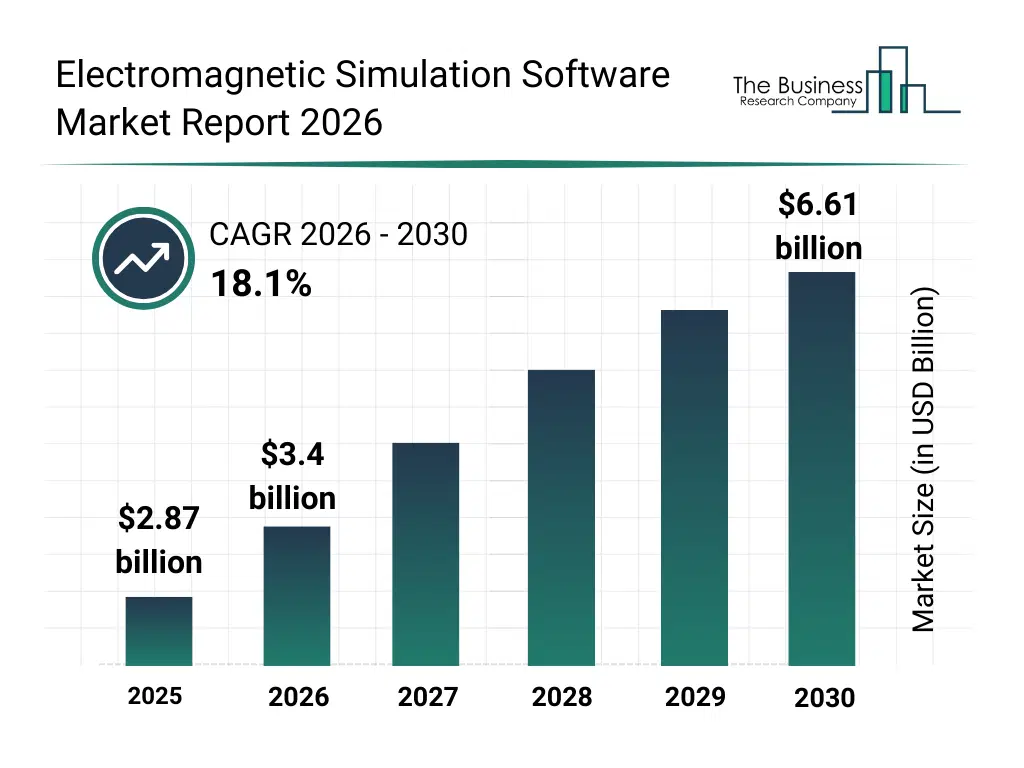
What Is The Electromagnetic Simulation Software Market Size and Share 2026?
The electromagnetic simulation software market size has grown rapidly in recent years. It will grow from $2.87 billion in 2025 to $3.4 billion in 2026 at a compound annual growth rate (CAGR) of 18.5%. The growth in the historic period can be attributed to growth in electronics product development, expansion of automotive electronics usage, rising demand for faster design cycles, adoption of digital prototyping tools, increasing investment in R&D activities.What Is The Electromagnetic Simulation Software Market Growth Forecast?
The electromagnetic simulation software market size is expected to see rapid growth in the next few years. It will grow to $6.61 billion in 2030 at a compound annual growth rate (CAGR) of 18.1%. The growth in the forecast period can be attributed to expansion of electric vehicle electronics design, rising adoption of 5G communication systems, growth in aerospace simulation applications, increasing demand for cloud simulation services, integration of AI based modeling tools. Major trends in the forecast period include cloud based simulation platform adoption, multi physics simulation integration, automated design optimization tools, high frequency component modeling, virtual prototyping expansion.
Global Electromagnetic Simulation Software Market Segmentation
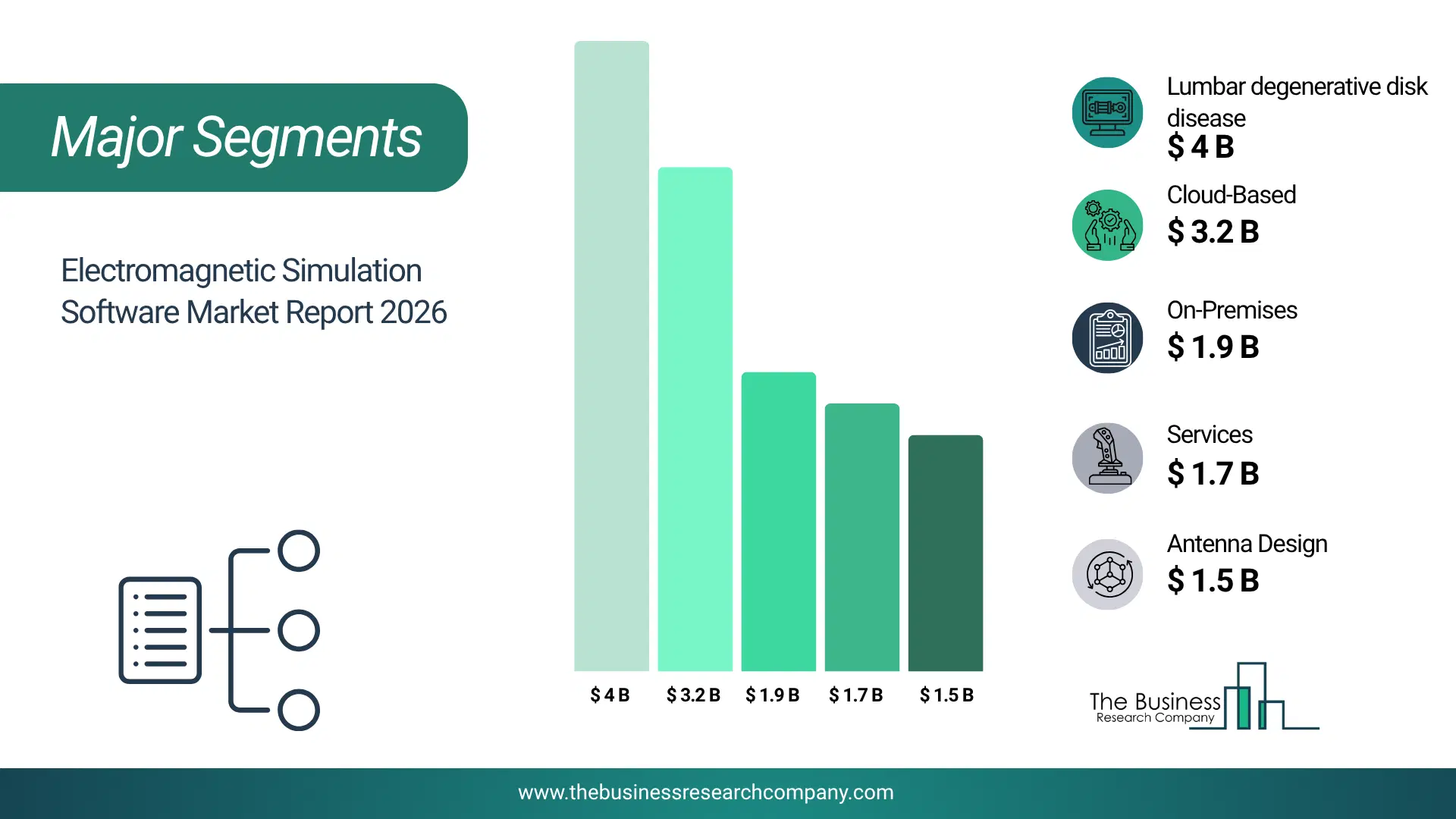
1) By Component: Software, Services 2) By Deployment Mode: On-Premises, Cloud-Based, Hybrid Deployment 3) By Application: Antenna Design, Electromagnetic Compatibility, Microwave And Radio Frequency Component Design, Radar And Satellite, Automotive Electronics, Medical Devices, Other Applications 4) By End-User: Automotive, Aerospace And Defense, Electronics And Electrical, Healthcare, Telecommunications, Other End Users Subsegments: 1) By Software: On-Premise, Cloud-Based 2) By Services: Consulting, Implementation And Integration, Support And Maintenance The top segments in the electromagnetic simulation software market will be: • Software will reach $4068.71 Million by 2030. • On-Premises will reach $1959.26 Million by 2030. • Cloud-Based will reach $3245.93 Million by 2030. • Services will reach $1789.4 Million by 2030. • Antenna Design will reach $1572.02 Million by 2030.What Is The Driver Of The Electromagnetic Simulation Software Market?
The rising demand for high-speed connectivity in telecommunications is expected to propel the growth of the electromagnetic simulation software market going forward. High-speed connectivity in telecommunications refers to the fast transmission of large amounts of data over advanced networks such as 4G, 5G, and fiber-optic systems. The rising high-speed connectivity is due to the increasing use of data-heavy applications such as video conferencing, online gaming, and cloud computing that require low latency and uninterrupted performance. Electromagnetic simulation software supports high-speed connectivity in telecommunications by enabling accurate modeling of high-frequency components and optimizing signal transmission efficiency. For instance, in January 2023, GSM Association, a UK-based non-profit trade association, reported that over 90 fixed-broadband providers, mostly mobile network operators, had already rolled out commercial 5G-based fixed wireless access (FWA) services across more than 48 countries. This indicated that roughly 40% of all global 5G mobile launches included an FWA component, a notably high share at such an early stage of the 5G deployment cycle. Therefore, the rising demand for high-speed connectivity in telecommunications is driving the growth of the electromagnetic simulation software industry.
Infographic Chart Showing Key Market Drivers Analysis And Restraints For Electromagnetic Simulation Software Market
The chart presents an impact analysis of key drivers and restraints, quantifying their relative influence on the market's growth rate and helping assess the balance between growth enablers and limiting factors. This chart offers a high-level perspective; the full report contains more detailed insights.
How Will The Drivers Impact Growth In The Global Electromagnetic Simulation Software Market?
• Surge in Deployment of IoT Devices (Medium) – During the forecast period, the surge in deployment of iot devices will become a key driver of growth in the electromagnetic simulation software market by 2030. as industries and enterprises increasingly roll out large volumes of connected devices across consumer electronics, industrial automation, smart infrastructure, and healthcare, the density and complexity of wireless hardware environments continue to rise. the rapid spread of iot devices amplifies challenges related to signal integrity, electromagnetic interference, antenna performance, and hardware reliability, increasing the need for advanced electromagnetic simulation tools during the design and validation stages. as a result, the widespread deployment of iot devices is anticipated to significantly boost demand for electromagnetic simulation software, as manufacturers rely on virtual modeling to improve design accuracy, reduce hardware failures, and accelerate time-to-market for next-generation connected products. as a result, the surge in deployment of iot devices is anticipated to contributing to a 2.0% annual growth in the market. • Aerospace and Defense Modernization (Medium) – During the forecast period, the aerospace and defense modernization will emerge as a major factor driving the expansion of the electromagnetic simulation software market by 2030. as governments intensify investments in upgrading military platforms and expanding indigenous defense manufacturing capabilities, the development of next-generation aircraft, naval vessels, radar systems, electronic warfare platforms, and secure communication networks is increasing the complexity of electromagnetic design and validation requirements. as defense manufacturers and system integrators design increasingly sophisticated platforms operating across wider frequency ranges and harsher operational environments, electromagnetic simulation becomes critical to predict interference, optimize system performance, and reduce reliance on costly physical testing. consequently, ongoing aerospace and defense modernization initiatives are expected to significantly boost demand for electromagnetic simulation software, as stakeholders seek to accelerate development cycles, improve system reliability, and enhance mission readiness through advanced virtual design and validation tools. consequently, the aerospace and defense modernization is projected to contributing to a 1.3% annual growth in the market. • Rising Adoption of Cloud-Based and SaaS Simulation Platforms (Medium) – During the forecast period, the rising adoption of cloud-based and saas simulation platforms will serve as a key growth catalyst for the electromagnetic simulation software market by 2030. as organizations increasingly shift engineering and simulation workloads to cloud environments to improve accessibility, scalability, and collaboration, demand for cloud-native electromagnetic simulation solutions is rising across industries such as electronics, aerospace, automotive, and telecommunications. cloud computing enables users to access high-performance computing (hpc) resources on-demand, run large-scale simulations without significant upfront hardware investment, and collaborate seamlessly across distributed teams, supporting more efficient design exploration and iteration. consequently, the shift toward cloud-based and saas simulation platforms is expected to significantly boost demand for electromagnetic simulation software by lowering barriers to entry, enabling broader access to advanced tools, and enhancing collaboration across global engineering teams. therefore, this rising adoption of cloud-based and saas simulation platforms is projected to supporting to a 1.1% annual growth in the market. • Growing Integration of AI and Machine Learning (Low) – During the forecast period, the growing integration of artificial intelligence (AI) and machine learning (ML) will drive the growth of the electromagnetic simulation software market. As AI adoption expands across education, research, and industry, there is a broader shift toward data-driven and intelligent tools that can automate complex analytical tasks and enhance decision-making capabilities. This increasing familiarity and reliance on AI technologies is translating into engineering and design environments, where AI and ML are being embedded into simulation workflows to accelerate model setup, optimize designs, and predict electromagnetic behavior more efficiently. As a result, the expanding integration of AI and machine learning is expected to significantly boost demand for electromagnetic simulation software, as organizations seek smarter, faster, and more efficient tools to support next-generation product development. The growing integration of artificial intelligence (AI) and machine learning (ML) growth contribution during the forecast period in 2025 is 0.8%.How Will The Restraints Impact Growth In The Global Electromagnetic Simulation Software Market?
• High Cost of Engineering Software Licenses (Medium) – During the forecast period, high cost of engineering software licenses is restricting the growth of the electromagnetic simulation software market during the forecast period. many electromagnetic simulation solutions, particularly those offering advanced multiphysics and high-frequency capabilities, are priced at a premium, reflecting significant development investment, specialized solver technology, and ongoing support and update fees. for organizations, especially small and medium-sized enterprises, the upfront and recurring license costs can strain it budgets, making it difficult to justify the expense relative to other engineering tools or internal development priorities. as a result, potential buyers may postpone or limit purchases, opt for legacy or lower-feature alternatives, or delay scaling simulation use across departments, thereby restricting the overall growth of the electromagnetic simulation software market during the forecast period. growth affected by the high cost of engineering software licenses during the forecast period in 2025 is -1.3%. • Integration Difficulties with Legacy Systems (Medium) – During the forecast period, integration difficulties with legacy systems are restricting the growth of the electromagnetic simulation software market during the forecast period. many established engineering enterprises and manufacturers rely on long-standing design, analysis, and product lifecycle management systems that were not built to interface seamlessly with modern, high-performance simulation platforms. these legacy infrastructures often use proprietary data formats, older computing architectures, and siloed workflows that complicate the integration of advanced electromagnetic solvers, data exchange, and collaborative simulation processes. as a result, engineering teams can face prolonged deployment timelines, increased it overhead to develop custom interfaces or data converters, and disruptions to established product development cycles when attempting to merge cutting-edge simulation tools with existing systems. from an operational standpoint, these integration challenges can deter organizations, especially those with complex, multi-generation technology stacks, from adopting or fully leveraging next-generation electromagnetic simulation solutions, thereby limiting software utilization, slowing innovation in design processes, and restricting the overall growth of the electromagnetic simulation software market during the forecast period. growth affected by the integration difficulties with legacy systems during the forecast period in 2025 is -1.0%. • Impact of Trade Wars and Tariffs (Medium) – During the forecast period, impact of trade war and tariffs is restricting the growth of the electromagnetic simulation software market during the forecast period. heightened geopolitical tensions and trade measures, such as export controls, tariffs, and restrictions on technology transfers, are creating uncertainties and barriers for engineering software vendors and buyers alike. such policies can limit access to advanced simulation technologies in key markets, disrupt global supply chains for semiconductor design tools, and increase costs for companies that rely on imported software licenses, high-performance computing infrastructure, or international support services. as a result, the impact of trade wars and tariffs is expected to dampen adoption rates and restrict the growth of the electromagnetic simulation software market during the forecast period by creating market fragmentation, raising entry barriers, and complicating cross-border technology deployment. growth affected by the impact of trade war and tariffs during the forecast period in 2025 is -0.3%.Key Players In The Global Electromagnetic Simulation Software Market
Major companies operating in the electromagnetic simulation software market are Siemens AG, Dassault Systèmes SE, Keysight Technologies Inc., Synopsys Inc., Cadence Design Systems Inc., Zuken Inc., COMSOL Inc., SimScale GmbH, IMST GmbH, Nullspace Inc., EMWorks Inc., Remcom Inc., Modelithics Inc., Lorentz Solution Inc., Sonnet Software Inc., Tera Analysis Ltd., Crosslight Software Inc., JCMwave GmbH, Applied Simulation Tech Inc., Vector Fields Inc.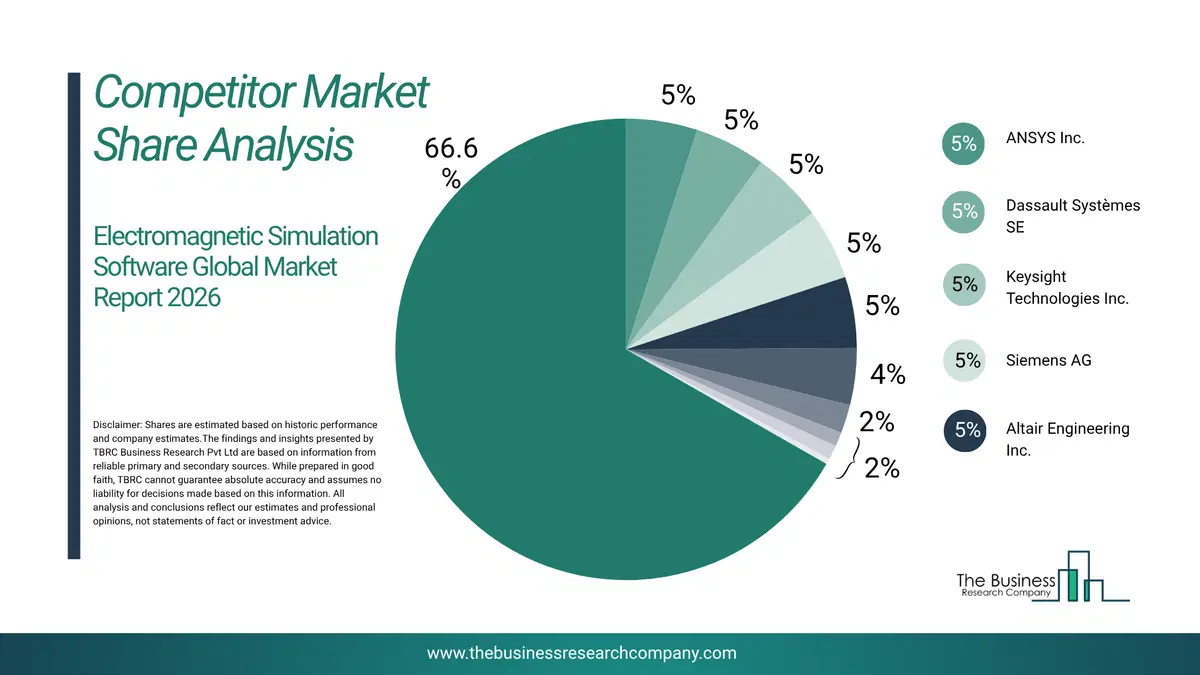
This chart is for illustrative purposes; the full report includes a detailed competitor analysis and comprehensive overview of the top 10 companies in the market.
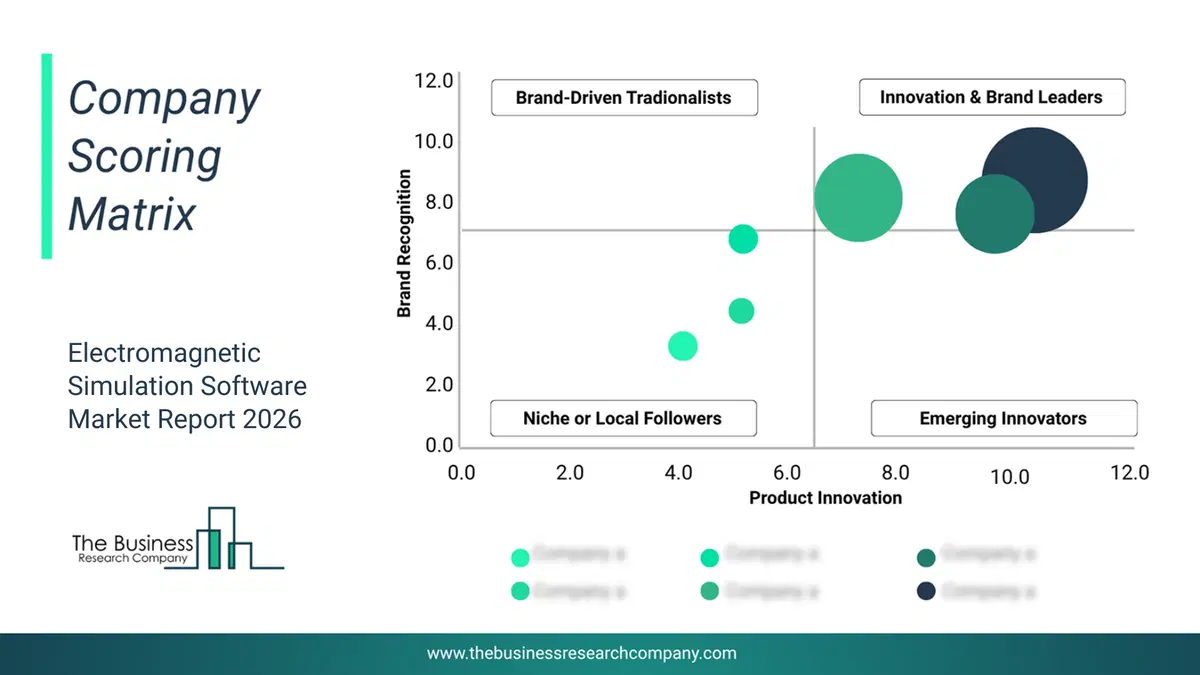
This chart maps companies by product innovation and brand strength, with bubble size indicating relative revenue, helping identify market leaders, challengers, and niche players. This is an illustrative chart; the full report provides a complete and accurate competitive analysis.
Global Electromagnetic Simulation Software Market Trends and Insights
Major companies operating in the electromagnetic simulation software market are focusing on developing innovative approaches, such as circuit–EM co-design tools automation, to accelerate mmWave and sub-THz design for 5G and emerging 6G technologies. Circuit–EM co-design tools automation refers to the seamless integration and automated interaction between circuit simulation and electromagnetic simulation tools to optimize the design and performance of high-frequency electronic components efficiently. For instance, in June 2023, Keysight Technologies, Inc., a US-based electronics company, launched PathWave Advanced Design System (ADS) 2024 to advance 5G and 6G wireless component design. This new version offers significantly faster 3D electromagnetic solvers, enhanced electrothermal validation, advanced layout and verification features, and expanded automation capabilities, enabling designers to tackle complex challenges such as mmWave signal loss, multi-process module integration, and power amplifier optimization with greater speed, accuracy, and efficiency.What Are Latest Mergers And Acquisitions In The Electromagnetic Simulation Software Market?
In July 2025, Synopsys Inc., a US-based provider of electronic design automation (EDA) software and semiconductor IP solutions, acquired Ansys Inc. for an undisclosed amount. Through this acquisition, Synopsys aims to integrate Ansys’s industry-leading multiphysics simulation and electromagnetic field-solver capabilities into its existing EDA portfolio, thereby enabling a unified silicon-to-systems design workflow that enhances customers’ ability to model, analyze, and validate complex electromechanical and electronic systems across multiple industries. Ansys Inc. is a US-based engineering simulation software company that offers comprehensive tools for electromagnetic, thermal, structural, and fluid modeling, used to optimize product performance in sectors such as automotive, aerospace, industrial electronics, and beyond.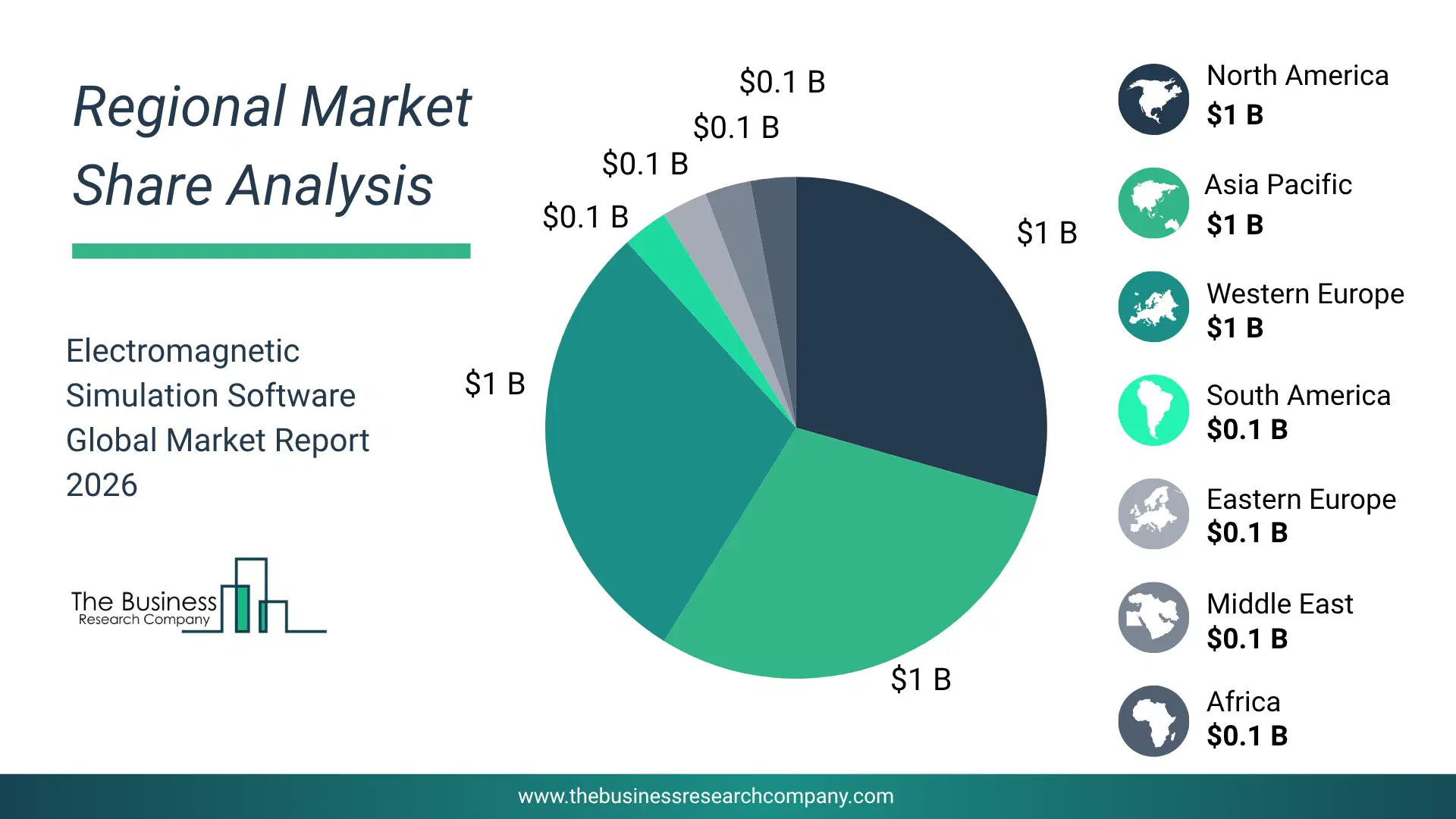
Regional Insights
North America was the largest region in the electromagnetic simulation software market in 2025. Asia-Pacific is expected to be the fastest-growing region in the forecast period. The regions covered in this market report are Asia-Pacific, South East Asia, Western Europe, Eastern Europe, North America, South America, Middle East, Africa. The countries covered in this market report are Australia, Brazil, China, France, Germany, India, Indonesia, Japan, Taiwan, Russia, South Korea, UK, USA, Canada, Italy, Spain.What Defines the Electromagnetic Simulation Software Market?
The electromagnetic simulation software market consists of revenues earned by entities by providing services such as electromagnetic field modeling, signal propagation analysis, interference detection, virtual prototyping, and design verification. The market value includes the value of related goods sold by the service provider or included within the service offering. Only goods and services traded between entities or sold to end consumers are included.How is Market Value Defined and Measured?
The market value is defined as the revenues that enterprises gain from the sale of goods and/or services within the specified market and geography through sales, grants, or donations in terms of the currency (in USD unless otherwise specified). The revenues for a specified geography are consumption values that are revenues generated by organizations in the specified geography within the market, irrespective of where they are produced. It does not include revenues from resales along the supply chain, either further along the supply chain or as part of other products.
This chart presents market attractiveness based on a quantitative evaluation of growth, competition, strategic alignment, and risk, offering a clear view of opportunity areas for decision-making. This chart is for illustrative purposes; the full report contains the complete analysis.

This chart highlights the Total Addressable Market (TAM) by estimating the maximum revenue opportunity using an assumption-driven approach, supporting strategic planning and opportunity sizing across markets. The chart is illustrative; the full report provides a more comprehensive analysis.
What Key Data and Analysis Are Included in the Electromagnetic Simulation Software Market Report 2026?
The electromagnetic simulation software market research report is one of a series of new reports from The Business Research Company that provides market statistics, including industry global market size, regional shares, competitors with the market share, detailed market segments, market trends and opportunities, and any further data you may need to thrive in the electromagnetic simulation software industry. The market research report delivers a complete perspective of everything you need, with an in-depth analysis of the current and future state of the industry.Electromagnetic Simulation Software Market Report Forecast Analysis
| Report Attribute | Details |
|---|---|
| Market Size Value In 2026 | $3.4 billion |
| Revenue Forecast In 2030 | $6.61 billion |
| Growth Rate | CAGR of 18.5% from 2026 to 2030 |
| Base Year For Estimation | 2025 |
| Actual Estimates/Historical Data | 2020-2025 |
| Forecast Period | 2026 - 2030 - 2035 |
| Market Representation | Revenue in USD Billion and CAGR from 2026 to 2030 |
| Segments Covered | Component, Deployment Mode, Application, End-User |
| Regional Scope | Asia-Pacific, Western Europe, Eastern Europe, North America, South America, Middle East, Africa |
| Country Scope | The countries covered in the report are Australia, Brazil, China, France, Germany, India, Indonesia, Japan, Taiwan, Russia, South Korea, UK, USA, Canada, Italy, Spain. |
| Key Companies Profiled | Siemens AG, Dassault Systèmes SE, Keysight Technologies Inc., Synopsys Inc., Cadence Design Systems Inc., Zuken Inc., COMSOL Inc., SimScale GmbH, IMST GmbH, Nullspace Inc., EMWorks Inc., Remcom Inc., Modelithics Inc., Lorentz Solution Inc., Sonnet Software Inc., Tera Analysis Ltd., Crosslight Software Inc., JCMwave GmbH, Applied Simulation Tech Inc., Vector Fields Inc. |
| Customization Scope | Request for Customization |
| Pricing And Purchase Options | Explore Purchase Options |