
Electromagnetic Simulation Software Global Market Opportunities And Strategies To 2035
By Component (Software, Services), By Deployment Mode (On-Premises, Cloud-Based, Hybrid Deployment), By Application (Antenna Design, Electromagnetic Compatibility, Microwave and Radio Frequency Component Design, Radar and Satellite, Automotive Electronics, Medical Devices, Other Applications), By End-User (Automotive, Aerospace and Defense, Electronics and Electrical, Healthcare, Telecommunications, Other End-Users), And By Region, Opportunities And Strategies – Global Forecast To 2035
Electromagnetic Simulation Software Market Definition
Electromagnetic simulation software is a specialized computational tool used to model, analyze, and predict the behavior of electromagnetic fields and waves in virtual environments. It applies numerical methods to simulate how electric and magnetic fields interact with materials, components, and systems across different frequencies. The primary purpose of electromagnetic simulation software is to design, optimize, and validate electromagnetic systems before physical prototyping. The electromagnetic simulation software market consists of sales, by entities (organizations, sole traders, or partnerships) of electromagnetic simulation software used to model, analyze, and predict electromagnetic field behavior across electrical, electronic, and electromagnetic systems. These solutions are used to evaluate electromagnetic performance in applications such as antenna systems, electronic circuits, wireless communication devices, radar systems and medical equipment. The software applies numerical methods such as finite element analysis, method of moments and finite-difference time-domain techniques to accurately model real-world electromagnetic behavior.
Electromagnetic Simulation Software Market Size
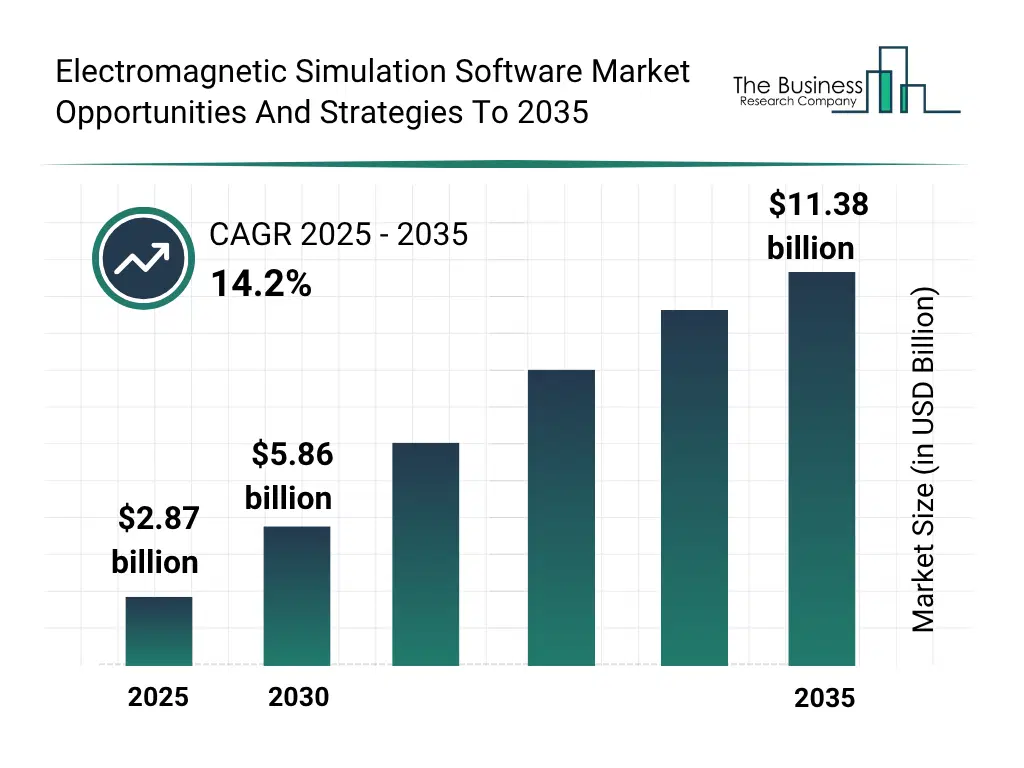
The global electromagnetic simulation software market reached a value of nearly $2,870.0 million in 2025, having grown at a compound annual growth rate (CAGR) of 16.5% since 2020. The market is expected to grow from $2,870.0 million in 2025 to $5,858.1 million in 2030 at a rate of 15.3%. The market is then expected to grow at a CAGR of 14.2% from 2030 and reach $11,376.4 million in 2035. Growth in the historic period resulted from surge in consumer electronics production, growing semiconductor complexity, rapid deployment of 5G/6G wireless networks and rising production of electric and hybrid vehicles. Factors that negatively affected growth in the historic period were shortage of skilled engineers and expensive computational infrastructure requirements. Going forward, the surge in deployment of IoT devices, aerospace and defense modernization, rising adoption of cloud-based and SaaS simulation platforms, growing integration of AI and machine learning will drive the growth. Factor that could hinder the growth of the electromagnetic simulation software market in the future include high cost of engineering software licenses, integration difficulties with legacy systems and impact of trade war and tariffs.Electromagnetic Simulation Software Market Segmentation
The electromagnetic simulation software market is segmented by component, by deployment mode, by application and by end-user.By Component –
The electromagnetic simulation software market is segmented by component into:
- a) Software
- b) Services
By Deployment Mode–
The electromagnetic simulation software market is segmented by deployment mode into:
- a) On-Premises
- b) Cloud-Based
- c) Hybrid Deployment
By Application –
The electromagnetic simulation software market is segmented by application into:
- a) Antenna Design
- b) Electromagnetic Compatibility
- c) Microwave And Radio Frequency Component Design
- d) Radar And Satellite
- e) Automotive Electronics
- f) Medical Devices
- g) Other Applications
By End-User –
The electromagnetic simulation software market is segmented by end-user into:
- a) Automotive
- b) Aerospace And Defense
- c) Electronics And Electrical
- d) Healthcare
- e) Telecommunications
- f) Other End Users
By Geography - The electromagnetic simulation software market is segmented by geography into:
- China
- India
- Japan
- Australia
- Indonesia
- South Korea
- USA
- Canada
- Brazil
- France
- Germany
- UK
- Italy
- Spain
- Russia
-
o Asia Pacific
o Africa