
Electronic Batch Record (EBR) Market Report 2026
Global Outlook – By Component (Software, Services), By Deployment Type (Cloud Based, On Premise), By Functionality (Batch Tracking And Monitoring, Quality Management, Compliance And Regulatory Reporting, Data Management And Analytics, Production Scheduling), By End User (Pharmaceutical Companies, Biotech Firms, Contract Manufacturing Organizations, Food And Beverage Manufacturers, Cosmetics Manufacturers) – Market Size, Trends, Strategies, and Forecast to 2030
Electronic Batch Record (EBR) Market Overview
• Electronic Batch Record (EBR) market size has reached to $17.55 billion in 2025 • Expected to grow to $31.7 billion in 2030 at a compound annual growth rate (CAGR) of 12.6% • Growth Driver: Growing Adoption Of Industry 4.0 Is Fueling Market Growth Due To Real-Time Data Integration, Automation, And Enhanced Regulatory Compliance In Manufacturing Systems • Market Trend: Technological Advancements In AI-Powered Solutions For Smart Pharmaceutical Manufacturing • North America was the largest region in 2025 and Asia-Pacific is the fastest growing region.What Is Covered Under Electronic Batch Record (EBR) Market?
Electronic batch record (EBR) systems are digital platforms used to capture, manage, and document manufacturing batch production records in an electronic format. They replace traditional paper-based batch records by enabling real-time data capture, automated workflow enforcement, and compliance with regulatory standards. EBR systems improve traceability, data integrity, and operational efficiency by ensuring that all production steps, quality checks, and process parameters are accurately recorded and validated throughout the manufacturing lifecycle. The main components of electronic batch record (EBR) include software and services. Software refers to digital systems that automate the creation, management, tracking, and documentation of batch production records, helping organizations improve efficiency, accuracy, and regulatory compliance. These solutions are deployed through cloud based and on premise models. They provide functionalities including batch tracking and monitoring, quality management, compliance and regulatory reporting, data management and analytics, and production scheduling and utilized by end users including pharmaceutical companies, biotech firms, contract manufacturing organizations, food and beverage manufacturers, and cosmetics manufacturers.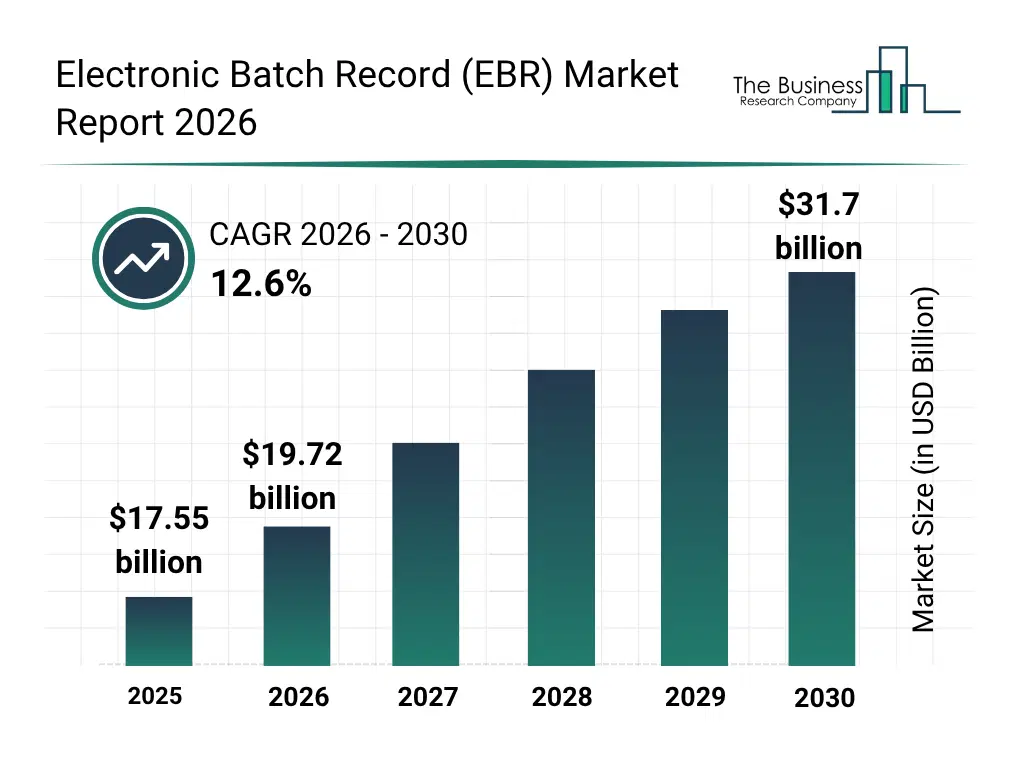
What Is The Electronic Batch Record (EBR) Market Size and Share 2026?
The electronic batch record (EBR) market size has grown rapidly in recent years. It will grow from $17.55 billion in 2025 to $19.72 billion in 2026 at a compound annual growth rate (CAGR) of 12.4%. The growth in the historic period can be attributed to growing regulatory requirements for electronic documentation and traceability, increasing transition from paper-based batch records to digital systems, rising demand for improved manufacturing process efficiency, expanding adoption of quality management systems across regulated industries, increasing need for accurate production data capture and audit readiness.What Is The Electronic Batch Record (EBR) Market Growth Forecast?
The electronic batch record (EBR) market size is expected to see rapid growth in the next few years. It will grow to $31.7 billion in 2030 at a compound annual growth rate (CAGR) of 12.6%. The growth in the forecast period can be attributed to growing adoption of cloud-based EBR platforms across manufacturing facilities, increasing investment in advanced analytics for production optimization, rising demand for integrated compliance and validation solutions, expanding use of automated production scheduling and workflow management tools, increasing focus on scalable digital manufacturing infrastructure. Major trends in the forecast period include increasing adoption of electronic batch record systems for paperless manufacturing operations, growing demand for real-time batch tracking and process visibility across production environments, rising focus on regulatory compliance and data integrity management in manufacturing workflows, expanding integration of electronic batch records with quality management and manufacturing execution systems, increasing implementation of automated workflow validation and exception management capabilities.
Global Electronic Batch Record (EBR) Market Segmentation
1) By Component: Software; Services 2) By Deployment Type: Cloud Based; On Premise 3) By Functionality: Batch Tracking And Monitoring; Quality Management; Compliance And Regulatory Reporting; Data Management And Analytics; Production Scheduling 4) By End User: Pharmaceutical Companies; Biotech Firms; Contract Manufacturing Organizations; Food And Beverage Manufacturers; Cosmetics Manufacturers Subsegments: 1) By Software: Batch Record Management Software; Manufacturing Execution Software; Quality Management Software; Compliance Tracking Software; Cloud Based Record Management Software 2) By Services: Implementation And Integration Services; Validation And Compliance Services; Consulting Services; Training And Support Services; Maintenance And Upgrade ServicesWhat Are The Drivers Of The Electronic Batch Record (EBR) Market?
The growing adoption of industry 4.0 technologies is expected to propel the growth of electronic batch record (EBR) market going forward. Industry 4.0 refers to the integration of advanced digital technologies such as the internet of things, artificial intelligence, cloud computing, and automation into manufacturing processes to create smart, connected, and data-driven production environments. The adoption of Industry 4.0 is increasing due to the rising demand for real-time decision-making and improved production transparency across highly regulated industries such as pharmaceuticals and biotechnology. Industry 4.0 enhances electronic batch record systems by enabling real-time data capture, automated documentation, predictive analytics, and seamless integration of production equipment and software systems, thereby improving compliance, reducing human error, and increasing manufacturing efficiency. For instance, in March 2024, according to Rockwell Automation Inc., a US-based automation company, manufacturers consider AI the leading capability for achieving significant business impact, with 83% anticipating the adoption of generative AI (GenAI) in their operations. Furthermore, 95% of manufacturers are either using or evaluating smart manufacturing technologies, up from 84% in 2023. Therefore, the growing adoption of industry 4.0 technologies is driving the growth of the electronic batch record (EBR) industry. The rising pharmaceutical production is expected to propel the growth of the electronic batch record (EBR) market going forward. Pharmaceutical production refers to the large-scale manufacturing of medicines and drug products under regulated conditions to ensure safety, quality, and efficacy. Pharmaceutical production is increasing due to the growing prevalence of chronic and age-related diseases, which is driving higher global demand for medicines and long-term treatments. Electronic batch record (EBR) enables pharmaceutical production by digitally capturing, managing, and validating manufacturing data in real time, improving regulatory compliance, reducing human errors, enhancing process traceability, and ensuring consistent product quality in large-scale drug manufacturing. For instance, in June 2023, according to the European Federation of Pharmaceutical Industries and Associations, a Belgium-based trade association, in 2023, North America accounted for 52.3% of global pharmaceutical sales, whereas Europe contributed 22.4%. Therefore, the rising pharmaceutical production is driving the growth of the electronic batch record (EBR) industry.Key Players In The Global Electronic Batch Record (EBR) Market
Major companies operating in the electronic batch record (ebr) market are Microsoft Corporation; Dassault Systèmes SE; Siemens AG; Emerson Electric Co.; Oracle Corporation; Schneider Electric SE; Honeywell International Inc.; SAP SE; ABB Ltd.; Rockwell Automation Inc.; Körber AG; MasterControl Inc.; Tulip Interfaces Inc.; Aizon Inc.; Antares Vision Group; Vimachem; Nexgensis; LZ LifescienceGlobal Electronic Batch Record (EBR) Market Trends and Insights
Major companies operating in the electronic batch record (EBR) market are focusing on developing innovative solutions, such as lightweight eBR execution platforms to enhance production efficiency, reduce deviations, and accelerate batch release cycles in pharmaceutical manufacturing. Lightweight eBR execution platforms are simplified electronic batch record systems that digitally capture, manage, and execute manufacturing batch data with minimal configuration and faster deployment, helping manufacturers transition from paper-based records to digital workflows more quickly. For instance, in September 2024, Aizon Inc., a US-based artificial intelligence SaaS company, in collaboration with EUROAPI S.A., a France-based pharmaceutical active ingredient manufacturer, launched Aizon Execute, an AI-powered lightweight electronic batch record solution designed to modernize pharmaceutical manufacturing operations. The platform enables rapid conversion of paper-based manufacturing recipes into digital workflows, supporting multi-language batch documentation and improving operational flexibility across chemical API production environments. It integrates AI-driven process optimization capabilities to reduce manufacturing deviations, enhance recipe execution accuracy, and speed up batch release timelines. The solution is designed for small-scale and highly flexible production facilities, enabling faster digital transformation with reduced implementation complexity compared to traditional full-scale EBR systems.Regional Outlook
North America was the largest region in the electronic batch record (EBR) market in 2025. Asia-Pacific is expected to be the fastest-growing region in the forecast period. The regions covered in this market report are Asia-Pacific, South East Asia, Western Europe, Eastern Europe, North America, South America, Middle East, Africa. The countries covered in this market report are Australia, Brazil, China, France, Germany, India, Indonesia, Japan, Taiwan, Russia, South Korea, UK, USA, Canada, Italy, Spain.What Defines the Electronic Batch Record (EBR) Market?
The electronic batch record (EBR) market includes revenues earned by entities by providing services such as software licensing and subscription, cloud-based deployment, system integration with manufacturing execution systems (MES) and enterprise resource planning (ERP) platforms, customization and configuration, validation and compliance support, maintenance and upgrades, consulting, training, and technical support. The market value includes the value of related goods sold by the service provider or included within the service offering. Only goods and services traded between entities or sold to end consumers are included.How is Market Value Defined and Measured?
The market value is defined as the revenues that enterprises gain from the sale of goods and/or services within the specified market and geography through sales, grants, or donations in terms of the currency (in USD unless otherwise specified). The revenues for a specified geography are consumption values that are revenues generated by organizations in the specified geography within the market, irrespective of where they are produced. It does not include revenues from resales along the supply chain, either further along the supply chain or as part of other products.What Key Data and Analysis Are Included in the Electronic Batch Record (EBR) Market Report 2026?
The electronic batch record (ebr) market research report is one of a series of new reports from The Business Research Company that provides market statistics, including industry global market size, regional shares, competitors with the market share, detailed market segments, market trends and opportunities, and any further data you may need to thrive in the electronic batch record (ebr) industry. The market research report delivers a complete perspective of everything you need, with an in-depth analysis of the current and future state of the industry.Electronic Batch Record (EBR) Market Report Forecast Analysis
| Report Attribute | Details |
|---|---|
| Market Size Value In 2026 | $19.72 billion |
| Revenue Forecast In 2030 | $31.7 billion |
| Growth Rate | CAGR of 12.6% from 2026 to 2030 |
| Base Year For Estimation | 2025 |
| Actual Estimates/Historical Data | 2020-2025 |
| Forecast Period | 2026 - 2030 |
| Market Representation | Revenue in USD Billion and CAGR from 2026 to 2030 |
| Segments Covered | Component, Deployment Type, Functionality, End User |
| Regional Scope | Asia-Pacific, Western Europe, Eastern Europe, North America, South America, Middle East, Africa |
| Country Scope | The countries covered in the report are Australia, Brazil, China, France, Germany, India, ... |
| Key Companies Profiled | Microsoft Corporation; Dassault Systèmes SE; Siemens AG; Emerson Electric Co.; Oracle Corporation; Schneider Electric SE; Honeywell International Inc.; SAP SE; ABB Ltd.; Rockwell Automation Inc.; Körber AG; MasterControl Inc.; Tulip Interfaces Inc.; Aizon Inc.; Antares Vision Group; Vimachem; Nexgensis; LZ Lifescience |
| Customization Scope | Request for Customization |
| Pricing And Purchase Options | Explore Purchase Options |