
Electronic Measuring Instruments Market Report 2026
Global Outlook – By Type ( Digital Instruments, Analog Instruments, Smart Instruments), By Technology ( Digital Technology, Analog Technology, Hybrid Technology), By Application ( Circuit Testing And Troubleshooting, Frequency And Phase Measurement, High-Voltage Testing, Power Quality Testing, Signal Analysis, Voltage And Current Measurement), By Sales Channel ( Online, Offline), By End-User Industry ( Aerospace And Defense, Automotive And Transportation, Consumer Electronics, Education And Research, Energy And Power, Healthcare, Industrial Manufacturing, Telecommunications) – Market Size, Trends, Strategies, and Forecast to 2035
Electronic Measuring Instruments Market Overview
• Electronic Measuring Instruments market size has reached to $12.03 billion in 2025 • Expected to grow to $16.72 billion in 2030 at a compound annual growth rate (CAGR) of 6.9% • Growth Driver: The Growth Of 5G And Next-Generation Communication Systems Is Driving The Market Due To Faster Connectivity • Market Trend: Advancements In Particle Measurement Instruments For High-Precision Research And Quality Control • North America was the largest region in 2025 and Asia-Pacific is the fastest growing region.What Is Covered Under Electronic Measuring Instruments Market?
Electronic measuring instruments are devices that use electrical signals to measure physical quantities such as voltage, current, resistance, frequency, or temperature with precision. They convert these physical quantities into readable electrical signals or digital displays for analysis, monitoring, and control. These instruments help engineers and technicians ensure systems operate efficiently, safely, and within specified standards. The main types of electronic measuring instruments are digital instruments, analog instruments, and smart instruments. Digital instruments refer to devices that measure electrical or physical quantities and display the results in discrete numerical form using digital signals for high accuracy and ease of reading. They incorporate various technologies such as digital technology, analog technology, and hybrid technology and are used for various applications such as circuit testing and troubleshooting, frequency and phase measurement, high-voltage testing, power quality testing, signal analysis, and voltage and current measurement. These instruments are available through both online and offline sales channels and serve a wide range of end users, including aerospace and defense, automotive and transportation, consumer electronics, education and research, energy and power, healthcare, industrial manufacturing, and telecommunications.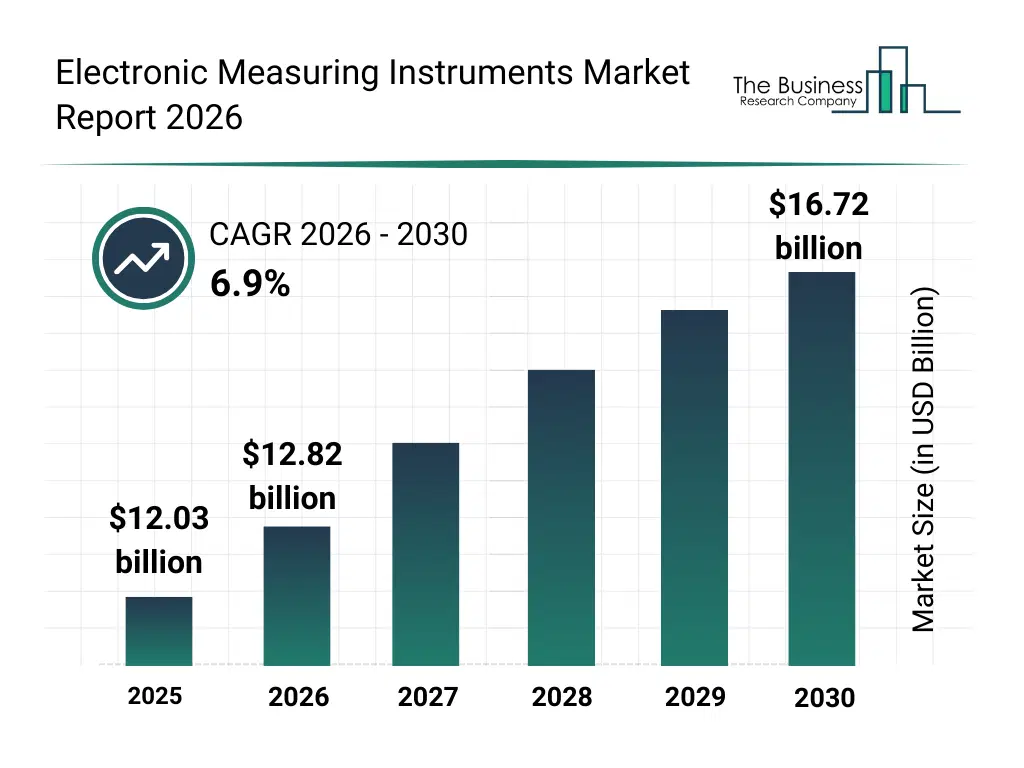
What Is The Electronic Measuring Instruments Market Size 2026 And Growth Rate?
The electronic measuring instruments market size has grown strongly in recent years. It will grow from $12.03 billion in 2025 to $12.82 billion in 2026 at a compound annual growth rate (CAGR) of 6.5%. The growth in the historic period can be attributed to increasing adoption of electronics in industrial applications, rising need for precise measurements in research and development, growth of consumer electronics industry, advancements in analog measurement technologies, demand for power quality testing.What Is The Electronic Measuring Instruments Market Growth Forecast?
The electronic measuring instruments market size is expected to see strong growth in the next few years. It will grow to $16.72 billion in 2030 at a compound annual growth rate (CAGR) of 6.9%. The growth in the forecast period can be attributed to integration of AI and machine learning in measuring instruments, growth in smart manufacturing and industry 4.0 applications, rising demand for iot-enabled measurement devices, expansion of renewable energy monitoring, increasing use in electric vehicles and transportation electrification. Major trends in the forecast period include high-precision measurement instruments, portable & compact devices, wireless & iot-enabled measuring instruments, ai-powered instrumentation, energy-efficient measuring solutions.
Global Electronic Measuring Instruments Market Segmentation
1) By Type: Digital Instruments, Analog Instruments, Smart Instruments 2) By Technology: Digital Technology, Analog Technology, Hybrid Technology 3) By Application: Circuit Testing And Troubleshooting, Frequency And Phase Measurement, High-Voltage Testing, Power Quality Testing, Signal Analysis, Voltage And Current Measurement 4) By Sales Channel: Online, Offline 5) By End-User Industry: Aerospace And Defense, Automotive And Transportation, Consumer Electronics, Education And Research, Energy And Power, Healthcare, Industrial Manufacturing, Telecommunications Subsegments: 1) By Digital Instruments: Digital Multimeters, Digital Oscilloscopes, Logic Analyzers, Spectrum Analyzers 2) By Analog Instruments: Analog Multimeters, Analog Oscilloscopes, Signal Generators, Analog Ammeters 3) By Smart Instruments: Wireless Measuring Devices, IoT-Enabled Instruments, AI-Powered Instruments, Portable Smart SensorsWhat Is The Driver Of The Electronic Measuring Instruments Market?
The rise of 5G and next-generation communication systems is expected to drive the growth of the electronic measuring instruments market going forward. 5G and next-generation communication systems refer to the latest advancements in wireless communication technologies designed to deliver significantly faster data speeds, lower latency, greater connectivity, and improved reliability compared to previous generations. The growth of 5G and next-generation communication systems is driven by higher data speeds, as they enable faster, more reliable connectivity for advanced applications and seamless communication. Electronic measuring instruments help the growth of 5G and next-generation communication systems by providing precise testing, calibration, and monitoring of network components, ensuring optimal performance, reliability, and efficiency in high-speed communication infrastructure. For instance, in September 2025, according to 5G Americas, a US-based trade organization that provides telecommunication services, reported that global 5G connections surpassed 2.6 billion in Q2 2025, marking a 37% year-over-year increase, and are projected to soar to nearly 9 billion by 2030, accounting for 60% of all wireless connections worldwide, demonstrating a significantly faster adoption rate compared to earlier wireless technologies. Therefore, the growth of 5G and next-generation communication systems is driving the electronic measuring instruments industry.Key Players In The Global Electronic Measuring Instruments Market
Major companies operating in the electronic measuring instruments market are Keysight Technologies, Fortive Corporation, Rohde & Schwarz, Fluke Corporation, National Instruments, Yokogawa Electric Corporation, Anritsu Corporation, Danaher Corporation, Hioki E.E. Corporation, Advantest Corporation, Teledyne Technologies, Good Will Instrument Co., B&K Precision, Rigol Technologies, Siglent Technologies, Agilent Technologies, FLIR Systems, Kikusui Electronics, Megger Group, Chauvin Arnoux, Ametek, Inc., Omicron Electronics GmbHGlobal Electronic Measuring Instruments Market Trends and Insights
Major companies operating in the electronic measuring instruments market are focusing on developing particle measurement instruments, to enable precise detection and efficiency in quality control and research applications. Particle measurement instruments detect, count, and analyze microscopic particles in gases, liquids, or solids, providing precise data on size, concentration, and distribution and enhancing quality control, ensuring compliance, and supporting accurate research and industrial processes. For instance, in June 2024, Advantest Corporation, a Japan-based semiconductor test equipment supplier, launched WEL2100, a new product in its nanoSCOUTER particle measuring equipment family. The WEL2100 uses a precise nanopore sensor and microcurrent measurement technology to measure fine particles such as lipid nanoparticles, viruses, and exosomes with high speed and precision. It can individually measure particle quantity, size, and zeta potential, and it features Advantest's proprietary APT-Pore device for enhanced accuracy, especially for particles smaller than 30 nm. The product is particularly suited for pharmaceutical and biotechnology research and development applications.What Are Latest Mergers And Acquisitions In The Electronic Measuring Instruments Market?
In July 2025, AMETEK Inc., a US-based manufacturing company, acquired FARO Technologies Inc. for an undisclosed amount. Through this acquisition, AMETEK aims to enhance its capabilities in precision measurement and expand its reach into high-growth market segments, including advanced manufacturing and digital reality. FARO Technologies Inc. is a US-based manufacturing company that offers electronic measuring instruments.Regional Outlook
North America was the largest region in the electronic measuring instruments market in 2025. Asia-Pacific is expected to be the fastest-growing region in the forecast period. The regions covered in this market report are Asia-Pacific, South East Asia, Western Europe, Eastern Europe, North America, South America, Middle East, Africa. The countries covered in this market report are Australia, Brazil, China, France, Germany, India, Indonesia, Japan, Taiwan, Russia, South Korea, UK, USA, Canada, Italy, Spain.What Defines the Electronic Measuring Instruments Market?
The electronic measuring instruments market consists of sales of digital multimeters, oscilloscopes, signal generators, power analyzers, and spectrum analyzers. Values in this market are ‘factory gate’ values, that is, the value of goods sold by the manufacturers or creators of the goods, whether to other entities (including downstream manufacturers, wholesalers, distributors, and retailers) or directly to end customers. The value of goods in this market includes related services sold by the creators of the goods.How is Market Value Defined and Measured?
The market value is defined as the revenues that enterprises gain from the sale of goods and/or services within the specified market and geography through sales, grants, or donations in terms of the currency (in USD unless otherwise specified). The revenues for a specified geography are consumption values that are revenues generated by organizations in the specified geography within the market, irrespective of where they are produced. It does not include revenues from resales along the supply chain, either further along the supply chain or as part of other products.What Key Data and Analysis Are Included in the Electronic Measuring Instruments Market Report 2026?
The electronic measuring instruments market research report is one of a series of new reports from The Business Research Company that provides market statistics, including industry global market size, regional shares, competitors with the market share, detailed market segments, market trends and opportunities, and any further data you may need to thrive in the electronic measuring instruments industry. The market research report delivers a complete perspective of everything you need, with an in-depth analysis of the current and future state of the industry.Electronic Measuring Instruments Market Report 2026 Market Report Forecast Analysis
| Report Attribute | Details |
|---|---|
| Market Size Value In 2026 | $12.82 billion |
| Revenue Forecast In 2035 | $16.72 billion |
| Growth Rate | CAGR of 6.5% from 2026 to 2035 |
| Base Year For Estimation | 2025 |
| Actual Estimates/Historical Data | 2020-2025 |
| Forecast Period | 2026 - 2030 - 2035 |
| Market Representation | Revenue in USD Billion and CAGR from 2026 to 2035 |
| Segments Covered | Type, Technology, Application, Sales Channel, End-User Industry |
| Regional Scope | Asia-Pacific, Western Europe, Eastern Europe, North America, South America, Middle East, Africa |
| Country Scope | The countries covered in the report are Australia, Brazil, China, France, Germany, India, ... |
| Key Companies Profiled | Keysight Technologies, Fortive Corporation, Rohde & Schwarz, Fluke Corporation, National Instruments, Yokogawa Electric Corporation, Anritsu Corporation, Danaher Corporation, Hioki E.E. Corporation, Advantest Corporation, Teledyne Technologies, Good Will Instrument Co., B&K Precision, Rigol Technologies, Siglent Technologies, Agilent Technologies, FLIR Systems, Kikusui Electronics, Megger Group, Chauvin Arnoux, Ametek, Inc., Omicron Electronics GmbH |
| Customization Scope | Request for Customization |
| Pricing And Purchase Options | Explore Purchase Options |