
Electronics Films Market Report 2026
Global Outlook – By Type (Conductive Films, Insulating Films, Barrier Films, Optical Films), By Deposition Technology (Vacuum Evaporation, Sputtering, Chemical Vapor Deposition, Atomic Layer Deposition, Printing And Coating), By Material Type (Polymer, Ceramic, Metal), By Application (Displays, Printed Circuit Boards, Semiconductors, Batteries, Sensors), By End-Use Industry (Consumer Electronics, Automotive, Aerospace, Healthcare, Other End-Use Industry) – Market Size, Trends, Strategies, and Forecast to 2035
Electronics Films Market Overview
• Electronics Films market size has reached to $12.92 billion in 2025 • Expected to grow to $18.95 billion in 2030 at a compound annual growth rate (CAGR) of 8% • Growth Driver: Surge In Consumer Electronics Adoption Fueling The Growth Of The Market Due To Increasing Demand For Smart And Connected Devices • Market Trend: Innovations In Protective Packaging Films For Electronic Device Safety And Transport • Asia-Pacific was the largest region and fastest growing region.What Is Covered Under Electronics Films Market?
Electronics films refer to thin, high-performance polymer or composite materials engineered for use in electronic systems to support functional performance such as electrical insulation, thermal management, surface protection, and structural stability. These films are designed to enhance reliability, efficiency, and miniaturization of electronic devices by enabling precise integration within compact and high-performance electronic architectures. The main types of electronics films include conductive films, insulating films, barrier films, and optical films. Conductive films refer to thin material layers designed to enable electrical conductivity in electronic devices while maintaining flexibility and performance. These films are produced using deposition technologies such as vacuum evaporation, sputtering, chemical vapor deposition, atomic layer deposition, and printing and coating processes. They are based on material types including polymer, ceramic, and metal. The various applications involved are displays, printed circuit boards, semiconductors, batteries, and sensors, and they are used by several end use industries such as consumer electronics, automotive, aerospace, healthcare, and others.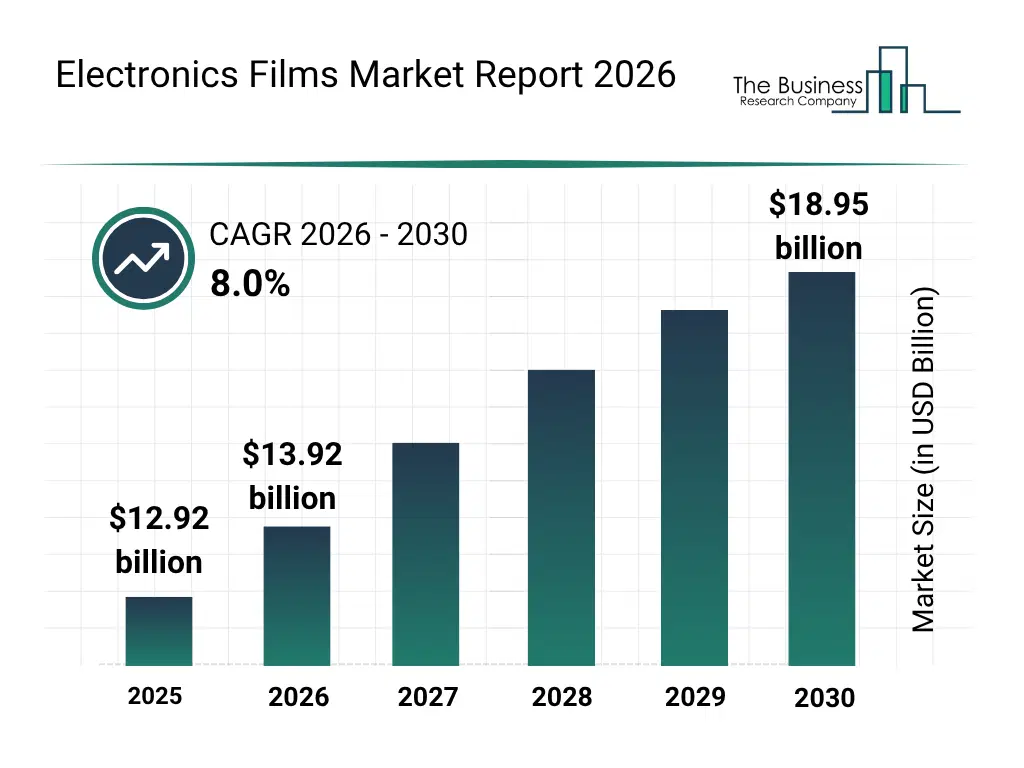
What Is The Electronics Films Market Size and Share 2026?
The electronics films market size has grown strongly in recent years. It will grow from $12.92 billion in 2025 to $13.92 billion in 2026 at a compound annual growth rate (CAGR) of 7.8%. The growth in the historic period can be attributed to increasing demand for consumer electronics miniaturization, rising adoption of display technologies in smartphones and televisions, expansion of semiconductor manufacturing capacity, growth in automotive electronics integration, increasing use of protective coatings in industrial electronics.What Is The Electronics Films Market Growth Forecast?
The electronics films market size is expected to see strong growth in the next few years. It will grow to $18.95 billion in 2030 at a compound annual growth rate (CAGR) of 8.0%. The growth in the forecast period can be attributed to rising adoption of flexible and foldable electronics devices, increasing demand for energy efficient thermal management solutions, growth in electric vehicle battery film applications, expansion of advanced semiconductor packaging technologies, increasing investment in smart wearable and IoT enabled devices. Major trends in the forecast period include rising adoption of ultra thin flexible electronics films in wearable and compact devices, increasing demand for high performance thermal management films in advanced electronics, growing use of optical films in high resolution display technologies, expansion of barrier films for moisture and oxygen protection in semiconductor packaging, increasing integration of conductive films in flexible printed electronics and sensors.
Global Electronics Films Market Segmentation
1) By Type: Conductive Films, Insulating Films, Barrier Films, Optical Films 2) By Deposition Technology: Vacuum Evaporation, Sputtering, Chemical Vapor Deposition, Atomic Layer Deposition, Printing And Coating 3) By Material Type: Polymer, Ceramic, Metal 4) By Application: Displays, Printed Circuit Boards, Semiconductors, Batteries, Sensors 5) By End-Use Industry: Consumer Electronics, Automotive, Aerospace, Healthcare, Other End-Use Industry Subsegments: 1) By Conductive Films: Transparent Conductive Films, Metal Mesh Conductive Films, Carbon Based Conductive Films, Conductive Polymer Films, Indium Tin Oxide Coated Films 2) By Insulating Films: Polyethylene Terephthalate Films, Polyimide Films, Polypropylene Films, Polycarbonate Films, Fluoropolymer Films 3) By Barrier Films: Moisture Barrier Films, Oxygen Barrier Films, Ultraviolet Barrier Films, Gas Barrier Films, Aroma Barrier Films 4) By Optical Films: Anti Reflective Films, Polarizing Films, Diffusion Films, Brightness Enhancement Films, Light Management FilmsWhat Is The Driver Of The Electronics Films Market?
The increasing demand for consumer electronics devices is expected to propel the growth of the electronics films market going forward. Consumer electronics devices refer to electronic equipment such as smart TVs, smartphones, and smart speakers used for personal and household purposes. Demand for consumer electronics is rising due to increasing consumer preference for smart, connected, and multifunctional devices, as well as ongoing technological advancements and shorter product replacement cycles, which enhance convenience and integration with modern digital lifestyles. Electronics films support consumer electronics devices by providing essential functions such as display protection, electrical insulation, thermal management, and performance enhancement, improving durability, efficiency, and overall device reliability. For instance, in May 2023, according to the Japan Electronics and Information Technology Industries Association, a Japan-based trade association, Japan's electronic equipment production amounted to approximately 771,457 million yen ($5,600 million). The output of consumer electronics reached 32,099 million yen ($233 million), increasing from 25,268 million yen ($183 million), recorded in May 2022. Therefore, the increasing demand for consumer electronics devices is driving the growth of the electronics films industry.Key Players In The Global Electronics Films Market
Major companies operating in the electronics films market are LG Chem Ltd., Mitsubishi Chemical Corporation, 3M Company, FUJIFILM Holdings Corporation, Asahi Kasei Corporation, Sumitomo Chemical Company Limited, Toray Industries Inc., DuPont de Nemours Inc., Toppan Inc., Arkema S.A., Eastman Chemical Company, Teijin Limited, Nitto Denko Corporation, Kuraray Co. Ltd., Kolon Industries Inc., Ube Corporation, TOYOBO Co. Ltd., Zeon Corporation, SKC Co. Ltd., BenQ Materials Corporation, Hyosung Chemical Corporation, CHI MEI CorporationGlobal Electronics Films Market Trends and Insights
Major companies operating in the electronics films market are focusing on developing innovative solutions such as, permanent electrostatic discharge (ESD) stretch films to enhance static protection, prevent corrosion, and ensure safe packaging and transport of sensitive electronic components. Electronics films are specialized plastic packaging materials engineered to protect electronic devices and assemblies from electrostatic discharge, moisture, dust, and mechanical damage during storage and shipment, offering improved reliability compared to conventional polyethylene films that provide only temporary or limited static protection. For instance, in December 2025, Cortec Corporation, a U.S.-based chemical and packaging solutions company, introduced EcoSonic VpCI-125 HP Permanent ESD Stretch Film designed specifically for electronics packaging applications. The film provides permanent static-dissipative properties that remain effective throughout its service life and meets MIL-STD 3010 requirements for static decay performance before and after stretching. It also integrates vapor phase corrosion inhibitors (VpCI) that form a protective molecular layer on metal surfaces, preventing corrosion inside sealed packages. The solution is designed for use on standard stretch-wrapping equipment and enables visual inspection of packaged goods without removal, making it suitable for electronics, industrial components, and other static-sensitive products requiring high-performance protection.What Are Latest Mergers And Acquisitions In The Electronics Films Market?
In October 2025, Carl Zeiss AG, a Germany-based optics and optoelectronics technology company, partnered with LG Chem Ltd. to form a strategic alliance for photopolymer film development and supply. With this partnership, both companies aim to strengthen the global supply chain for advanced optical materials and co-develop photopolymer solutions for next-generation holographic and automotive windshield display technologies, enabling scalable, high-performance optical innovations for future mobility and display applications. LG Chem, Ltd. is a South Korea-based advanced materials and chemical manufacturing company that provides electronics films.Regional Outlook/Insights
Asia-Pacific was the largest region in the electronics films market in 2025 and is expected to be the fastest-growing region in the forecast period. The regions covered in this market report are Asia-Pacific, South East Asia, Western Europe, Eastern Europe, North America, South America, Middle East, Africa. The countries covered in this market report are Australia, Brazil, China, France, Germany, India, Indonesia, Japan, Taiwan, Russia, South Korea, UK, USA, Canada, Italy, Spain.What Defines the Electronics Films Market?
The electronics films market consists of sales of adhesive films, protective films, dielectric films, flexible circuit films, semiconductor process films, display support films, shielding films, release films, surface protection films, and other specialty electronic-grade films. Values in this market are ‘factory gate’ values, that is, the value of goods sold by the manufacturers or creators of the goods, whether to other entities (including downstream manufacturers, wholesalers, distributors, and retailers) or directly to end customers. The value of goods in this market includes related services sold by the creators of the goods.How is Market Value Defined and Measured?
The market value is defined as the revenues that enterprises gain from the sale of goods and/or services within the specified market and geography through sales, grants, or donations in terms of the currency (in USD unless otherwise specified). The revenues for a specified geography are consumption values that are revenues generated by organizations in the specified geography within the market, irrespective of where they are produced. It does not include revenues from resales along the supply chain, either further along the supply chain or as part of other products.What Key Data and Analysis Are Included in the Electronics Films Market Report 2026?
The electronics films market research report is one of a series of new reports from The Business Research Company that provides market statistics, including industry global market size, regional shares, competitors with the market share, detailed market segments, market trends and opportunities, and any further data you may need to thrive in the electronics films industry. The market research report delivers a complete perspective of everything you need, with an in-depth analysis of the current and future state of the industry.Electronics Films Market Report Forecast Analysis
| Report Attribute | Details |
|---|---|
| Market Size Value In 2026 | $13.92 billion |
| Revenue Forecast In 2035 | $18.95 billion |
| Growth Rate | CAGR of 8.0% from 2026 to 2035 |
| Base Year For Estimation | 2025 |
| Actual Estimates/Historical Data | 2020-2025 |
| Forecast Period | 2026 - 2030 - 2035 |
| Market Representation | Revenue in USD Billion and CAGR from 2026 to 2035 |
| Segments Covered | Type, Deposition Technology, Material Type, Application, End-Use Industry |
| Regional Scope | Asia-Pacific, Western Europe, Eastern Europe, North America, South America, Middle East, Africa |
| Country Scope | The countries covered in the report are Australia, Brazil, China, France, Germany, India, Indonesia, Japan, Taiwan, Russia, South Korea, UK, USA, Canada, Italy, Spain. |
| Key Companies Profiled | LG Chem Ltd., Mitsubishi Chemical Corporation, 3M Company, FUJIFILM Holdings Corporation, Asahi Kasei Corporation, Sumitomo Chemical Company Limited, Toray Industries Inc., DuPont de Nemours Inc., Toppan Inc., Arkema S.A., Eastman Chemical Company, Teijin Limited, Nitto Denko Corporation, Kuraray Co. Ltd., Kolon Industries Inc., Ube Corporation, TOYOBO Co. Ltd., Zeon Corporation, SKC Co. Ltd., BenQ Materials Corporation, Hyosung Chemical Corporation, CHI MEI Corporation |
| Customization Scope | Request for Customization |
| Pricing And Purchase Options | Explore Purchase Options |