

Email Verification Software Market Report 2026
Global Outlook – By Type (Cloud-Based, Web-Based), By Organization Size (Small And Medium-Sized Enterprises, Large Enterprises), By Business Model (Business-To-Business (B2B), Business-To-Customers (B2C)) – Market Size, Trends, Strategies, and Forecast to 2030
Email Verification Software Market Overview
• Email Verification Software market size has reached to $0.71 billion in 2025 • Expected to grow to $1.1 billion in 2030 at a compound annual growth rate (CAGR) of 8.9% • Growth Driver: Rising Adoption Of Cloud-Based Solutions Is Fueling The Email Verification Software Market • Market Trend: Continuous Innovations Transforming The Email Verification Software Market • North America was the largest region in 2025.What Is Covered Under Email Verification Software Market?
Email verification software is a tool or platform designed to verify the validity and deliverability of email addresses. It helps businesses and organizations ensure that the email addresses in their databases are accurate, up-to-date, and safe to send messages. It also helps businesses maintain clean and accurate email lists, improve deliverability rates, and prevent bouncebacks and spam complaints. The main types of email verification software include cloud-based and web-based. Cloud-based refers to a computing model where services such as storage, servers, and applications are delivered over the Internet on demand, rather than being hosted on local servers or personal computers. These software have applications in both small and medium-sized enterprises and large enterprises, and are provided by channels such as business-to-business (B2B), and business-to-customers (B2C).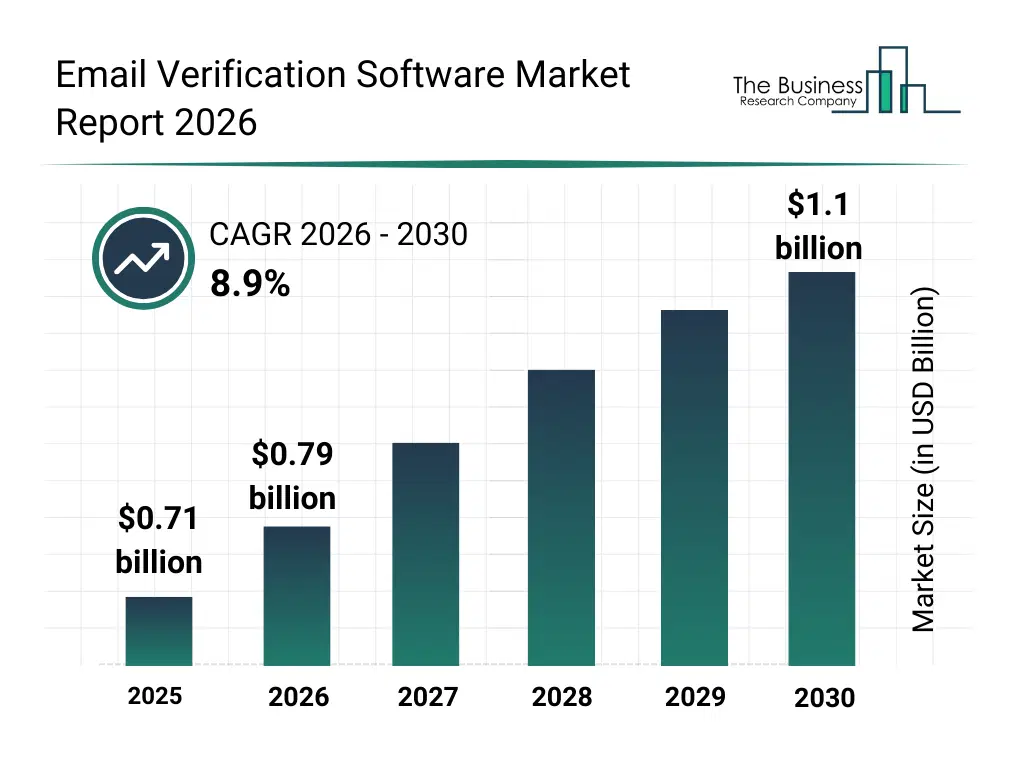
What Is The Email Verification Software Market Size and Share 2026?
The email verification software market size has grown rapidly in recent years. It will grow from $0.71 billion in 2025 to $0.79 billion in 2026 at a compound annual growth rate (CAGR) of 10.4%. The growth in the historic period can be attributed to rising email marketing adoption, increasing importance of sender reputation management, growth of digital customer databases, expanding use of cloud-based marketing tools, rising awareness of data quality management.What Is The Email Verification Software Market Growth Forecast?
The email verification software market size is expected to see strong growth in the next few years. It will grow to $1.1 billion in 2030 at a compound annual growth rate (CAGR) of 8.9%. The growth in the forecast period can be attributed to increasing regulatory focus on communication compliance, growing adoption of api-driven verification services, expansion of real-time validation for transactional emails, rising demand for fraud prevention tools, increasing use by large enterprises. Major trends in the forecast period include increasing adoption of AI-based email validation algorithms, rising demand for real-time email verification apis, growing focus on reducing spam and bounce rates, expansion of automated email list cleaning solutions, enhanced integration with marketing platforms.
Global Email Verification Software Market Segmentation
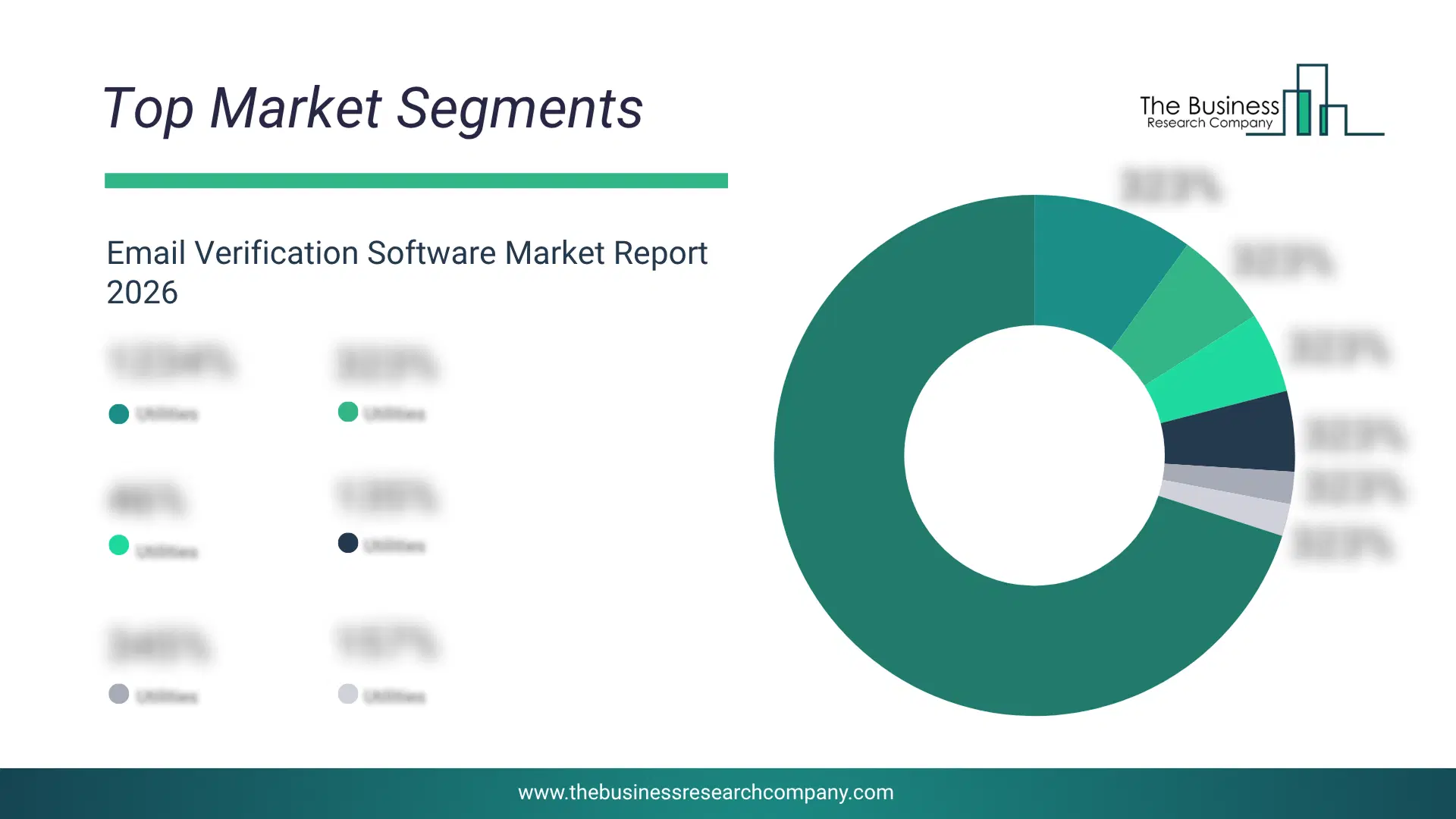
1) By Type: Cloud-Based, Web-Based 2) By Organization Size: Small And Medium-Sized Enterprises, Large Enterprises 3) By Business Model: Business-To-Business (B2B), Business-To-Customers (B2C) Subsegments: 1) By Cloud-Based: Saas Email Verification Solutions, Cloud-Based Bulk Email Validation, API-Driven Email Verification Services, Real-Time Cloud Email Verification, Cloud-Based Email List Cleaning And Validation, Cloud-Integrated Email Verification For Marketing Platforms 2) By Web-Based: Web Portal Email Verification Tools, Online Email Validation Services, Web-Based Real-Time Email Verification For Websites, Self-Service Web-Based Email Validation SolutionsWhat Are The Drivers Of The Email Verification Software Market?
The rising adoption of cloud-based solutions is expected to propel the growth of the email verification software market going forward. Cloud-based solutions are software or services hosted, maintained, and accessed remotely over the internet rather than on local servers or devices. Cloud-based solutions are increasing due to scalability, cost-effectiveness, flexibility, accessibility, and the increasing adoption of digital transformation initiatives across industries. Email verification software ensures the accuracy of email lists, enhances deliverability rates, minimizes bounce rates, and protects the sender's reputation by validating email addresses in real-time through cloud infrastructure. For instance, in 2025, according to the Eurostat, a Luxembourg-based statistical office of the European Union, in 2023, 45% of EU businesses purchased cloud computing services. Large enterprises were significantly more inclined to adopt cloud solutions than SMEs, with 78% of large businesses using cloud services compared to 44% of SMEs. Therefore, the rise in the adoption of cloud-based solutions is driving the growth of the email verification software industry. The growth in fraud prevention is expected to propel the growth of the email verification software market going forward. Fraud prevention refers to the proactive measures and systems implemented to detect and block fraudulent behavior across transactions, accounts, or user interactions. Increasing fraud prevention is driven by the surge in digital transactions, which creates more opportunities for cybercriminals and requires stronger safeguards to protect users and reduce financial losses. Email verification software helps fraud prevention by validating the authenticity of email addresses, reducing fake or disposable accounts, and preventing malicious users from accessing systems with invalid or high-risk identities. For instance, in October 2025, according to the Australian Signals Directorate, an Australia-based government agency, in FY2024–25, the Australian Signals Directorate’s (ASD) Australian Cyber Security Centre (ACSC) received over 42,500 calls to the Australian Cyber Security Hotline, marking a 16% rise from the previous year. Therefore, the growth in fraud prevention is driving the growth of the email verification software industry.Key Players In The Global Email Verification Software Market
Major companies operating in the email verification software market are ZeroBounce, NeverBounce, Kickbox, EmailListVerify, Proofy, DeBounce, Clearout, Bounceless, TheChecker, Hunter, GetEmail, FindThatLead, Mailfloss, Validity, Emailable, QuickEmailVerification, Verifalia, Xverify, MailerCheck, CaptainVerify, EmailChecker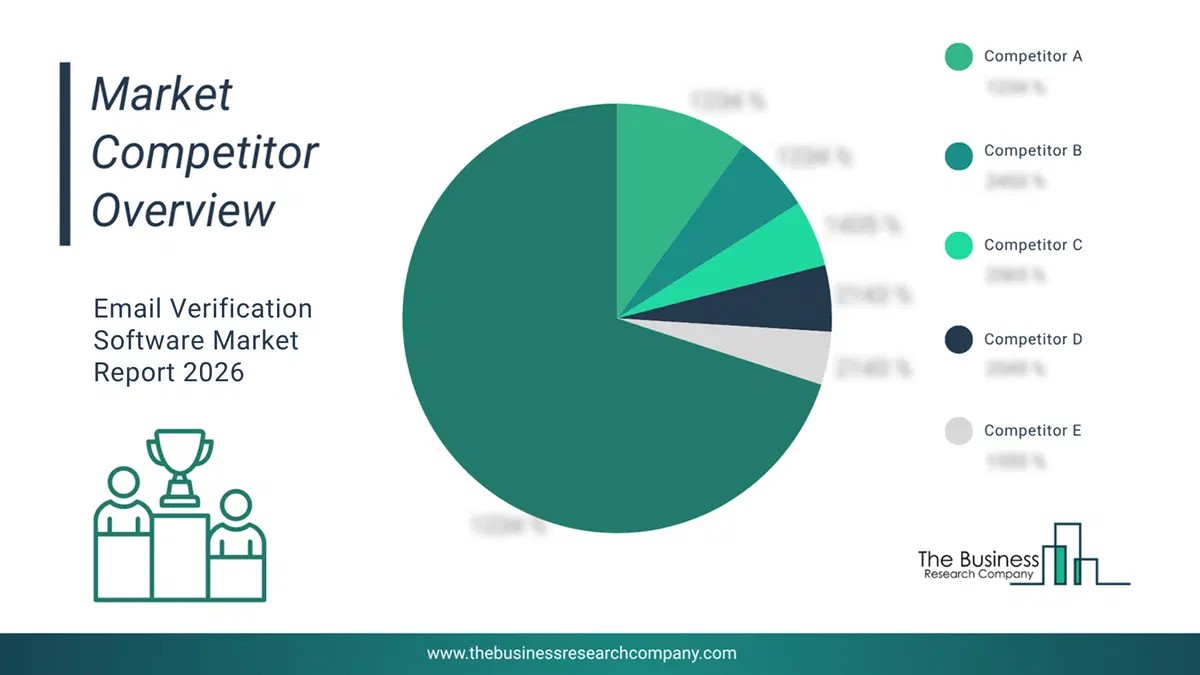
This chart is for illustrative purposes; the full report includes a detailed competitor analysis and comprehensive overview of the top 10 companies in the market.
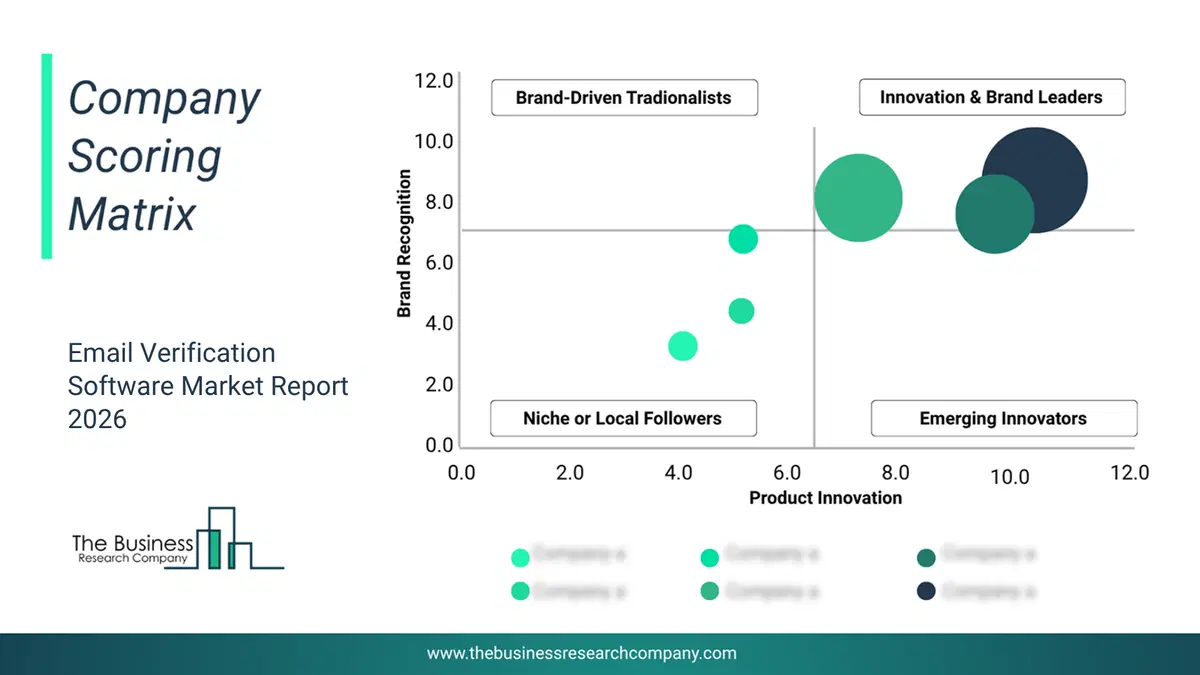
This chart maps companies by product innovation and brand strength, with bubble size indicating relative revenue, helping identify market leaders, challengers, and niche players. This is an illustrative chart; the full report provides a complete and accurate competitive analysis.
Global Email Verification Software Market Trends and Insights
Major companies operating in the email verification software market are providing innovative services using machine learning and automation technologies to advance the offering and provide better solutions to their customers. Machine learning and automation refer to integrating advanced algorithms and automated processes to enhance email verification processes' accuracy, efficiency, and reliability. For instance, in June 2023, Reoon Technology, an India-based prominent B2B SaaS development company, launched the Reoon Email Verifier to enhance email deliverability and reduce bounce rates for businesses of all sizes. It provides a cutting-edge service that allows businesses and organizations to validate email addresses in bulk and in real time without sending any emails to recipients. The feature is handy for marketing agencies, e-commerce companies, business owners, SaaS businesses, recruitment firms, and other organizations relying heavily on email communication with customers or clients.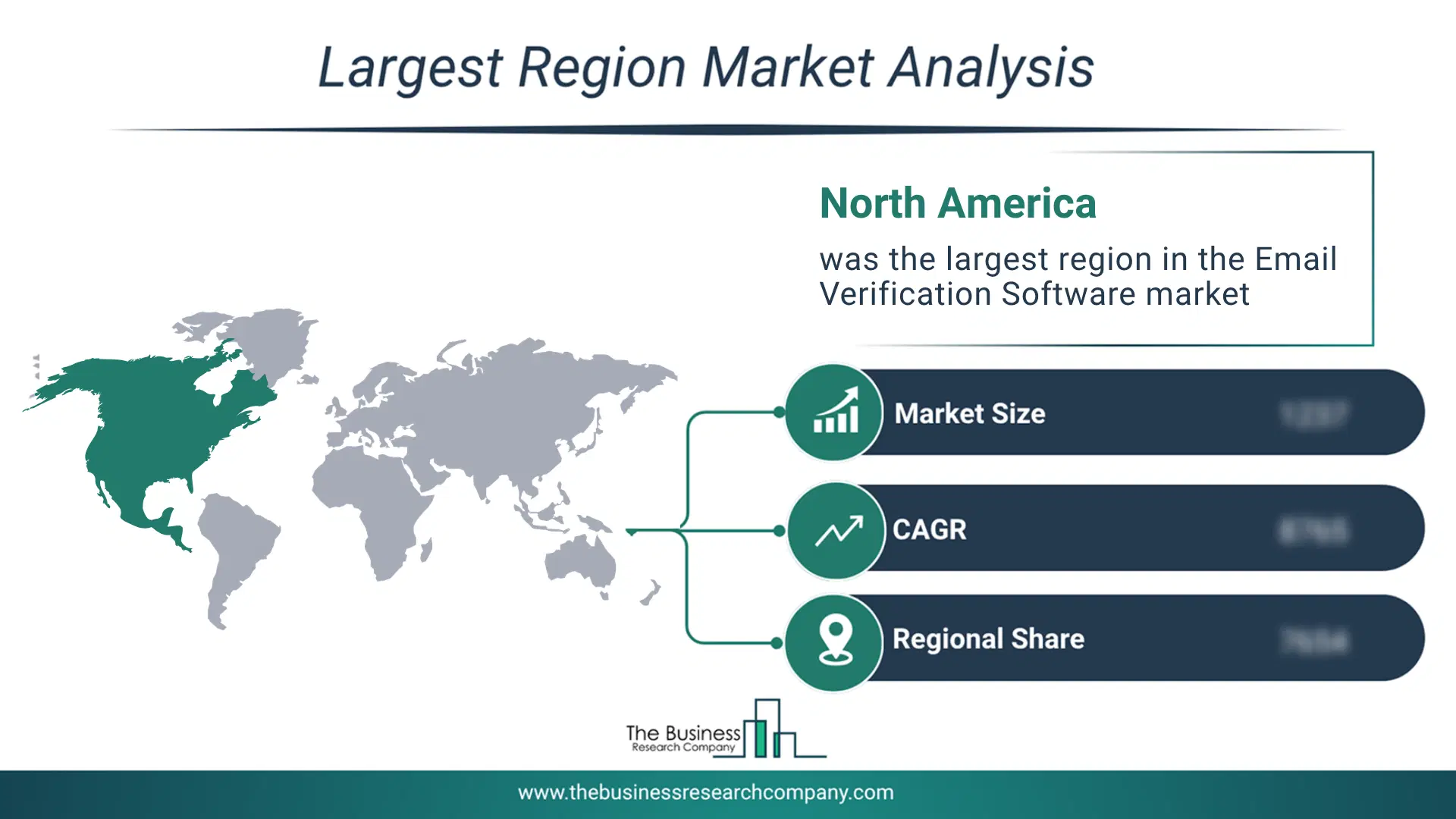
Regional Insights
North America was the largest region in the email verification software market in 2025. The regions covered in this market report are Asia-Pacific, South East Asia, Western Europe, Eastern Europe, North America, South America, Middle East, Africa. The countries covered in this market report are Australia, Brazil, China, France, Germany, India, Indonesia, Japan, Taiwan, Russia, South Korea, UK, USA, Canada, Italy, Spain.What Defines the Email Verification Software Market?
The email verification software market consists of sales of stand-alone software, integrated solutions, and API-based solutions. Values in this market are ‘factory gate’ values, that is the value of goods sold by the manufacturers or creators of the goods, whether to other entities (including downstream manufacturers, wholesalers, distributors, and retailers) or directly to end customers. The value of goods in this market includes related services sold by the creators of the goods.How is Market Value Defined and Measured?
The market value is defined as the revenues that enterprises gain from the sale of goods and/or services within the specified market and geography through sales, grants, or donations in terms of the currency (in USD unless otherwise specified). The revenues for a specified geography are consumption values that are revenues generated by organizations in the specified geography within the market, irrespective of where they are produced. It does not include revenues from resales along the supply chain, either further along the supply chain or as part of other products.
This chart presents market attractiveness based on a quantitative evaluation of growth, competition, strategic alignment, and risk, offering a clear view of opportunity areas for decision-making. This chart is for illustrative purposes; the full report contains the complete analysis.

This chart highlights the Total Addressable Market (TAM) by estimating the maximum revenue opportunity using an assumption-driven approach, supporting strategic planning and opportunity sizing across markets. The chart is illustrative; the full report provides a more comprehensive analysis.
What Key Data and Analysis Are Included in the Email Verification Software Market Report 2026?
The email verification software market research report is one of a series of new reports from The Business Research Company that provides market statistics, including industry global market size, regional shares, competitors with the market share, detailed market segments, market trends and opportunities, and any further data you may need to thrive in the email verification software industry. The market research report delivers a complete perspective of everything you need, with an in-depth analysis of the current and future state of the industry.Email Verification Software Market Report Forecast Analysis
| Report Attribute | Details |
|---|---|
| Market Size Value In 2026 | $0.79 billion |
| Revenue Forecast In 2030 | $1.1 billion |
| Growth Rate | CAGR of 8.9% from 2026 to 2030 |
| Base Year For Estimation | 2025 |
| Actual Estimates/Historical Data | 2020-2025 |
| Forecast Period | 2026 - 2030 |
| Market Representation | Revenue in USD Billion and CAGR from 2026 to 2030 |
| Segments Covered | Type, Organization Size, Business Model |
| Regional Scope | Asia-Pacific, Western Europe, Eastern Europe, North America, South America, Middle East, Africa |
| Country Scope | The Countries Covered In This Market Report Are Australia, Brazil, China, France, Germany, India, Indonesia, Japan, Taiwan, Russia, South Korea, Uk, Usa, Canada, Italy, Spain. |
| Key Companies Profiled | ZeroBounce, NeverBounce, Kickbox, EmailListVerify, Proofy, DeBounce, Clearout, Bounceless, TheChecker, Hunter, GetEmail, FindThatLead, Mailfloss, Validity, Emailable, QuickEmailVerification, Verifalia, Xverify, MailerCheck, CaptainVerify, EmailChecker |
| Customization Scope | Request for Customization |
| Pricing And Purchase Options | Explore Purchase Options |