

Embedded Card Issuing Market Report 2026
Global Outlook – By Component (Platform, Services ), By Card Type (Credit Cards, Debit Cards, Prepaid Cards, Other Card Types ), By Deployment Mode (Cloud, On-Premises ), By End-User (Banks And Financial Institutions, Fintech Companies, Retailers, Corporates, Other End-Users ) – Market Size, Trends, Strategies, and Forecast to 2030
Embedded Card Issuing Market Overview
• Embedded Card Issuing market size has reached to $20.79 billion in 2025 • Expected to grow to $38.16 billion in 2030 at a compound annual growth rate (CAGR) of 13% • Growth Driver: Surge In Digital Payments Fueling The Market Growth Due To Rapid Smartphone Adoption And Affordable Internet Access • Market Trend: Stablecoin-Linked Card Solutions Enhance Embedded Card Issuing Capabilities For Cross-Border Payments • North America was the largest region in 2025 and Asia-Pacific is the fastest growing region.What Is Covered Under Embedded Card Issuing Market?
Embedded card issuing is the integration of card issuance functionality directly into a company’s digital platform, allowing businesses to generate and manage branded virtual or physical payment cards via APIs without becoming a bank. It enhances user experience by enabling seamless payment processing, real-time spending controls, compliance management, and transaction visibility within the platform ecosystem. The main components of embedded card issuing include platform and services. The platform provides tools for issuing, managing, and monitoring credit, debit, and prepaid cards in an integrated environment. The card types consist of credit cards, debit cards, prepaid cards, and other card types. The deployment modes are categorized as cloud and on-premises, while the end-use includes banks and financial institutions, fintech companies, retailers, corporates, and other end users.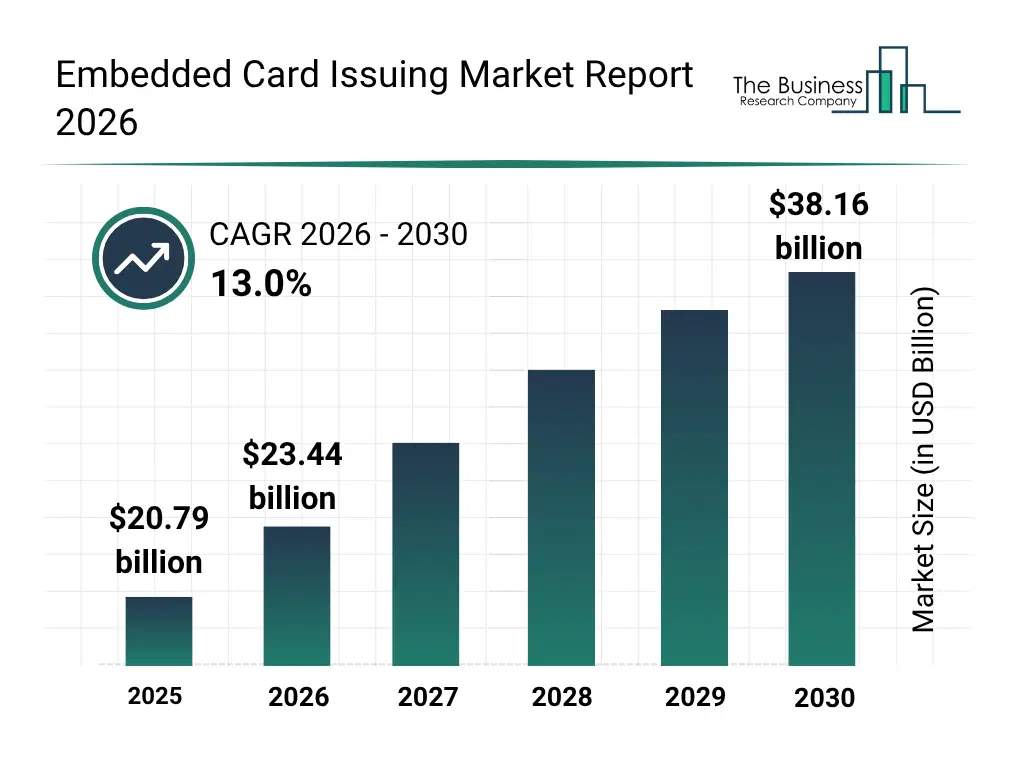
What Is The Embedded Card Issuing Market Size and Share 2026?
The embedded card issuing market size has grown rapidly in recent years. It will grow from $20.79 billion in 2025 to $23.44 billion in 2026 at a compound annual growth rate (CAGR) of 12.7%. The growth in the historic period can be attributed to increasing digital payment adoption, growth of e-commerce transactions, expansion of prepaid and debit card usage, rising need for corporate expense control, adoption of traditional banking card issuance systems.What Is The Embedded Card Issuing Market Growth Forecast?
The embedded card issuing market size is expected to see rapid growth in the next few years. It will grow to $38.16 billion by 2030 at a compound annual growth rate (CAGR) of 13.0%. The growth in the forecast period can be attributed to growing shift toward embedded finance ecosystems, increasing demand for instant digital card issuance, rising adoption of programmable payment infrastructure, expansion of global fintech partnerships, growing need for real-time fraud and compliance monitoring. Major trends in the forecast period include increasing adoption of api-first card issuance platforms, growing demand for virtual and instant card provisioning, rising integration of real-time spend control features, expansion of embedded finance within non-banking platforms, increasing use of lifecycle-based card management systems.
Global Embedded Card Issuing Market Segmentation
1) By Component: Platform, Services 2) By Card Type: Credit Cards, Debit Cards, Prepaid Cards, Other Card Types 3) By Deployment Mode: Cloud, On-Premises 4) By End-User: Banks And Financial Institutions, Fintech Companies, Retailers, Corporates, Other End-Users Subsegments: 1) By Platform: Card Issuance Management Platform, Application Programming Interface Integration Platform, Compliance And Regulatory Management Platform, Fraud Detection And Risk Management Platform, Digital Wallet Integration Platform, Real Time Transaction Processing Platform, Card Lifecycle Management Platform 2) By Services: Program Management Services, Card Personalization Services, Regulatory Compliance Advisory Services, Fraud Monitoring And Prevention Services, Customer Support And Onboarding Services, Data Analytics And Reporting Services, Technical Integration And Implementation ServicesWhat Is The Driver Of The Embedded Card Issuing Market?
The rising demand for digital payments is expected to propel the growth of the embedded card issuing market going forward. Digital payments refer to transactions conducted electronically through cards, e-wallets, mobile apps, or online banking, replacing cash and traditional payment methods. Digital payments are increasing mainly due to the rapid adoption of smartphones and affordable internet access, which have made online banking and mobile wallet services easily accessible to a larger population. Embedded card issuing supports digital payments by enabling businesses to seamlessly integrate branded virtual and physical cards directly into their platforms, simplifying user transactions within apps and ecosystems. For instance, in July 2024, according to UK Finance, a UK-based non-profit trade association, in 2023, the UK recorded 18.3 billion contactless transactions, marking a 7% increase from 17.0 billion in 2022. Overall, contactless payments accounted for 38% of all transactions conducted across the country. Therefore, the rising demand for digital payments is driving the growth of the embedded card issuing industry.Key Players In The Global Embedded Card Issuing Market
Major companies operating in the embedded card issuing market are Stripe Inc., Airwallex Pty Ltd, Marqeta Inc., Nium Pte. Ltd., i2c Inc., Pleo Technologies ApS, Unit Finance Inc., Highnote Platform Inc., Rain Technologies Inc., Solarisbank AG, EnKash Technologies Pvt. Ltd., Enfuce Financial Services Ltd, Treasury Prime Inc., Synctera Inc., Paymentology Ltd, B4B Payments Ltd, Cardlay A/S, Wallester AS, Weavr Ltd, Boxopay Ltd.
This chart is for illustrative purposes; the full report includes a detailed competitor analysis and comprehensive overview of the top 10 companies in the market.
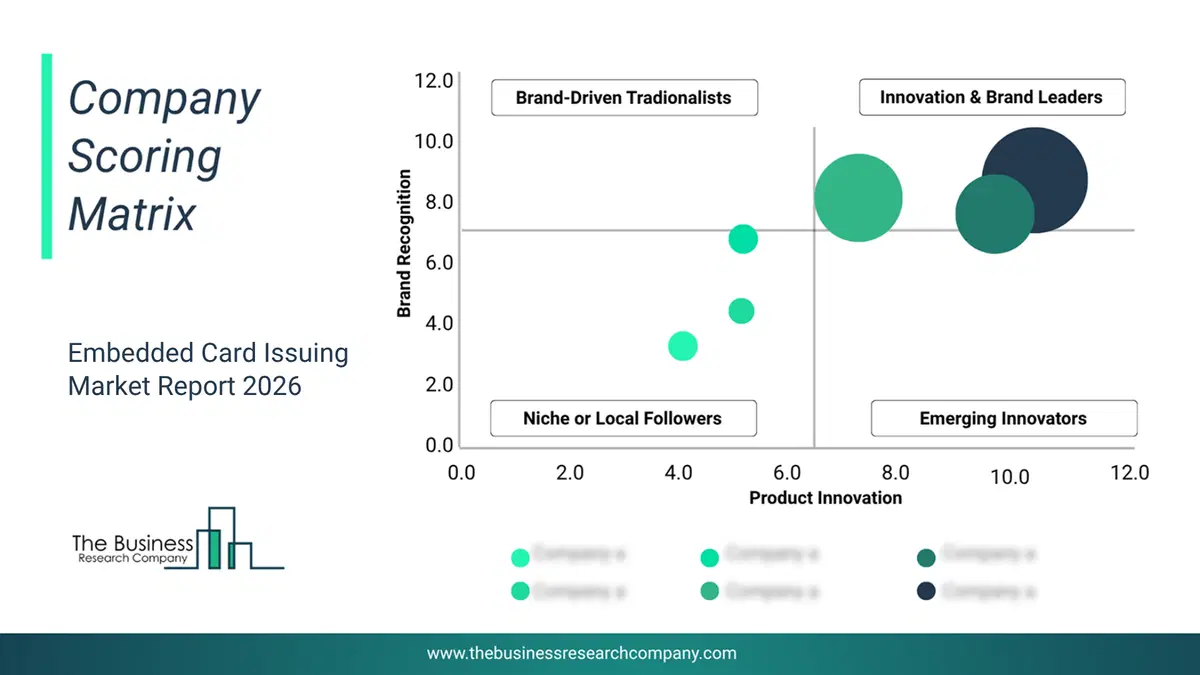
This chart maps companies by product innovation and brand strength, with bubble size indicating relative revenue, helping identify market leaders, challengers, and niche players. This is an illustrative chart; the full report provides a complete and accurate competitive analysis.
Global Embedded Card Issuing Market Trends and Insights
Major companies operating in the embedded card issuing market are focusing on developing API-first card infrastructure, such as developer-friendly interfaces that allow platforms to programmatically create, manage, and control both digital and physical cards with real-time authorization and dynamic spend controls. Developer-friendly interfaces refer to software tools, APIs, or platforms designed to be easy for developers to understand, integrate, and customize with minimal complexity. For instance, in December 2025, Zepz, a UK-based financial technology company, launched stablecoin-linked Visa cards to enhance cross-border payment efficiency, enabling users to spend stablecoin balances seamlessly through the Visa network while benefiting from faster settlement and reduced foreign exchange costs. The Zepz stablecoin-linked Visa card's introduction enables users to connect stablecoin wallets directly to Visa cards, allowing real-time conversion of digital assets into local fiat currency at the point of sale for seamless global spending.What Are Latest Mergers And Acquisitions In The Embedded Card Issuing Market?
In February 2023, Marqeta, Inc., a US-based modern card-issuing platform, acquired Power Finance, Inc. for an undisclosed amount. Through this acquisition, Marqeta aims to strengthen its leadership in modern card issuing and expand its capabilities for managing credit card programs by integrating Power Finance’s cloud-native credit platform, rewards engine, and data science tools into its API-driven infrastructure. Power Finance, Inc. is an India-based cloud-native credit card program management platform that offers embedded card issuing.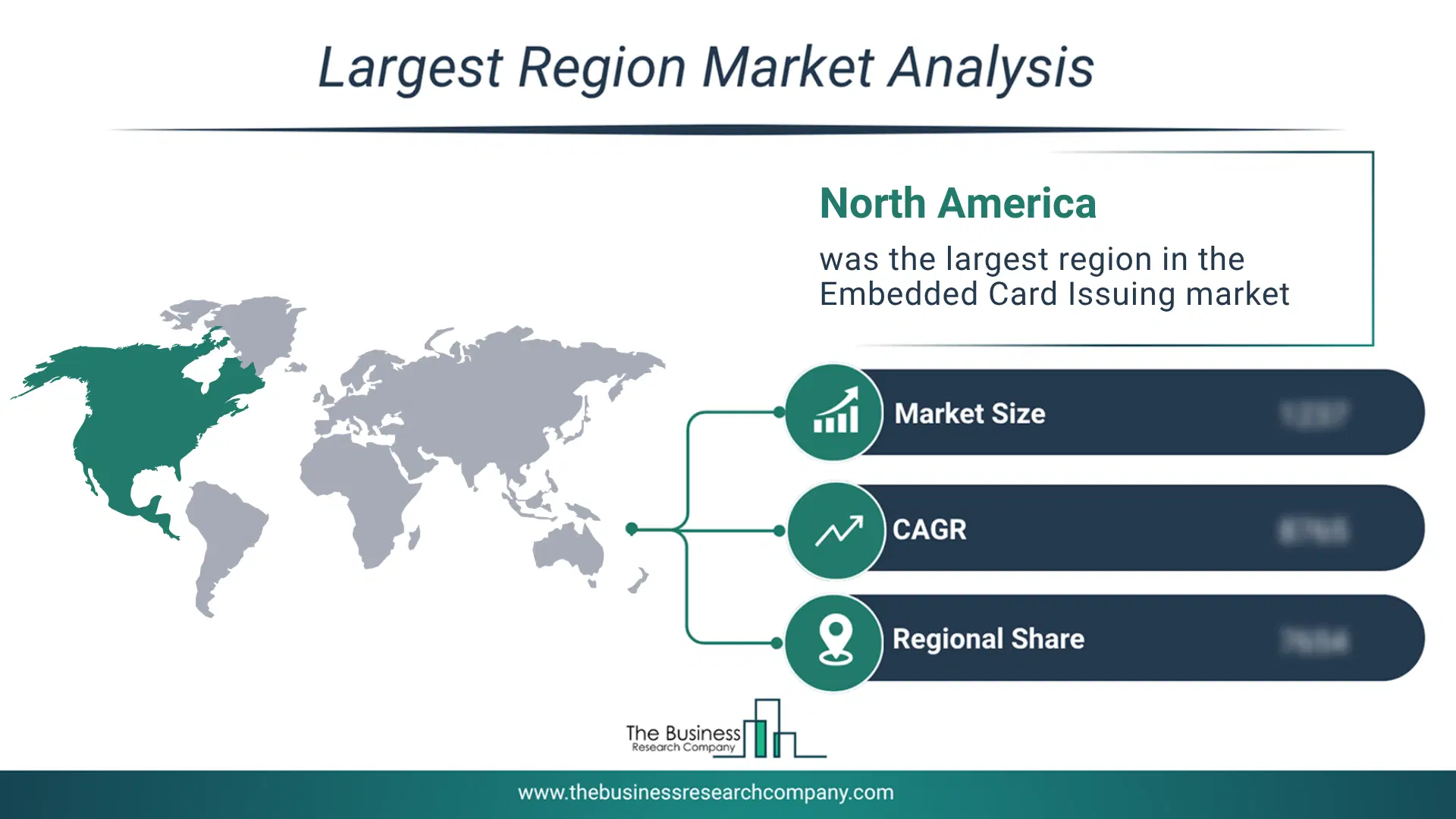
Regional Insights
North America was the largest region in the embedded card issuing market in 2025. Asia-Pacific is expected to be the fastest-growing region in the forecast period. The regions covered in this market report are Asia-Pacific, South East Asia, Western Europe, Eastern Europe, North America, South America, Middle East, Africa. The countries covered in this market report are Australia, Brazil, China, France, Germany, India, Indonesia, Japan, Taiwan, Russia, South Korea, UK, USA, Canada, Italy, Spain.What Defines the Embedded Card Issuing Market?
The embedded card issuing market consists of revenues earned by entities providing services such as embedded payment card issuance, virtual and physical card provisioning, API-based card management, compliance and KYC integration, fraud monitoring, and transaction processing. The market value includes the value of related goods sold by the service provider or included within the service offering. Only goods and services traded between entities or sold to end consumers are included.How is Market Value Defined and Measured?
The market value is defined as the revenues that enterprises gain from the sale of goods and/or services within the specified market and geography through sales, grants, or donations in terms of the currency (in USD unless otherwise specified). The revenues for a specified geography are consumption values that are revenues generated by organizations in the specified geography within the market, irrespective of where they are produced. It does not include revenues from resales along the supply chain, either further along the supply chain or as part of other products.
This chart presents market attractiveness based on a quantitative evaluation of growth, competition, strategic alignment, and risk, offering a clear view of opportunity areas for decision-making. This chart is for illustrative purposes; the full report contains the complete analysis.

This chart highlights the Total Addressable Market (TAM) by estimating the maximum revenue opportunity using an assumption-driven approach, supporting strategic planning and opportunity sizing across markets. The chart is illustrative; the full report provides a more comprehensive analysis.
What Key Data and Analysis Are Included in the Embedded Card Issuing Market Report 2026?
The embedded card issuing market research report is one of a series of new reports from The Business Research Company that provides market statistics, including industry global market size, regional shares, competitors with the market share, detailed market segments, market trends and opportunities, and any further data you may need to thrive in the embedded card issuing industry. The market research report delivers a complete perspective of everything you need, with an in-depth analysis of the current and future state of the industry.Embedded Card Issuing Market Report Forecast Analysis
| Report Attribute | Details |
|---|---|
| Market Size Value In 2026 | $23.44 billion |
| Revenue Forecast In 2030 | $38.16 billion |
| Growth Rate | CAGR of 12.7% from 2026 to 2030 |
| Base Year For Estimation | 2025 |
| Actual Estimates/Historical Data | 2020-2025 |
| Forecast Period | 2026 - 2030 |
| Market Representation | Revenue in USD Billion and CAGR from 2026 to 2030 |
| Segments Covered | Component, Card Type, Deployment Mode, End-User |
| Regional Scope | Asia-Pacific, Western Europe, Eastern Europe, North America, South America, Middle East, Africa |
| Country Scope | The countries covered in the report are Australia, Brazil, China, France, Germany, India, Indonesia, Japan, Taiwan, Russia, South Korea, UK, USA, Canada, Italy, Spain. |
| Key Companies Profiled | Stripe Inc., Airwallex Pty Ltd, Marqeta Inc., Nium Pte. Ltd., i2c Inc., Pleo Technologies ApS, Unit Finance Inc., Highnote Platform Inc., Rain Technologies Inc., Solarisbank AG, EnKash Technologies Pvt. Ltd., Enfuce Financial Services Ltd, Treasury Prime Inc., Synctera Inc., Paymentology Ltd, B4B Payments Ltd, Cardlay A/S, Wallester AS, Weavr Ltd, Boxopay Ltd. |
| Customization Scope | Request for Customization |
| Pricing And Purchase Options | Explore Purchase Options |