

Emergency Medical Services Software Market Report 2026
Global Outlook – By Product Type (Computer-Aided Dispatch, Electronic Patient Care Reporting, Emergency Medical Services (EMS) Billing, Scheduling And Workforce Management, Fleet Management, Other Product Types), By Deployment Mode (Cloud-Based, On-Premises), By Functionality (Incident Reporting, Resource Allocation, Communication And Coordination, Reporting And Analytics, Compliance Management), By Application (Hospitals And Clinics, Emergency Service Providers, Other Applications), By End User (Public Ambulance Services, Private Ambulance Services, Healthcare Organizations, Fire Departments, Other Emergency Services) – Market Size, Trends, Strategies, and Forecast to 2030
Emergency Medical Services Software Market Overview
• Emergency Medical Services Software market size has reached to $2.22 billion in 2025 • Expected to grow to $3.6 billion in 2030 at a compound annual growth rate (CAGR) of 10.2% • Growth Driver: Rise In Emergency Call Volumes And Medical Incidents Fueling The Growth Of The Market Due To Increasing Demand For Efficient Dispatch And Patient Care • Market Trend: Alignment With National Incident Data Standards Driving EMS Software Interoperability And Data Quality Improvements • North America was the largest region in 2025 and Asia-Pacific is the fastest growing region.Market Gains By 2030 – Top Opportunities By Segment
Market Gain identifies the most promising market opportunities by highlighting the segments or products expected to generate the highest incremental revenue growth over the next five years.
What Is Covered Under Emergency Medical Services Software Market?
Emergency medical services software refers to a suite of digital solutions designed to support and optimize pre-hospital emergency care operations by enabling efficient dispatch, patient data management, real-time communication, clinical documentation, and coordination between emergency responders, hospitals, and healthcare systems. These solutions help improve response times, enhance patient outcomes, and streamline emergency workflows by ensuring accurate information flow and effective resource utilization. The main product types of emergency medical services software include computer-aided dispatch, electronic patient care reporting, emergency medical services (EMS) billing, scheduling and workforce management, fleet management, and other product types. Computer-aided dispatch refers to software systems used to receive emergency calls, prioritize incidents, dispatch appropriate resources, and track response activities in real time to improve operational efficiency and response times. The solutions are deployed through cloud-based and on-premises modes. The functionalities supported include incident reporting, resource allocation, communication and coordination, reporting and analytics, and compliance management. The various applications involved are hospitals and clinics, emergency service providers, and other applications. The end users of emergency medical services software include public Ambulance Services, private ambulance services, healthcare organizations, fire departments, and other emergency services.
What Is The Emergency Medical Services Software Market Size and Share 2026?
The emergency medical services software market size has grown strongly in recent years. It will grow from $2.22 billion in 2025 to $2.44 billion in 2026 at a compound annual growth rate (CAGR) of 10.0%. The growth in the historic period can be attributed to growing demand for efficient pre-hospital care, increasing adoption of digital health solutions, expansion of emergency medical services infrastructure, rising need for patient data management, integration of communication tools in EMS operations.What Is The Emergency Medical Services Software Market Growth Forecast?
The emergency medical services software market size is expected to see rapid growth in the next few years. It will grow to $3.6 billion in 2030 at a compound annual growth rate (CAGR) of 10.2%. The growth in the forecast period can be attributed to advancement in ai-driven dispatch systems, cloud-based emergency services solutions, adoption of interoperable health record sharing, expansion of telehealth integration in EMS, increased focus on predictive analytics for resource allocation. Major trends in the forecast period include real-time emergency response coordination, patient data interoperability, fleet and resource optimization, regulatory compliance and reporting, clinical documentation automation.
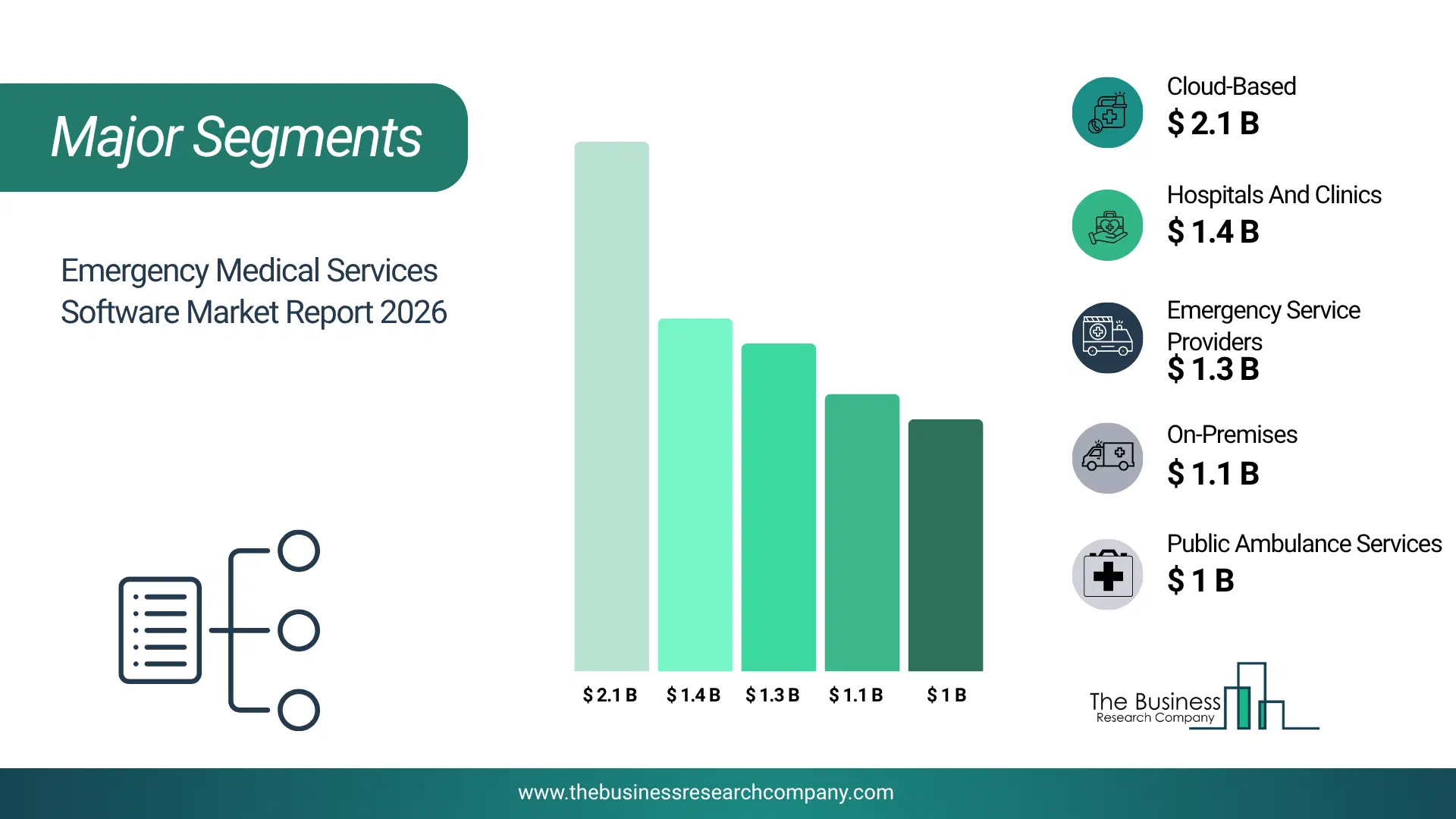
Global Emergency Medical Services Software Market Segmentation
1) By Product Type: Computer-Aided Dispatch, Electronic Patient Care Reporting, Emergency Medical Services (EMS) Billing, Scheduling And Workforce Management, Fleet Management, Other Product Types 2) By Deployment Mode: Cloud-Based, On-Premises 3) By Functionality: Incident Reporting, Resource Allocation, Communication And Coordination, Reporting And Analytics, Compliance Management 4) By Application: Hospitals And Clinics, Emergency Service Providers, Other Applications 5) By End User: Public Ambulance Services, Private Ambulance Services, Healthcare Organizations, Fire Departments, Other Emergency Services Subsegments: 1) By Computer-Aided Dispatch: Priority Based Dispatch, Real Time Unit Tracking, Call Taking And Triage, Location Based Dispatching, Inter Agency Dispatch Coordination 2) By Electronic Patient Care Reporting: Clinical Documentation Management, Patient Data Capture, Treatment And Outcome Recording, Interoperable Health Record Sharing, Quality Assurance And Audit Support 3) By Emergency Medical Services (EMS) Billing: Insurance Claim Processing, Automated Invoice Generation, Reimbursement Management, Revenue Cycle Optimization, Payment Tracking And Reporting 4) By Scheduling And Workforce Management: Shift Scheduling, Staff Availability Management, Credential And Certification Tracking, Overtime And Leave Management, Workforce Performance Monitoring 5) By Fleet Management: Vehicle Location Tracking, Maintenance And Service Scheduling, Fuel And Cost Monitoring, Asset And Equipment Tracking, Fleet Utilization Analysis 6) By Other Product Types: Inventory And Supply Management, Compliance And Regulatory Reporting, Training And Simulation Management, Analytics And Performance Dashboards, Telehealth And Remote Support Integration The top segments in the emergency medical services software market will be: • Cloud-Based will reach $2180.85 Million by 2030. • Hospitals And Clinics will reach $1456.87 Million by 2030. • Emergency Service Providers will reach $1314.38 Million by 2030. • On-Premises will reach $1126.58 Million by 2030. • Public Ambulance Services will reach $1077.39 Million by 2030.What Is The Driver Of The Emergency Medical Services Software Market?
The rising emergency call volumes and medical incidents is expected to propel the growth of the emergency medical services software market going forward. Emergency call volumes and medical incidents refer to the total number of emergency service requests received by dispatch centers and the corresponding number of patient care events managed by EMS personnel. Emergency call volumes and medical incidents are increasing due to growing population density, aging demographics, and rising prevalence of chronic health conditions. Emergency medical services software helps manage rising call volumes by enabling faster incident prioritization and more efficient dispatch, improving response times under high demand. For instance, in December 2025, according to the Midland Fire Department, a US-based provider of fire protection and emergency medical services, emergency medical services (EMS) calls rose from 14,895 during January to November 2024 to 15,592 over the same period in 2025, representing a year-over-year increase of approximately 4.08%. Therefore, the rising emergency call volumes and medical incidents is driving the growth of the emergency medical services software industry.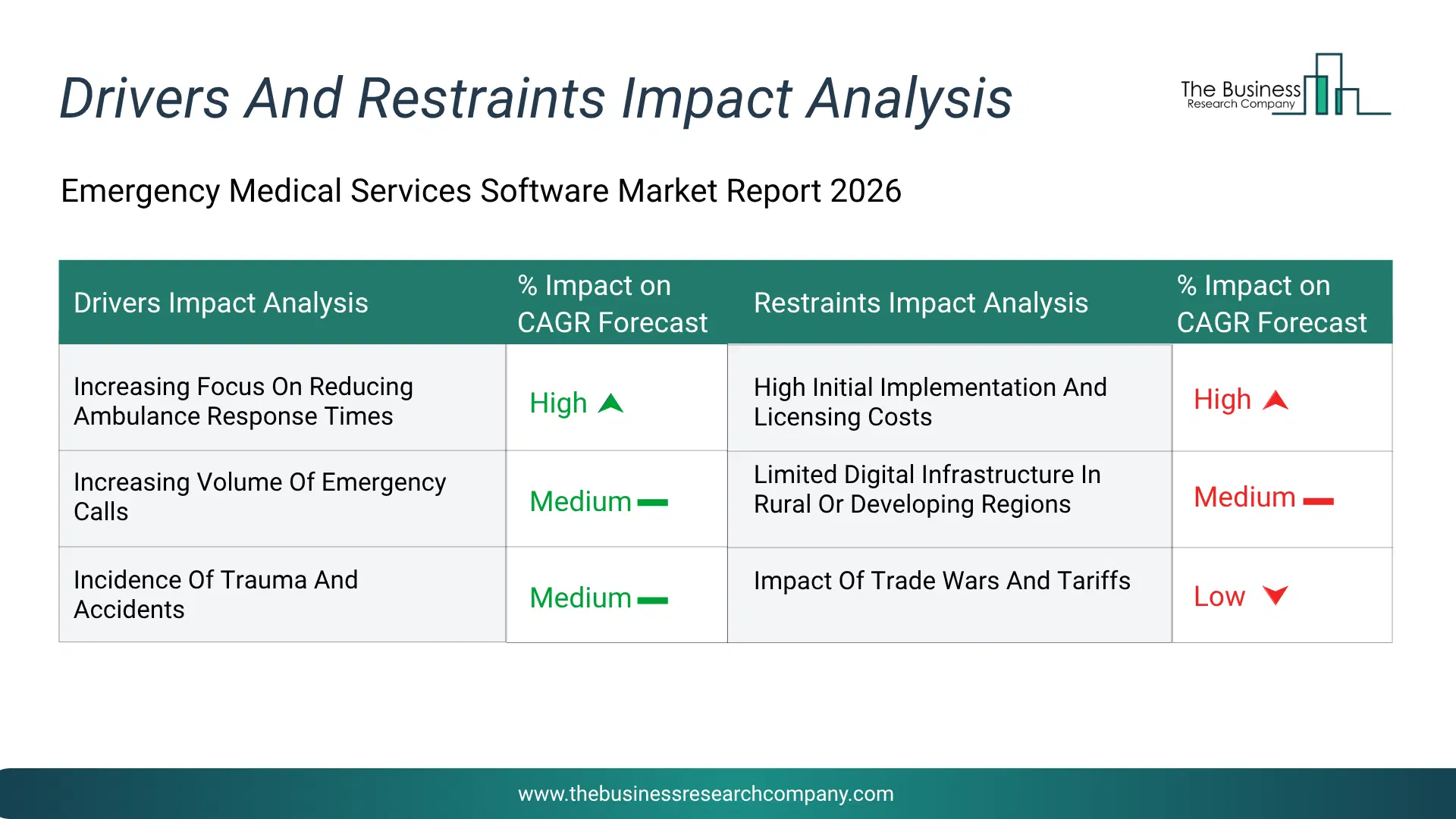
Infographic Chart Showing Key Market Drivers Analysis And Restraints For Emergency Medical Services Software Market
The chart presents an impact analysis of key drivers and restraints, quantifying their relative influence on the market's growth rate and helping assess the balance between growth enablers and limiting factors. This chart offers a high-level perspective; the full report contains more detailed insights.
How Will The Drivers Impact Growth In The Global Emergency Medical Services Software Market?
• Increasing Focus On Reducing Ambulance Response Times (High) – During the forecast period, the increasing focus on reducing ambulance response times is expected to propel expansion in the emergency medical services software market. With greater emphasis on minimizing delays in reaching patients, EMS software becomes essential for efficiently dispatching ambulances, tracking their location in real time, and optimizing routes. Advanced systems help ensure that first responders reach emergencies faster, improve coordination among multiple units, and provide real-time updates to hospitals. This enhances patient outcomes and operational efficiency, making digital solutions critical in time-sensitive situations. The increasing focus on reducing ambulance response times growth contribution during the forecast period in 2025 is 2.0%. • Increasing Volume Of Emergency Calls (Medium) – During the forecast period, the increasing volume of emergency calls is expected to propel growth in the emergency medical services software market. Growing numbers of emergency calls put pressure on response teams to act quickly and accurately. EMS software helps by automating call triage, logging incidents, and dispatching the nearest available units efficiently. Integration with mobile apps and GPS tracking allows teams to respond to high call volumes without delays, ensuring optimal utilization of resources and better patient care. The increasing volume of emergency calls growth contribution during the forecast period in 2025 is 1.5%. • Incidence Of Trauma And Accidents (Medium) – During the forecast period, the incidence of trauma and accidents is expected to propel growth in the emergency medical services software market. A rise in accidents and trauma cases increases the demand for rapid and well-coordinated emergency response. EMS software enables centralized reporting, prioritization of critical cases, and integration with hospital emergency departments to prepare for incoming patients. By streamlining incident logging, resource allocation, and communication, software solutions ensure timely and effective intervention in high-volume trauma scenarios. The incidence of trauma and accidents growth contribution during the forecast period in 2025 is 1.0%. • Government Support For The Expansion Of Ambulance Service Networks In Rural Area (Low) – During the forecast period, the government support for the expansion of ambulance service networks in rural are expected to propel growth in the emergency medical services software market. Government initiatives to extend ambulance coverage in remote regions require advanced technology to manage dispersed resources. EMS software supports route planning, vehicle tracking, and centralized communication across rural networks where connectivity and coordination are challenging. This ensures that even underserved areas benefit from rapid response, reducing the gap in emergency services and improving overall healthcare delivery. The government support for the expansion of ambulance service networks growth contribution during the forecast period in 2025 is 0.5%.How Will The Restraints Impact Growth In The Global Emergency Medical Services Software Market?
• High Initial Implementation And Licensing Costs (High) – During the forecast period, high initial implementation and licensing costs are restricting the growth of the emergency medical services software market. The upfront expenses for purchasing, installing, and configuring emergency medical services software can be substantial, making it challenging for smaller hospitals or ambulance providers to adopt advanced systems. High licensing fees further add to the financial burden, deterring organizations from upgrading their digital capabilities. As a result, many institutions delay deployment or continue relying on outdated manual processes, slowing the overall digital transformation of emergency healthcare services. Growth affected by the high initial implementation and licensing costs during the forecast period in 2025 is -2.0%. • Limited Digital Infrastructure In Rural Or Developing Regions (Medium) – During the forecast period, limited digital infrastructure in rural or developing regions is restricting the growth of the emergency medical services software market. In areas with poor internet connectivity, insufficient hardware, or limited access to IT support, the deployment of sophisticated EMS software becomes difficult. Hospitals and emergency service providers may struggle to maintain real-time data transfer, telemedicine integration, or cloud-based operations. This lack of supportive infrastructure restricts the adoption of modern solutions, leaving rural populations underserved in terms of rapid and coordinated emergency response. Growth affected by the limited digital infrastructure in rural or developing regions during the forecast period in 2025 is -1.3%. • Impact Of Trade Wars And Tariffs (Medium) – During the forecast period, the impact of trade wars and tariffs is restricting the growth of the emergency medical services software market. Increasing tariffs on imported medical equipment, software licenses, or IT hardware can inflate the cost of implementing emergency management systems. Trade restrictions may also limit access to advanced technologies or delay the delivery of critical components, creating procurement challenges. These economic and regulatory barriers slow down digital adoption and force organizations to prioritize short-term operational needs over long-term technological investments. Growth affected by the impact of trade wars and tariffs during the forecast period in 2025 is -0.3%.Key Players In The Global Emergency Medical Services Software Market
Major companies operating in the emergency medical services software market are Motorola Solutions Incorporation, Hexagon AB, Tyler Technologies Inc., Eso Solutions Inc., ZOLL Medical Corporation, ImageTrend Inc., Forte Holdings Inc., Sansio, Emergency Reporting, Digitech Computer Inc., Ortivus AB, Traumasoft Inc., AngelTrack LLC, MP Cloud Technologies Inc., AIM System, EPIC EMS, Documed Systems International Inc., Healthware Corp., Macrologic Inc., Emergidata.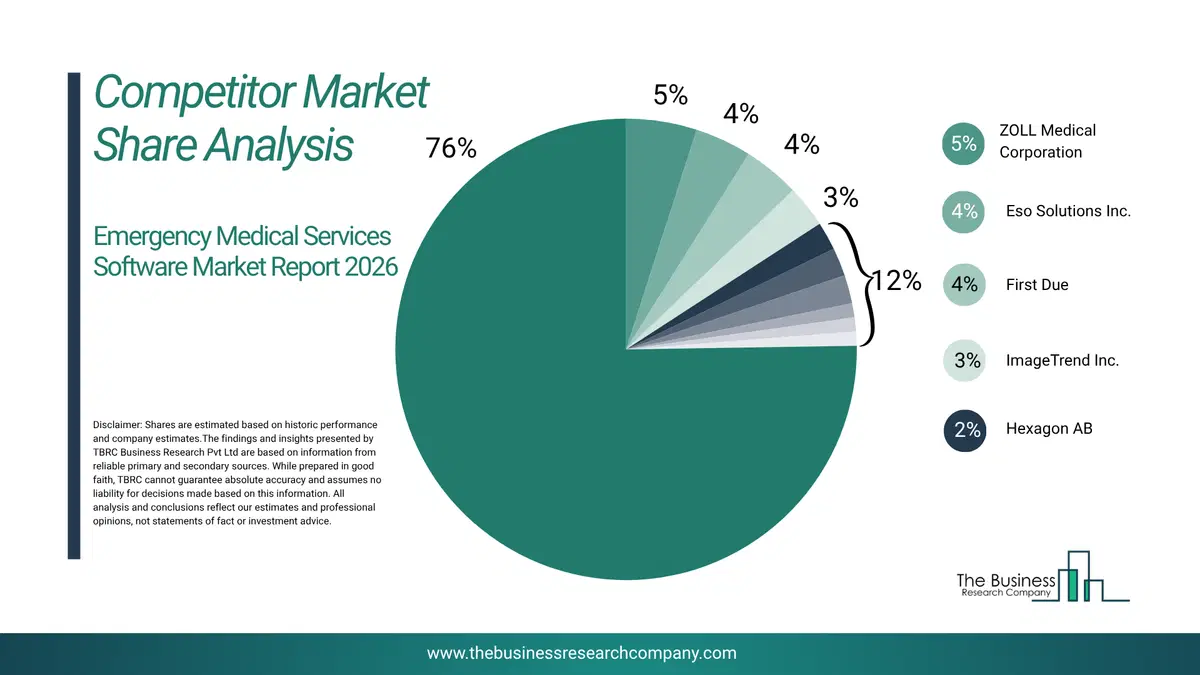
This chart is for illustrative purposes; the full report includes a detailed competitor analysis and comprehensive overview of the top 10 companies in the market.
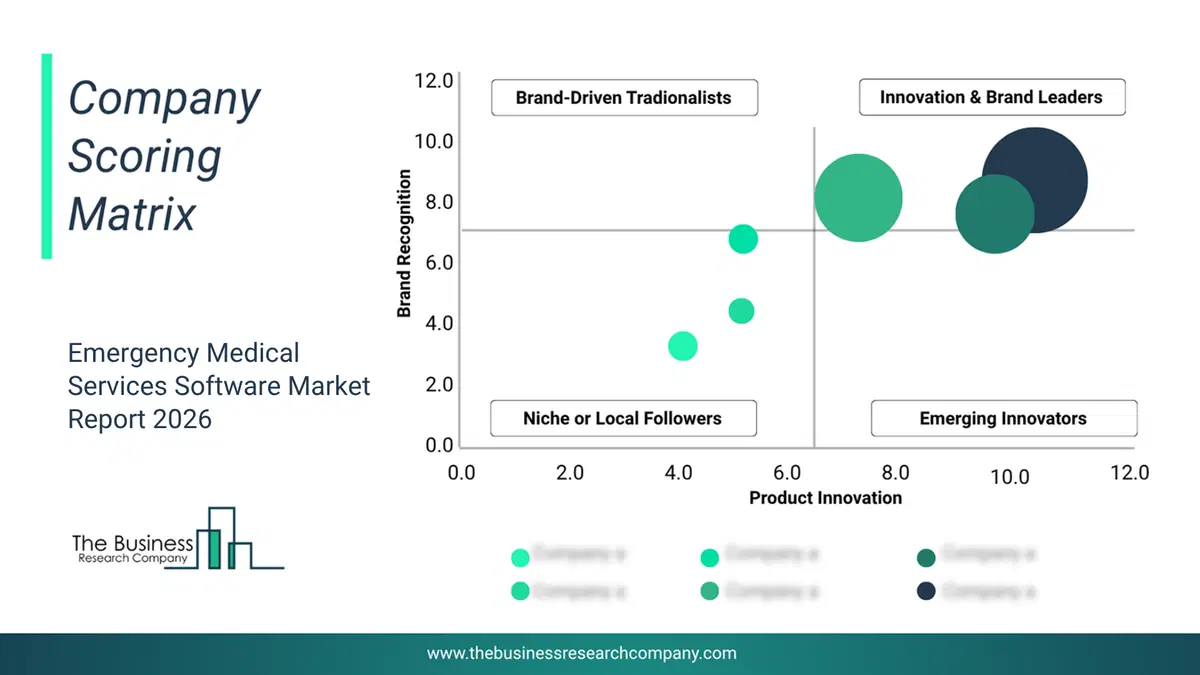
This chart maps companies by product innovation and brand strength, with bubble size indicating relative revenue, helping identify market leaders, challengers, and niche players. This is an illustrative chart; the full report provides a complete and accurate competitive analysis.
Global Emergency Medical Services Software Market Trends and Insights
Major companies operating in the emergency medical services software market are focusing on aligning their platforms with evolving national incident data standards such as NEMSIS and the National Emergency Response Information System (NERIS) to improve data quality and usability. NEMSIS-compliant and NERIS-aligned data architectures are standardized digital frameworks designed to structure, validate, and exchange emergency medical and fire incident data in accordance with federal and state reporting requirements. For instance, in April 2024, ImageTrend, a US -based public safety and healthcare software company, issued a policy position statement outlining its approach to NERIS data flow within its EMS and fire data platform. The company emphasized support for NERIS modernization while advocating for a state-centric data submission model, where incident data continues to flow from local agencies to state systems before being shared with NERIS. This initiative highlights ImageTrend’s implementation of NERIS-aligned data frameworks and transition resources within its software to help EMS and fire agencies adapt to the National Emergency Response Information System while maintaining data governance, interoperability, and compliance with evolving federal reporting requirements.What Are Latest Mergers And Acquisitions In The Emergency Medical Services Software Market?
In July 2025, Tyler Technologies Inc., a US-based provider of integrated public sector software and technology services, acquired Emergency Networking Inc. for an undisclosed amount. With this acquisition, Tyler Technologies aimed to expand its public safety and EMS software suite to support new federal emergency reporting requirements and strengthen its records management and analytics offerings for EMS and fire agencies. Emergency Networking Inc. is a US-based provider of emergency medical services–related software.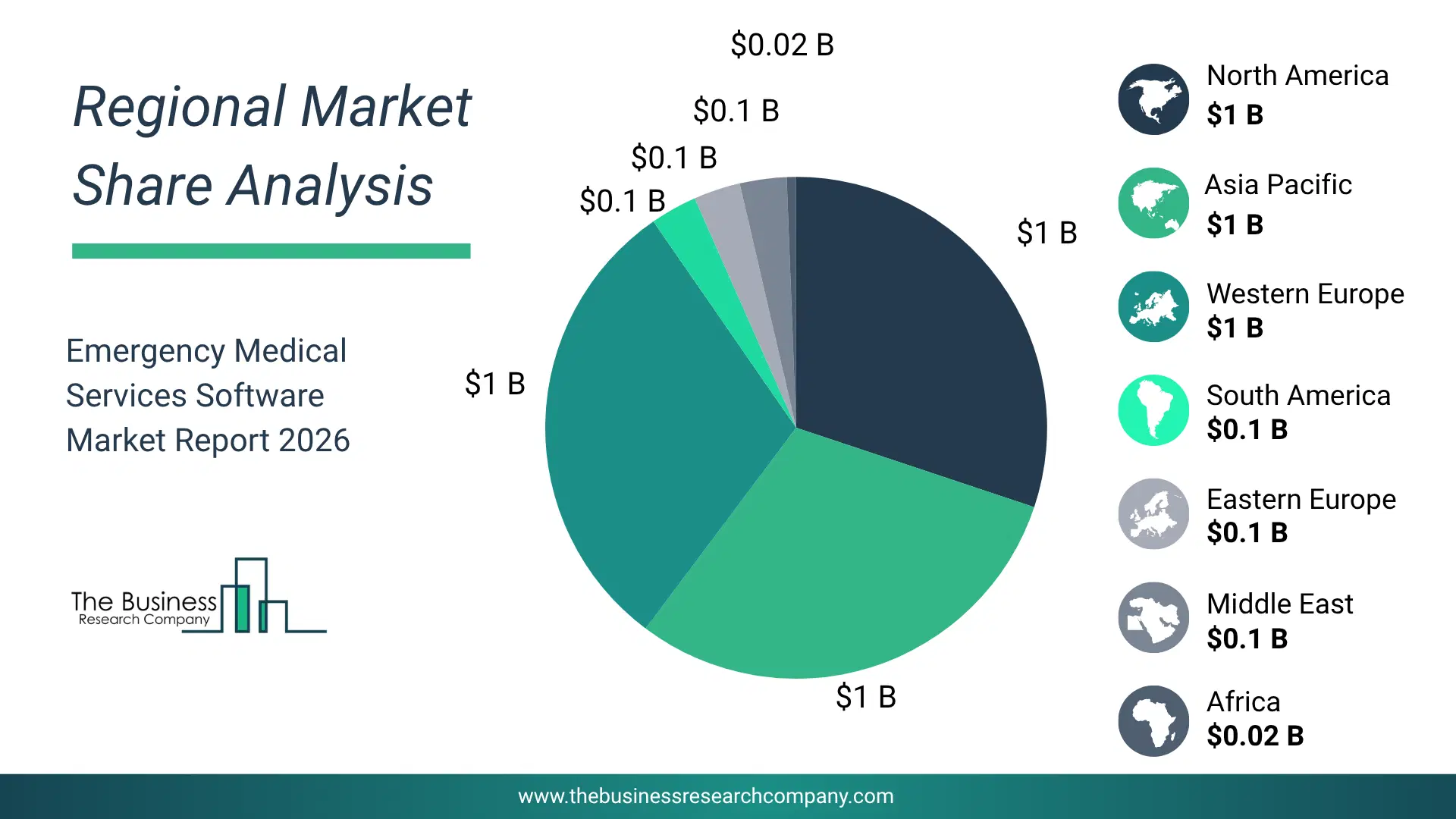
Regional Outlook
North America was the largest region in the emergency medical services software market in 2025. Asia-Pacific is expected to be the fastest-growing region in the forecast period. The regions covered in this market report are Asia-Pacific, South East Asia, Western Europe, Eastern Europe, North America, South America, Middle East, Africa. The countries covered in this market report are Australia, Brazil, China, France, Germany, India, Indonesia, Japan, Taiwan, Russia, South Korea, UK, USA, Canada, Italy, Spain.What Defines the Emergency Medical Services Software Market?
The emergency medical services software market consists of revenues earned by entities by providing services such as computer-aided dispatch, patient care reporting, emergency response coordination, resource and fleet management, real-time communication, data analytics and reporting, and technical support and maintenance services. The market value includes the value of related goods sold by the service provider or included within the service offering. The emergency medical services software market also includes sales of real-time communication tools, fleet and resource management solutions, data analytics and reporting tools, and integrated emergency response software solutions. Values in this market are ‘factory gate’ values, that is, the value of goods sold by the manufacturers or creators of the goods, whether to other entities (including downstream manufacturers, wholesalers, distributors, and retailers) or directly to end customers. The value of goods in this market includes related services sold by the creators of the goods.How is Market Value Defined and Measured?
The market value is defined as the revenues that enterprises gain from the sale of goods and/or services within the specified market and geography through sales, grants, or donations in terms of the currency (in USD unless otherwise specified). The revenues for a specified geography are consumption values that are revenues generated by organizations in the specified geography within the market, irrespective of where they are produced. It does not include revenues from resales along the supply chain, either further along the supply chain or as part of other products.
This chart presents market attractiveness based on a quantitative evaluation of growth, competition, strategic alignment, and risk, offering a clear view of opportunity areas for decision-making. This chart is for illustrative purposes; the full report contains the complete analysis.

This chart highlights the Total Addressable Market (TAM) by estimating the maximum revenue opportunity using an assumption-driven approach, supporting strategic planning and opportunity sizing across markets. The chart is illustrative; the full report provides a more comprehensive analysis.
What Key Data and Analysis Are Included in the Emergency Medical Services Software Market Report 2026?
The emergency medical services software market research report is one of a series of new reports from The Business Research Company that provides market statistics, including industry global market size, regional shares, competitors with the market share, detailed market segments, market trends and opportunities, and any further data you may need to thrive in the emergency medical services software industry. The market research report delivers a complete perspective of everything you need, with an in-depth analysis of the current and future state of the industry.Emergency Medical Services Software Market Report Forecast Analysis
| Report Attribute | Details |
|---|---|
| Market Size Value In 2026 | $2.44 billion |
| Revenue Forecast In 2030 | $3.6 billion |
| Growth Rate | CAGR of 10.0% from 2026 to 2030 |
| Base Year For Estimation | 2025 |
| Actual Estimates/Historical Data | 2020-2025 |
| Forecast Period | 2026 - 2030 - 2035 |
| Market Representation | Revenue in USD Billion and CAGR from 2026 to 2030 |
| Segments Covered | Product Type, Deployment Mode, Functionality, Application, End User |
| Regional Scope | Asia-Pacific, Western Europe, Eastern Europe, North America, South America, Middle East, Africa |
| Country Scope | The countries covered in the report are Australia, Brazil, China, France, Germany, India, Indonesia, Japan, Taiwan, Russia, South Korea, UK, USA, Canada, Italy, Spain. |
| Key Companies Profiled | Motorola Solutions Incorporation, Hexagon AB, Tyler Technologies Inc., Eso Solutions Inc., ZOLL Medical Corporation, ImageTrend Inc., Forte Holdings Inc., Sansio, Emergency Reporting, Digitech Computer Inc., Ortivus AB, Traumasoft Inc., AngelTrack LLC, MP Cloud Technologies Inc., AIM System, EPIC EMS, Documed Systems International Inc., Healthware Corp., Macrologic Inc., Emergidata. |
| Customization Scope | Request for Customization |
| Pricing And Purchase Options | Explore Purchase Options |