
Emission Control Catalysts Market Report 2026
Global Outlook – By Product (Palladium-based ECC, Platinum-based ECC, Rhodium-based ECC, Other Products), By Fuel Type (Diesel Vehicles, Gasoline Vehicles), By Application (Mobile Emission Control Catalysts, Stationary Emission Control Catalysts), By End User (Automotive and Transportation, Power Industry, Other End Users) – Market Size, Trends, Strategies, and Forecast to 2030
Emission Control Catalysts Market Overview
• Emission Control Catalysts market size has reached to $29.48 billion in 2025 • Expected to grow to $49.94 billion in 2030 at a compound annual growth rate (CAGR) of 11% • Growth Driver: Stringent Air Pollution Regulations Boost Demand For Emission Control Catalysts • Market Trend: Production Expansion Strategy Drives Emission Control Catalysts Market Growth • Asia-Pacific was the largest region in 2025 and North America is the fastest growing region.What Is Covered Under Emission Control Catalysts Market?
The emission control catalysts are used to control the harmful pollutants generated by combustion engines. Emission control catalysts break down the solid particulates from exhaust systems of industrial machinery and vehicles to reduce the content of pollutants generated into the environment. Emission control catalysts are simple and offer low-maintenance operation, durability, a relatively low cost, and negligible adverse effects on the engines. The main types of products in emission control catalysts are palladium-based ECC, platinum-based ECC, rhodium-based ECC, and others. Palladium-based ECC undergoes catalyst reactions and produces carbon-carbon bonds, which are used in electronic connectors. The different fuel types include diesel vehicles and gasoline vehicles. The various applications include mobile emission control catalysts and stationary emission control catalysts and are used in several areas, such as automotive and transportation, the chemical industry, the oil and gas industry, the mining industry, the power industry, and other end users.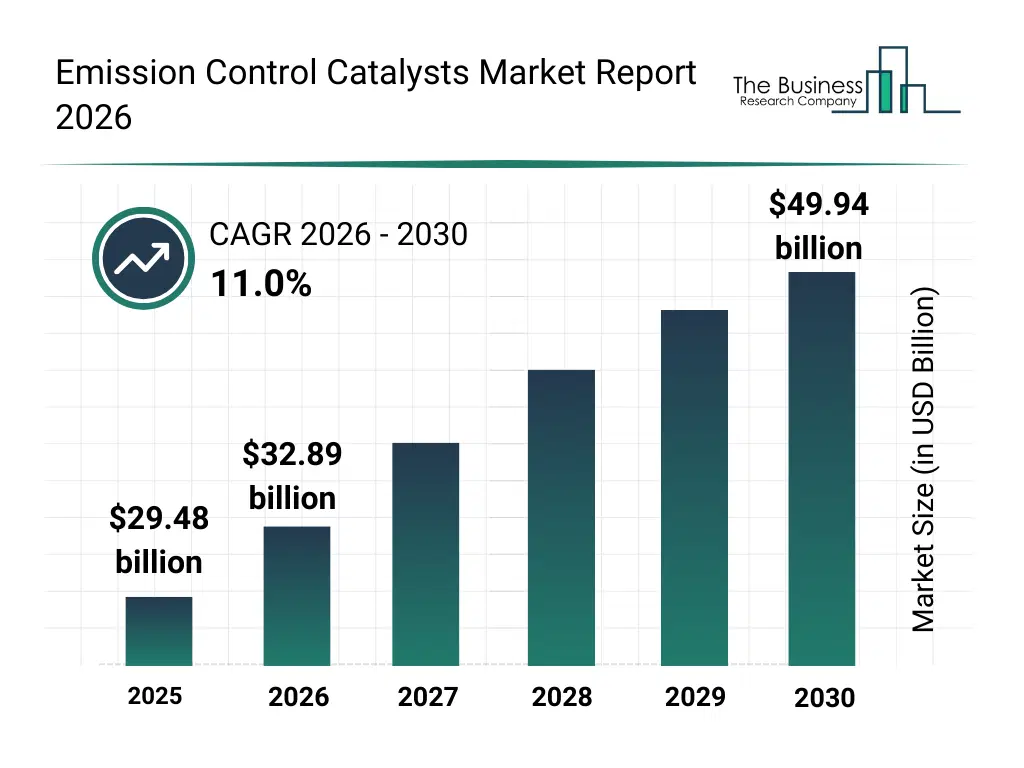
What Is The Emission Control Catalysts Market Size and Share 2026?
The emission control catalysts market size has grown rapidly in recent years. It will grow from $29.48 billion in 2025 to $32.89 billion in 2026 at a compound annual growth rate (CAGR) of 11.6%. The growth in the historic period can be attributed to stricter environmental emission regulations, expansion of automotive production volumes, growth in industrial combustion equipment, rising adoption of diesel emission controls, improvements in catalyst coating technologies.What Is The Emission Control Catalysts Market Growth Forecast?
The emission control catalysts market size is expected to see rapid growth in the next few years. It will grow to $49.94 billion in 2030 at a compound annual growth rate (CAGR) of 11.0%. The growth in the forecast period can be attributed to increasing tightening of emission norms worldwide, rising adoption of low-emission industrial processes, expansion of electric and hybrid vehicle platforms, growing investments in catalyst recycling, increasing focus on cost-effective emission reduction. Major trends in the forecast period include increasing adoption of advanced catalyst formulations, rising use of precious metal optimization techniques, growing demand for industrial emission control, expansion of stationary emission applications, enhanced catalyst durability and efficiency.
Global Emission Control Catalysts Market Segmentation
1) By Product: Palladium-based ECC, Platinum-based ECC, Rhodium-based ECC, Other Products 2) By Fuel Type: Diesel Vehicles, Gasoline Vehicles 3) By Application: Mobile Emission Control Catalysts, Stationary Emission Control Catalysts 4) By End User: Automotive and Transportation, Power Industry, Other End Users Subsegments: 1) By Palladium-based ECC: Palladium Catalyst for Gasoline Engines, Palladium Catalyst for Diesel Engines 2) By Platinum-based ECC: Platinum Catalyst for Gasoline Engines, Platinum Catalyst for Diesel Engines 3) By Rhodium-based ECC: Rhodium Catalyst for Gasoline Engines, Rhodium Catalyst for Diesel Engines 4) By Other Products: Mixed Metal Catalysts, Base Metal Catalysts, Catalyst Supports and CarriersWhat Is The Driver Of The Emission Control Catalysts Market?
Stringent regulations for controlling air pollution are significantly contributing to the growth of the market for emission control catalysts. Air pollution is mainly caused by rapid industrialization and urbanization, which are responsible for higher emissions in the environment. The governments are more concerned about the adverse effects of air pollution on public health and the environment, so they have implemented regulations to control air pollution, and this has increased the demand for the use of emission control catalysts in the exhaust systems of industrial machinery and vehicles. For instance, in September 2023, according to the United Nations Environment Programme (UNEP), a US-based government body, air pollution is the greatest environmental threat to public health globally and accounts for more than 8 million premature deaths every year. Therefore, the stringent regulations for controlling air pollution are expected to propel the growth of the emission control catalysts industry going forward.Key Players In The Global Emission Control Catalysts Market
Major companies operating in the emission control catalysts market are BASF SE, Johnson Matthey plc, Clariant AG, Tenneco Inc., Cataler Corporation, Heraeus Holding GmbH, Innovative Emissions Control Inc., DCL International Inc., Interkat Catalyst GmbH, Sinocat Environmental Technology Co. Ltd., Umicore SA, Corning Incorporated, Kunming Sino-Platinum Metals Catalyst Co. Ltd., NGK Insulators Ltd., Clean Diesel Technologies Advanced Materials Inc., Eberspaecher Group, Hug Engineering AG, Katcon Global S.A. de C.V., Emitec Technologies India Private Limited, Honeywell International Inc., Albemarle Corporation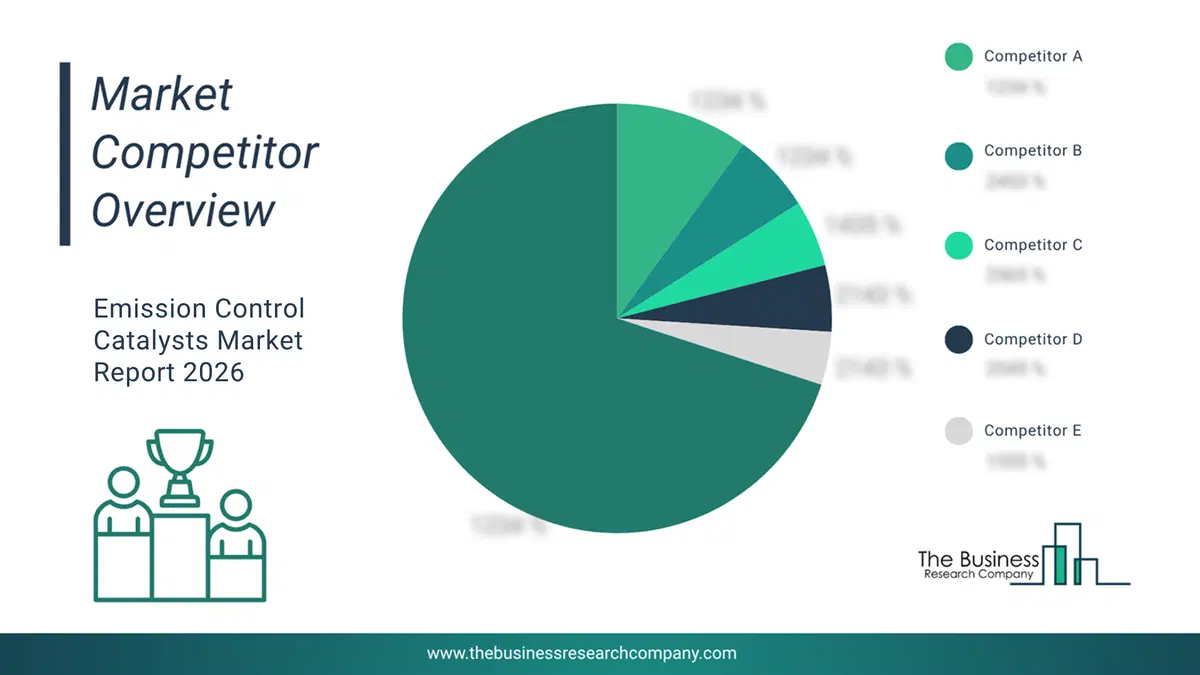
This chart is for illustrative purposes; the full report includes a detailed competitor analysis and comprehensive overview of the top 10 companies in the market.
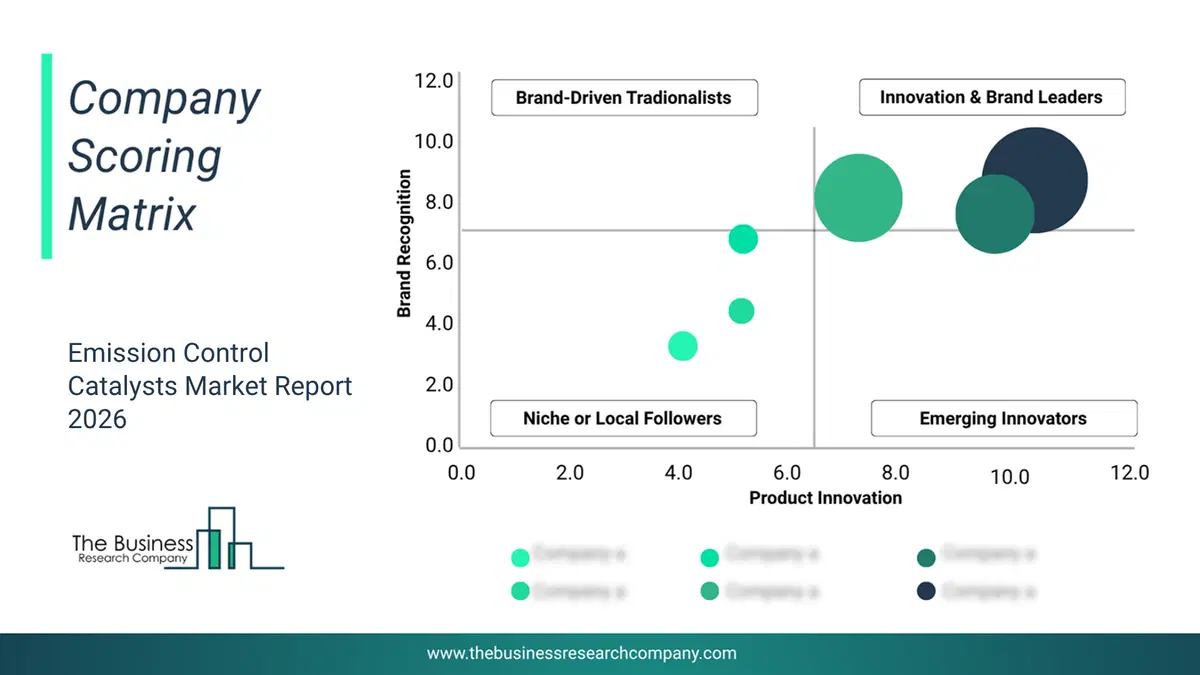
This chart maps companies by product innovation and brand strength, with bubble size indicating relative revenue, helping identify market leaders, challengers, and niche players. This is an illustrative chart; the full report provides a complete and accurate competitive analysis.
Global Emission Control Catalysts Market Trends and Insights
Major companies operating in the Emission Control Catalysts market are focusing on developing innovative solutions, such as automotive emissions control solutions to reduce harmful pollutants like nitrogen oxides (NOx), carbon monoxide (CO), and hydrocarbons (HC). Automotive emissions control solutions refer to technologies and systems designed to reduce or eliminate harmful pollutants emitted by vehicles. For instance, in August 2024, Boff Catalyst India Mountain. Ltd., an India-based chemicals manufacturing company, announced it inaugurated a new Research, Development, and Application (RD&A) laboratory aimed at enhancing automotive emissions control solutions. This cutting-edge facility seeks to create novel catalyst technologies that meet strict emission standards, including Euro 7 and Bharat Stage VI (BS6). The lab will be able to conduct thorough validation procedures for different catalysts used in gasoline and diesel engines because it is outfitted with sophisticated testing capabilities.What Are Latest Mergers And Acquisitions In The Emission Control Catalysts Market?
In September 2024, TPG Capital, a US-based private equity company, acquired Miratech for an undisclosed amount. Through this acquisition, TPG aims to enhance emissions reduction solutions to meet the rising power demands from data centers driven by AI and cloud migration, while aligning with TPG's focus on negative emissions technologies and addressing regulatory pressures for cleaner energy solutions. Miratech, a US-based industrial emissions reduction tech company.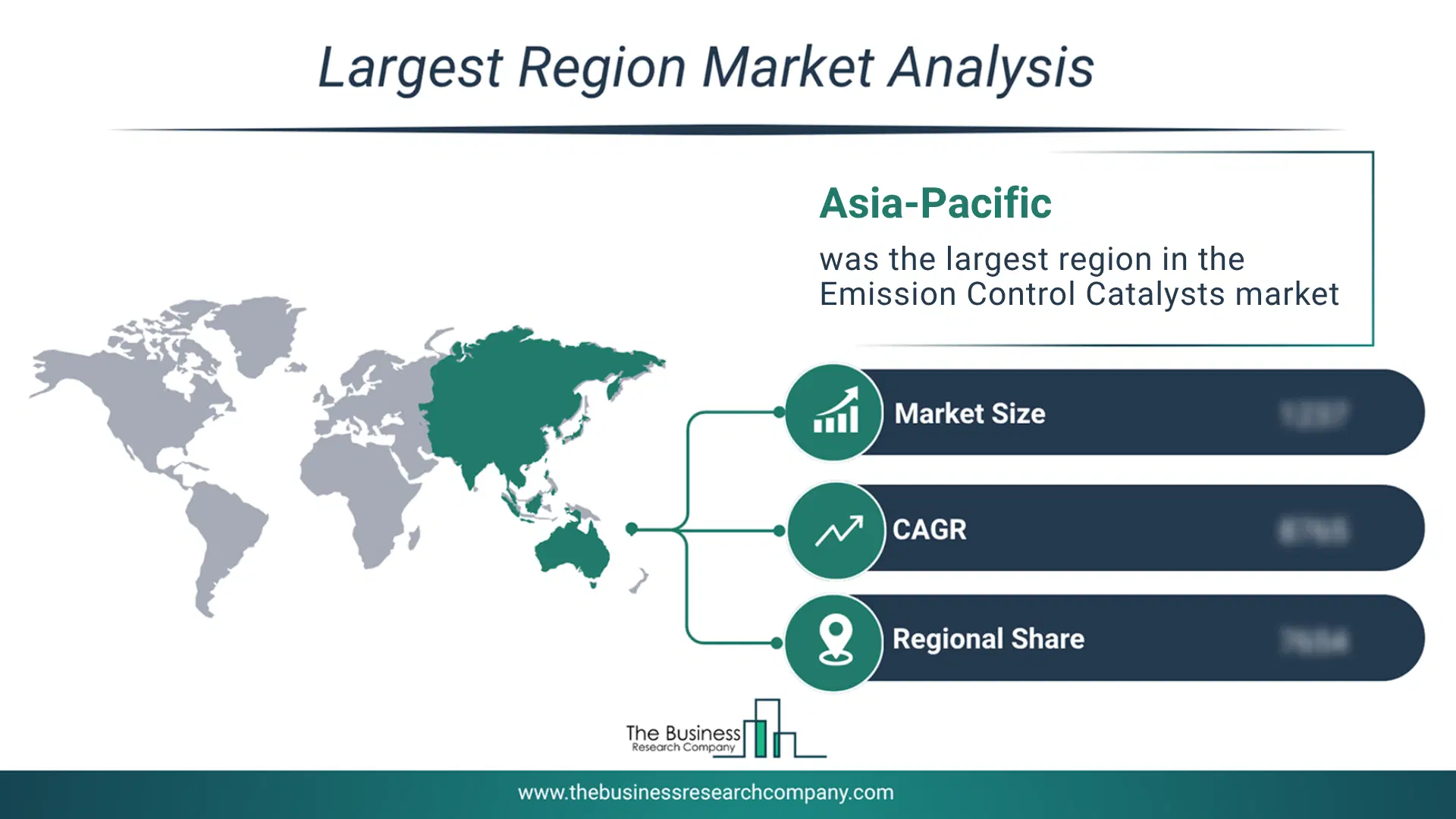
Regional Insights
Asia-Pacific was the largest region in the emission control catalysts market in 2025. Asia-Pacific is expected to be the fastest-growing region in the emission control catalysts market during the forecast period. The regions covered in this market report are Asia-Pacific, South East Asia, Western Europe, Eastern Europe, North America, South America, Middle East, Africa The countries covered in this market report are Australia, Brazil, China, France, Germany, India, Indonesia, Japan, Taiwan, Russia, South Korea, UK, USA, Canada, Italy, SpainWhat Defines the Emission Control Catalysts Market?
The emission control catalysts market consists of sales of emission control catalysts including iridium, ruthenium, and vanadium. Values in this market are ‘factory gate’ values, that is, the value of goods sold by the manufacturers or creators of the goods, whether to other entities (including downstream manufacturers, wholesalers, distributors, and retailers) or directly to end customers. The value of goods in this market includes related services sold by the creators of the goods.How is Market Value Defined and Measured?
The market value is defined as the revenues that enterprises gain from the sale of goods and/or services within the specified market and geography through sales, grants, or donations in terms of the currency (in USD unless otherwise specified). The revenues for a specified geography are consumption values that are revenues generated by organizations in the specified geography within the market, irrespective of where they are produced. It does not include revenues from resales along the supply chain, either further along the supply chain or as part of other products.
This chart presents market attractiveness based on a quantitative evaluation of growth, competition, strategic alignment, and risk, offering a clear view of opportunity areas for decision-making. This chart is for illustrative purposes; the full report contains the complete analysis.

This chart highlights the Total Addressable Market (TAM) by estimating the maximum revenue opportunity using an assumption-driven approach, supporting strategic planning and opportunity sizing across markets. The chart is illustrative; the full report provides a more comprehensive analysis.
What Key Data and Analysis Are Included in the Emission Control Catalysts Market Report 2026?
The emission control catalysts market research report is one of a series of new reports from The Business Research Company that provides market statistics, including industry global market size, regional shares, competitors with the market share, detailed market segments, market trends and opportunities, and any further data you may need to thrive in the emission control catalysts industry. The market research report delivers a complete perspective of everything you need, with an in-depth analysis of the current and future state of the industry.Emission Control Catalysts Market Report Forecast Analysis
| Report Attribute | Details |
|---|---|
| Market Size Value In 2026 | $32.89 billion |
| Revenue Forecast In 2030 | $49.94 billion |
| Growth Rate | CAGR of 11.6% from 2026 to 2030 |
| Base Year For Estimation | 2025 |
| Actual Estimates/Historical Data | 2020-2025 |
| Forecast Period | 2026 - 2030 |
| Market Representation | Revenue in USD Billion and CAGR from 2026 to 2030 |
| Segments Covered | Product, Fuel Type, Application, End User |
| Regional Scope | Asia-Pacific, Western Europe, Eastern Europe, North America, South America, Middle East, Africa |
| Country Scope | The countries covered in this market report are Australia, Brazil, China, France, Germany, India, Indonesia, Japan, Taiwan, Russia, South Korea, UK, USA, Canada, Italy, Spain |
| Key Companies Profiled | BASF SE, Johnson Matthey plc, Clariant AG, Tenneco Inc., Cataler Corporation, Heraeus Holding GmbH, Innovative Emissions Control Inc., DCL International Inc., Interkat Catalyst GmbH, Sinocat Environmental Technology Co. Ltd., Umicore SA, Corning Incorporated, Kunming Sino-Platinum Metals Catalyst Co. Ltd., NGK Insulators Ltd., Clean Diesel Technologies Advanced Materials Inc., Eberspaecher Group, Hug Engineering AG, Katcon Global S.A. de C.V., Emitec Technologies India Private Limited, Honeywell International Inc., Albemarle Corporation |
| Customization Scope | Request for Customization |
| Pricing And Purchase Options | Explore Purchase Options |