
Emulsion Polymer Market Report 2026
Global Outlook – By Product Type (Acrylic Emulsions, Styrene Butadiene Latex, Vinyl Acetate Emulsions, Vinyl Acetate Ethylene Emulsions, Polyurethane Dispersions, Nitrile Latex, Other Product Types), By Solid Content (Low Solids, Medium Solids, High Solids), By End Use Industry (Building And Construction, Packaging, Automotive And Transportation, Textile, Paper And Pulp, Consumer Goods, Other End Use Industries) – Market Size, Trends, Strategies, and Forecast to 2030
Emulsion Polymer Market Overview
• Emulsion Polymer market size has reached to $38.2 billion in 2025 • Expected to grow to $52.69 billion in 2030 at a compound annual growth rate (CAGR) of 6.6% • Growth Driver: Expansion Of Construction Activities Driving The Growth Of The Market Due To Rapid Urbanization And Population Growth • Market Trend: Innovation In All-Acrylic Polymer Emulsions Enhances Adhesive Performance And Clean Removability • Asia-Pacific was the largest region and fastest growing region.What Is Covered Under Emulsion Polymer Market?
Emulsion polymer refers to a polymer produced through the polymerization of monomers dispersed in an aqueous medium, typically stabilized by surfactants or emulsifiers. It forms a stable polymer dispersion that provides properties such as durability, flexibility, adhesion, and chemical resistance for various industrial applications. The main product types of emulsion polymers include acrylic emulsions, styrene butadiene latex, vinyl acetate emulsions, vinyl acetate ethylene emulsions, polyurethane dispersions, nitrile latex, and other product types. Acrylic emulsions are water-based polymer dispersions formed by polymerizing acrylic monomers to provide adhesion, flexibility, durability, and film-forming properties. These polymers are available in low solids, medium solids, and high solids formulations and are end use industries such as building and construction, packaging, automotive and transportation, textile, paper and pulp, consumer goods, and others.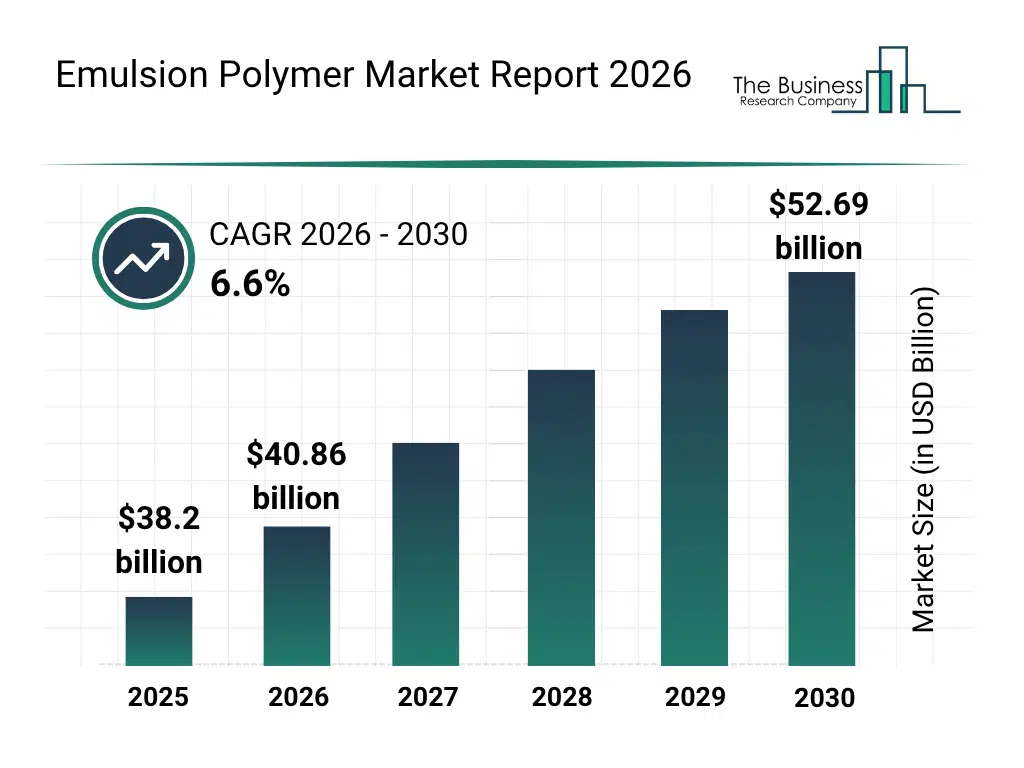
What Is The Emulsion Polymer Market Size and Share 2026?
The emulsion polymer market size has grown strongly in recent years. It will grow from $38.2 billion in 2025 to $40.86 billion in 2026 at a compound annual growth rate (CAGR) of 7.0%. The growth in the historic period can be attributed to rising demand for water-based coatings, increasing construction activities, growth in packaging production, expansion of textile manufacturing, increasing paper and pulp production.What Is The Emulsion Polymer Market Growth Forecast?
The emulsion polymer market size is expected to see strong growth in the next few years. It will grow to $52.69 billion in 2030 at a compound annual growth rate (CAGR) of 6.6%. The growth in the forecast period can be attributed to growing demand for low-voc coatings and adhesives, increasing automotive production, rising consumption of flexible packaging, expansion of water-based polymer applications, growing demand for high-performance specialty polymers. Major trends in the forecast period include increasing development of high-performance emulsion polymers, growing demand for water-based polymer dispersions, rising adoption of low-voc emulsion polymer formulations, increasing use of specialty emulsion polymers for improved adhesion, development of emulsion polymers with enhanced chemical resistance.Tariff Impact On Emulsion Polymer Market
Tariffs are impacting the emulsion polymer market by increasing the cost of imported monomers, surfactants, emulsifiers, initiators, additives, specialty chemicals, and polymer processing equipment. This is slowing the expansion of water-based coatings, adhesives, and polymer applications, particularly in regions dependent on imported raw materials such as Asia-Pacific and Europe. Material-intensive segments such as acrylic emulsions, styrene butadiene latex, vinyl acetate emulsions, and polyurethane dispersions are most affected due to global supply chain dependencies across building and construction, packaging, automotive and transportation, and textile industries. However, tariffs are also encouraging local manufacturing, regional supplier diversification, domestic raw material sourcing, and increased investment in localized emulsion polymer production, creating long-term resilience in the market.
Global Emulsion Polymer Market Segmentation
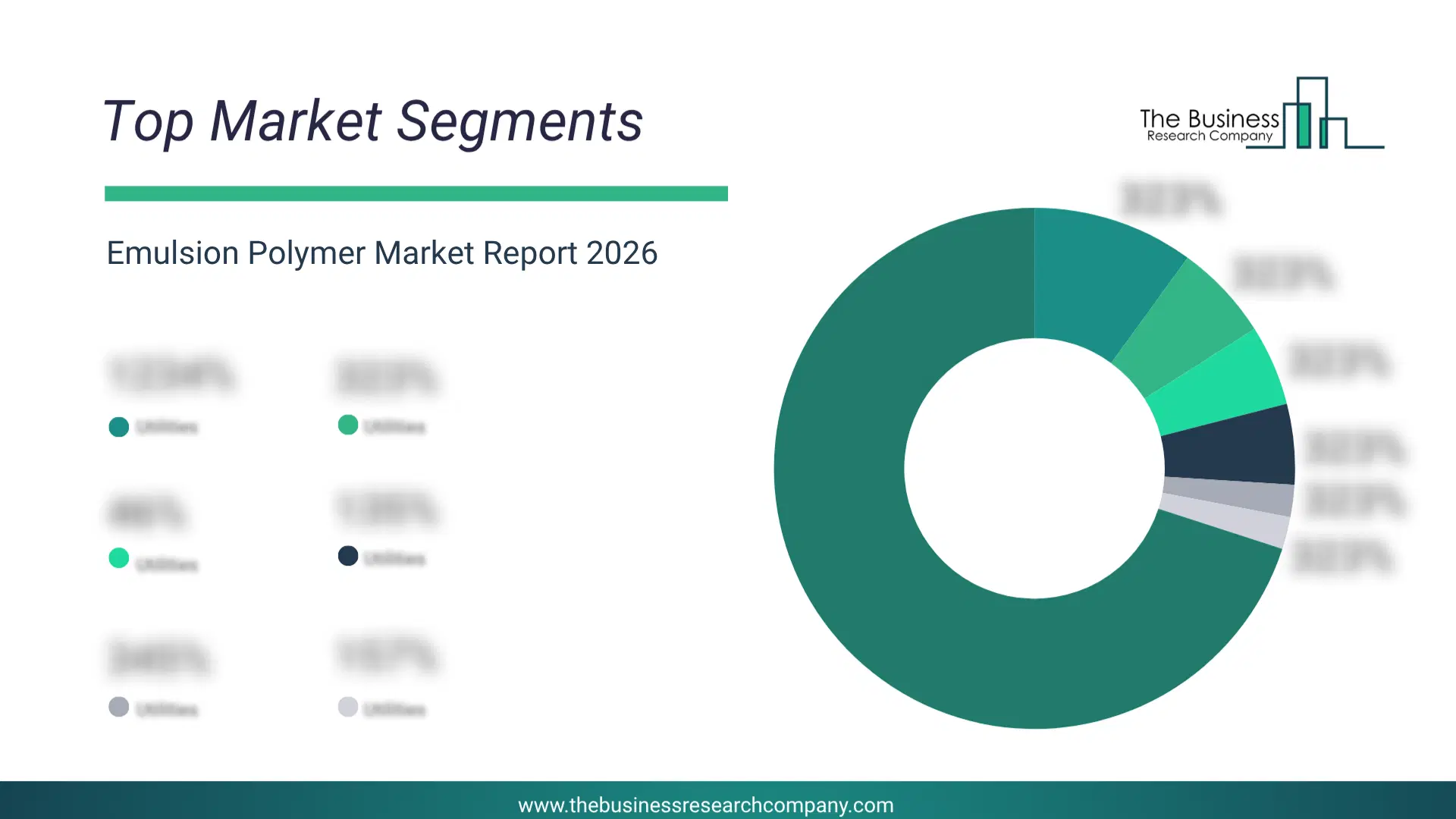
1) By Product Type: Acrylic Emulsions, Styrene Butadiene Latex, Vinyl Acetate Emulsions, Vinyl Acetate Ethylene Emulsions, Polyurethane Dispersions, Nitrile Latex, Other Product Types 2) By Solid Content: Low Solids, Medium Solids, High Solids 3) By End Use Industry: Building And Construction, Packaging, Automotive And Transportation, Textile, Paper And Pulp, Consumer Goods, Other End Use Industries Subsegments: 1) By Acrylic Emulsions: Pure Acrylic Emulsions, Styrene Acrylic Emulsions, Vinyl Acrylic Emulsions 2) By Styrene Butadiene Latex: Carboxylated Styrene Butadiene Latex, Non Carboxylated Styrene Butadiene Latex, High Solids Styrene Butadiene Latex 3) By Vinyl Acetate Emulsions: Homopolymer Vinyl Acetate Emulsions, Copolymer Vinyl Acetate Emulsions, Terpolymer Vinyl Acetate Emulsions 4) By Vinyl Acetate Ethylene Emulsions: Standard Vinyl Acetate Ethylene Emulsions, High Vinyl Acetate Ethylene Emulsions, Low Vinyl Acetate Ethylene Emulsions 5) By Polyurethane Dispersions: Anionic Polyurethane Dispersions, Cationic Polyurethane Dispersions, Nonionic Polyurethane Dispersions 6) By Nitrile Latex: Carboxylated Nitrile Latex, Non Carboxylated Nitrile Latex, Modified Nitrile Latex 7) By Other Product Types: Vinyl Chloride Emulsions, Silicone EmulsionsWhat Is The Driver Of The Emulsion Polymer Market?
The expansion of construction activities is expected to propel the growth of the emulsion polymer market going forward. Construction activities encompass the planning, development, renovation, and maintenance of residential, commercial, industrial, and infrastructure projects using a wide range of construction materials and engineering processes. The expansion of construction activities is due to rapid urbanization and population growth, as the increasing urban population creates a greater need for new buildings, housing, and urban infrastructure. The expansion of construction activities increases the demand for emulsion polymers, as these materials are widely used in construction applications such as paints, coatings, adhesives, and sealants due to their durability, flexibility, and water-resistance properties. For instance, in August 2025, according to Eurostat, a Luxembourg-based statistical office of the European Union, production in construction increased by 1.7% in the euro area in June 2025 compared with June 2024. Therefore, the expansion of construction activities is driving the growth of the emulsion polymer industry.Key Players In The Global Emulsion Polymer Market
Major companies operating in the emulsion polymer market are BASF SE, Dow Inc, Mitsubishi Chemical Group Corporation, Sumitomo Chemical Co Ltd, Celanese Corporation, Arkema SA, Mitsui Chemicals Inc, LG Chem Ltd, Syensqo SA, Asahi Kasei Corporation, Wacker Chemie AG, DIC Corporation, Kuraray Co Ltd, Clariant AG, JSR Corporation, Toagosei Co Ltd, Zeon Corporation, Kaneka Corporation, Nouryon Holding BV, Trinseo PLC, Hexion Inc, Momentive Performance Materials Inc, Synthomer PLC, Allnex GmbH, Dairen Chemical Corporation, Daicel Corporation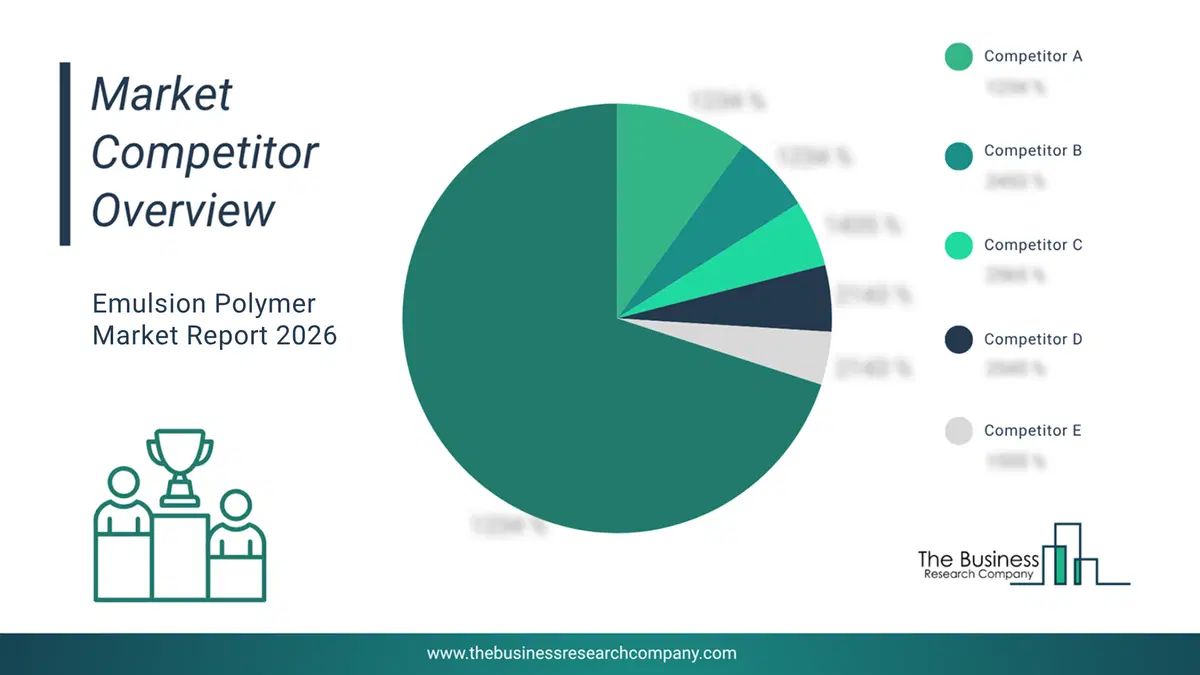
This chart is for illustrative purposes; the full report includes a detailed competitor analysis and comprehensive overview of the top 10 companies in the market.
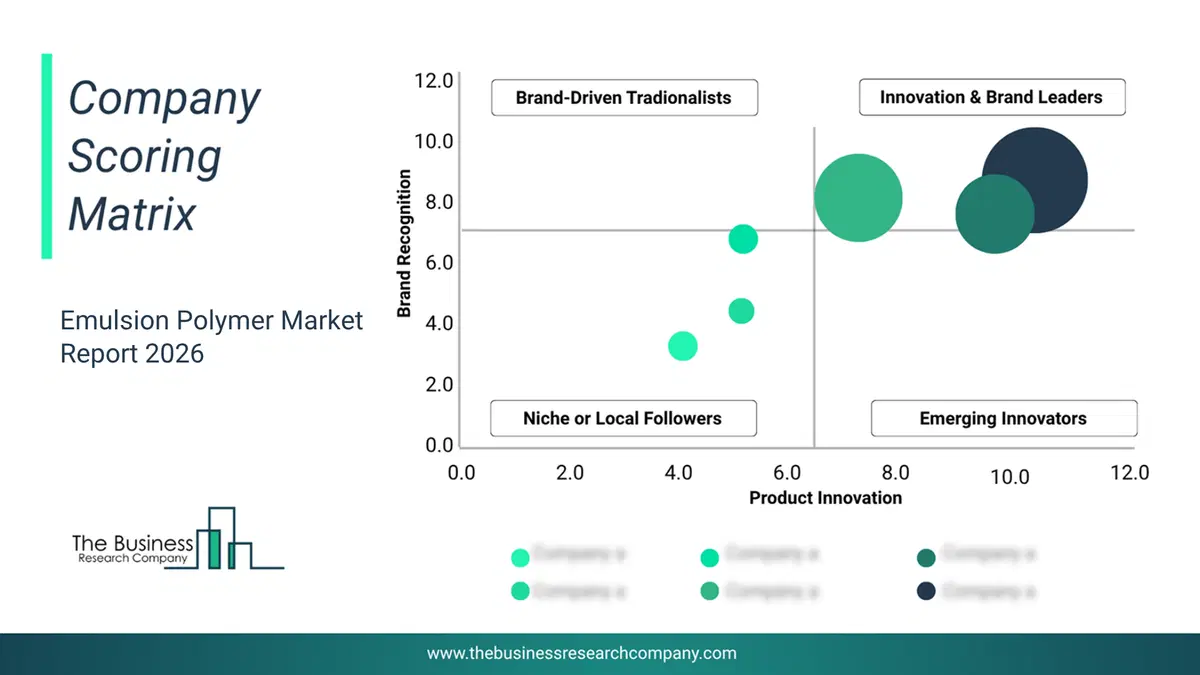
This chart maps companies by product innovation and brand strength, with bubble size indicating relative revenue, helping identify market leaders, challengers, and niche players. This is an illustrative chart; the full report provides a complete and accurate competitive analysis.
Global Emulsion Polymer Market Trends and Insights
Major companies operating in the emulsion polymer market are focusing on developing innovative solutions, such as all-acrylic polymer emulsions, to enhance adhesive performance, removability, shear strength, and application versatility. All-acrylic polymer emulsions are water-based acrylic polymer dispersions that provide pressure-sensitive adhesion while offering controlled peel, tack, and shear properties compared with conventional adhesive systems. For instance, in November 2025, Engineered Polymer Solutions (EPS), a US-based polymer solutions company, launched EPS 2157D, an all-acrylic polymer emulsion designed for removable pressure-sensitive adhesive (PSA) applications. The product provides moderate peel and tack combined with high shear performance, supporting strong adhesion while enabling clean removal. It delivers a soft peel compared with products offering similar peel and tack but producing a harder, zip-like peel. EPS 2157D also offers low foaming, with a 180° peel of 2.2 lbs/in, loop tack of 2.3 lbs/in, and static shear exceeding 10,000 minutes. With a solids content of approximately 52.5% and a glass transition temperature of −40°C, the emulsion is suitable for protective films, tapes, labels, and removable PSAs, including protective masking for appliances, doors, and glass.What Are Latest Mergers And Acquisitions In The Emulsion Polymer Market?
In June 2026, Archroma, a Switzerland-based provider of specialty chemicals, sustainable solutions, and advanced polymer dispersions for coatings, adhesives, textiles, and industrial applications, entered into a strategic distribution partnership with TER Chemicals to expand the availability of Archroma’s advanced polymer dispersions across the European market. With this partnership, both companies aim to strengthen the distribution network for high-performance emulsion polymer solutions and enhance customer access to sustainable polymer dispersion technologies for applications such as paints and coatings, construction adhesives, and sealants. TER Chemicals GmbH & Co. KG is a Germany-based provider of specialty chemical distribution services, offering a broad portfolio of raw materials, additives, and performance chemicals to industries including coatings, adhesives, construction, and plastics.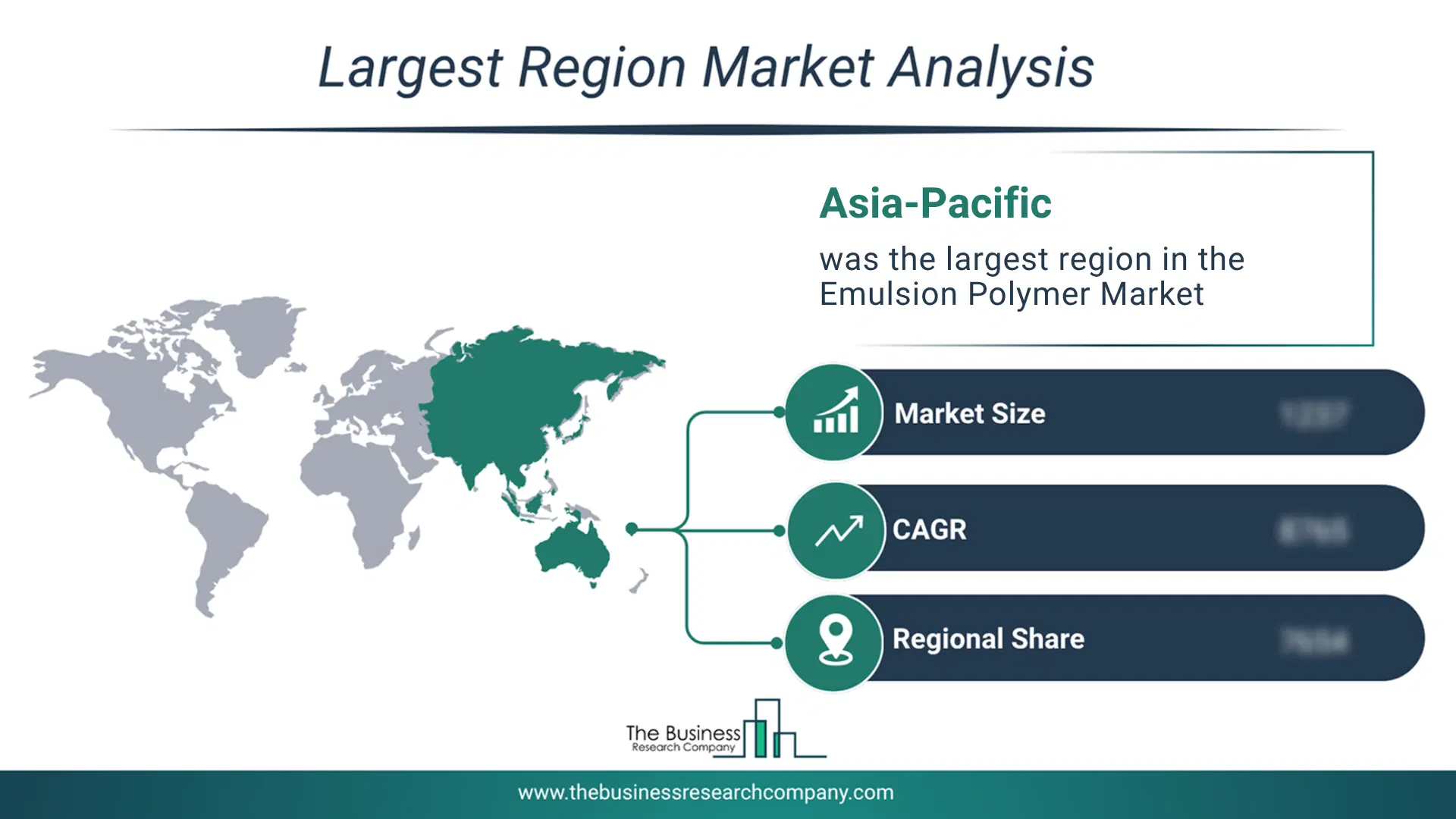
Regional Outlook
Asia-Pacific was the largest region in the emulsion polymer market in 2025. Asia-Pacific is expected to be the fastest-growing region in the forecast period. The regions covered in this market report are Asia-Pacific, South East Asia, Western Europe, Eastern Europe, North America, South America, Middle East, Africa. The countries covered in this market report are Australia, Brazil, China, France, Germany, India, Indonesia, Japan, Taiwan, Russia, South Korea, UK, USA, Canada, Italy, Spain.What Defines the Emulsion Polymer Market?
The emulsion polymer market consists of sales of styrene-acrylic polymers, ethylene-vinyl acetate copolymers, acrylonitrile-based emulsion polymers, chloroprene emulsion polymers, and silicone-based emulsion polymers. Values in this market are ‘factory gate’ values, that is, the value of goods sold by the manufacturers or creators of the goods, whether to other entities (including downstream manufacturers, wholesalers, distributors, and retailers) or directly to end customers. The value of goods in this market includes related services sold by the creators of the goods.How is Market Value Defined and Measured?
The market value is defined as the revenues that enterprises gain from the sale of goods and/or services within the specified market and geography through sales, grants, or donations in terms of the currency (in USD unless otherwise specified). The revenues for a specified geography are consumption values that are revenues generated by organizations in the specified geography within the market, irrespective of where they are produced. It does not include revenues from resales along the supply chain, either further along the supply chain or as part of other products.
This chart presents market attractiveness based on a quantitative evaluation of growth, competition, strategic alignment, and risk, offering a clear view of opportunity areas for decision-making. This chart is for illustrative purposes; the full report contains the complete analysis.

This chart highlights the Total Addressable Market (TAM) by estimating the maximum revenue opportunity using an assumption-driven approach, supporting strategic planning and opportunity sizing across markets. The chart is illustrative; the full report provides a more comprehensive analysis.
What Key Data and Analysis Are Included in the Emulsion Polymer Market Report 2026?
The emulsion polymer market research report is one of a series of new reports from The Business Research Company that provides market statistics, including industry global market size, regional shares, competitors with the market share, detailed market segments, market trends and opportunities, and any further data you may need to thrive in the emulsion polymer industry. The market research report delivers a complete perspective of everything you need, with an in-depth analysis of the current and future state of the industry.Emulsion Polymer Market Report Forecast Analysis
| Report Attribute | Details |
|---|---|
| Market Size Value In 2026 | $40.86 billion |
| Revenue Forecast In 2030 | $52.69 billion |
| Growth Rate | CAGR of 6.6% from 2026 to 2030 |
| Base Year For Estimation | 2025 |
| Actual Estimates/Historical Data | 2020-2025 |
| Forecast Period | 2026 - 2030 |
| Market Representation | Revenue in USD Billion and CAGR from 2026 to 2030 |
| Segments Covered | Product Type, Solid Content, End Use Industry |
| Regional Scope | Asia-Pacific, Western Europe, Eastern Europe, North America, South America, Middle East, Africa |
| Country Scope | The countries covered in the report are Australia, Brazil, China, France, Germany, India, Indonesia, Japan, Taiwan, Russia, South Korea, UK, USA, Canada, Italy, Spain. |
| Key Companies Profiled | BASF SE, Dow Inc, Mitsubishi Chemical Group Corporation, Sumitomo Chemical Co Ltd, Celanese Corporation, Arkema SA, Mitsui Chemicals Inc, LG Chem Ltd, Syensqo SA, Asahi Kasei Corporation, Wacker Chemie AG, DIC Corporation, Kuraray Co Ltd, Clariant AG, JSR Corporation, Toagosei Co Ltd, Zeon Corporation, Kaneka Corporation, Nouryon Holding BV, Trinseo PLC, Hexion Inc, Momentive Performance Materials Inc, Synthomer PLC, Allnex GmbH, Dairen Chemical Corporation, Daicel Corporation |
| Customization Scope | Request for Customization |
| Pricing And Purchase Options | Explore Purchase Options |