

Emulsion Stabilizers Market Report 2026
Global Outlook – By Type (Natural Stabilizers, Synthetic Stabilizers, Semi Synthetic Stabilizers, Other Types), By Function (Emulsifying Agents, Thickening Agents, Gelling Agents, Stabilizing Agents), By Form (Liquid Stabilizers, Powder Stabilizers, Gel Based Stabilizers, Other Forms), By Application (Food and Beverages, Cosmetics and Personal Care, Pharmaceuticals, Industrial Applications) – Market Size, Trends, Strategies, and Forecast to 2035
Emulsion Stabilizers Market Overview
• Emulsion Stabilizers market size has reached to $2.81 billion in 2025 • Expected to grow to $3.69 billion in 2030 at a compound annual growth rate (CAGR) of 5.7% • Growth Driver: Rising Bakery Product Consumption Fueling The Growth Of The Market Due To Increasing Demand For Improved Texture, Shelf Life, And Ingredient Stability • Market Trend: High-Pressure Homogenization Driving Innovation In Emulsion Stabilization • North America was the largest region in 2025 and Asia-Pacific is the fastest growing region.What Is Covered Under Emulsion Stabilizers Market?
Emulsion stabilizers refer to functional ingredients used to maintain the uniform dispersion of immiscible liquids, such as oil and water, in food, cosmetic, pharmaceutical, and industrial formulations. It is used to provide stability, texture enhancement, and extended shelf life in products across multiple industries by preventing phase separation and improving product consistency. The main types of emulsion stabilizers include natural stabilizers, synthetic stabilizers, semi synthetic stabilizers, and other types. Natural stabilizers refer to plant or bio-based compounds used to maintain the stability and consistency of emulsions in various formulations. They are categorized by function including emulsifying agents, thickening agents, gelling agents, and stabilizing agents. These are available in forms such as liquid stabilizers, powder stabilizers, gel based stabilizers, and others and the various applications involved are food and beverages, cosmetics and personal care, pharmaceuticals, and industrial applications.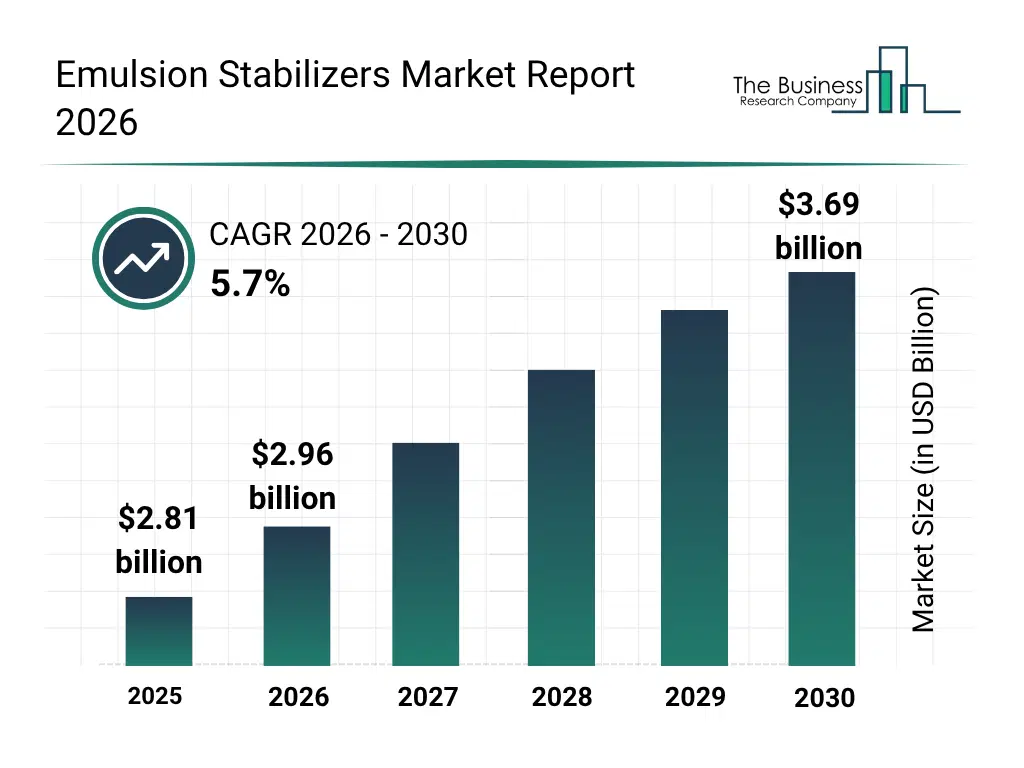
What Is The Emulsion Stabilizers Market Size and Share 2026?
The emulsion stabilizers market size has grown strongly in recent years. It will grow from $2.81 billion in 2025 to $2.96 billion in 2026 at a compound annual growth rate (CAGR) of 5.4%. The growth in the historic period can be attributed to growth in processed food consumption, rising demand for packaged cosmetics and personal care products, expansion of pharmaceutical formulation development, increasing use of synthetic emulsifiers in industrial applications, growing urbanization and lifestyle changes driving convenience foods.What Is The Emulsion Stabilizers Market Growth Forecast?
The emulsion stabilizers market size is expected to see strong growth in the next few years. It will grow to $3.69 billion in 2030 at a compound annual growth rate (CAGR) of 5.7%. The growth in the forecast period can be attributed to rising demand for clean label and natural ingredients, growth in biotechnology-based stabilizer innovations, increasing adoption of plant-derived emulsifiers, expansion of functional foods and nutraceuticals, innovation in nano structured and multifunctional stabilizer systems. Major trends in the forecast period include growing demand for clean label and natural emulsifier-based stabilizers, increasing use of plant-based functional ingredients in food and cosmetics, rising adoption of high-performance stabilizers in pharmaceutical formulations, expansion of processed and packaged food industries, growing focus on texture and shelf-life enhancement in consumer products.
Global Emulsion Stabilizers Market Segmentation
1) By Type: Natural Stabilizers, Synthetic Stabilizers, Semi Synthetic Stabilizers, Other Types 2) By Function: Emulsifying Agents, Thickening Agents, Gelling Agents, Stabilizing Agents 3) By Form: Liquid Stabilizers, Powder Stabilizers, Gel Based Stabilizers, Other Forms 4) By Application: Food and Beverages, Cosmetics and Personal Care, Pharmaceuticals, Industrial Applications Subsegments: 1) By Natural Stabilizers: Plant Derived Stabilizers, Animal Derived Stabilizers, Microbial Derived Stabilizers, Seaweed Derived Stabilizers, Fermentation Based Stabilizers 2) By Synthetic Stabilizers: Chemically Synthesized Emulsifiers, Petrochemical Based Stabilizers, Synthetic Polymer Stabilizers, Artificial Surface Active Agents 3) By Semi Synthetic Stabilizers: Modified Cellulose Stabilizers, Esterified Natural Stabilizers, Chemically Modified Starches, Partially Synthetic Hydrocolloids, Derivatized Protein Stabilizers 4) By Other Types: Hybrid Stabilizer Systems, Enzyme Modified Stabilizers, Nano Structured Stabilizers, Multi Functional Stabilizer Blends, Specialty Application StabilizersWhat Is The Driver Of The Emulsion Stabilizers Market?
The rise in bakery product consumption is expected to propel the growth of the emulsion stabilizers market going forward. Bakery products refer to food items such as bread, cakes, pastries, biscuits, and other baked goods that are prepared using flour, sugar, fats, and other ingredients and are either freshly baked or packaged for extended consumption. Consumption of these products is increasing due to changing dietary habits and growing demand for convenient and indulgent food options, particularly among working populations and younger consumers. Emulsion stabilizers support the growth of bakery products by improving dough stability, enhancing texture, maintaining moisture, and extending shelf life while ensuring uniform distribution of ingredients such as fats and water. For instance, in March 2026, according to the Agriculture and Agri-Food Canada, a Canada-based federal department responsible for supporting the country’s agriculture and agri-food sector, retail sales of baked goods demonstrated strong growth, reaching $8.7 billion (Can$11.8 billion) in 2024, with bread and pastries accounting for a significant share of this expansion. Therefore, the rise in bakery product consumption is driving the growth of the emulsion stabilizers industry.Key Players In The Global Emulsion Stabilizers Market
Major companies operating in the emulsion stabilizers market are Cargill Incorporated, Archer-Daniels-Midland Company, BASF SE, Evonik Industries AG, DuPont de Nemours Inc., Givaudan SA, Lonza Group AG, Kerry Group plc, Ingredion Incorporated, AAK AB, Tate & Lyle PLC, Ashland Inc., Corbion NV, CP Kelco US Inc., Riken Vitamin Co. Ltd., Palsgaard AS, Camlin Fine Sciences Limited, Lasenor Emul SL, Stearinerie Dubois SAS, Estelle Chemicals Private Limited.Global Emulsion Stabilizers Market Trends and Insights
Major companies operating in the emulsion stabilizers market are focusing on developing innovative solutions, such as high pressure homogenization, to enhance emulsion stability, improve texture and shelf life, and enable the development of clean-label, high-performance food and beverage formulations. High pressure homogenization is a mechanical process that forces liquid through narrow gaps at elevated pressure to create fine and uniform droplets, which enhances emulsion stability, improves texture, and extends product shelf life. For instance, in October 2024, Lubrizol Corporation, a US-based specialty chemicals company, launched Novemer CS polymer, an innovative polymeric emulsifier and emulsion stabilizer designed for versatile use across personal care applications such as skin care, sun care, and makeup. The product enables the formation of stable oil-in-water emulsions across low to high viscosity systems, enhances texture and sensory properties with a light, watery feel, and provides compatibility with UV filters and pigments, while also supporting precise control over formulation performance and stability.What Are Latest Mergers And Acquisitions In The Emulsion Stabilizers Market?
In November 2024, Tate & Lyle PLC, a UK-based provider of specialty food ingredients including sweeteners, texturants, and stabilizing systems, acquired CP Kelco for $1.8 billion. Through this acquisition, Tate & Lyle aims to strengthen its position in texture and stabilization solutions by expanding its portfolio of hydrocolloids and enhancing its capabilities in clean-label and plant-based formulations. CP Kelco Inc. is a US-based provider of emulsion stabilizers.Regional Outlook/Insights
North America was the largest region in the emulsion stabilizers market in 2025. Asia-Pacific is expected to be the fastest-growing region in the forecast period. The regions covered in this market report are Asia-Pacific, South East Asia, Western Europe, Eastern Europe, North America, South America, Middle East, Africa. The countries covered in this market report are Australia, Brazil, China, France, Germany, India, Indonesia, Japan, Taiwan, Russia, South Korea, UK, USA, Canada, Italy, Spain.What Defines the Emulsion Stabilizers Market?
The emulsion stabilizers market consists of sales of products including protein-based stabilizers, polysaccharide-based stabilizers, and emulsifying agents. Values in this market are ‘factory gate’ values, that is, the value of goods sold by the manufacturers or creators of the goods, whether to other entities (including downstream manufacturers, wholesalers, distributors, and retailers) or directly to end customers. The value of goods in this market includes related services sold by the creators of the goods.How is Market Value Defined and Measured?
The market value is defined as the revenues that enterprises gain from the sale of goods and/or services within the specified market and geography through sales, grants, or donations in terms of the currency (in USD unless otherwise specified). The revenues for a specified geography are consumption values that are revenues generated by organizations in the specified geography within the market, irrespective of where they are produced. It does not include revenues from resales along the supply chain, either further along the supply chain or as part of other products.What Key Data and Analysis Are Included in the Emulsion Stabilizers Market Report 2026?
The emulsion stabilizers market research report is one of a series of new reports from The Business Research Company that provides market statistics, including industry global market size, regional shares, competitors with the market share, detailed market segments, market trends and opportunities, and any further data you may need to thrive in the emulsion stabilizers industry. The market research report delivers a complete perspective of everything you need, with an in-depth analysis of the current and future state of the industry.Emulsion Stabilizers Market Report Forecast Analysis
| Report Attribute | Details |
|---|---|
| Market Size Value In 2026 | $2.96 billion |
| Revenue Forecast In 2035 | $3.69 billion |
| Growth Rate | CAGR of 5.7% from 2026 to 2035 |
| Base Year For Estimation | 2025 |
| Actual Estimates/Historical Data | 2020-2025 |
| Forecast Period | 2026 - 2030 - 2035 |
| Market Representation | Revenue in USD Billion and CAGR from 2026 to 2035 |
| Segments Covered | Type, Function, Form, Application |
| Regional Scope | Asia-Pacific, Western Europe, Eastern Europe, North America, South America, Middle East, Africa |
| Country Scope | The countries covered in the report are Australia, Brazil, China, France, Germany, India, Indonesia, Japan, Taiwan, Russia, South Korea, UK, USA, Canada, Italy, Spain. |
| Key Companies Profiled | Cargill Incorporated, Archer-Daniels-Midland Company, BASF SE, Evonik Industries AG, DuPont de Nemours Inc., Givaudan SA, Lonza Group AG, Kerry Group plc, Ingredion Incorporated, AAK AB, Tate & Lyle PLC, Ashland Inc., Corbion NV, CP Kelco US Inc., Riken Vitamin Co. Ltd., Palsgaard AS, Camlin Fine Sciences Limited, Lasenor Emul SL, Stearinerie Dubois SAS, Estelle Chemicals Private Limited. |
| Customization Scope | Request for Customization |
| Pricing And Purchase Options | Explore Purchase Options |