
End-User Computing (EUC) Market Report 2026
Global Outlook – By Deployment Mode (Cloud, On-Premises), By Solution (Virtual Desktop Infrastructure, Unified Communication, Device Management, Software Asset Management, Other Solutions), By Service (Consulting, Support And Maintenance, Training And Education, System Integration, Managed Services), By Industry (IT And Telecom, Banking, Financial Services, And Insurance (BFSI), Education, Healthcare, Government, Retail, Media And Entertainment, Manufacturing, Other Industries) – Market Size, Trends, Strategies, and Forecast to 2030
End-User Computing (EUC) Market Overview
• End-User Computing (EUC) market size has reached to $14.77 billion in 2025 • Expected to grow to $25.25 billion in 2030 at a compound annual growth rate (CAGR) of 11.3% • Growth Driver: The Growing Trend Of Bring Your Own Device (BYOD) Is Driving The Market Due To Increasing Productivity Demands And Rising Support For Remote Environments • Market Trend: Increasing Focus On Technological Advancements To Drive The Revenues • North America was the largest region in 2025 and Asia-Pacific is the fastest growing region.What Is Covered Under End-User Computing (EUC) Market?
End-user computing (EUC) refers to computer platforms and technologies that help non-programmers to build applications and give clients access to corporate data and apps from anywhere, at any time, using one or more devices. It comprises virtual desktop infrastructure (VDI), which may handle a wide range of client devices, including traditional PCs, tablets, smartphones, and thin-client terminal devices. It provides businesses with a number of advantages, including increased mobility, efficiency, and business continuity and it also lowers costs. The main modes of deployment for end-user computing are cloud and on-premises. Cloud-based deployment refers to any application or piece of software that is stored, controlled, and accessible via the cloud. The various solutions involved are virtual desktop infrastructure, unified communication, device management, software asset management, and other solutions, which may further need services such as consulting, support and maintenance, training and education, system integration, and managed services for industries including IT and telecom, banking, financial services, and insurance (BFSI), education, healthcare, government, retail, media and entertainment, manufacturing, and other industries.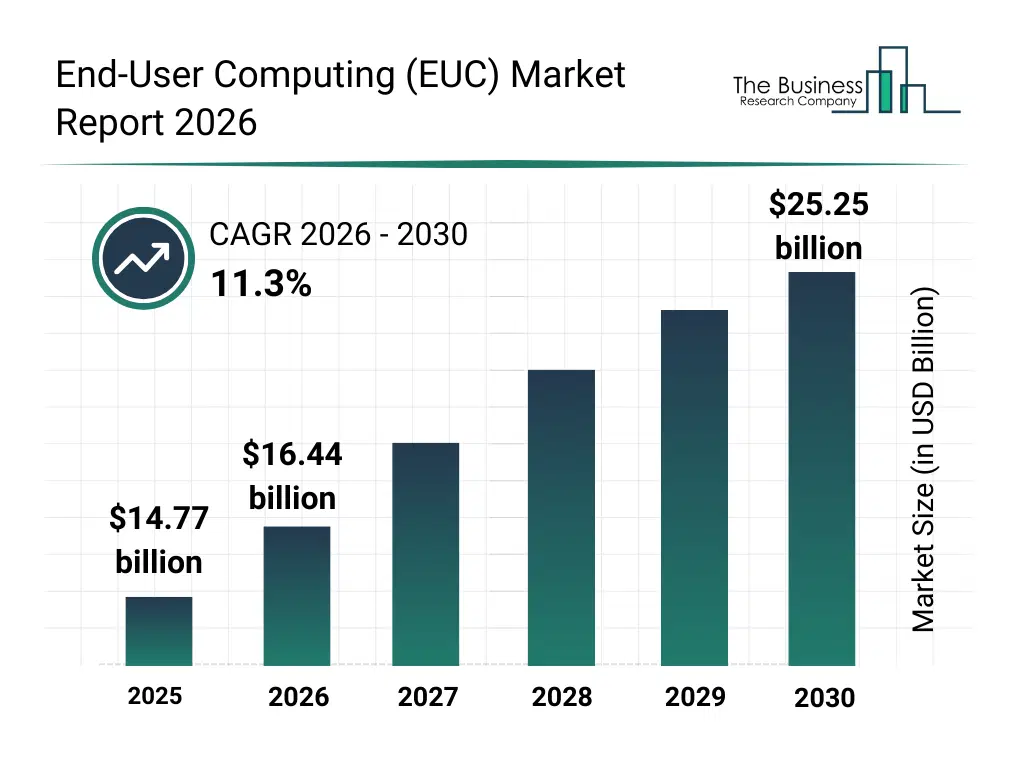
What Is The End-User Computing (EUC) Market Size and Share 2026?
The end-user computing (euc) market size has grown rapidly in recent years. It will grow from $14.77 billion in 2025 to $16.44 billion in 2026 at a compound annual growth rate (CAGR) of 11.3%. The growth in the historic period can be attributed to increasing adoption of virtual desktops, demand for remote working solutions, need for centralized device management, rise of unified communication tools, focus on business continuity and cost reduction.What Is The End-User Computing (EUC) Market Growth Forecast?
The end-user computing (euc) market size is expected to see rapid growth in the next few years. It will grow to $25.25 billion in 2030 at a compound annual growth rate (CAGR) of 11.3%. The growth in the forecast period can be attributed to integration of AI in end-user computing, growth of hybrid and remote work models, expansion of immersive learning platforms, adoption of cloud-first strategies, increasing demand for software asset optimization. Major trends in the forecast period include cloud-based virtual desktop infrastructure, ai-driven device management, unified communication platforms, software asset management solutions, virtual training and education.
Global End-User Computing (EUC) Market Segmentation
1) By Deployment Mode: Cloud, On-Premises 2) By Solution: Virtual Desktop Infrastructure, Unified Communication, Device Management, Software Asset Management, Other Solutions 3) By Service: Consulting, Support And Maintenance, Training And Education, System Integration, Managed Services 4) By Industry: IT And Telecom, Banking, Financial Services, And Insurance (BFSI), Education, Healthcare, Government, Retail, Media And Entertainment, Manufacturing, Other Industries Subsegments: 1) By Cloud: Public Cloud, Private Cloud, Hybrid Cloud 2) By On-Premises: On-Premises Virtual Desktop Infrastructure (VDI), On-Premises Thin Client SolutionsWhat Is The Driver Of The End-User Computing (EUC) Market?
The growing trend of bring your own device (BYOD) is expected to propel the growth of the end-user computing (EUC) market going forward. Bring your own device (BYOD) refers to a policy that allows employees to use their personally owned devices for work-related activities instead of company-provided ones. The growth of BYOD is fueled by the increasing shift toward remote and hybrid work models, which encourage flexibility and reduce organizational hardware costs. End-user computing supports this shift by providing secure access to enterprise applications and data across employee-owned devices, ensuring productivity without compromising data protection. For instance, in October 2024, according to JumpCloud, a US-based cloud-based directory platform, propelled by adoption in over 80 percent of organizations, strengthened by 68 percent reporting higher employee productivity, supported by 42 percent of IT leaders linking smartphones to faster innovation, and further evidenced by the increasing benefits seen as organizational size grows, the BYOD model shows a clear and accelerating upward trend. Therefore, the growing trend of bring your own device (BYOD) is driving the growth of the end-user computing market.Key Players In The Global End-User Computing (EUC) Market
Major companies operating in the end-user computing (euc) market are Microsoft Corporation; Dell Technologies Inc.; Amazon Web Services Inc.; Lenovo Group Limited; Fujitsu Limited; Infosys Limited; Tech Mahindra Ltd.; NetApp Inc.; VMware Inc.; CSS Corp; Citrix Systems Inc.; SITA; Nutanix Inc.; Mindtree Limited; Emtec Inc.; Mainline Information Systems; IGEL Technology; Hitachi Systems Micro Clinic Pvt. Ltd.; HCL Infosystems Ltd.
This chart is for illustrative purposes; the full report includes a detailed competitor analysis and comprehensive overview of the top 10 companies in the market.
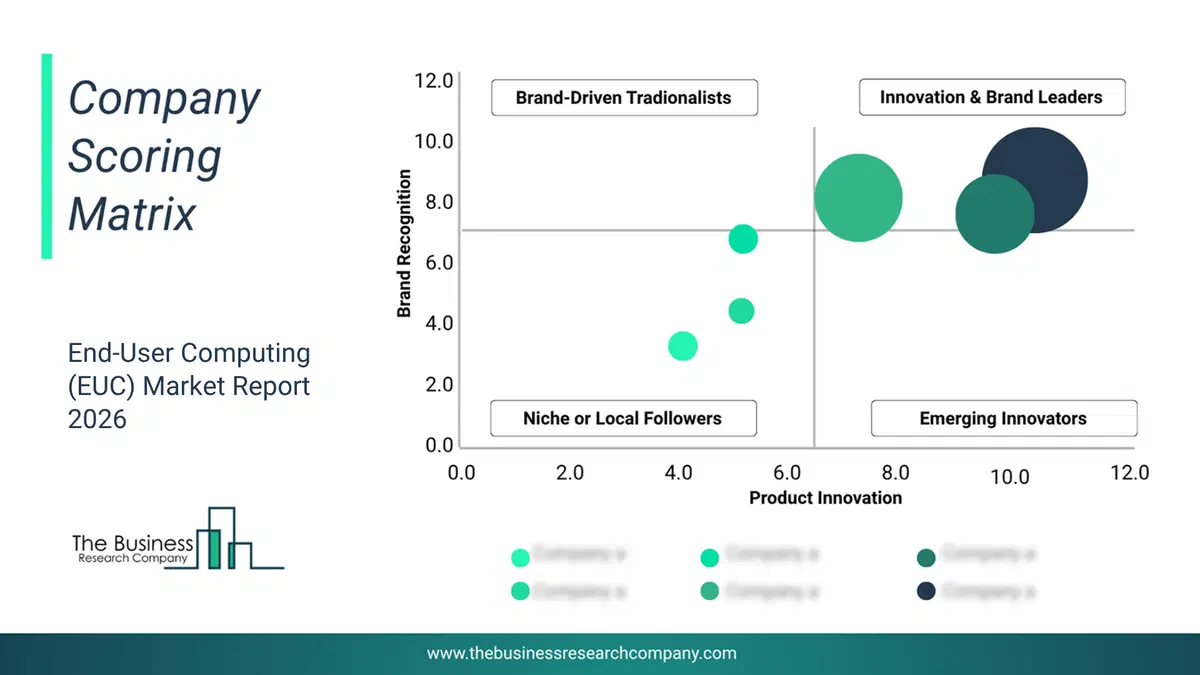
This chart maps companies by product innovation and brand strength, with bubble size indicating relative revenue, helping identify market leaders, challengers, and niche players. This is an illustrative chart; the full report provides a complete and accurate competitive analysis.
Global End-User Computing (EUC) Market Trends and Insights
Major companies operating in the end-user computing market are developing new technologies, such as unified end-user computing platforms, to meet larger customer bases, increase sales, and increase revenue. A unified end-user computing platform refers to a cohesive, flexible platform that securely manages and automates the supply of digital workplaces. For instance, in February 2023, IGEL, a Germany-based provider of end-user computing solutions, launched IGEL COSMOS, a unified platform for end-user computing that enables secure, managed access to any cloud workspace. The unique feature of COSMOS is its capacity to give businesses considerable control over the full capability of both present-day and future clouds while enabling ideal user experiences for current hybrid operations. COSMOS provides the concurrent use, management, and control of endpoints running both IGEL OS 11 and the new IGEL OS 12 operating system. COSMOS features extensive management and control enabled by the new IGEL UMS 12, the next generation of the IGEL Universal Management Suite (UMS).What Are Latest Mergers And Acquisitions In The End-User Computing (EUC) Market?
In February 2024, KKR & Co. Inc., a US-based global investment firm, acquired VMware’s End-User Computing (EUC) division from Broadcom Inc. for approximately US $4 billion. Through this acquisition, KKR aims to establish the EUC business as an independent company and invest in expanding its digital workspace and endpoint management capabilities, including Workspace ONE and Horizon, to better serve enterprise customers and partners worldwide. Broadcom Inc. is a US-based technology company that provides semiconductor and infrastructure software solutions across cloud, data center, networking, and security markets.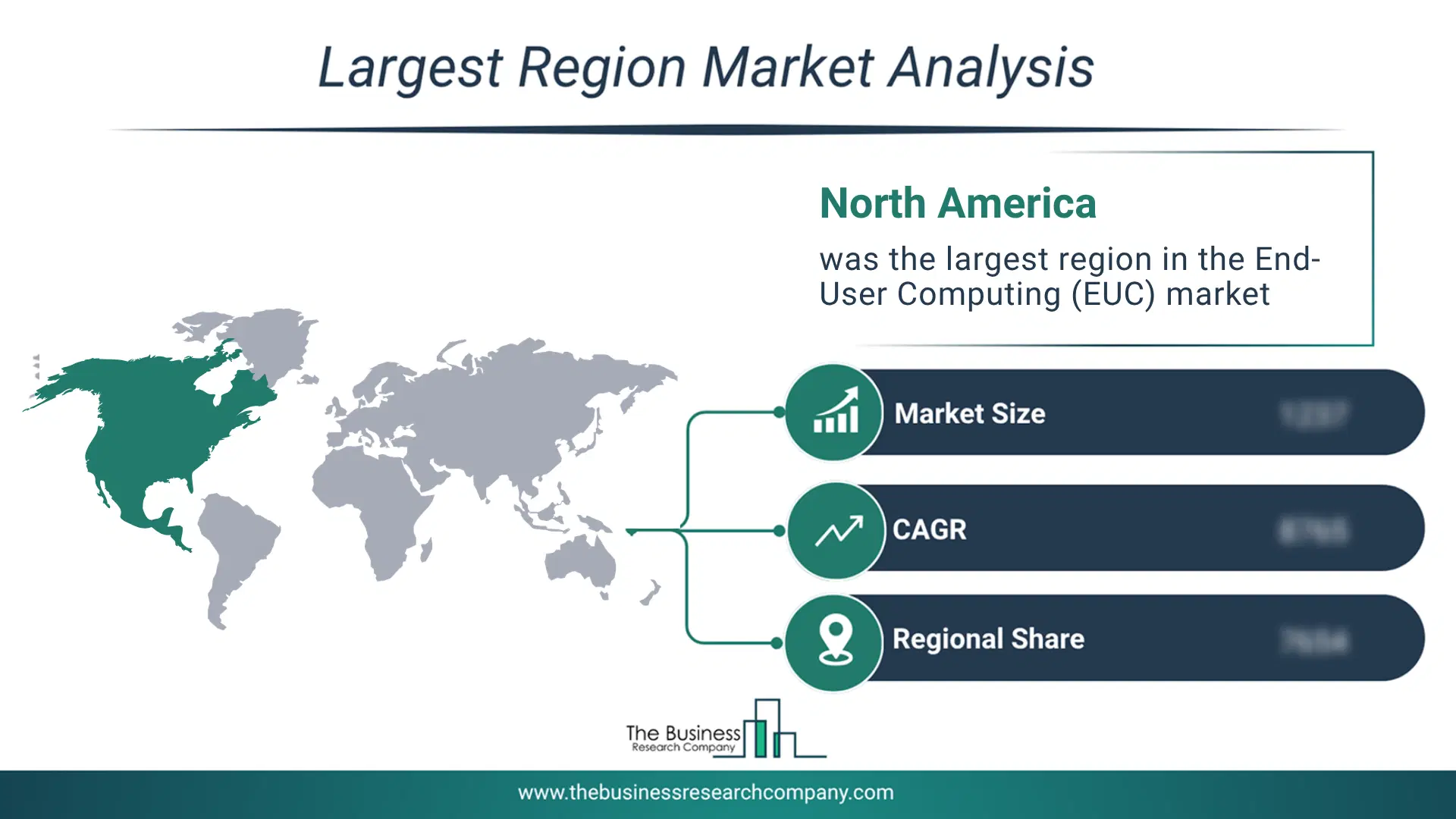
Regional Insights
North America was the largest region in the end-user computing market in 2025. Asia-Pacific is expected to be the fastest-growing region in the forecast period. The regions covered in this market report are Asia-Pacific, South East Asia, Western Europe, Eastern Europe, North America, South America, Middle East, Africa. The countries covered in this market report are Australia, Brazil, China, France, Germany, India, Indonesia, Japan, Taiwan, Russia, South Korea, UK, USA, Canada, Italy, SpainWhat Defines the End-User Computing (EUC) Market?
The end-user computing (EUC) market includes revenues earned by entities by providing services such as workforce customization, cloud-based solutions, monitoring and management of desktops and applications, app refactoring, and related services. The market value includes the value of related goods sold by the service provider or included within the service offering. Only goods and services traded between entities or sold to end consumers are included.How is Market Value Defined and Measured?
The market value is defined as the revenues that enterprises gain from the sale of goods and/or services within the specified market and geography through sales, grants, or donations in terms of the currency (in USD unless otherwise specified). The revenues for a specified geography are consumption values that are revenues generated by organizations in the specified geography within the market, irrespective of where they are produced. It does not include revenues from resales along the supply chain, either further along the supply chain or as part of other products.
This chart presents market attractiveness based on a quantitative evaluation of growth, competition, strategic alignment, and risk, offering a clear view of opportunity areas for decision-making. This chart is for illustrative purposes; the full report contains the complete analysis.

This chart highlights the Total Addressable Market (TAM) by estimating the maximum revenue opportunity using an assumption-driven approach, supporting strategic planning and opportunity sizing across markets. The chart is illustrative; the full report provides a more comprehensive analysis.
What Key Data and Analysis Are Included in the End-User Computing (EUC) Market Report 2026?
The end-user computing (euc) market research report is one of a series of new reports from The Business Research Company that provides market statistics, including industry global market size, regional shares, competitors with the market share, detailed market segments, market trends and opportunities, and any further data you may need to thrive in the end-user computing (euc) industry. The market research report delivers a complete perspective of everything you need, with an in-depth analysis of the current and future state of the industry.End-User Computing (EUC) Market Report Forecast Analysis
| Report Attribute | Details |
|---|---|
| Market Size Value In 2026 | $16.44 billion |
| Revenue Forecast In 2030 | $25.25 billion |
| Growth Rate | CAGR of 11.3% from 2026 to 2030 |
| Base Year For Estimation | 2025 |
| Actual Estimates/Historical Data | 2020-2025 |
| Forecast Period | 2026 - 2030 |
| Market Representation | Revenue in USD Billion and CAGR from 2026 to 2030 |
| Segments Covered | Deployment Mode, Solution, Service, Industry |
| Regional Scope | Asia-Pacific, Western Europe, Eastern Europe, North America, South America, Middle East, Africa |
| Country Scope | The Countries Covered In This Market Report Are Australia, Brazil, China, France, Germany, India, Indonesia, Japan, Taiwan, Russia, South Korea, Uk, Usa, Canada, Italy, Spain. |
| Key Companies Profiled | Microsoft Corporation, Dell Technologies Inc., Amazon Web Services Inc., Lenovo Group Limited, Fujitsu Limited, Infosys Limited, Tech Mahindra Ltd., NetApp Inc., VMware Inc., CSS Corp, Citrix Systems Inc., SITA, Nutanix Inc., Mindtree Limited, Emtec Inc., Mainline Information Systems, IGEL Technology, Hitachi Systems Micro Clinic Pvt. Ltd., HCL Infosystems Ltd. |
| Customization Scope | Request for Customization |
| Pricing And Purchase Options | Explore Purchase Options |