
Energy Storage Systems Global Market Opportunities And Strategies To 2035
By Technology (Pumped Hydro Storage, Battery Energy Storage, Compressed Air Energy Storage, Flywheel Energy Storage), By Application (Stationary, Transportation), By End-User (Residential, Non-Residential, Utilities, Transport), And By Region, Opportunities And Strategies – Global Forecast To 2035
Energy Storage Systems Market Definition
Energy storage systems refer to technologies and solutions that capture energy produced at one time for use at a later time, thereby balancing supply and demand across electricity networks and end-use applications. These systems are used by utilities, commercial and industrial enterprises, and residential consumers to enhance energy reliability, integrate renewable energy sources such as solar and wind, and improve grid stability. They are typically deployed when there is a mismatch between energy generation and consumption, such as during peak demand periods or when intermittent renewable generation fluctuates. The energy storage systems market consists of revenues generated by entities (organizations, sole traders, and partnerships) that provide technologies and solutions designed to store energy for later use. The includes integrated systems combining storage hardware, power conversion systems, and energy management software used across a wide range of applications.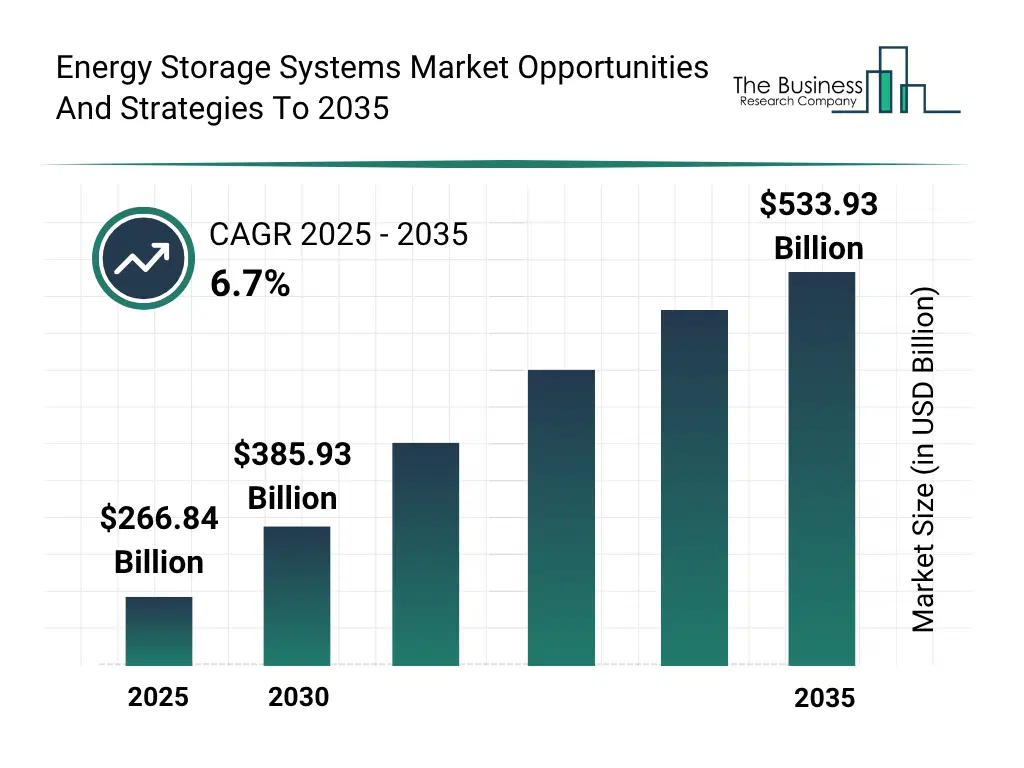
Energy Storage Systems Market Size
The global energy storage systems market reached a value of nearly $266,840.0 million in 2025, having grown at a compound annual growth rate (CAGR) of 8.3% since 2020. The market is expected to grow from $266,840.0 million in 2025 to $385,933.2 million in 2030 at a rate of 7.7%. The market is then expected to grow at a CAGR of 6.7% from 2030 and reach $533,933.6 million in 2035. Growth in the historic period resulted from rising investments in utility-scale energy storage projects, rising global electricity demand, growing electric vehicles (EVs) charging infrastructure and rising demand for backup power and energy resilience. Factors that negatively affected growth in the historic period were high cost of advanced energy storage systems and impact of limited cycle life on energy storage. Going forward, increasing adoption of microgrids and off-grid solutions, rapid expansion of renewable energy capacity, stringent carbon reduction and net-zero emission targets and expansion of distributed energy resources (DERs) such as rooftop solar will drive the growth. Factors that could hinder the growth of the energy storage systems market in the future include regulatory and permitting delays, infrastructure limitations and impact of trade war and tariffs.
Energy Storage Systems Market Segmentation
The energy storage systems market is segmented by technology, by application and by end-user.By Technology –
The energy storage systems market is segmented by technology into:
- a) Pumped Hydro Storage
- b) Battery Energy Storage
- c) Compressed Air Energy Storage
- d) Flywheel Energy Storage
By Application –
The energy storage systems market is segmented by application into:
- a) Stationary
- b) Transportation
By End-User –
The energy storage systems market is segmented by end-user into:
- a) Residential
- b) Non-Residential
- c) Utilities
- d) Transport
By Geography - The energy storage systems market is segmented by geography into:
- China
- India
- Japan
- Australia
- Taiwan
- South Korea
- Indonesia
- USA
- Canada
- Brazil
- France
- Germany
- UK
- Italy
- Spain
- Russia
-
o Asia Pacific
o Africa