
Energy Technology For Telecom Networks Market Report 2026
Global Outlook – By Type (Lithium-Ion Batteries Technology, Lead–Acid Batteries Technology), By Application (Military, Industry, Marine, Oil And Gas), By End-User (Telecom Infrastructure, Data Center) – Market Size, Trends, Strategies, and Forecast to 2030
Energy Technology For Telecom Networks Market Overview
• Energy Technology For Telecom Networks market size has reached to $13.29 billion in 2025 • Expected to grow to $51.41 billion in 2030 at a compound annual growth rate (CAGR) of 31.1% • Growth Driver: Enhanced Network Performance Fuels Expansion Of Energy Technology For Telecom Networks Market • Market Trend: ZTE Corporation's Innovative End-To-End Telecom Energy Solution Revolutionizes Network Operations And Maintenance • Asia-Pacific was the largest region in 2025.What Is Covered Under Energy Technology For Telecom Networks Market?
Energy technology for telecom networks refers to using energy-efficient and sustainable technologies to power telecommunications networks. It includes a variety of solutions, including energy-efficient hardware design, power management software, renewable energy systems such as solar panels or wind turbines, energy storage solutions, and integration with smart grids. These technologies play a crucial role in reducing operational costs, lowering carbon emissions, and maintaining the dependable performance of telecom networks, all while aligning with sustainability objectives. The main types of energy technology for telecom networks are Lithium-ion battery technology and lead–acid battery technology. Lithium-ion battery technology refers to a type of rechargeable battery technology that utilizes lithium ions as the primary component for energy storage, it is used for military, industry, marine, and oil and gas, and used in telecom infrastructure and data centers.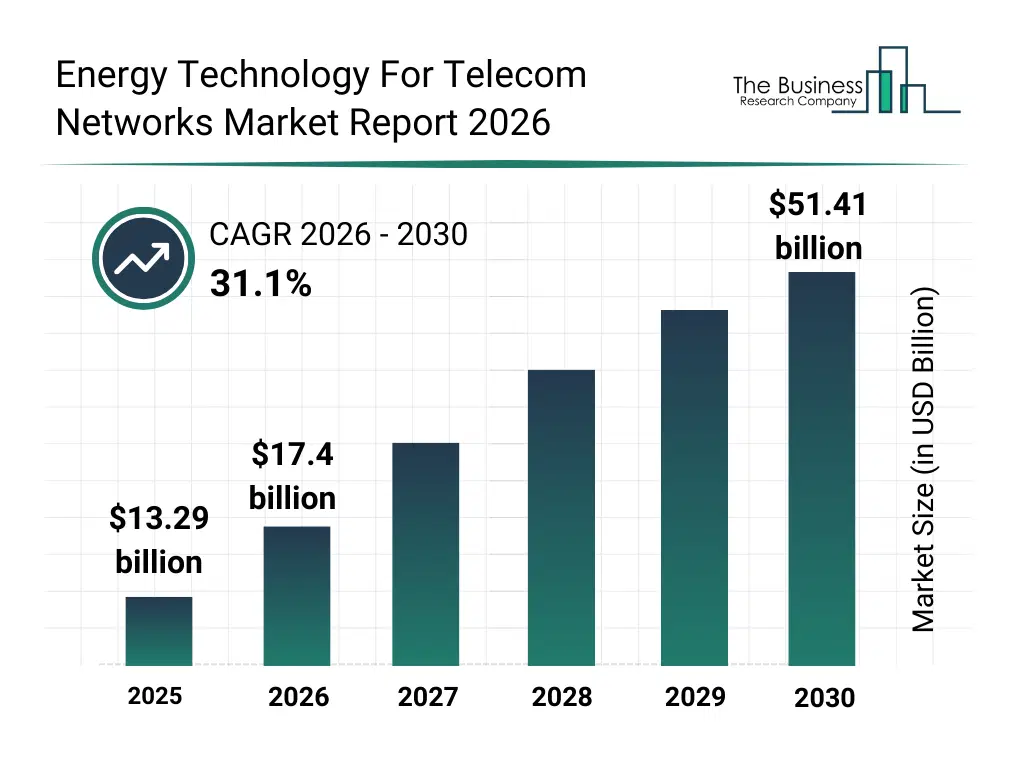
What Is The Energy Technology For Telecom Networks Market Size and Share 2026?
The energy technology for telecom networks market size has grown exponentially in recent years. It will grow from $13.29 billion in 2025 to $17.4 billion in 2026 at a compound annual growth rate (CAGR) of 30.9%. The growth in the historic period can be attributed to increasing energy costs for telecom operations, rising demand for reliable network uptime, adoption of lead-acid and lithium-ion battery solutions, focus on reducing carbon footprint, government incentives for sustainable energy.What Is The Energy Technology For Telecom Networks Market Growth Forecast?
The energy technology for telecom networks market size is expected to see exponential growth in the next few years. It will grow to $51.41 billion in 2030 at a compound annual growth rate (CAGR) of 31.1%. The growth in the forecast period can be attributed to deployment of renewable energy sources, expansion of energy-efficient hardware, integration with smart grids, adoption of advanced energy storage technologies, growing telecom infrastructure investments in emerging economies. Major trends in the forecast period include renewable energy integration for telecom networks, energy storage solutions deployment, energy-efficient hardware design, smart grid integration for telecom, power management software solutions.
Global Energy Technology For Telecom Networks Market Segmentation
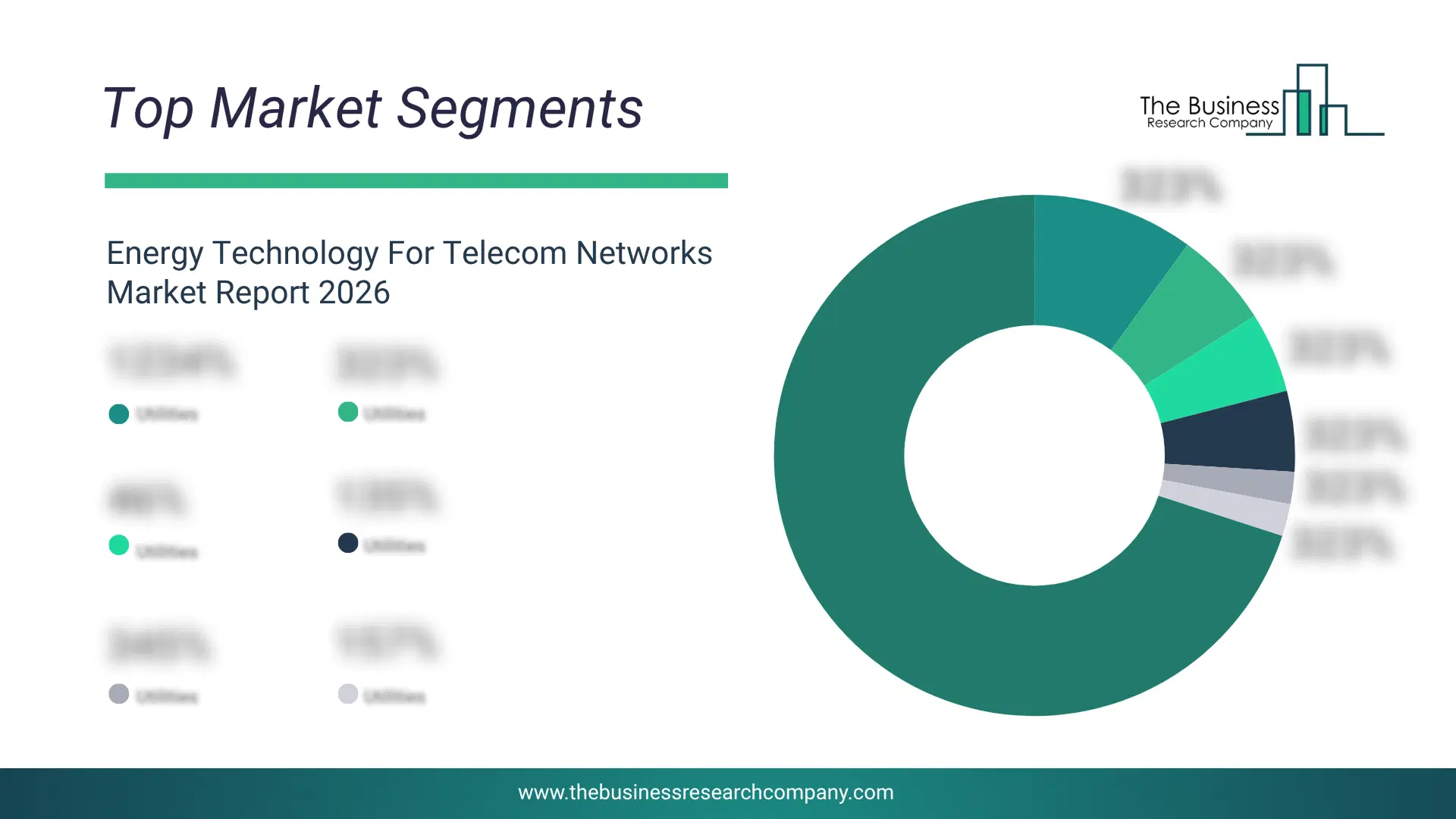
1) By Type: Lithium-Ion Batteries Technology, Lead–Acid Batteries Technology 2) By Application: Military, Industry, Marine, Oil And Gas 3) By End-User: Telecom Infrastructure, Data Center Subsegments: 1) By Lithium-Ion Batteries Technology: Lithium Nickel Manganese Cobalt (NMC), Lithium Iron Phosphate (LFP), Lithium Cobalt Oxide (LCO) 2) By Lead–Acid Batteries Technology: Flooded Lead-Acid Batteries, Absorbent Glass Mat (AGM) Batteries, Gel Lead-Acid BatteriesWhat Is The Driver Of The Energy Technology For Telecom Networks Market?
An increasing demand for improved network performance is expected to propel the growth of energy technology in the telecom network market in the future. Network performance refers to the measure of the service quality of a network as perceived by the user. Improved network performance can be achieved through network optimization, which involves strategies and best practices to enhance the efficiency and speed of a computer network. Improving network performance is essential for businesses to enhance productivity, reduce costs, and provide a seamless experience for employees and customers. For instance, in December 2023, according to Ofcom, a UK-based regulatory agency, 5G mobile?data traffic reached 151 PB (petabytes) in 2023, up 140% from 63 PB (petabytes) in 2022, with traffic on 5G?capable handsets rising to 17% from ~9%, while 5G outdoor coverage expanded to 85–93% in 2023 from 67–78% in 2022. Therefore, an increasing demand for improved network performance is driving the growth of energy technology in the telecom network market.Key Players In The Global Energy Technology For Telecom Networks Market
Major companies operating in the energy technology for telecom networks market are Huawei Technologies Co. Ltd.; General Electric Company; BYD Co. Ltd.; Contemporary Amperex Technology Ltd.; Schneider Electric SE; Asea Brown Boveri Ltd.; Cummins Inc.; Nippon Electric Company; Eaton Corporation Inc.; LG Energy Solution Ltd.; ZTE Corporation; Samsung SDI Co. Ltd.; Emerson Electric Co.; Jiangsu Zhongtian Technology Co Ltd.; Gotion High Tech Co. Ltd.; Narada Power Source Co. Ltd.; American Tower Corporation; Shenzhen Center Power Tech Co Ltd.; Coslight India Telecom Pvt Ltd.; Efore Group; Eltek AS; Shandong Sacred Sun Power Sources Co. Ltd.; Rectifier Technologies Ltd.; Alpha Technologies Private Limited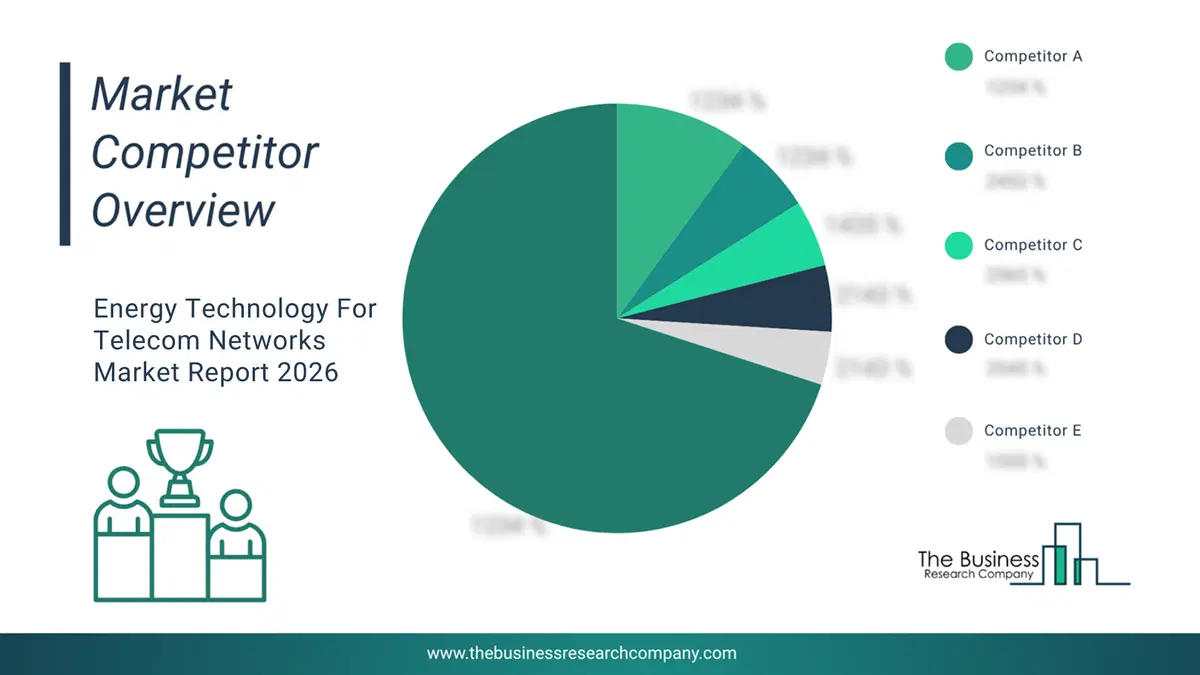
This chart is for illustrative purposes; the full report includes a detailed competitor analysis and comprehensive overview of the top 10 companies in the market.
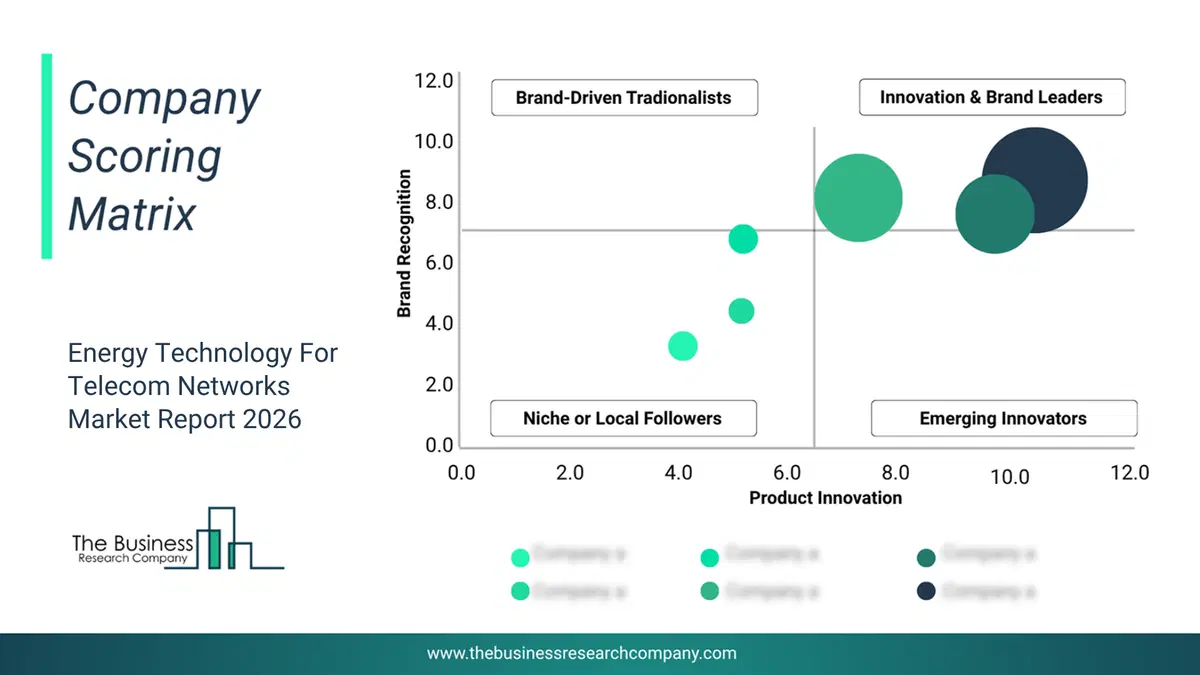
This chart maps companies by product innovation and brand strength, with bubble size indicating relative revenue, helping identify market leaders, challengers, and niche players. This is an illustrative chart; the full report provides a complete and accurate competitive analysis.
Global Energy Technology For Telecom Networks Market Trends and Insights
Major companies operating in the energy technology for telecom networks market are developing innovative technology, such as integrated end-to-end telecom energy solutions, to increase their profitability in the market. The integrated end-to-end telecom energy solution is used to provide effective means for operators to achieve detailed operations and maintenance of energy networks and reduce operational expenditure on complicated existing networks. For instance, in December 2023, ZTE Corporation, a China-based, partially state-owned technology company, launched an integrated end-to-end telecom energy solution; this system takes care of the production, conversion, use, storage, and management of electricity at the site. Its goal is to guarantee smooth coordination to satisfy various scenario needs, leading to network-wide visibility, manageability, and upgradeability, reducing O&M risks.What Are Latest Mergers And Acquisitions In The Energy Technology For Telecom Networks Market?
In January 2024, Belenos Energy Corp., a Philippines-based company that focuses on developing and operating renewable solar energy solutions for telecom towers and industrial facilities, acquired YMP Telecom Power Inc. for an undisclosed amount. The acquisition aims to enhance the development and operation of solar-powered solutions specifically for telecom towers and industrial facilities in the Philippines. expand renewable energy solutions and improve energy efficiency in the telecom sector. YMP Telecom Power Inc. is a Myanmar-based company that specialize in providing solar power solutions for telecom towers and industrial facilities.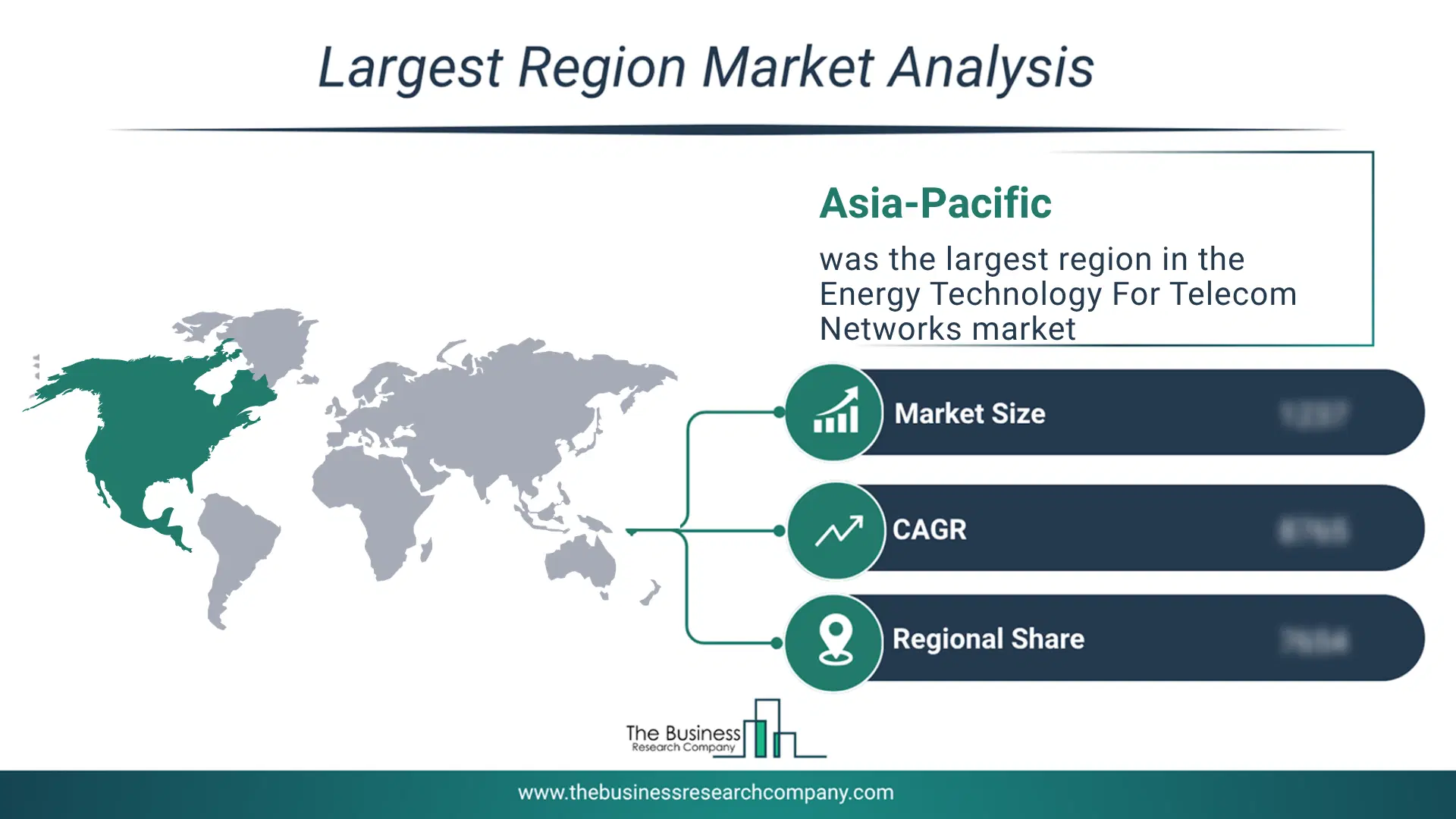
Regional Insights
Asia-Pacific was the largest region in the energy technology for telecom networks market in 2025. The regions covered in this market report are Asia-Pacific, South East Asia, Western Europe, Eastern Europe, North America, South America, Middle East, Africa. The countries covered in this market report are Australia, Brazil, China, France, Germany, India, Indonesia, Japan, Taiwan, Russia, South Korea, UK, USA, Canada, Italy, SpainWhat Defines the Energy Technology For Telecom Networks Market?
The energy technology for telecom networks market includes revenues earned by entities by energy audit and assessment, design and engineering services, consulting and advisory services, training and education. The market value includes the value of related goods sold by the service provider or included within the service offering. The energy technology for telecom networks market consists of sales of energy storage solutions, energy management systems, remote monitoring and control systems, energy-efficient telecom equipment. Values in this market are ‘factory gate’ values, that is the value of goods sold by the manufacturers or creators of the goods, whether to other entities (including downstream manufacturers, wholesalers, distributors and retailers) or directly to end customers. The value of goods in this market includes related services sold by the creators of the goods.How is Market Value Defined and Measured?
The market value is defined as the revenues that enterprises gain from the sale of goods and/or services within the specified market and geography through sales, grants, or donations in terms of the currency (in USD unless otherwise specified). The revenues for a specified geography are consumption values that are revenues generated by organizations in the specified geography within the market, irrespective of where they are produced. It does not include revenues from resales along the supply chain, either further along the supply chain or as part of other products.
This chart presents market attractiveness based on a quantitative evaluation of growth, competition, strategic alignment, and risk, offering a clear view of opportunity areas for decision-making. This chart is for illustrative purposes; the full report contains the complete analysis.

This chart highlights the Total Addressable Market (TAM) by estimating the maximum revenue opportunity using an assumption-driven approach, supporting strategic planning and opportunity sizing across markets. The chart is illustrative; the full report provides a more comprehensive analysis.
What Key Data and Analysis Are Included in the Energy Technology For Telecom Networks Market Report 2026?
The energy technology for telecom networks market research report is one of a series of new reports from The Business Research Company that provides market statistics, including industry global market size, regional shares, competitors with the market share, detailed market segments, market trends and opportunities, and any further data you may need to thrive in the energy technology for telecom networks industry. The market research report delivers a complete perspective of everything you need, with an in-depth analysis of the current and future state of the industry.Energy Technology For Telecom Networks Market Report Forecast Analysis
| Report Attribute | Details |
|---|---|
| Market Size Value In 2026 | $17.4 billion |
| Revenue Forecast In 2030 | $51.41 billion |
| Growth Rate | CAGR of 31.1% from 2026 to 2030 |
| Base Year For Estimation | 2025 |
| Actual Estimates/Historical Data | 2020-2025 |
| Forecast Period | 2026 - 2030 |
| Market Representation | Revenue in USD Billion and CAGR from 2026 to 2030 |
| Segments Covered | Type, Application, End-User |
| Regional Scope | Asia-Pacific, Western Europe, Eastern Europe, North America, South America, Middle East, Africa |
| Country Scope | The Countries Covered In This Market Report Are Australia, Brazil, China, France, Germany, India, Indonesia, Japan, Taiwan, Russia, South Korea, Uk, Usa, Canada, Italy, Spain. |
| Key Companies Profiled | Huawei Technologies Co. Ltd., General Electric Company, BYD Co. Ltd., Contemporary Amperex Technology Ltd., Schneider Electric SE, Asea Brown Boveri Ltd., Cummins Inc., Nippon Electric Company, Eaton Corporation Inc., LG Energy Solution Ltd., ZTE Corporation, Samsung SDI Co. Ltd., Emerson Electric Co., Jiangsu Zhongtian Technology Co Ltd., Gotion High Tech Co. Ltd., Narada Power Source Co. Ltd., American Tower Corporation, Shenzhen Center Power Tech Co Ltd., Coslight India Telecom Pvt Ltd., Efore Group, Eltek AS, Shandong Sacred Sun Power Sources Co. Ltd., Rectifier Technologies Ltd., Alpha Technologies Private Limited |
| Customization Scope | Request for Customization |
| Pricing And Purchase Options | Explore Purchase Options |