
Engine Crankshaft Torsional Vibration Damper Market Report 2026
Global Outlook – By Product Type (Elastomeric Torsional Vibration Dampers, Viscous Torsional Vibration Dampers, Friction or Rubber-Bonded Harmonic Balancers, Dual-Mass or Tuned Dampers, Other Damper Types), By Material Type (Rubber-Based Dampers, Polymer or Composite Dampers, Metal-Based Dampers (Steel, Aluminum), Hybrid Material Dampers), By Engine Type (Gasoline Engines, Diesel Engines, Hybrid Engines, Industrial Engines (Non-Automotive)), By Sales Channel (Original Equipment Manufacturer (OEM), Aftermarket (Replacement / Repair), Original Equipment Supplier (OES)), By Application (Automotive Passenger Vehicles, Commercial Vehicles (Light, Medium, Heavy Trucks), Off-Highway Equipment (Power Generation Engines) – Market Size, Trends, Strategies, and Forecast to 2030
Engine Crankshaft Torsional Vibration Damper Market Overview
• Engine Crankshaft Torsional Vibration Damper market size has reached to $1.54 billion in 2025 • Expected to grow to $2.22 billion in 2030 at a compound annual growth rate (CAGR) of 7.5% • Growth Driver: Increasing Adoption Of Electric And Hybrid Vehicles Fueling The Growth Of The Market Due To Enhanced Vehicle Performance And Environmental Awareness • Market Trend: Next-Gen Dampers Enhance Engine Efficiency • North America was the largest region in 2025 and Asia-Pacific is the fastest growing region.What Is Covered Under Engine Crankshaft Torsional Vibration Damper Market?
The engine crankshaft torsional vibration damper is a manufacturing-focused market centered on the production of engine components designed to reduce torsional vibrations and protect the crankshaft. It involves OEM supply to automotive, heavy-duty, and industrial engine manufacturers, supported by precision engineering and material technologies. The market also includes an aftermarket segment for replacement dampers, but the core activity remains component manufacturing. The main product types of the engine crankshaft torsional vibration damper include elastomeric torsional vibration dampers, viscous torsional vibration dampers, friction or rubber-bonded harmonic balancers, dual-mass or tuned dampers, and other damper types. Elastomeric torsional vibration dampers are widely adopted due to their simple construction, cost-effectiveness, and reliable vibration isolation, making them suitable for a broad range of gasoline and diesel engine applications. Different material types include rubber-based dampers, polymer or composite dampers, metal-based dampers such as steel and aluminum, and hybrid material dampers. Various engine types include gasoline engines, diesel engines, hybrid engines, and industrial non-automotive engines. Key sales channels consist of original equipment manufacturers (OEMs), aftermarket replacement or repair services, and original equipment suppliers (OES), and they are used by several applications such as automotive passenger vehicles, commercial vehicles including light, medium, and heavy trucks, off-highway equipment used in agriculture, construction, and mining, industrial machinery engines, marine engines, and power generation engines.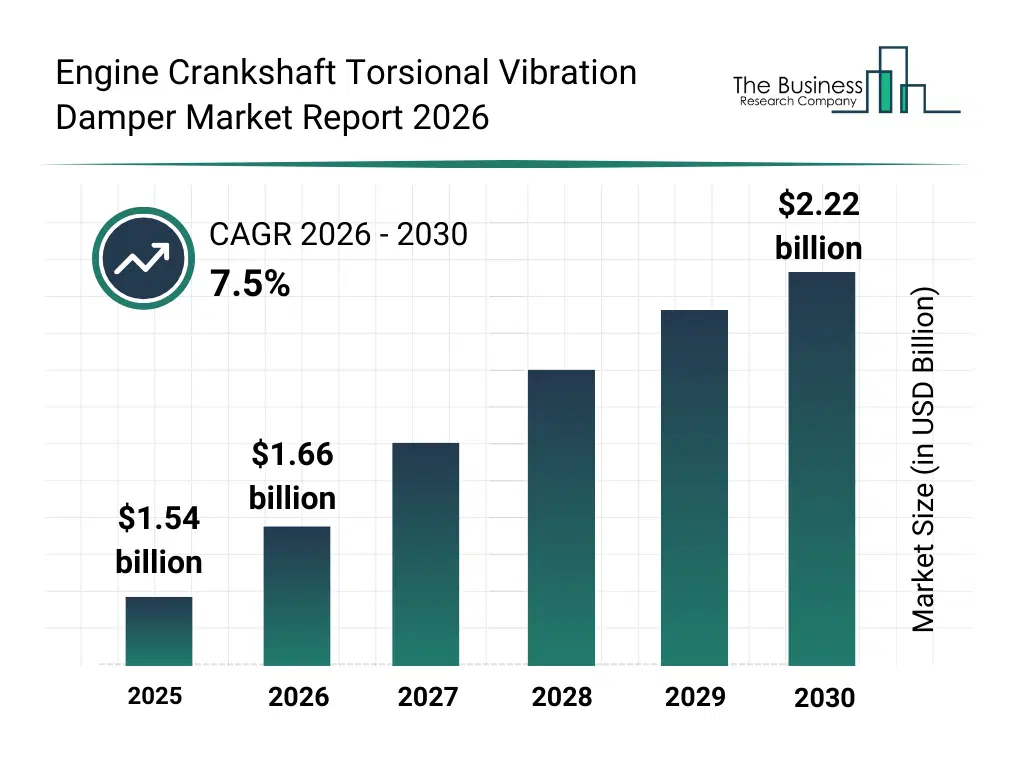
What Is The Engine Crankshaft Torsional Vibration Damper Market Size and Share 2026?
The engine crankshaft torsional vibration damper market size has grown strongly in recent years. It will grow from $1.54 billion in 2025 to $1.66 billion in 2026 at a compound annual growth rate (CAGR) of 7.8%. The growth in the historic period can be attributed to increasing automotive production, growing heavy-duty engine usage, rising demand for engine reliability, expansion of industrial machinery manufacturing, increasing aftermarket replacement needs.What Is The Engine Crankshaft Torsional Vibration Damper Market Growth Forecast?
The engine crankshaft torsional vibration damper market size is expected to see strong growth in the next few years. It will grow to $2.22 billion in 2030 at a compound annual growth rate (CAGR) of 7.5%. The growth in the forecast period can be attributed to growing adoption of high-torque engines, rising focus on fuel efficiency, increasing demand for advanced nvH control, expansion of hybrid powertrain engines, growing manufacturing capacity in asia-pacific. Major trends in the forecast period include technology advancements in damper materials, innovations in viscous and dual-mass designs, developments in precision CNC manufacturing, research and development in high-temperature elastomers, and advancements in simulation and CAE-based optimization.
Global Engine Crankshaft Torsional Vibration Damper Market Segmentation
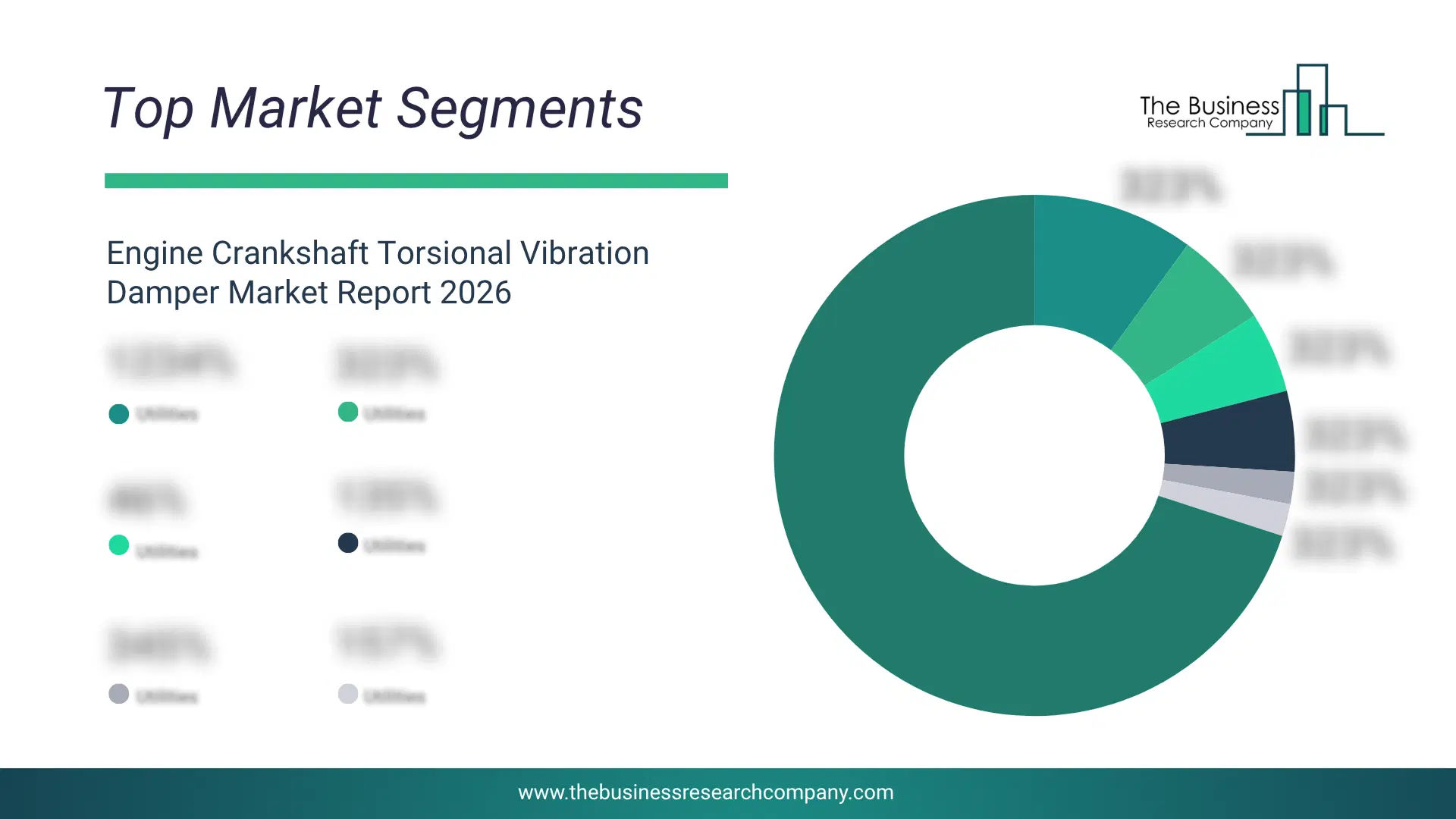
1) By Product Type: Elastomeric Torsional Vibration Dampers, Viscous Torsional Vibration Dampers, Friction or Rubber-Bonded Harmonic Balancers, Dual-Mass or Tuned Dampers, Other Damper Types 2) By Material Type: Rubber-Based Dampers, Polymer or Composite Dampers, Metal-Based Dampers (Steel, Aluminum), Hybrid Material Dampers 3) By Engine Type: Gasoline Engines, Diesel Engines, Hybrid Engines, Industrial Engines (Non-Automotive) 4) By Sales Channel: Original Equipment Manufacturer (OEM), Aftermarket (Replacement / Repair), Original Equipment Supplier (OES) 5) By Application: Automotive Passenger Vehicles, Commercial Vehicles (Light, Medium, Heavy Trucks), Off-Highway Equipment (Agriculture, Construction, Mining), Industrial Machinery Engines, Marine Engines, Power Generation Engines Subsegments: 1) By Elastomeric Torsional Vibration Dampers: Standard Elastomer, High Temperature Elastomer, Low Stiffness Elastomer, High Stiffness Elastomer, Custom Elastomer 2) By Viscous Torsional Vibration Dampers: Single Chamber Viscous, Dual Chamber Viscous, High Torque Viscous, Low Torque Viscous, Temperature Resistant Viscous 3) By Friction or Rubber-Bonded Harmonic Balancers: Single Mass Friction, Dual Mass Friction, High Torque Rubber-Bonded, Low Torque Rubber-Bonded, Custom Rubber-Bonded 4) By Dual-Mass or Tuned Dampers: Automotive Dual-Mass, Heavy Duty Dual-Mass, High Performance Tuned, Standard Tuned, Custom Tuned 5) By Other Damper Types: Overrunning Alternator Decoupler, Hydraulic Dampers, Magnetic Dampers, Composite Dampers, Specialty DampersWhat Are The Drivers Of The Engine Crankshaft Torsional Vibration Damper Market?
The growing adoption of electric and hybrid vehicles is expected to drive the growth of the engine crankshaft torsional vibration damper market going forward. Adoption of electric and hybrid vehicles refers to the extent and pace at which individuals, businesses, and public bodies start using these vehicles instead of conventional internal combustion engine vehicles in real-world fleets and daily transport. The adoption of electric and hybrid vehicles is increasing due to rising environmental awareness, as more people prefer cleaner transportation options to reduce air pollution and carbon emissions. The engine crankshaft torsional vibration damper supports the growing adoption of electric and hybrid vehicles by reducing vibrations and enhancing engine reliability, which improves overall vehicle performance and longevity. For instance, in April 2025, according to the International Council on Clean Transportation (ICCT), a US-based nonprofit research organization, passenger electric vehicle sales reached about 1.56 million in 2024, and EVs accounted for 10% of all light-duty vehicle sales, up from 2023. Therefore, the growing adoption of electric and hybrid vehicles is driving the growth of the engine crankshaft torsional vibration damper industry. The rising vehicle production is expected to propel the growth of the engine crankshaft torsional vibration damper market going forward. Vehicle production is the industrial process of manufacturing motor vehicles including cars, trucks, buses, and other automotive units. The rising vehicle production is driven by rising demand for personal and commercial transportation expanding logistics networks, and improving consumer purchasing power worldwide. Engine crankshaft torsional vibration dampers support rising vehicle production by improving engine durability, performance, and noise control, enabling manufacturers to produce reliable, high-efficiency vehicles at large scale while meeting strict quality and regulatory standards. For instance, in May 2025, according to the European Automobile Manufacturers’ Association (ACEA), a Belgium-based motor vehicle manufacturing company, South American car production grew by 1.7% in 2024 compared to 2023, largely driven by Brazil, which experienced a 6.3% rise, producing approximately 1.9 million cars. Meanwhile, global bus production reached 362,005 units last year, marking a 10.3% increase from 2023. Therefore, the rising vehicle production drives the engine crankshaft torsional vibration damper industry.Key Players In The Global Engine Crankshaft Torsional Vibration Damper Market
Major companies operating in the engine crankshaft torsional vibration damper market are Continental AG, ZF Friedrichshafen AG, Magna International Inc., Valeo SA, Schaeffler Technologies AG & Co. KG, Knorr-Bremse AG, Voith Group, Vibracoustic GmbH, Trelleborg AB, Metaldyne Performance Group Inc., Anhui Zhongding Group Co. Ltd., Dongfeng (Shiyan) Automotive Component Co. Ltd., Tsubakimoto Chain Co., FUKOKU Co. Ltd., Dayco Products LLC, Geislinger GmbH, Premier Seals Ltd., Vibratech TVD, Hasse & Wrede GmbH, Ningbo Sedsun Vibration Damper Co. Ltd.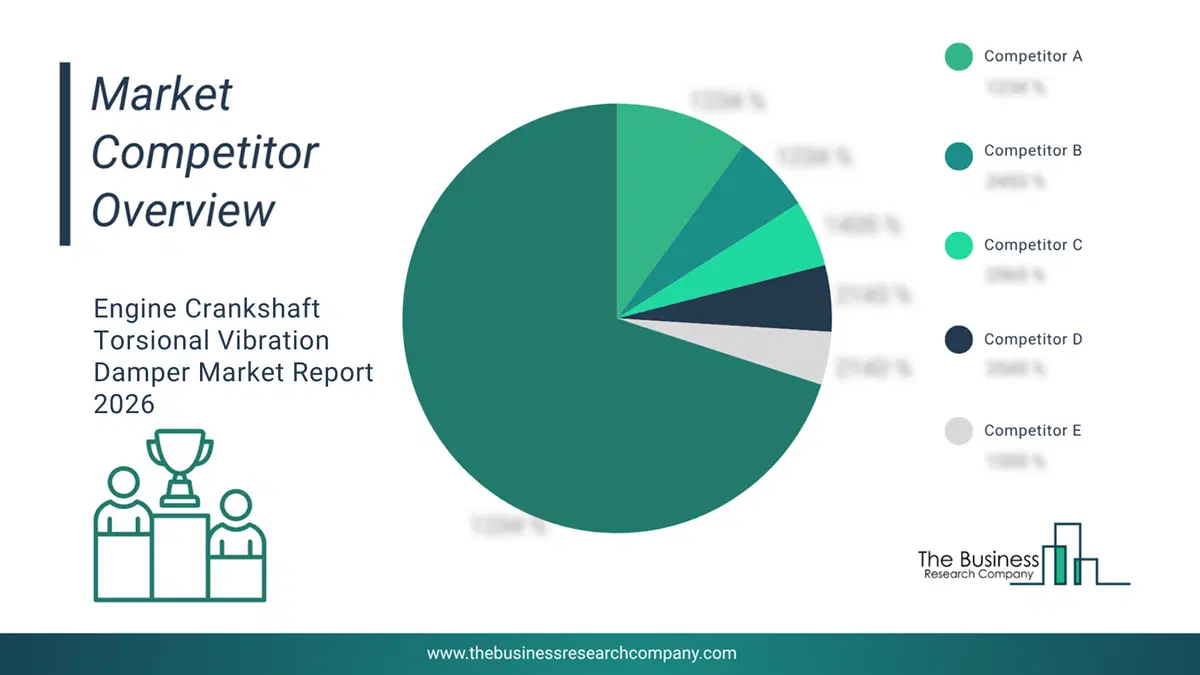
This chart is for illustrative purposes; the full report includes a detailed competitor analysis and comprehensive overview of the top 10 companies in the market.
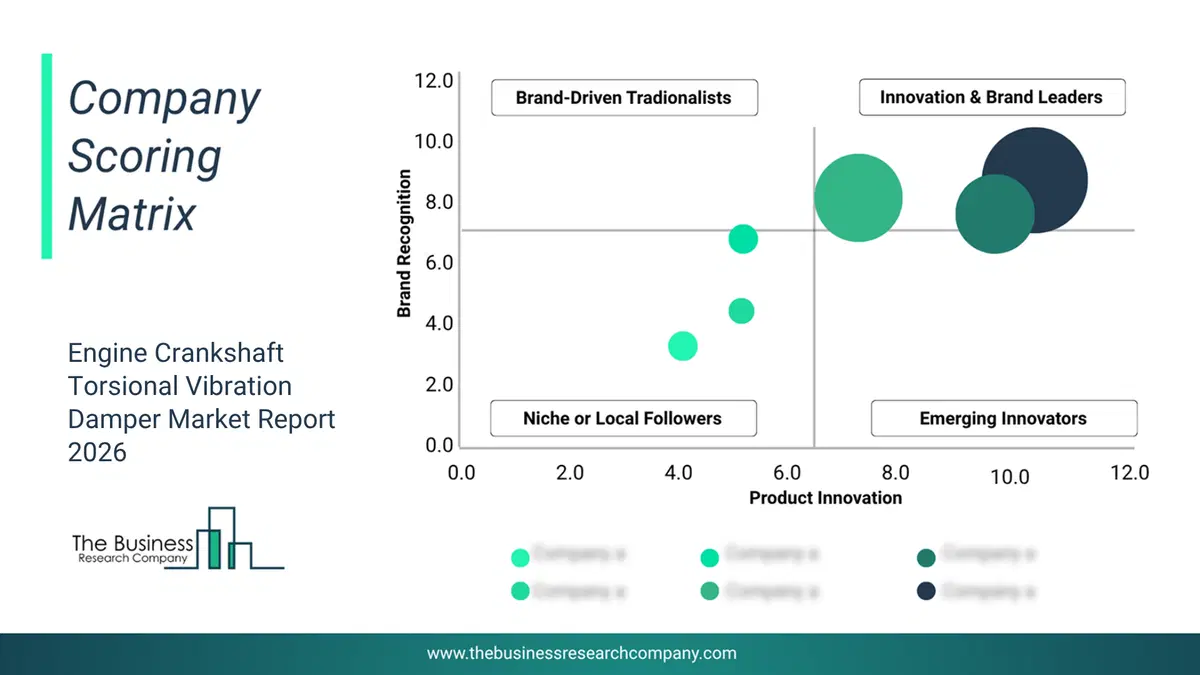
This chart maps companies by product innovation and brand strength, with bubble size indicating relative revenue, helping identify market leaders, challengers, and niche players. This is an illustrative chart; the full report provides a complete and accurate competitive analysis.
Global Engine Crankshaft Torsional Vibration Damper Market Trends and Insights
Major companies operating in the engine crankshaft torsional vibration damper market are focusing on developing advanced products, such as torsional vibration dampers with overrunning functions, to boost efficiency, enhance smoothness, and reduce component strain and emissions. Torsional vibration dampers with overrunning functions refer to advanced components that decouple the belt drive from the crankshaft, isolating high torsional vibrations to allow for low belt tension and reduced friction. For instance, in April 2024, Continental AG, a Germany-based automotive technology company, launched its new line of torsional vibration dampers. These dampers feature an advanced multi-layered design that incorporates high-quality rubber and friction materials to absorb vibrations more effectively. This technology offers better durability and noise reduction compared to traditional steel-based dampers, making them ideal for modern powertrains, including those in electric and hybrid vehicles. The product's innovative features help enhance engine smoothness, reduce fuel consumption, and improve overall engine life by mitigating wear and tear on engine components.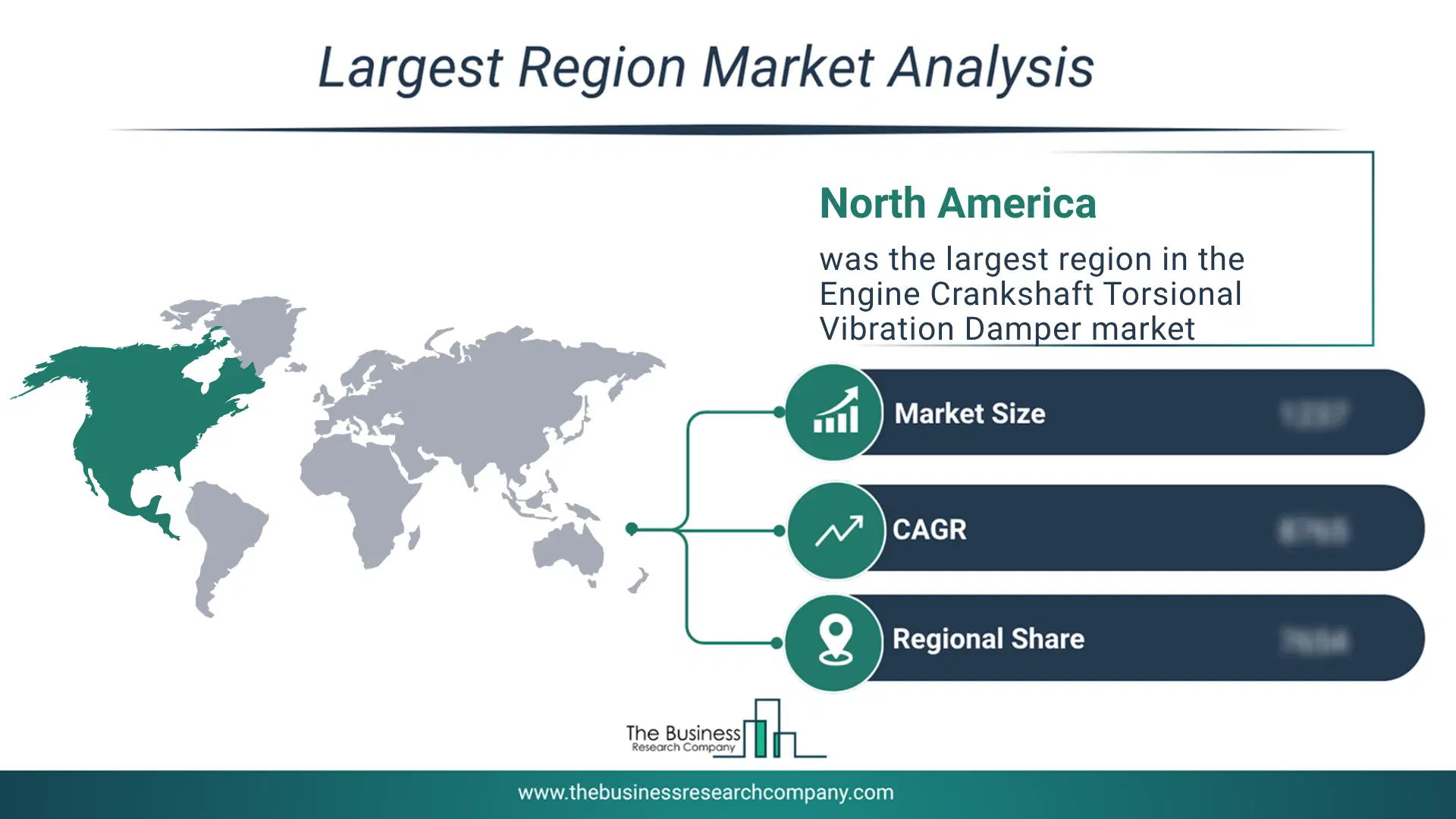
Regional Insights
North America was the largest region in the engine crankshaft torsional vibration damper market in 2025. Asia-Pacific is expected to be the fastest-growing region in the forecast period. The regions covered in this market report are Asia-Pacific, South East Asia, Western Europe, Eastern Europe, North America, South America, Middle East, Africa. The countries covered in this market report are Australia, Brazil, China, France, Germany, India, Indonesia, Japan, Taiwan, Russia, South Korea, UK, USA, Canada, Italy, Spain.What Defines the Engine Crankshaft Torsional Vibration Damper Market?
The engine crankshaft torsional vibration damper market consists of sales of products such as harmonic balancers, torsional vibration dampers, crankshaft pulleys with integrated dampers, viscous dampers, elastomeric dampers, and multi-mass flywheels. Values in this market are ‘factory gate’ values, that is, the value of goods sold by the manufacturers or creators of the goods, whether to other entities (including downstream manufacturers, wholesalers, distributors, and retailers) or directly to end customers. The value of goods in this market includes related services sold by the creators of the goods.How is Market Value Defined and Measured?
The market value is defined as the revenues that enterprises gain from the sale of goods and/or services within the specified market and geography through sales, grants, or donations in terms of the currency (in USD unless otherwise specified). The revenues for a specified geography are consumption values that are revenues generated by organizations in the specified geography within the market, irrespective of where they are produced. It does not include revenues from resales along the supply chain, either further along the supply chain or as part of other products.
This chart presents market attractiveness based on a quantitative evaluation of growth, competition, strategic alignment, and risk, offering a clear view of opportunity areas for decision-making. This chart is for illustrative purposes; the full report contains the complete analysis.

This chart highlights the Total Addressable Market (TAM) by estimating the maximum revenue opportunity using an assumption-driven approach, supporting strategic planning and opportunity sizing across markets. The chart is illustrative; the full report provides a more comprehensive analysis.
What Key Data and Analysis Are Included in the Engine Crankshaft Torsional Vibration Damper Market Report 2026?
The engine crankshaft torsional vibration damper market research report is one of a series of new reports from The Business Research Company that provides market statistics, including industry global market size, regional shares, competitors with the market share, detailed market segments, market trends and opportunities, and any further data you may need to thrive in the engine crankshaft torsional vibration damper industry. The market research report delivers a complete perspective of everything you need, with an in-depth analysis of the current and future state of the industry.Engine Crankshaft Torsional Vibration Damper Market Report Forecast Analysis
| Report Attribute | Details |
|---|---|
| Market Size Value In 2026 | $1.66 billion |
| Revenue Forecast In 2030 | $2.22 billion |
| Growth Rate | CAGR of 7.5% from 2026 to 2030 |
| Base Year For Estimation | 2025 |
| Actual Estimates/Historical Data | 2020-2025 |
| Forecast Period | 2026 - 2030 |
| Market Representation | Revenue in USD Billion and CAGR from 2026 to 2030 |
| Segments Covered | Product Type, Material Type, Engine Type, Sales Channel, Application |
| Regional Scope | Asia-Pacific, Western Europe, Eastern Europe, North America, South America, Middle East, Africa |
| Key Companies Profiled | Continental AG, ZF Friedrichshafen AG, Magna International Inc., Valeo SA, Schaeffler Technologies AG & Co. KG, Knorr-Bremse AG, Voith Group, Vibracoustic GmbH, Trelleborg AB, Metaldyne Performance Group Inc., Anhui Zhongding Group Co. Ltd., Dongfeng (Shiyan) Automotive Component Co. Ltd., Tsubakimoto Chain Co., FUKOKU Co. Ltd., Dayco Products LLC, Geislinger GmbH, Premier Seals Ltd., Vibratech TVD, Hasse & Wrede GmbH, Ningbo Sedsun Vibration Damper Co. Ltd. |
| Customization Scope | Request for Customization |
| Pricing And Purchase Options | Explore Purchase Options |