
Engine Encapsulation Market Report 2026
Global Outlook – By Product Type (Engine-Mounted, Body-Mounted), By Material (Polypropylene, Polyurethane), By Fuel Type (Gasoline, Diesel), By Vehicle Class (Economic Light-Duty Vehicles, Mid-Priced Light-Duty Vehicles, Luxury Light-Duty Vehicles), By Sales Channel (Original Equipment Manufacturer (OEM), Aftermarket) – Market Size, Trends, Strategies, and Forecast to 2030
Engine Encapsulation Market Overview
• Engine Encapsulation market size has reached to $6.25 billion in 2025 • Expected to grow to $8.78 billion in 2030 at a compound annual growth rate (CAGR) of 7.1% • Growth Driver: Growing Demand for Commercial Vehicles Fuels Engine Encapsulation Growth • Market Trend: Innovative Engine Encapsulation Solutions for Electric Vehicles: Röchling SE's Latest Launch • Asia-Pacific was the largest region and fastest growing region.What Is Covered Under Engine Encapsulation Market?
Engine encapsulation slows motor cool-down and increases the likelihood of a high initial temperature at the next engine start, resulting in a shorter warm-up time and less friction between engine parts. The engine encapsulation is used to insulate the engine from the outside environment and retain heat in the engine after it has been turned off, offering high thermal and acoustic insulation. The main types of products in engine encapsulation are body-mounted and engine-mounted. Body-mounted engine encapsulation refers to engine encapsulation on parts attached to the body, covering all sides of the engine. The different material types include polypropylene, polyurethane, polyamide, glass wool, and carbon fiber and involve several vehicle classes, such as economic, mid-priced, and luxury. The several fuel types include diesel and gasoline and are distributed through various channels such as original equipment manufacturer (OEM) and aftermarket.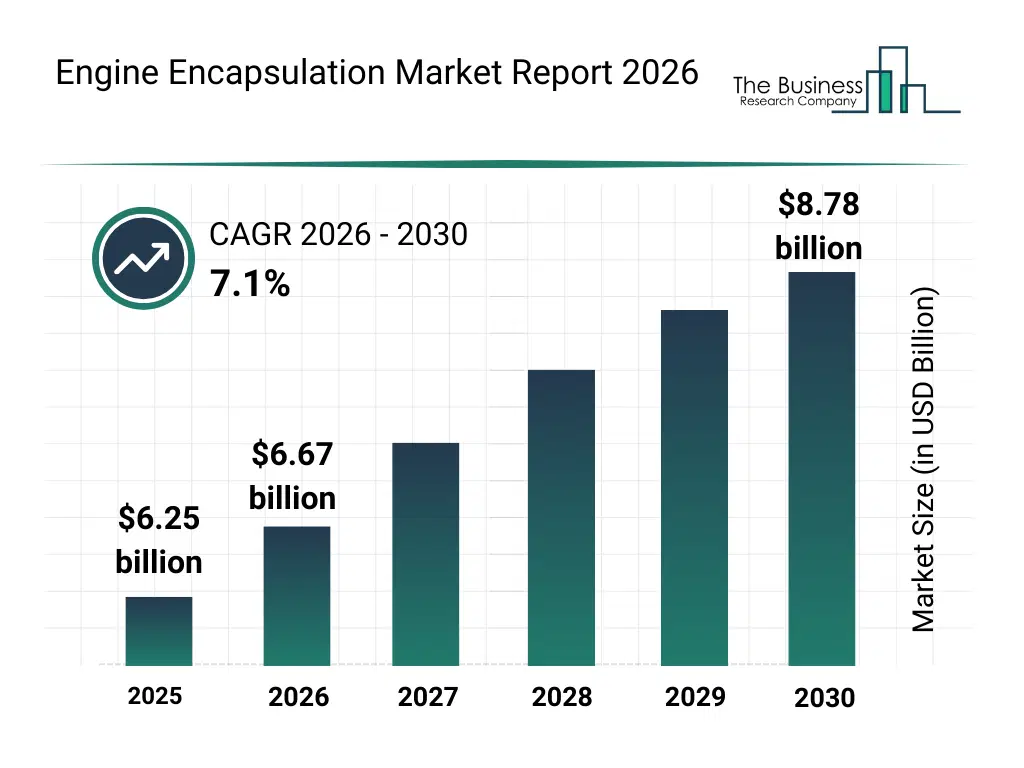
What Is The Engine Encapsulation Market Size and Share 2026?
The engine encapsulation market size has grown strongly in recent years. It will grow from $6.25 billion in 2025 to $6.67 billion in 2026 at a compound annual growth rate (CAGR) of 6.8%. The growth in the historic period can be attributed to automotive efficiency regulations, noise reduction requirements, growth in passenger vehicle production, thermal management demand, fuel consumption reduction.What Is The Engine Encapsulation Market Growth Forecast?
The engine encapsulation market size is expected to see strong growth in the next few years. It will grow to $8.78 billion in 2030 at a compound annual growth rate (CAGR) of 7.1%. The growth in the forecast period can be attributed to stricter emission standards, lightweight material innovation, electric and hybrid vehicle growth, demand for engine efficiency, oem focus on thermal optimization. Major trends in the forecast period include increasing use of thermal and acoustic insulation, adoption in fuel-efficient vehicles, growth of lightweight encapsulation materials, expansion in oem installations, focus on engine efficiency.
Global Engine Encapsulation Market Segmentation
1) By Product Type: Engine-Mounted, Body-Mounted 2) By Material: Polypropylene, Polyurethane 3) By Fuel Type: Gasoline, Diesel 4) By Vehicle Class: Economic Light-Duty Vehicles, Mid-Priced Light-Duty Vehicles, Luxury Light-Duty Vehicles 5) By Sales Channel: Original Equipment Manufacturer (OEM), Aftermarket Subsegments: 1) By Engine-Mounted: Acoustic Covers, Thermal Shields, Insulation Blankets 2) By Body-Mounted: Underbody Shields, Sound Absorbing Panels, Engine Compartment LinersWhat Is The Driver Of The Engine Encapsulation Market?
The increase in demand for commercial vehicles is driving the growth of the engine encapsulation market. Commercial vehicles are used for the transportation of goods over long distances, increasing the need for better fuel efficiency. Commercial vehicles are used for the transportation of goods over long distances, increasing the need for better fuel efficiency. Engine encapsulation saves fuel and minimizes engine noise and heat transfer, making it an attractive solution for commercial vehicles. For instance, in January 2024, according to the European Automobile Manufacturers’ Association (ACEA), a Belgium-based automotive industry association, new commercial-vehicle registrations increased by 14.6% for vans, 16.3% for trucks, and 19.4% for buses compared to 2022, marking a significant rise in demand across the European Union. Hence, the increasing demand for commercial vehicles is expected to drive the growth of the engine encapsulation industry in the forecast period.Key Players In The Global Engine Encapsulation Market
Major companies operating in the engine encapsulation market report include ElringKlinger AG, Autoneum Holding AG, Continental AG, Roechling Group, Greiner Foam International GmbH, Trocellen GmbH, Adler Pelzer Holding GmbH, BASF SE, Furukawa Electric Co. Ltd., Evonik Industries AG, Hennecke GmbH, Compagnie de Saint-Gobain S. A., UFP Technologies Inc., Polytec Group, DBW Advanced Fiber Technologies GmbH, ZF Friedrichshafen AG, GKN plc, Schaeffler Technologies AG & Co KG, BorgWarner Inc., AVL List GmbH, Axletech International, Dana Limited, Woco Industrietechnik GmbH, 3M Company, SA Automotive Ltd, Charlotte Baur Formschaumtechnik GmbH, Carcoustics International GmbH, Uniproducts Inc., UGN Inc., Robert Bosch GmbH
This chart is for illustrative purposes; the full report includes a detailed competitor analysis and comprehensive overview of the top 10 companies in the market.
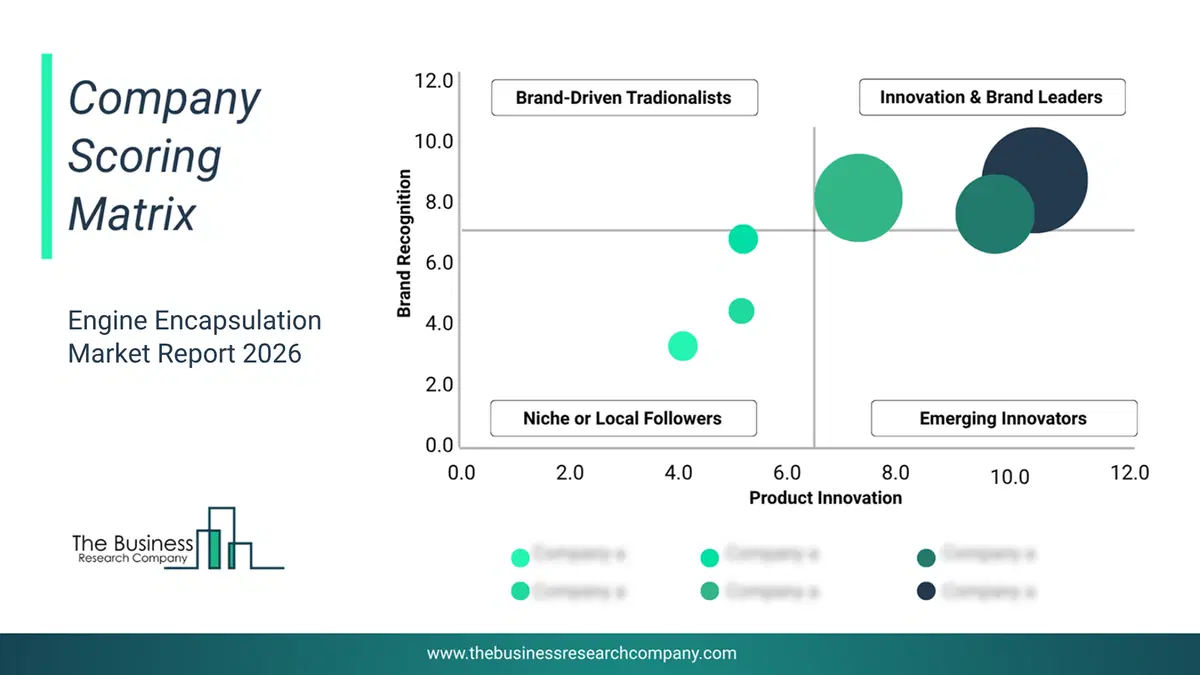
This chart maps companies by product innovation and brand strength, with bubble size indicating relative revenue, helping identify market leaders, challengers, and niche players. This is an illustrative chart; the full report provides a complete and accurate competitive analysis.
Global Engine Encapsulation Market Trends and Insights
Major companies operating in the engine encapsulation market are developing innovative products such as advanced EV-specific encapsulation systems to enhance thermal management and reduce noise. Advanced EV-specific encapsulation systems are specially designed covers and materials that surround electric vehicle motors and batteries, helping maintain optimal temperatures, reduce vibrations and noise, extend component life, and improve overall vehicle performance. For instance, in March 2024, Röchling SE and Co. KG, a Germany-based manufacturing engineering plastics and components company, launched a new engine encapsulation system specifically for electric vehicles (EVs). The launch underscores the company’s commitment to supporting the growing EV market with solutions that improve efficiency and driving comfort. The encapsulation system enhances the driving experience by reducing noise and vibrations, while also addressing the unique thermal challenges of electric drivetrains, helping to extend battery life and maintain optimal performance.What Are Latest Mergers And Acquisitions In The Engine Encapsulation Market?
In April 2023, Autoneum Holding AG, a Switzerland-based vehicle acoustic and thermal insulation company, acquired Borgers Automotive GmbH & Co. KG for $0.136 (€0.117) billion. Through this acquisition, Autoneum Holding AG aims to enhance its engine encapsulation and vehicle acoustic and thermal management capabilities by integrating Borgers Automotive GmbH & Co. KG’s expertise in textile-based insulation, wheel-arch liners, trunk linings, and underbody shielding. Borgers Automotive GmbH & Co. KG is a Germany-based automotive manufacturing company that provides acoustic protection, insulation, and trim solutions for cars and commercial vehicles, supporting improved thermal management and noise reduction in engine compartments.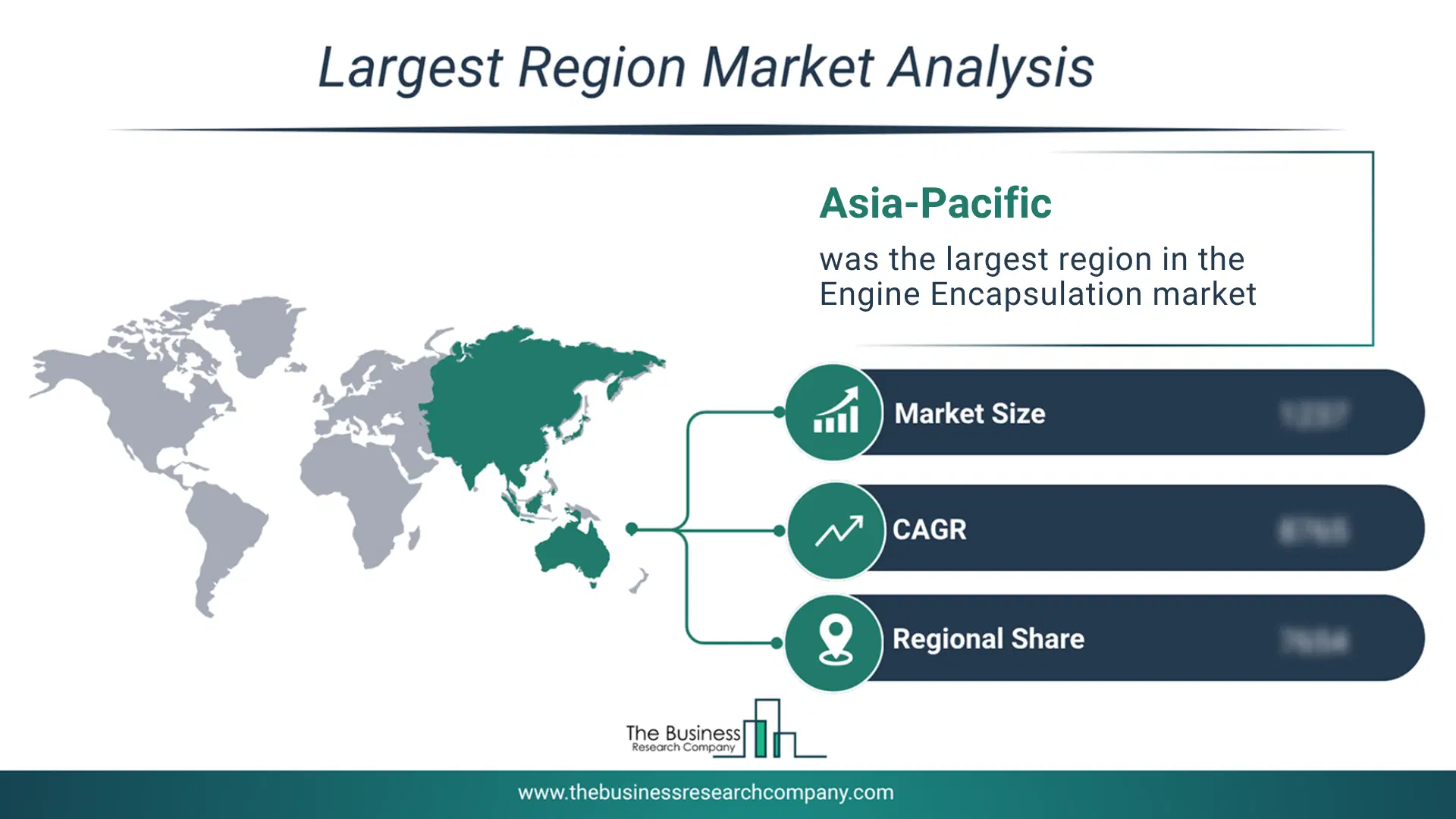
Regional Outlook
Asia-Pacific was the largest region in the engine encapsulation market in 2025.Asia-PAcific is expected to be the fastest-growing region in the forecast period. The regions covered in this market report include Asia-Pacific, South East Asia, Western Europe, Eastern Europe, North America, South America, Middle East, Africa. The countries covered in this market report include Australia, Brazil, China, France, Germany, India, Indonesia, Japan, Taiwan, Russia, South Korea, UK, USA, Canada, Italy, SpainWhat Defines the Engine Encapsulation Market?
The engine encapsulation market consists of sales of engine encapsulation made of polyamide and glasswool. Values in this market are ‘factory gate’ values, that is the value of goods sold by the manufacturers or creators of the goods, whether to other entities (including downstream manufacturers, wholesalers, distributors and retailers) or directly to end customers. The value of goods in this market includes related services sold by the creators of the goods.How is Market Value Defined and Measured?
The market value is defined as the revenues that enterprises gain from the sale of goods and/or services within the specified market and geography through sales, grants, or donations in terms of the currency (in USD unless otherwise specified). The revenues for a specified geography are consumption values that are revenues generated by organizations in the specified geography within the market, irrespective of where they are produced. It does not include revenues from resales along the supply chain, either further along the supply chain or as part of other products.
This chart presents market attractiveness based on a quantitative evaluation of growth, competition, strategic alignment, and risk, offering a clear view of opportunity areas for decision-making. This chart is for illustrative purposes; the full report contains the complete analysis.

This chart highlights the Total Addressable Market (TAM) by estimating the maximum revenue opportunity using an assumption-driven approach, supporting strategic planning and opportunity sizing across markets. The chart is illustrative; the full report provides a more comprehensive analysis.
What Key Data and Analysis Are Included in the Engine Encapsulation Market Report 2026?
The engine encapsulation market research report is one of a series of new reports from The Business Research Company that provides market statistics, including industry global market size, regional shares, competitors with the market share, detailed market segments, market trends and opportunities, and any further data you may need to thrive in the engine encapsulation industry. The market research report delivers a complete perspective of everything you need, with an in-depth analysis of the current and future state of the industry.Engine Encapsulation Market Report Forecast Analysis
| Report Attribute | Details |
|---|---|
| Market Size Value In 2026 | $6.67 billion |
| Revenue Forecast In 2030 | $8.78 billion |
| Growth Rate | CAGR of 6.8% from 2026 to 2030 |
| Base Year For Estimation | 2025 |
| Actual Estimates/Historical Data | 2020-2025 |
| Forecast Period | 2026 - 2030 - 2030 |
| Market Representation | Revenue in USD Billion and CAGR from 2026 to 2030 |
| Segments Covered | Product Type, Material, Fuel Type, Vehicle Class, Sales Channel |
| Regional Scope | Asia-Pacific, Western Europe, Eastern Europe, North America, South America, Middle East, Africa |
| Country Scope | The countries covered in the report are Australia, Brazil, China, France, Germany, India, Indonesia, Japan, Taiwan, Russia, South Korea, UK, USA, Canada, Italy, Spain. |
| Key Companies Profiled | ElringKlinger AG, Autoneum Holding AG, Continental AG, Roechling Group, Greiner Foam International GmbH, Trocellen GmbH, Adler Pelzer Holding GmbH, BASF SE, Furukawa Electric Co. Ltd., Evonik Industries AG, Hennecke GmbH, Compagnie de Saint-Gobain S. A., UFP Technologies Inc., Polytec Group, DBW Advanced Fiber Technologies GmbH, ZF Friedrichshafen AG, GKN plc, Schaeffler Technologies AG & Co KG, BorgWarner Inc., AVL List GmbH, Axletech International, Dana Limited, Woco Industrietechnik GmbH, 3M Company, SA Automotive Ltd, Charlotte Baur Formschaumtechnik GmbH, Carcoustics International GmbH, Uniproducts Inc., UGN Inc., Robert Bosch GmbH |
| Customization Scope | Request for Customization |
| Pricing And Purchase Options | Explore Purchase Options |