

English Language Learning For Kids Market Report 2026
Global Outlook – By Learning Type (Grammar Learning Apps, Vocabulary Building Apps, Speaking And Listening Practice Apps, Reading And Writing Skill Apps, Comprehensive Gamified Learning Platforms), By Age Group (Preschool (3–5 Years), Early Primary (6–8 Years), Upper Primary (9–12 Years), Pre-Teens Or Beginner Teens (13–15 Years)), By Platform Or Device Type (Mobile-Based, Tablet-Based Learning Apps, Desktop Or Web-Based Platforms, Hybrid Learning Platforms), By End User (Individual Home Learners, K–12 School-Based Learning, After-School Tutoring Centers, English As Second Language Learners) – Market Size, Trends, Strategies, and Forecast to 2030
English Language Learning For Kids Market Overview
• English Language Learning For Kids market size has reached to $14.48 billion in 2025 • Expected to grow to $25.93 billion in 2030 at a compound annual growth rate (CAGR) of 12.4% • Growth Driver: Expansion Of International Schools Is Fueling Market Growth Due To Rising Demand For English-Medium Education And Global Curriculum Adoption • Market Trend: Technology-Driven Literacy Solutions Advancing Kids’ Language Education • Asia-Pacific was the largest region and fastest growing region.What Is Covered Under English Language Learning For Kids Market?
English language learning for kids refers to educational programs, tools, and learning methods designed to help children develop english language skills, including reading, writing, speaking, and listening. These learning solutions use interactive content, visual aids, games, storytelling, and structured lessons to improve language comprehension and communication abilities in an engaging and age-appropriate manner. They support early language development, cognitive learning, and educational proficiency through classroom-based, digital, and blended learning approaches. The main learning types of English language learning for kids include grammar learning apps, vocabulary building apps, speaking and listening practice apps, reading and writing skill apps, and comprehensive gamified learning platforms. Grammar learning apps refer to educational applications designed to help children understand language rules, sentence structures, and correct usage through interactive activities. These solutions cater to age groups including preschool (3–5 years), early primary (6–8 years), upper primary (9–12 years), and pre-teens or beginner teens (13–15 years). They are available through mobile-based, tablet-based learning apps, desktop or web-based platforms, and hybrid learning platforms, and they are used by several end users such as individual home learners, K–12 school-based learning, after-school tutoring centers, and English as second language learners.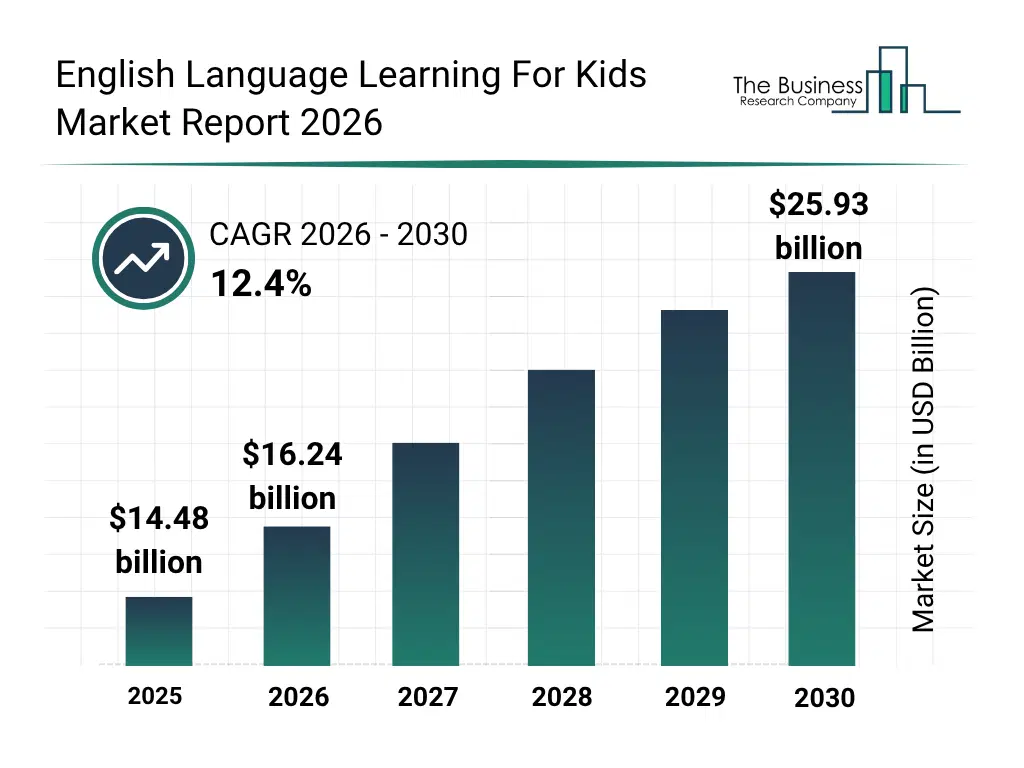
What Is The English Language Learning For Kids Market Size and Share 2026?
The english language learning for kids market size has grown rapidly in recent years. It will grow from $14.48 billion in 2025 to $16.24 billion in 2026 at a compound annual growth rate (CAGR) of 12.2%. The growth in the historic period can be attributed to expansion of early childhood education programs, increasing adoption of english as a global communication language, growth of traditional classroom-based language teaching, rising availability of educational multimedia content, increasing parental focus on early cognitive development.What Is The English Language Learning For Kids Market Growth Forecast?
The english language learning for kids market size is expected to see rapid growth in the next few years. It will grow to $25.93 billion in 2030 at a compound annual growth rate (CAGR) of 12.4%. The growth in the forecast period can be attributed to increasing penetration of digital learning apps for children, growth of AI-powered personalized tutoring systems, rising demand for immersive and interactive learning experiences, expansion of hybrid education models in schools, increasing access to low-cost smart devices and internet connectivity. Major trends in the forecast period include increasing use of gamified learning platforms to improve engagement in early language acquisition, growing adoption of storytelling-based english learning methods to enhance comprehension skills in children, rising integration of speech recognition tools for pronunciation improvement and fluency training, increasing shift toward adaptive learning systems that personalize english lessons based on child performance, growing expansion of blended learning models combining classroom teaching with digital english learning applications.
Global English Language Learning For Kids Market Segmentation
1) By Learning Type: Grammar Learning Apps; Vocabulary Building Apps; Speaking And Listening Practice Apps; Reading And Writing Skill Apps; Comprehensive Gamified Learning Platforms 2) By Age Group: Preschool (3–5 Years); Early Primary (6–8 Years); Upper Primary (9–12 Years); Pre-Teens Or Beginner Teens (13–15 Years) 3) By Platform Or Device Type: Mobile-Based; Tablet-Based Learning Apps; Desktop Or Web-Based Platforms; Hybrid Learning Platforms 4) By End User: Individual Home Learners; K–12 School-Based Learning; After-School Tutoring Centers; English As Second Language Learners Subsegments: 1) By Grammar Learning Apps: Sentence Structure Learning; Tense Practice Learning; Parts Of Speech Learning; Punctuation Learning; Interactive Grammar Games 2) By Vocabulary Building Apps: Word Recognition Learning; Picture-Based Vocabulary Learning; Spelling Improvement Learning; Flashcard Vocabulary Learning; Contextual Word Usage Learning 3) By Speaking And Listening Practice Apps: Pronunciation Training; Conversation Practice Learning; Audio Story Listening; Speech Recognition Learning; Interactive Listening Exercises 4) By Reading And Writing Skill Apps: Phonics Reading Learning; Handwriting Practice Learning; Reading Comprehension Learning; Creative Writing Learning; Story-Based Reading Activities 5) By Comprehensive Gamified Learning Platforms: Reward-Based Learning Platforms; Adventure-Based Learning Games; Artificial Intelligence Personalized Learning; Multi-Skill Learning Platforms; Interactive Educational ChallengesWhat Is The Driver Of The English Language Learning For Kids Market?
The expansion of international schools is expected to propel the growth of the english language learning for kids market going forward. International schools typically use English as the primary medium of instruction and attract both local and expatriate families seeking globally recognized education. International schools are growing due to rising demand for internationally recognized education, which is increasing the need for english language learning among children to help them succeed in global academic environments and future careers. International schools use english as the primary medium of instruction, create immersive multilingual environments, integrate interactive learning methods and digital tools, and encourage daily communication in english, helping children develop strong language proficiency from an early age. For instance, in May 2024, according to the Study in the States, a US-based official government website, the number of international students enrolled in kindergarten through grade 12 (K–12) schools rose by 1.9% between 2022 and 2023, increasing by 1,041 students. Therefore, the expansion of international schools is driving the growth of the english language learning for kids industry.Key Players In The Global English Language Learning For Kids Market
Major companies operating in the english language learning for kids market are British Council; Berlitz Corporation; EF Education First Ltd.; Duolingo Kids; ABCmouse.com Early Learning Academy; Rosetta Stone Ltd.; Lingokids Inc.; 51Talk Online Education Group; Cambly Inc.; Outschool Inc.; Novakid Inc.; Reading Eggs; WuKong; iTalki; Studycat Limited; Helen Doron Educational Group; Hooked; Muzzy BBC; Mango Languages; Little Pim Corporation; Petralingua; Vipkid Inc.Global English Language Learning For Kids Market Trends and Insights
Major companies operating in the english language learning for kids market are focusing on developing innovative solutions, such as gamified literacy learning applications, to enhance early reading skills, language comprehension, and learner engagement among children. Gamified literacy learning applications are digital educational platforms that combine interactive lessons, phonics-based instruction, storytelling, and reward-driven activities to help children develop reading and writing abilities in a more engaging manner than traditional classroom-based or textbook-focused learning methods. For instance, in March 2023, Duolingo Inc., a US-based language learning technology company, launched Duolingo ABC in India, an innovative literacy learning app designed specifically for children aged three to eight years. The free-to-use app offers more than 700 short lessons covering alphabet recognition, phonics, sight words, and foundational reading skills through interactive activities and games. It features nine distinct learning levels that adapt to a child’s reading ability, starting with shorter and easier words in the early stages and progressing to longer stories with reduced support in advanced levels. The application also includes personalized exercises such as name-writing lessons and activities for learning lowercase and uppercase letters, helping children strengthen literacy and comprehension skills in an engaging environment.What Are Latest Mergers And Acquisitions In The English Language Learning For Kids Market?
In October 2023, Discovery Education Inc., a US-based education technology company, acquired DreamBox Learning Inc. for an undisclosed amount. With this acquisition, Discovery Education, Inc. aimed to strengthen its K-12 digital learning ecosystem by integrating DreamBox Learning, Inc.’s adaptive mathematics and reading solutions, thereby expanding personalized learning capabilities and enhancing data-driven instructional support for educators and students across multiple grade levels. DreamBox Learning Inc. is a US-based education technology company that specializes in adaptive online learning platforms for mathematics and reading, using artificial intelligence and real-time analytics to personalize instruction for K-12 students.Regional Outlook
Asia-Pacific was the largest region in the english language learning for kids market in 2025 and is expected to be the fastest-growing region in the forecast period. The regions covered in this market report are Asia-Pacific, South East Asia, Western Europe, Eastern Europe, North America, South America, Middle East, Africa. The countries covered in this market report are Australia, Brazil, China, France, Germany, India, Indonesia, Japan, Taiwan, Russia, South Korea, UK, USA, Canada, Italy, Spain.What Defines the English Language Learning For Kids Market?
The english language learning for kids market consists of revenues earned by entities by providing services such as language instruction, online tutoring, curriculum development, digital learning platforms, interactive learning applications, assessment and progress tracking, and educational content delivery. The market value includes the value of related goods sold by the service provider or included within the service offering. Only goods and services traded between entities or sold to end consumers are included.How is Market Value Defined and Measured?
The market value is defined as the revenues that enterprises gain from the sale of goods and/or services within the specified market and geography through sales, grants, or donations in terms of the currency (in USD unless otherwise specified). The revenues for a specified geography are consumption values that are revenues generated by organizations in the specified geography within the market, irrespective of where they are produced. It does not include revenues from resales along the supply chain, either further along the supply chain or as part of other products.What Key Data and Analysis Are Included in the English Language Learning For Kids Market Report 2026?
The english language learning for kids market research report is one of a series of new reports from The Business Research Company that provides market statistics, including industry global market size, regional shares, competitors with the market share, detailed market segments, market trends and opportunities, and any further data you may need to thrive in the english language learning for kids industry. The market research report delivers a complete perspective of everything you need, with an in-depth analysis of the current and future state of the industry.English Language Learning For Kids Market Report Forecast Analysis
| Report Attribute | Details |
|---|---|
| Market Size Value In 2026 | $16.24 billion |
| Revenue Forecast In 2030 | $25.93 billion |
| Growth Rate | CAGR of 12.4% from 2026 to 2030 |
| Base Year For Estimation | 2025 |
| Actual Estimates/Historical Data | 2020-2025 |
| Forecast Period | 2026 - 2030 |
| Market Representation | Revenue in USD Billion and CAGR from 2026 to 2030 |
| Segments Covered | Learning Type, Age Group, Platform Or Device Type, End User |
| Regional Scope | Asia-Pacific, Western Europe, Eastern Europe, North America, South America, Middle East, Africa |
| Country Scope | The countries covered in the report are Australia, Brazil, China, France, Germany, India, ... |
| Key Companies Profiled | British Council; Berlitz Corporation; EF Education First Ltd.; Duolingo Kids; ABCmouse.com Early Learning Academy; Rosetta Stone Ltd.; Lingokids Inc.; 51Talk Online Education Group; Cambly Inc.; Outschool Inc.; Novakid Inc.; Reading Eggs; WuKong; iTalki; Studycat Limited; Helen Doron Educational Group; Hooked; Muzzy BBC; Mango Languages; Little Pim Corporation; Petralingua; Vipkid Inc. |
| Customization Scope | Request for Customization |
| Pricing And Purchase Options | Explore Purchase Options |