

Enterprise Collaboration Software Market Report 2026
Global Outlook – By Deployment Type (On-Premise, Cloud-Based), By Application (Communication Tools, Conferencing Tools, Coordination Tools), By End-User Industry (Telecommunications And IT, Travel And Hospitality, BFSI (Banking, Financial Services And insurance), Retail And Consumer Goods, Education, Transportation And Logistics, Healthcare, Other End-User Industries) – Market Size, Trends, Strategies, and Forecast to 2030
Enterprise Collaboration Software Market Overview
• Enterprise Collaboration Software market size has reached to $70.46 billion in 2025 • Expected to grow to $118.42 billion in 2030 at a compound annual growth rate (CAGR) of 11% • Growth Driver: Mobile Devices Driving Growth Of The Enterprise Collaboration Software Market • Market Trend: Advanced Cloud Migration Platforms Revolutionize The Enterprise Collaboration Software Market • North America was the largest region in 2025 and Asia-Pacific is the fastest growing region.What Is Covered Under Enterprise Collaboration Software Market?
Enterprise collaboration software refers to digital platforms and tools that facilitate communication and teamwork among employees within an organization, allowing them to collaborate effectively on projects regardless of their physical location. It enables seamless information sharing, enhances productivity, and promotes a positive work atmosphere by establishing a framework for managing communication and sharing information across a company. The main types of deployments of enterprise collaboration software include on-premise and cloud-based. On-premise deployment refers to the method of deploying software or IT infrastructure hardware and software applications that exist on-site, within a company's own facilities, and are maintained by the company itself. It is used for several applications, such as communication tools, conferencing tools, coordination tools, by various end-user industries, including telecommunications and IT, travel and hospitality, banking, financial services and insurance (BFSI), retail and consumer goods, education, transportation and logistics, healthcare and others.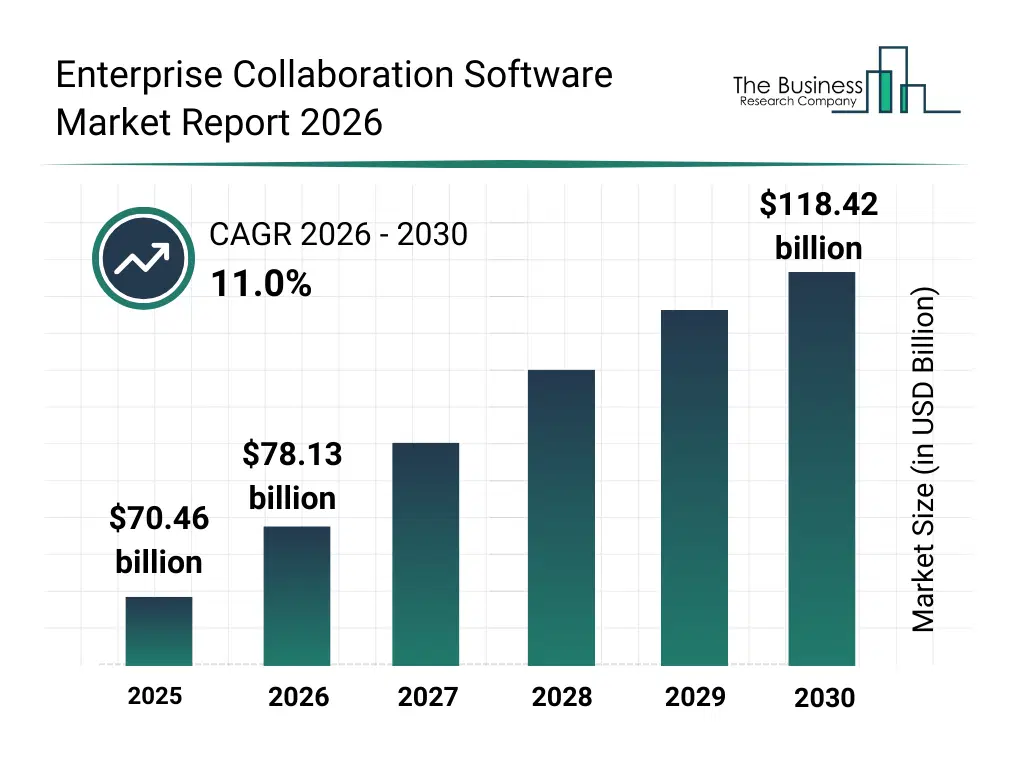
What Is The Enterprise Collaboration Software Market Size and Share 2026?
The enterprise collaboration software market size has grown rapidly in recent years. It will grow from $70.46 billion in 2025 to $78.13 billion in 2026 at a compound annual growth rate (CAGR) of 10.9%. The growth in the historic period can be attributed to increasing need for cross-departmental collaboration, adoption of enterprise communication tools, growth in distributed workforce, demand for efficient information sharing, rising reliance on email and intranet platforms.What Is The Enterprise Collaboration Software Market Growth Forecast?
The enterprise collaboration software market size is expected to see rapid growth in the next few years. It will grow to $118.42 billion in 2030 at a compound annual growth rate (CAGR) of 11.0%. The growth in the forecast period can be attributed to integration with ai-driven analytics, growth in hybrid and remote work models, adoption of cloud-based collaboration software, emphasis on employee productivity solutions, increasing use of immersive digital experiences. Major trends in the forecast period include remote work enablement, collaborative project management, unified communication platforms, employee engagement & productivity tools, knowledge management systems.
Global Enterprise Collaboration Software Market Segmentation
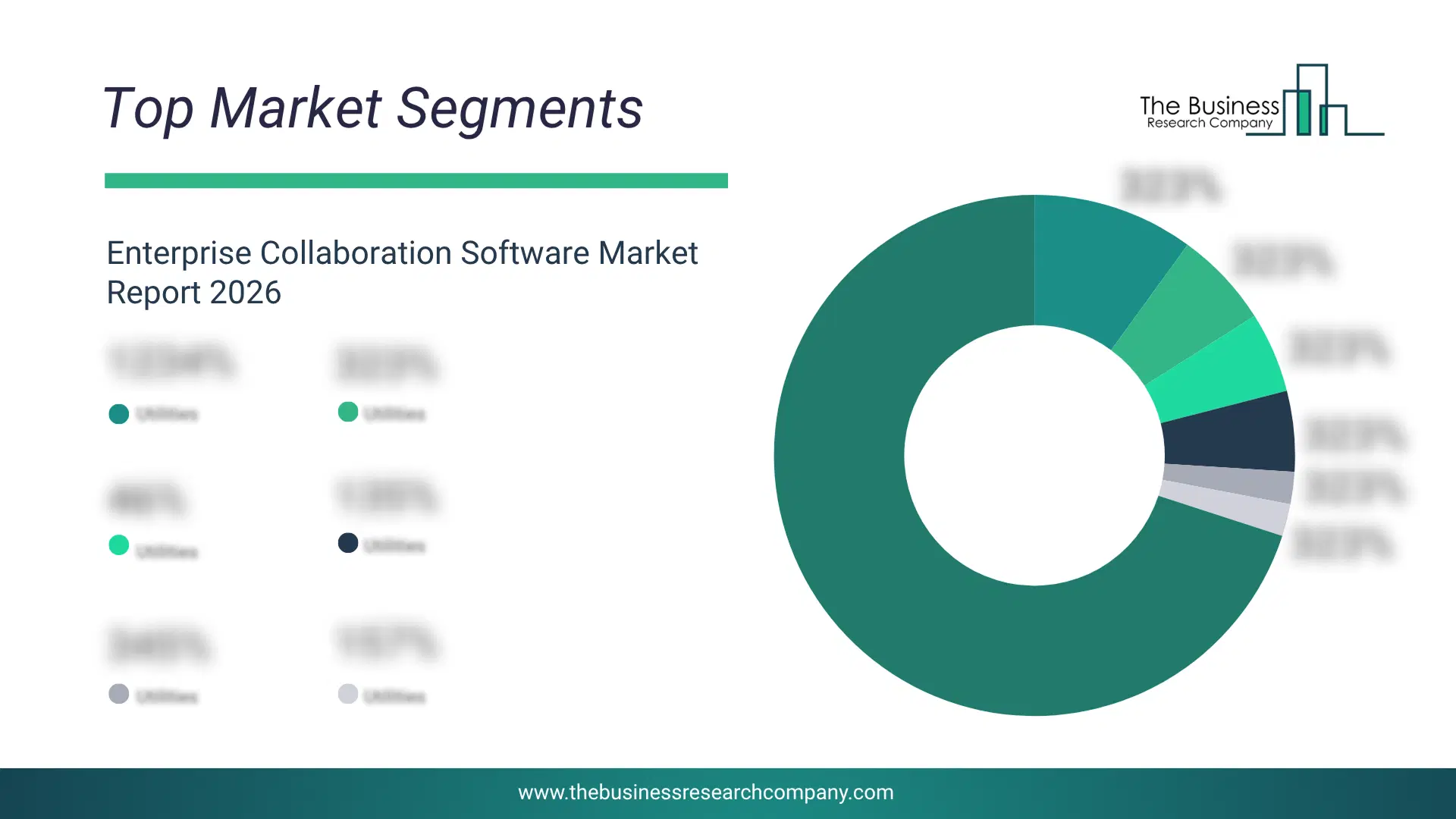
1) By Deployment Type: On-Premise, Cloud-Based 2) By Application: Communication Tools, Conferencing Tools, Coordination Tools 3) By End-User Industry: Telecommunications And IT, Travel And Hospitality, BFSI (Banking, Financial Services And insurance), Retail And Consumer Goods, Education, Transportation And Logistics, Healthcare, Other End-User Industries Subsegments: 1) By On-Premise: Self-Hosted, Dedicated Servers 2) By Cloud-Based: Public Cloud, Private Cloud, Hybrid CloudWhat Is The Driver Of The Enterprise Collaboration Software Market?
The growing usage of mobile devices is expected to propel the growth of the enterprise collaboration software market going forward. A mobile device is a handheld computer designed for portability, compactness, and lightweight characteristics. The usage of mobile devices is on the rise due to several factors, including easy access to information and communication, the widespread availability of high-speed internet connections, and the proliferation of Wi-Fi networks. Mobile devices enhance the use of workplace collaboration software by giving users more flexibility, mobility, and accessibility, allowing them to interact successfully and remain productive regardless of location or device. For instance, in July 2024, according to Ofcom, a UK-based government-regulated communications authority, reflecting continued expansion in 2023, mobile subscriptions rose 4 percent to 116.1 million, with machine-to-machine connections showing the strongest growth at 8 percent, or an additional 2 million subscriptions. Therefore, the growing usage of mobile devices is driving the growth of the enterprise collaboration software industry.Key Players In The Global Enterprise Collaboration Software Market
Major companies operating in the enterprise collaboration software market are Google LLC; Microsoft Corporation; Huawei Technologies Co. Ltd.; IBM Corporation; Cisco System Inc.; Oracle Corporation; SAP SE; Salesforce Inc.; Adobe Systems Inc.; Workday Inc.; Zoom Video Communications Inc.; Atlassian Corporation PLC; RingCentral Inc.; Polycom Inc.; Mitel LLC; TIBCO Software Inc.; Zoho Corporation Pvt. Ltd.; Slack Technologies Inc.; Dialpad Inc.; Wrike Inc.; Figma Inc.; Calendly LLC; Airtable; Workfront Inc.; Notion Labs Inc.; ProofHub LLC; Chanty Inc.; Axero Solutions LLC; Aurea Software Inc.; Nextcloud GmbH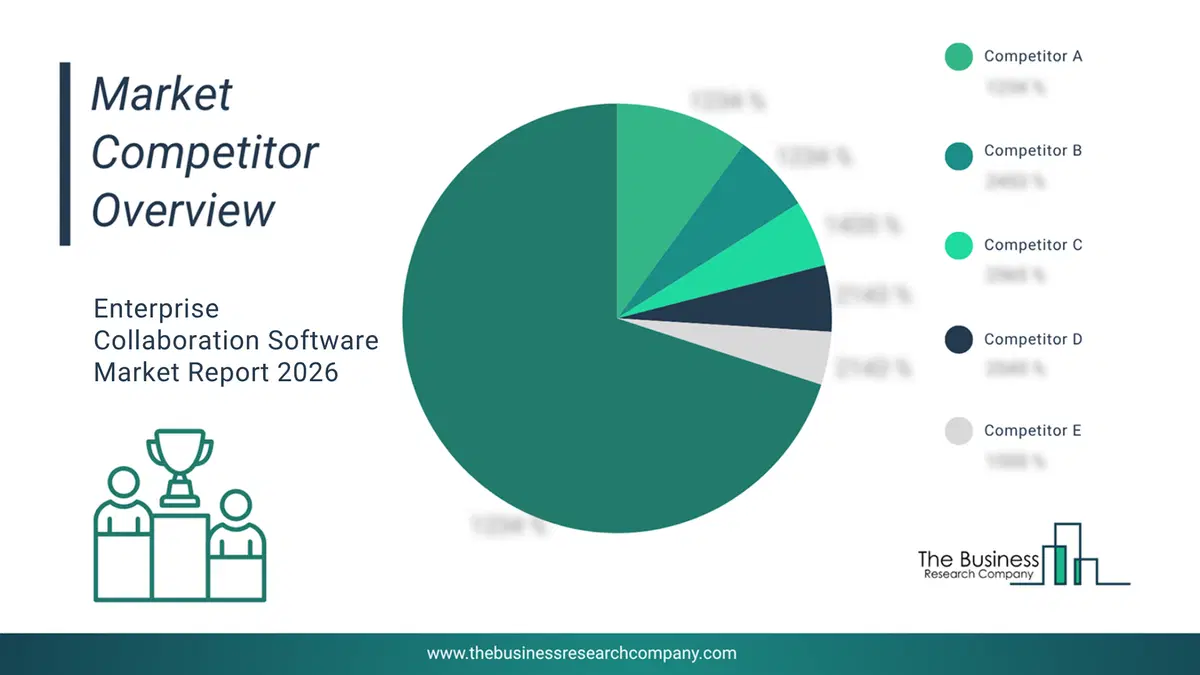
This chart is for illustrative purposes; the full report includes a detailed competitor analysis and comprehensive overview of the top 10 companies in the market.
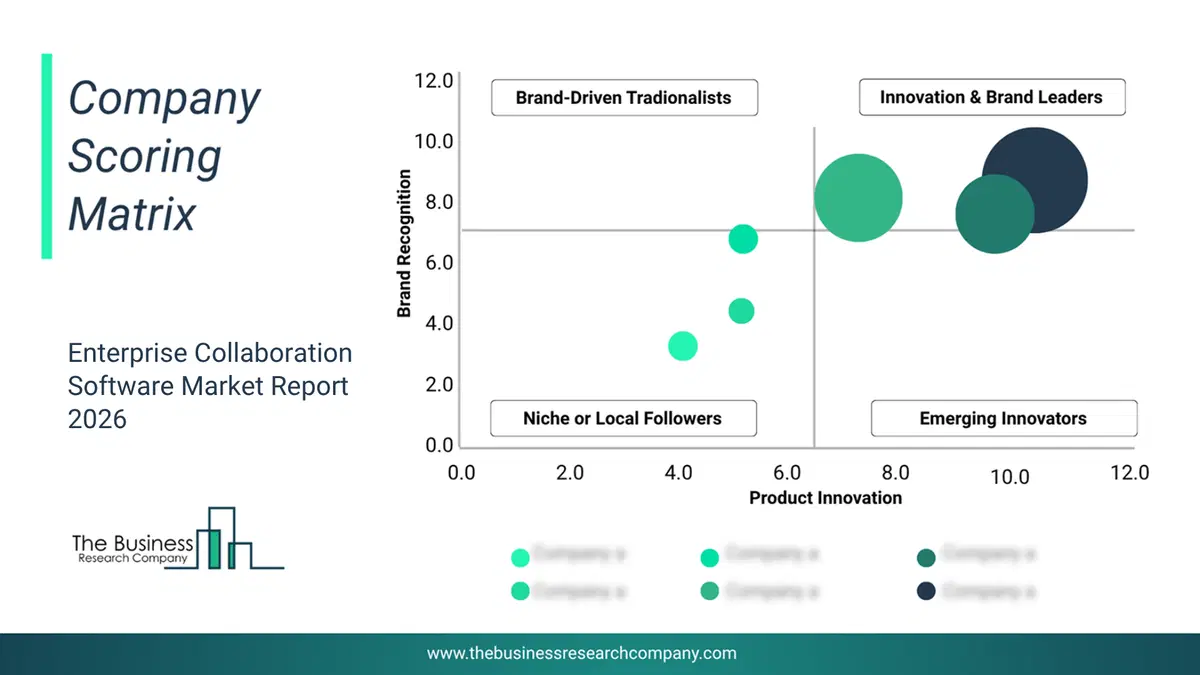
This chart maps companies by product innovation and brand strength, with bubble size indicating relative revenue, helping identify market leaders, challengers, and niche players. This is an illustrative chart; the full report provides a complete and accurate competitive analysis.
Global Enterprise Collaboration Software Market Trends and Insights
Major companies operating in the enterprise collaboration software market are developing advanced technologies, such as cloud migration platforms, to better serve customers with advanced features. A cloud migration platform is a set of tools and services that facilitate the process of moving data, applications, or other business elements from an on-premises data center to a cloud computing environment, or from one cloud platform to another. For instance, in March 2023, Flexera, a US-based computer software company, launched Flexera One FinOps, a suite of enterprise collaboration tools and solutions designed to help cloud teams collaborate with partners and stakeholders across the organization. This solution not only enhances the convergence of IT asset management (ITAM) and FinOps but also empowers enterprises to significantly elevate their visualization and allocation of cloud usage and billing. Furthermore, Flexera One FinOps enables efficient management of hybrid IT estates and the operation of cloud services at scale. This unique solution offers an integrated view of the entire technology ecosystem, facilitating collaboration among cloud teams, ITAM, software license management (SLM), IT operations and engineering, finance, architecture, and security teams across the organization.What Are Latest Mergers And Acquisitions In The Enterprise Collaboration Software Market?
In October 2024, Progress Software Corporation, a US-based company that produces software for creating and deploying business applications, acquired ShareFile for $875 million. Through this acquisition, Progress aims to expand its Digital Experience portfolio, enhance AI-powered, document-centric collaboration capabilities, and grow its customer base. ShareFile is a US-based SaaS company providing an AI-powered, document-centric collaboration platform for multiple industries.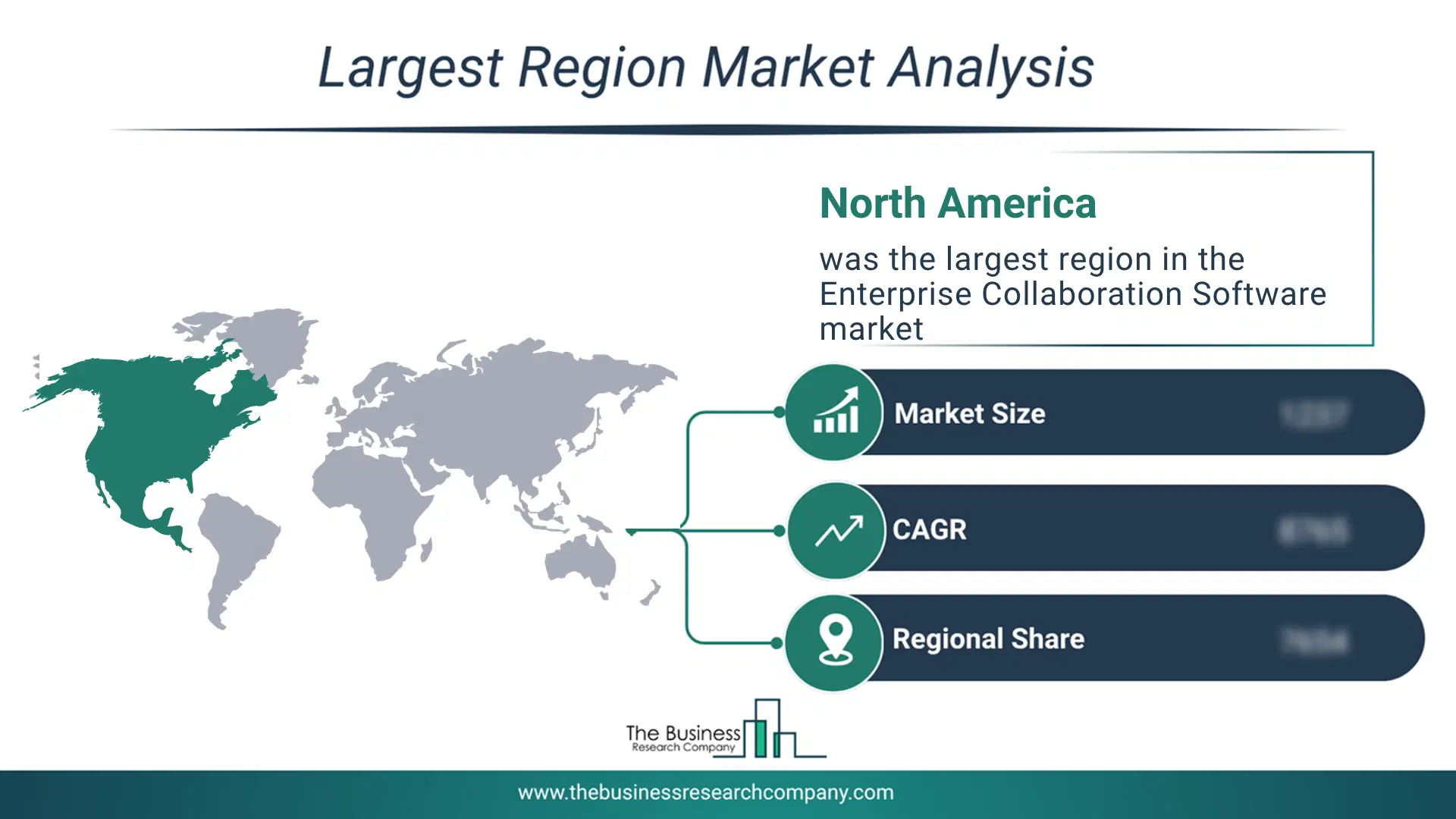
Regional Insights
North America was the largest region in the enterprise collaboration software market in 2025. Asia-Pacific is expected to be the fastest-growing region in the forecast period. The regions covered in this market report are Asia-Pacific, South East Asia, Western Europe, Eastern Europe, North America, South America, Middle East, Africa. The countries covered in this market report are Australia, Brazil, China, France, Germany, India, Indonesia, Japan, Taiwan, Russia, South Korea, UK, USA, Canada, Italy, SpainWhat Defines the Enterprise Collaboration Software Market?
The enterprise collaboration software market includes revenues earned by entities by providing security and access controls, knowledge management, integration with productivity tools, video conferencing and webinars, messaging and chat, and others. Values in this market are ‘factory gate’ values, that is the value of goods sold by the manufacturers or creators of the goods, whether to other entities (including downstream manufacturers, wholesalers, distributors and retailers) or directly to end customers. The value of goods in this market includes related services sold by the creators of the goods.How is Market Value Defined and Measured?
The market value is defined as the revenues that enterprises gain from the sale of goods and/or services within the specified market and geography through sales, grants, or donations in terms of the currency (in USD unless otherwise specified). The revenues for a specified geography are consumption values that are revenues generated by organizations in the specified geography within the market, irrespective of where they are produced. It does not include revenues from resales along the supply chain, either further along the supply chain or as part of other products.
This chart presents market attractiveness based on a quantitative evaluation of growth, competition, strategic alignment, and risk, offering a clear view of opportunity areas for decision-making. This chart is for illustrative purposes; the full report contains the complete analysis.

This chart highlights the Total Addressable Market (TAM) by estimating the maximum revenue opportunity using an assumption-driven approach, supporting strategic planning and opportunity sizing across markets. The chart is illustrative; the full report provides a more comprehensive analysis.
What Key Data and Analysis Are Included in the Enterprise Collaboration Software Market Report 2026?
The enterprise collaboration software market research report is one of a series of new reports from The Business Research Company that provides market statistics, including industry global market size, regional shares, competitors with the market share, detailed market segments, market trends and opportunities, and any further data you may need to thrive in the enterprise collaboration software industry. The market research report delivers a complete perspective of everything you need, with an in-depth analysis of the current and future state of the industry.Enterprise Collaboration Software Market Report Forecast Analysis
| Report Attribute | Details |
|---|---|
| Market Size Value In 2026 | $78.13 billion |
| Revenue Forecast In 2030 | $118.42 billion |
| Growth Rate | CAGR of 11% from 2026 to 2030 |
| Base Year For Estimation | 2025 |
| Actual Estimates/Historical Data | 2020-2025 |
| Forecast Period | 2026 - 2030 |
| Market Representation | Revenue in USD Billion and CAGR from 2026 to 2030 |
| Segments Covered | Deployment Type, Application, End-User Industry |
| Regional Scope | Asia-Pacific, Western Europe, Eastern Europe, North America, South America, Middle East, Africa |
| Country Scope | The Countries Covered In This Market Report Are Australia, Brazil, China, France, Germany, India, Indonesia, Japan, Taiwan, Russia, South Korea, Uk, Usa, Canada, Italy, Spain. |
| Key Companies Profiled | Google LLC, Microsoft Corporation, Huawei Technologies Co. Ltd., IBM Corporation, Cisco System Inc., Oracle Corporation, SAP SE, Salesforce Inc., Adobe Systems Inc., Workday Inc., Zoom Video Communications Inc., Atlassian Corporation PLC, RingCentral Inc., Polycom Inc., Mitel LLC, TIBCO Software Inc., Zoho Corporation Pvt. Ltd., Slack Technologies Inc., Dialpad Inc., Wrike Inc., Figma Inc., Calendly LLC, Airtable, Workfront Inc., Notion Labs Inc., ProofHub LLC, Chanty Inc., Axero Solutions LLC, Aurea Software Inc., Nextcloud GmbH |
| Customization Scope | Request for Customization |
| Pricing And Purchase Options | Explore Purchase Options |