

Enterprise Information Archiving Global Market Opportunities And Strategies To 2035
By Type (Content Type, Services), By Deployment Type (Cloud, On-Premises), By Organization Size (Large Enterprises, Small And Medium-Sized Enterprises (SMEs)), By Vertical (Government And Defense, BFSI, Retail And Ecommerce, Education And Research, Healthcare And Pharmaceutical, Manufacturing, Media And Entertainment, IT And Telecommunications, Other Verticals), And By Region, Opportunities And Strategies – Global Forecast To 2035
Enterprise Information Archiving Market Definition
Enterprise information archiving (EIA) is a strategy and technology framework used by organizations to systematically capture, store, manage, preserve, and retrieve business information over long periods. It consolidates data from multiple sources such as emails, documents, files, databases, instant messages, collaboration platforms, and other digital content into a secure and searchable repository. The primary purpose of enterprise information archiving is to enable long-term retention, protection, and efficient retrieval of critical business information while meeting legal, regulatory, and operational requirements. The enterprise information archiving market consists of revenues generated by entities (organizations, sole traders and partnerships) through the sale of software, platforms and associated services designed to archive, preserve, search, retrieve and manage enterprise information. Enterprise information archiving solutions are used by government agencies, financial institutions, healthcare providers, educational institutions, telecommunications companies, retailers and other enterprises that require secure long-term retention of digital records. Organizations typically use these solutions to ensure regulatory compliance, support litigation and e-discovery processes, facilitate knowledge management, improve information governance and reduce storage costs associated with active production environments.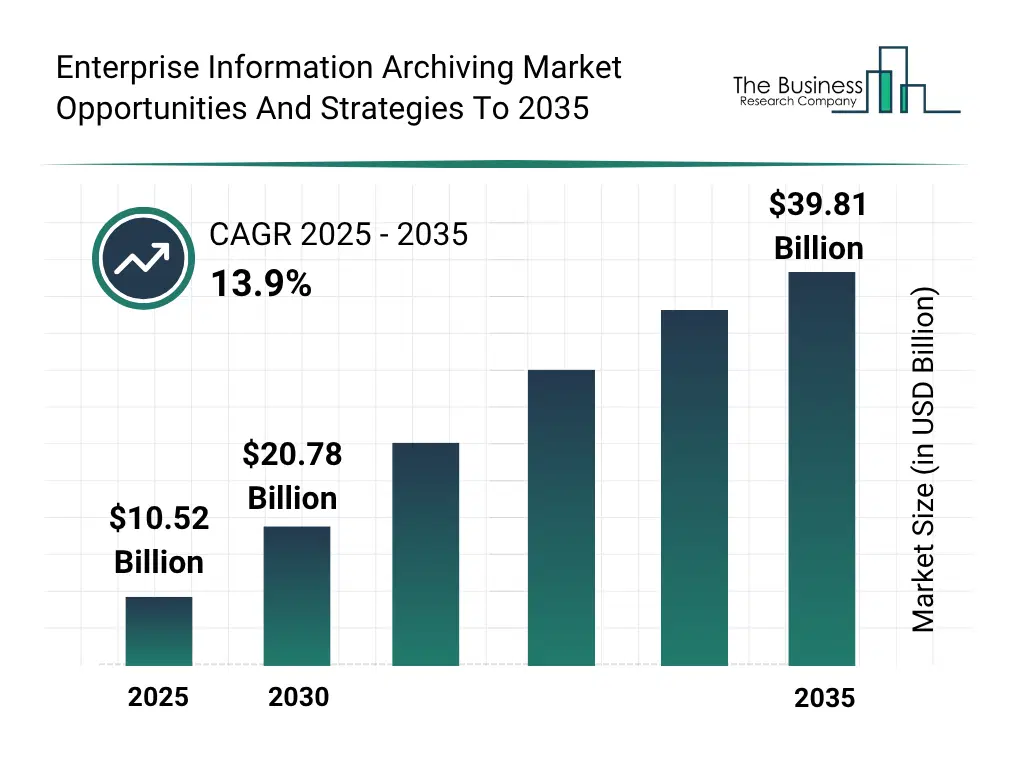
Enterprise Information Archiving Market Size
The global enterprise information archiving market reached a value of nearly $10,522.0 million in 2025, having grown at a compound annual growth rate (CAGR) of 15.1% since 2020. The market is expected to grow from $10,522.0 million in 2025 to $20,784.2 million in 2030 at a rate of 14.6%. The market is then expected to grow at a CAGR of 13.9% from 2030 and reach $39,813.0 million in 2035. Growth in the historic period resulted from rising cybersecurity concerns, rising adoption of cloud-based solutions, growth of remote and hybrid work environments and increasing adoption of SaaS applications. Factors that negatively affected growth in the historic period were high initial implementation and deployment costs and limited budgets and ROI concerns. Going forward, growing volume of unstructured enterprise data, expansion of digital record-keeping requirements, increasing regulatory compliance and data retention requirements across industries and increasing digital transformation initiatives will drive the growth. Factors that could hinder the growth of the enterprise information archiving market in the future include complexity of legacy system integration, vendor lock-in risks and impact of trade wars and tariffs.
Enterprise Information Archiving Market Segmentation
The carbon black market is segmented by type, by grade and by application.By Type –
The carbon black market is segmented by type into:
- a) Content Type
- b) Services
By Deployment Type –
The carbon black market is segmented by deployment type into:
- a) Cloud
- b) On-Premises
By Organization Size –
The carbon black market is segmented by organization size into:
- a) Large Enterprises
- b) Small And Medium-Sized Enterprises (SMEs)
By Organization Size –
The carbon black market is segmented by organization size into:
- a) Government And Defense
- b) BFSI
- c) Retail And Ecommerce
- d) Education And Research
- e) Healthcare And Pharmaceutical
- f) Manufacturing
- g) Media And Entertainment
- h) IT And Telecommunications
- i) Other Verticals
By Geography - The carbon black market is segmented by geography into:
- China
- India
- Japan
- Australia
- Indonesia
- South Korea
- USA
- Canada
- Brazil
- France
- Germany
- UK
- Italy
- Spain
- Russia
-
o Asia Pacific
o Africa