

Environmental Allergy Monitoring Market Report 2026
Global Outlook – By Type (Wearable Pollen Monitors, Internet Of Things Air Allergen Sensors, Real Time Air Quality Platforms), By Allergen Type (Pollen Allergens, Dust Mites, Mold Spores, Pet Dander, Air Pollutants, Other Allergen Types), By Distribution Channel (Direct Sales, Online Retail, Offline Retail, System Integrators And Solution Providers), By Application (Outdoor Pollen Monitoring, Indoor Allergen Tracking, Workplace Allergy Risk, Smart Home Allergy Alerts), By End User (Government Agencies, Healthcare Providers And Payers, Employers And Facility Managers, Consumers And Individuals, Universities And Research Institutes) – Market Size, Trends, Strategies, and Forecast to 2035
Environmental Allergy Monitoring Market Overview
• Environmental Allergy Monitoring market size has reached to $0.74 billion in 2025 • Expected to grow to $1.36 billion in 2030 at a compound annual growth rate (CAGR) of 13% • Growth Driver: Surge In Prevalence Of Allergic Diseases Fueling The Growth Of The Market Due To Increasing Environmental Allergen Exposure And Pollution Levels • Market Trend: Next-Generation Monitoring Tools Improve Environmental Awareness And Safety • North America was the largest region in 2025 and Asia-Pacific is the fastest growing region.What Is Covered Under Environmental Allergy Monitoring Market?
Environmental allergy monitoring is a technology that enables the detection, measurement, and analysis of environmental allergens such as pollen, dust mites, mold spores, and air pollutants to support health management and preventive care. It integrates advanced sensors, data analytics, artificial intelligence, and IoT capabilities to provide real-time monitoring, forecasting, and alerts regarding allergen levels. By connecting environmental data with digital platforms, it enhances awareness, supports timely interventions, and enables data-driven decision-making for individuals, healthcare providers, and organizations. The main types of environmental allergy monitoring include wearable pollen monitors, internet of things air allergen sensors, and real time air quality platforms. Wearable pollen monitors refer to portable devices designed to detect and measure airborne pollen exposure in real time, helping users track personal allergen exposure levels during daily activities. The allergen framework includes pollen allergens, dust mites, mold spores, pet dander, air pollutants, and other allergen types and they are distributed through direct sales, online retail, offline retail, and system integrators and solution providers. They find application in outdoor pollen monitoring, indoor allergen tracking, workplace allergy risk, and smart home allergy alerts, serving end users including government agencies, healthcare providers and payers, employers and facility managers, consumers and individuals, and universities and research institutes.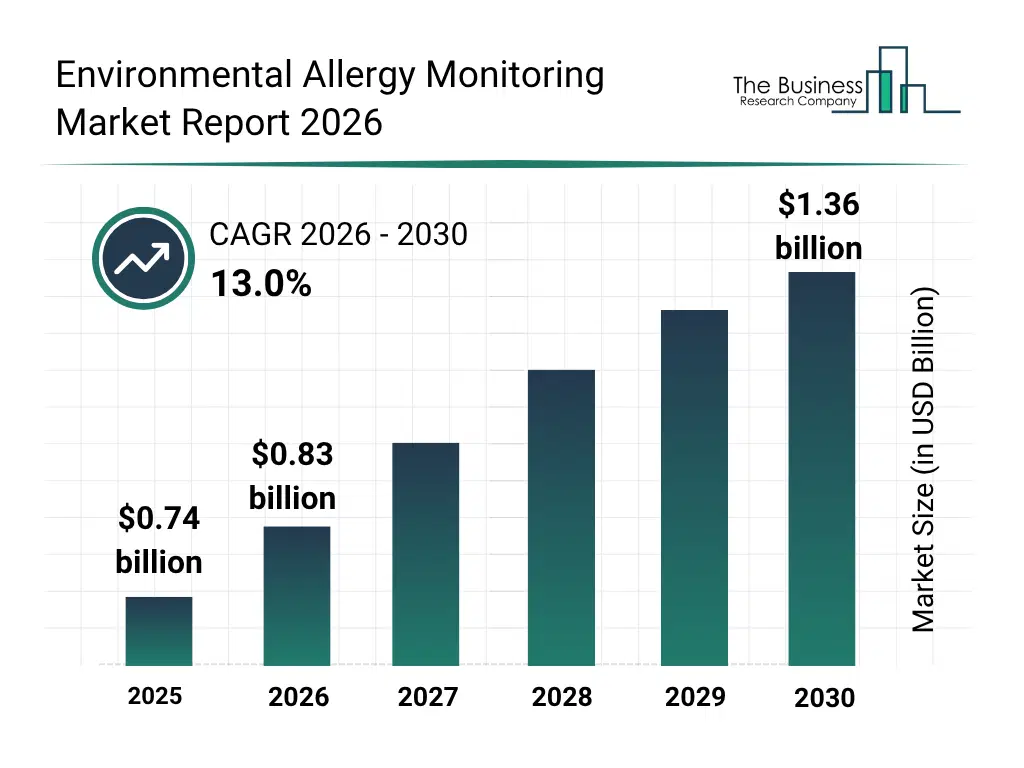
What Is The Environmental Allergy Monitoring Market Size and Share 2026?
The environmental allergy monitoring market size has grown rapidly in recent years.It will grow from $0.74 billion in 2025 to $0.83 billion in 2026 at a compound annual growth rate (CAGR) of 12.7%. The growth in the historic period can be attributed to basic manual pollen count reporting systems, limited awareness of environmental allergy triggers, growth of basic air quality monitoring stations, expansion of respiratory health surveillance programs, early adoption of digital weather forecasting tools.What Is The Environmental Allergy Monitoring Market Growth Forecast?
The environmental allergy monitoring market size is expected to see rapid growth in the next few years.It will grow to $1.36 billion by 2030 at a compound annual growth rate (CAGR) of 13.0%. The growth in the forecast period can be attributed to integration of ai based allergen prediction models, rising prevalence of respiratory allergies globally, expansion of smart city environmental monitoring networks, increasing demand for personalized health risk alerts, growth of iot enabled wearable health monitoring devices.Major trends in the forecast period include Hyperlocal allergen forecasting systems, wearable environmental exposure tracking devices, smart home integrated allergy alert systems, predictive air quality health risk modeling, real time urban pollution and allergen mapping platforms.
Global Environmental Allergy Monitoring Market Segmentation
1) By Type: Wearable Pollen Monitors, Internet Of Things Air Allergen Sensors, Real Time Air Quality Platforms 2) By Allergen Type: Pollen Allergens, Dust Mites, Mold Spores, Pet Dander, Air Pollutants, Other Allergen Types 3) By Distribution Channel: Direct Sales, Online Retail, Offline Retail, System Integrators And Solution Providers 4) By Application: Outdoor Pollen Monitoring, Indoor Allergen Tracking, Workplace Allergy Risk, Smart Home Allergy Alerts 5) By End User: Government Agencies, Healthcare Providers And Payers, Employers And Facility Managers, Consumers And Individuals, Universities And Research Institutes Subsegments: 1) By Wearable Pollen Monitors: Personal Wearable Pollen Detection Devices, Clip On Pollen Monitoring Devices, Wrist Based Pollen Monitoring Devices, Portable Handheld Pollen Monitoring Devices, Smart Clothing Integrated Pollen Sensors 2) By Internet Of Things Air Allergen Sensors: Indoor Air Allergen Monitoring Sensors, Outdoor Air Allergen Monitoring Sensors, Smart Home Integrated Allergen Sensors, Industrial Air Allergen Detection Sensors, Wireless Connected Allergen Sensor Networks 3) By Real Time Air Quality Platforms: Cloud Based Air Quality Monitoring Platforms, Mobile Application Based Air Quality Platforms, Web Based Air Quality Analytics Platforms, Integrated Environmental Data Visualization Platforms, Predictive Air Quality Forecasting PlatformsWhat Is The Driver Of The Environmental Allergy Monitoring Market?
The rising prevalence of allergic diseases is expected to propel the growth of the environmental allergy monitoring industry going forward.Allergic diseases are immune system conditions in which the body overreacts to typically harmless environmental substances such as pollen, dust, or certain foods.The prevalence of allergic diseases is increasing due to rising exposure to environmental pollutants and allergens, which heighten immune sensitivity among populations.Environmental allergy monitoring supports the prevalence of allergic diseases by enabling real-time detection and tracking of environmental allergens such as pollen, dust, and pollutants, helping individuals and healthcare providers manage exposure and reduce allergy-related health risks.For instance, in January 2026, according to the Centers for Disease Control and Prevention, a US-based public health agency, in 2024, 31.7% of adults had a diagnosed seasonal allergy, eczema, or food allergy, compared to lower historical levels, with 25.2% experiencing seasonal allergies, 7.7% experiencing eczema, and 6.7% experiencing food allergies.Therefore, the rising prevalence of allergic diseases is driving the growth of the environmental allergy monitoring industry.Key Players In The Global Environmental Allergy Monitoring Market
Major companies operating in the environmental allergy monitoring market are Samsung Electronics Co. Ltd., Siemens AG, Thermo Fisher Scientific Inc., Honeywell International Inc., ABB Ltd., Merck KGaA, Danaher Corporation, Agilent Technologies Inc., AMETEK Inc., Sartorius AG, Waters Corporation, HORIBA Ltd., Sensirion AG, ACOEM Group, Bosch Sensortec GmbH, IQAir AG, Airthings ASA, Awair Inc., Kaiterra Inc., Clarity Movement Co. Inc.Global Environmental Allergy Monitoring Market Trends and Insights
Major companies operating in the environmental allergy monitoring market are focusing on developing advanced solutions, such as AI-powered real-time air quality sensors, to enhance the detection of airborne allergens, provide hyperlocal insights, empower individuals to make informed decisions, and support citizen science initiatives. AI-powered real-time air quality sensors are devices that use artificial intelligence to automatically detect, classify, and report airborne particles like pollen, mold, and dust as they occur. For instance, in November 2024, Pollen Sense LLC, a US-based air quality monitoring company, announced the launch of the APS400 sensor for consumer use. The APS400 utilizes imaging and AI technologies to continuously sample and classify airborne particles, providing real-time allergen data accessible through the ParticleSense app. The sensor is designed for indoor and outdoor environments, offering hyperlocal air quality insights, seamless app integration, and user-friendly visualization, helping allergy sufferers manage exposure and contribute to a broader automated monitoring network.What Are Latest Mergers And Acquisitions In The Environmental Allergy Monitoring Market?
In February 2025, Turner MedTech, a US-based contract manufacturer of medical devices, collaborated with PollenSense to manufacture its innovative pollen detection device. Through this partnership, Turner MedTech aims to leverage its expertise in medical device manufacturing to scale production of AI-powered sensors that provide real-time monitoring of pollen and mold, helping allergy sufferers manage exposure and improve quality of life. PollenSense is a US-based company that has developed automated sensors delivering hyperlocal, real-time allergen data, offering a significant advancement over traditional manual monitoring methods.Regional Insights
North America was the largest region in the environmental allergy monitoring market in 2025. Asia-Pacific is expected to be the fastest-growing region in the forecast period. The regions covered in this market report are Asia-Pacific, South East Asia, Western Europe, Eastern Europe, North America, South America, Middle East and Africa. The countries covered in this market report are Australia, Brazil, China, France, Germany, India, Indonesia, Japan, Taiwan, Russia, South Korea, UK, USA, Canada, Italy, Spain.What Defines the Environmental Allergy Monitoring Market?
The environmental allergy monitoring market consists of revenues earned by entities by providing services such as air quality monitoring services, allergen detection services, data analytics and forecasting services, mobile application-based monitoring services, cloud-based data management services, and environmental health consulting services. The market value includes the value of related goods sold by the service provider or included within the service offering. The environmental allergy monitoring market also includes sales of air quality monitors, pollen sensors, particulate matter detectors, environmental sensing devices, and wearable allergy monitoring devices. Values in this market are ‘factory gate’ values, that is the value of goods sold by the manufacturers or creators of the goods, whether to other entities (including downstream manufacturers, wholesalers, distributors, and retailers) or directly to end customers. The value of goods in this market includes related services sold by the creators of the goods.What is the Market Assessment and Strategic Outlook for the Environmental Allergy Monitoring Industry?
The environmental allergy monitoring market research report is one of a series of new reports from The Business Research Company that provides market statistics, including industry global market size, regional shares, competitors with the market share, detailed market segments, market trends and opportunities, and any further data you may need to thrive in the environmental allergy monitoring industry. The market research report delivers a complete perspective of everything you need, with an in-depth analysis of the current and future state of the industry.What is the Market Assessment and Strategic Outlook for the Environmental Allergy Monitoring Market Report 2026?
The environmental allergy monitoring market research report is one of a series of new reports from The Business Research Company that provides environmental allergy monitoring market statistics, including environmental allergy monitoring industry global market size, regional shares, competitors with a environmental allergy monitoring market share, detailed environmental allergy monitoring market segments, market trends and opportunities, and any further data you may need to thrive in the environmental allergy monitoring industry. This environmental allergy monitoring market research report delivers a complete perspective of everything you need, with an in-depth analysis of the current and future scenario of the industry.Environmental Allergy Monitoring Market Report Forecast Analysis
| Report Attribute | Details |
|---|---|
| Market Size Value In 2026 | $0.83 billion |
| Revenue Forecast In 2035 | $1.36 billion |
| Growth Rate | CAGR of 13.0% from 2026 to 2035 |
| Base Year For Estimation | 2025 |
| Actual Estimates/Historical Data | 2020-2025 |
| Forecast Period | 2026 - 2030 - 2035 |
| Market Representation | Revenue in USD Billion and CAGR from 2026 to 2035 |
| Segments Covered | Type, Allergen Type, Distribution Channel, Application, End User |
| Regional Scope | Asia-Pacific, Western Europe, Eastern Europe, North America, South America, Middle East, Africa |
| Country Scope | The countries covered in the report are Australia, Brazil, China, France, Germany, India, Indonesia, Japan, Taiwan, Russia, South Korea, UK, USA, Canada, Italy, Spain. |
| Key Companies Profiled | Samsung Electronics Co. Ltd., Siemens AG, Thermo Fisher Scientific Inc., Honeywell International Inc., ABB Ltd., Merck KGaA, Danaher Corporation, Agilent Technologies Inc., AMETEK Inc., Sartorius AG, Waters Corporation, HORIBA Ltd., Sensirion AG, ACOEM Group, Bosch Sensortec GmbH, IQAir AG, Airthings ASA, Awair Inc., Kaiterra Inc., Clarity Movement Co. Inc. |
| Customization Scope | Request for Customization |
| Pricing And Purchase Options | Explore Purchase Options |