

Epigenetic Biological Age Diagnostic Market Report 2026
Global Outlook – By Test Type (Deoxyribonucleic Acid Methylation Clocks, Histone Modification Analysis, Chromatin Remodeling Biomarker Tests, Multi Omics Aging Diagnostics, Other Test Types), By Technology Platform (Next Generation Sequencing, Mass Spectrometry, Artificial Intelligence Powered Interpretation Software, Microarray), By Sample Type (Blood Samples, Saliva Samples, Buccal Swab Samples, Tissue Samples, Other Sample Types), By Application Type (Biological Age Estimation, Disease Risk Assessment, Longevity And Wellness Monitoring, Preventive Healthcare, Clinical Research And Drug Development), By End User (Hospitals And Clinics, Diagnostic Laboratories, Research Institutes, Direct To Consumer Users, Pharmaceutical And Biotech Companies) – Market Size, Trends, Strategies, and Forecast to 2030
Epigenetic Biological Age Diagnostic Market Overview
• Epigenetic Biological Age Diagnostic market size has reached to $4.96 billion in 2025 • Expected to grow to $10.26 billion in 2030 at a compound annual growth rate (CAGR) of 15.6% • Growth Driver: The Increasing Demand For Personalized Medicine Is Fueling The Market Growth Due To Advancements In Genomics • Market Trend: Organ-Specific Aging Algorithms Enable Precision Assessment of Biological Age Across Multiple Organ Systems • North America was the largest region in 2025 and Asia-Pacific is the fastest growing region.What Is Covered Under Epigenetic Biological Age Diagnostic Market?
Epigenetic biological age diagnostic refers to a molecular testing approach that estimates an individual’s biological age by analyzing epigenetic markers, primarily deoxyribonucleic acid methylation patterns, across the genome. It provides a more accurate measure of physiological aging compared to chronological age and helps assess disease risk, aging progression, and the effectiveness of longevity interventions. The main test types of epigenetic biological age diagnostic include deoxyribonucleic acid methylation clocks, histone modification analysis, chromatin remodeling biomarker tests, multi omics aging diagnostics, and other test types. Deoxyribonucleic acid methylation clocks refer to diagnostic tests that estimate biological age by analyzing age-related patterns of DNA methylation across the genome. These tests use technology platforms such as next generation sequencing, mass spectrometry, artificial intelligence powered interpretation software, and microarray and are performed on sample types including blood samples, saliva samples, buccal swab samples, tissue samples, and other sample types. The key applications of biological age estimation, disease risk assessment, longevity and wellness monitoring, preventive healthcare, and clinical research and drug development, while the end-users hospitals and clinics, diagnostic laboratories, research institutes, direct to consumer users, and pharmaceutical and biotech companies.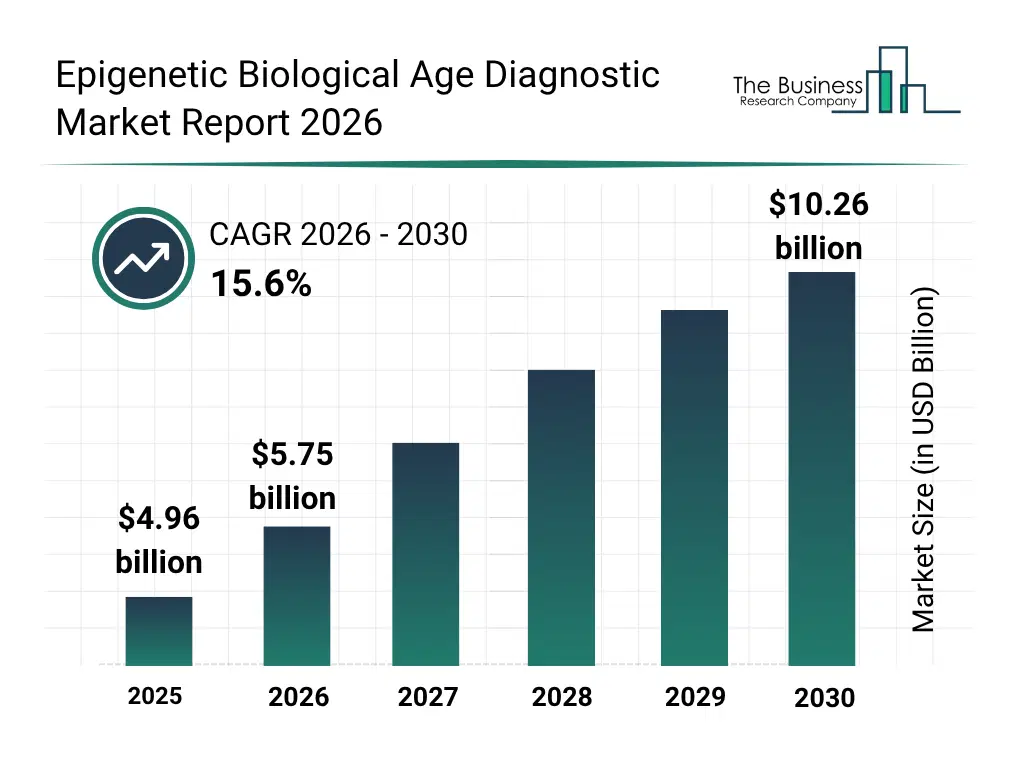
What Is The Epigenetic Biological Age Diagnostic Market Size and Share 2026?
The epigenetic biological age diagnostic market size has grown rapidly in recent years. It will grow from $4.96 billion in 2025 to $5.75 billion in 2026 at a compound annual growth rate (CAGR) of 16.0%. The growth in the historic period can be attributed to aging population growth, increasing prevalence of chronic diseases, advancement in dna methylation research, growth in academic aging research funding, early adoption of biomarker-based aging tests.What Is The Epigenetic Biological Age Diagnostic Market Growth Forecast?
The epigenetic biological age diagnostic market size is expected to see rapid growth in the next few years. It will grow to $10.26 billion in 2030 at a compound annual growth rate (CAGR) of 15.6%. The growth in the forecast period can be attributed to integration into preventive healthcare systems, expansion of personalized longevity medicine clinics, regulatory approval of standardized epigenetic age clocks, insurance reimbursement for biological age diagnostics, increased clinical trial usage for aging intervention therapies. Major trends in the forecast period include expansion of longevity and wellness clinics adopting biological age diagnostics, increasing regulatory standardization and validation frameworks for epigenetic aging biomarkers, rising integration of biological age testing into insurance and employer wellness programs, growth of direct-to-consumer at-home sample collection and mail-in diagnostic kits, expansion of biobanking and longitudinal cohort studies for aging research.
Global Epigenetic Biological Age Diagnostic Market Segmentation
1) By Test Type: Deoxyribonucleic Acid Methylation Clocks; Histone Modification Analysis; Chromatin Remodeling Biomarker Tests; Multi Omics Aging Diagnostics; Other Test Types 2) By Technology Platform: Next Generation Sequencing; Mass Spectrometry; Artificial Intelligence Powered Interpretation Software; Microarray 3) By Sample Type: Blood Samples; Saliva Samples; Buccal Swab Samples; Tissue Samples; Other Sample Types 4) By Application Type: Biological Age Estimation; Disease Risk Assessment; Longevity And Wellness Monitoring; Preventive Healthcare; Clinical Research And Drug Development 5) By End User: Hospitals And Clinics; Diagnostic Laboratories; Research Institutes; Direct To Consumer Users; Pharmaceutical And Biotech Companies Subsegments: 1) By Deoxyribonucleic Acid Methylation Clocks: Genome Wide Methylation Clocks; Tissue Specific Methylation Clocks; Cytosine Guanine Rich Region Methylation Clocks; Epigenetic Age Acceleration Clocks 2) By Histone Modification Analysis: Histone Acetylation Based Analysis; Histone Methylation Based Analysis; Histone Phosphorylation Based Analysis; Histone Code Mapping 3) By Chromatin Remodeling Biomarker Tests: Nucleosome Positioning Assays; Chromatin Accessibility Assays; Chromatin Looping Interaction Assays; Epigenomic Structure Profiling 4) By Multi Omics Aging Diagnostics: Transcriptomics Based Aging Analysis; Proteomics Based Aging Analysis; Metabolomics Based Aging Analysis; Integrated Multi Layer Aging Models 5) By Other Test Types: Circulating Cell Free Deoxyribonucleic Acid Tests; Senescence Associated Secretory Phenotype Tests; Mitochondrial Epigenetic Function Tests; Telomere Associated Epigenetic TestsWhat Is The Driver Of The Epigenetic Biological Age Diagnostic Market?
The increasing demand for personalized medicine is expected to propel the growth of the epigenetic biological age diagnostic market going forward. Personalized medicine refers to a medical approach that tailors disease prevention, diagnosis, and treatment based on an individual’s genetic profile, lifestyle, and environmental factors to improve clinical outcomes. The demand for personalized medicine is increasing due to the growing prevalence of chronic and complex diseases that require targeted therapies and precise diagnostic approaches. Epigenetic biological age diagnostic helps personalized medicine by translating DNA methylation–based aging signals into individualized biological age profiles that guide tailored prevention strategies, treatment selection, and lifestyle interventions for more precise and proactive healthcare. For instance, in February 2024, according to the Personalized Medicine Coalition, a US-based non-profit organization, in 2023, the FDA approved 16 new personalized therapies for patients with rare diseases, marking a substantial rise from the six approvals recorded in 2022. Therefore, the increasing demand for personalized medicine is driving the growth of epigenetic biological age diagnostic industry.Key Players In The Global Epigenetic Biological Age Diagnostic Market
Major companies operating in the epigenetic biological age diagnostic market are Illumina; Zymo Research; TruDiagnostic; Chronomics; Deep Longevity; Elysium Health; MyDNAge; Generation Lab; Nordic Labs; GlycanAge; GenknowMe S.A.; Horvath/UCLA; SiPhox Health; Rhelixa Inc.; MOLEQLAR GmbH; NUGENIS GmbH; epiAge GmbH; Clock Foundation; Nebula Genomics; Cerascreen GmbH; NOVOS LabsGlobal Epigenetic Biological Age Diagnostic Market Trends and Insights
Major companies operating in the epigenetic biological age diagnostic market are focusing on developing innovative platforms, such as organ-specific biological age testing algorithms to enhance precision in aging assessment, improve early disease risk prediction, and enable personalized longevity interventions. Organ-specific biological age testing algorithms are computational models that analyze biomarkers such as DNA methylation and estimate how fast individual organs (like the heart, brain, or liver) are aging biologically compared to their normal chronological age. For instance, in June 2024, TruDiagnostic Inc., a US-based epigenetic testing company, launched organ-specific aging analysis platform developed using the SYMPHONYAge algorithms created at Yale University. The solution leverages high-resolution DNA methylation data to estimate biological age across multiple organ systems, including cardiovascular, metabolic, and neurological profiles, offering deeper insights into differential aging within the body. It is designed to support clinicians, researchers, and longevity-focused healthcare providers in identifying accelerated aging patterns, tracking intervention outcomes, and personalizing anti-aging strategies based on organ-level biological performance.What Are Latest Mergers And Acquisitions In The Epigenetic Biological Age Diagnostic Market?
In April 2026, Infinite Epigenetics Inc., a US-based biotechnology company, acquired Tally Health for an undisclosed amount. Through this acquisition, Infinite Epigenetics aims to expand its direct-to-consumer biological age diagnostics and longevity platform by integrating Tally Health’s at-home epigenetic age testing products, personalized longevity intervention programs, and consumer health engagement capabilities into its broader data-driven diagnostics ecosystem. Tally Health LLC is a US-based consumer biotechnology company specializing in biological age testing using epigenetic age clocks and personalized longevity interventions.Regional Outlook
North America was the largest region in the epigenetic biological age diagnostic market in 2025. Asia-Pacific is expected to be the fastest-growing region in the forecast period. The regions covered in this market report are Asia-Pacific, South East Asia, Western Europe, Eastern Europe, North America, South America, Middle East, Africa. The countries covered in this market report are Australia, Brazil, China, France, Germany, India, Indonesia, Japan, Taiwan, Russia, South Korea, UK, USA, Canada, Italy, Spain.What Defines the Epigenetic Biological Age Diagnostic Market?
The epigenetic biological age diagnostic market consists of revenues earned by entities by providing services such as biological age assessment services, aging-risk evaluation, personalized health and longevity analysis, wellness monitoring, and preventive health screening. The market value includes the value of related goods sold by the service provider or included within the service offering. The epigenetic biological age diagnostic market also includes sales of epigenetic analysis panels, laboratory testing reagents, and associated accessories. Values in this market are ‘factory gate’ values, that is the value of goods sold by the manufacturers or creators of the goods, whether to other entities (including downstream manufacturers, wholesalers, distributors and retailers) or directly to end customers. The value of goods in this market includes related services sold by the creators of the goods.How is Market Value Defined and Measured?
The market value is defined as the revenues that enterprises gain from the sale of goods and/or services within the specified market and geography through sales, grants, or donations in terms of the currency (in USD unless otherwise specified). The revenues for a specified geography are consumption values that are revenues generated by organizations in the specified geography within the market, irrespective of where they are produced. It does not include revenues from resales along the supply chain, either further along the supply chain or as part of other products.What Key Data and Analysis Are Included in the Epigenetic Biological Age Diagnostic Market Report 2026?
The epigenetic biological age diagnostic market research report is one of a series of new reports from The Business Research Company that provides market statistics, including industry global market size, regional shares, competitors with the market share, detailed market segments, market trends and opportunities, and any further data you may need to thrive in the epigenetic biological age diagnostic industry. The market research report delivers a complete perspective of everything you need, with an in-depth analysis of the current and future state of the industry.Epigenetic Biological Age Diagnostic Market Report Forecast Analysis
| Report Attribute | Details |
|---|---|
| Market Size Value In 2026 | $5.75 billion |
| Revenue Forecast In 2030 | $10.26 billion |
| Growth Rate | CAGR of 15.6% from 2026 to 2030 |
| Base Year For Estimation | 2025 |
| Actual Estimates/Historical Data | 2020-2025 |
| Forecast Period | 2026 - 2030 |
| Market Representation | Revenue in USD Billion and CAGR from 2026 to 2030 |
| Segments Covered | Test Type, Technology Platform, Sample Type, Application Type, End User |
| Regional Scope | Asia-Pacific, Western Europe, Eastern Europe, North America, South America, Middle East, Africa |
| Country Scope | The countries covered in the report are Australia, Brazil, China, France, Germany, India, ... |
| Key Companies Profiled | Illumina; Zymo Research; TruDiagnostic; Chronomics; Deep Longevity; Elysium Health; MyDNAge; Generation Lab; Nordic Labs; GlycanAge; GenknowMe S.A.; Horvath/UCLA; SiPhox Health; Rhelixa Inc.; MOLEQLAR GmbH; NUGENIS GmbH; epiAge GmbH; Clock Foundation; Nebula Genomics; Cerascreen GmbH; NOVOS Labs |
| Customization Scope | Request for Customization |
| Pricing And Purchase Options | Explore Purchase Options |