

Ethyl Acrylate Market Report 2026
Global Outlook – By Product Type (Liquid Ethyl Acrylate, Solid Ethyl Acrylate), By Distribution Channel (Direct Sales, Distributors, Online Sales), By Application (Adhesives And Sealants, Surface Coatings, Detergents, Plastic Additives, Other Applications), By End User (Paints And Coatings, Plastics, Leather, Packaging, Paper, Textiles, Other End Users) – Market Size, Trends, Strategies, and Forecast to 2030
Ethyl Acrylate Market Overview
• Ethyl Acrylate market size has reached to $3.5 billion in 2025 • Expected to grow to $4.99 billion in 2030 at a compound annual growth rate (CAGR) of 7.4% • Growth Driver: The Growing Construction And Infrastructure Activities Drive The Growth Of The Market Due To Rapid Urbanization • Market Trend: Advancing Sustainable Chemical Solutions Through Renewable Bio-Based Formulations • Asia-Pacific was the largest region and fastest growing region.What Is Covered Under Ethyl Acrylate Market?
Ethyl acrylate is a colorless liquid organic compound primarily used in the production of adhesives, coatings, textiles, plastics, and surface treatment chemicals due to its high reactivity and flexibility-enhancing properties. It is an ester formed from acrylic acid and ethanol, commonly utilized as a key raw material in polymer and copolymer manufacturing for industrial and commercial applications. The main product types of ethyl acrylate include liquid ethyl acrylate and solid ethyl acrylate. Liquid ethyl acrylate refers to a colorless organic compound widely used as a key intermediate in the production of polymers, resins, coatings, and adhesives. These products are distributed through direct sales, distributors, and online sales channels. They find application in adhesives and sealants, surface coatings, detergents, plastic additives, and others, serving end users including paints and coatings, plastics, leather, packaging, paper, textiles, and others.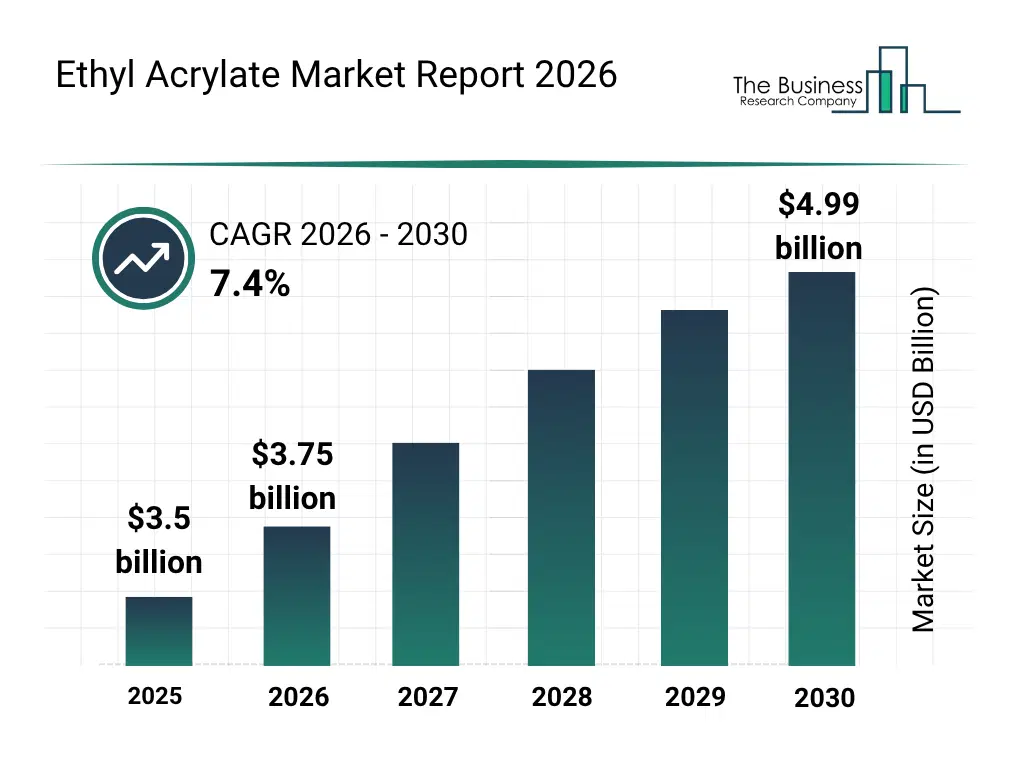
What Is The Ethyl Acrylate Market Size and Share 2026?
The ethyl acrylate market size has grown strongly in recent years. It will grow from $3.5 billion in 2025 to $3.75 billion in 2026 at a compound annual growth rate (CAGR) of 7.2%. The growth in the historic period can be attributed to growth in paints and coatings industry, expanding demand for pressure sensitive adhesives, increasing plastic production activities, rising consumption in textile processing applications, growth in packaging material manufacturing.What Is The Ethyl Acrylate Market Growth Forecast?
The ethyl acrylate market size is expected to see strongly grown in the next few years. It will grow to $4.99 billion in 2030 at a compound annual growth rate (CAGR) of 7.4%. The growth in the forecast period can be attributed to increasing demand for specialty polymers and copolymers, expansion of industrial coating applications, growing investments in chemical manufacturing capacity, rising demand from flexible packaging industries, increasing development of high performance adhesive technologies. Major trends in the forecast period include increasing demand for high performance adhesive formulations, growing use of ethyl acrylate in advanced surface coating applications, expansion of copolymer production for flexible plastic manufacturing, rising adoption of specialty chemical intermediates in industrial processing, increasing utilization of ethyl acrylate in textile finishing and treatment applications.
Global Ethyl Acrylate Market Segmentation
1) By Product Type: Liquid Ethyl Acrylate; Solid Ethyl Acrylate 2) By Distribution Channel: Direct Sales; Distributors; Online Sales 3) By Application: Adhesives And Sealants; Surface Coatings; Detergents; Plastic Additives; Other Applications 4) By End User: Paints And Coatings; Plastics; Leather; Packaging; Paper; Textiles; Other End Users Subsegments: 1) By Liquid Ethyl Acrylate: Industrial Grade Liquid Ethyl Acrylate; High Purity Liquid Ethyl Acrylate; Stabilized Liquid Ethyl Acrylate; Inhibitor Added Liquid Ethyl Acrylate; Polymer Grade Liquid Ethyl Acrylate 2) By Solid Ethyl Acrylate: Polymerized Solid Ethyl Acrylate; Resin Grade Solid Ethyl Acrylate; Stabilized Solid Ethyl Acrylate; Additive Based Solid Ethyl Acrylate; High Density Solid Ethyl AcrylateWhat Are The Drivers Of The Ethyl Acrylate Market?
The growing construction and infrastructure activities are expected to propel the growth of the ethyl acrylate market going forward. Construction and infrastructure activities refer to the development, expansion, and maintenance of buildings, roads, bridges, and other physical structures that support economic and social functions. Growing construction and infrastructure activities is due to rapid urbanization, as increasing population migration to cities creates higher demand for residential buildings, transportation networks, and essential public infrastructure. Construction and infrastructure activities drive demand for ethyl acrylate by increasing the consumption of paints, coatings, adhesives, sealants, and construction chemicals used in building development, repair, and large-scale infrastructure projects, thereby supporting its use as a key intermediate in high-performance polymer formulations. For instance, in July 2023, according to the Australian Bureau of Statistics, an Australia-based government administration, the number of dwellings under construction in the March quarter of 2023 increased by 1.3% to 240,813 units, surpassing the previous record of 240,065 units reported in the March 2022 quarter. Therefore, the growing construction and infrastructure activities are driving the growth of the ethyl acrylate industry. The expansion of the packaging industry is expected to propel the growth of the ethyl acrylate market going forward. The packaging industry refers to the sector involved in the design, production, and use of materials and containers used to protect, preserve, transport, and present products for distribution, storage, and sale. The expansion of the packaging industry is due to the rapid growth of e-commerce, which has increased the demand for durable, protective, and efficient packaging solutions for safe product delivery. Ethyl acrylate helps the packaging industry by enhancing the flexibility, adhesion, and durability of coatings and adhesives used in flexible and high-performance packaging materials. For instance, in September 2024, according to the State of the Flexible Packaging Industry Report by the Flexible Packaging Association, a US-based association, the U.S. flexible packaging industry reached an estimated $42.9 billion in sales in 2023, reflecting a 3.4% rise compared with $41.5 billion in 2022. Therefore, the expansion of the packaging industry is driving the growth of the ethyl acrylate industry.Key Players In The Global Ethyl Acrylate Market
Major companies operating in the ethyl acrylate market are The Dow Chemical Company; BASF SE; Mitsubishi Chemical Group Corporation; Wanhua Chemical Group; LG Chem Ltd.; Lotte Chemical; Sumitomo Chemical Co Ltd.; Arkema S.A.; Formosa Plastics Corporation; Sasol Limited; Nippon Shokubai Co Ltd.; SIBUR Holding Open Joint‑Stock Company; Fushun Petrochemical; Satellite Chemical Co Ltd.; Shanghai Huayi Group; Secco Petrochemical; Jiangsu Jurong Chemical; Saudi Acrylic Monomer Company Limited; Baicheng Chemical Co. Ltd.; Chemical Bull Pvt. Ltd.; JSK ChemicalsGlobal Ethyl Acrylate Market Trends and Insights
Major companies operating in ethyl acrylate the market are focusing on developing innovative solutions, such as bio-based formulations which are products manufactured using renewable biological raw materials, such as plant-based feedstocks or bioethanol, instead of conventional petroleum-derived chemicals. Bio-based formulations are products manufactured using renewable biological raw materials, such as plant-based feedstocks or bioethanol, instead of conventional petroleum-derived chemicals. For instance, in October 2024, Arkema S.A., a France-based specialty materials chemical company, launched bio-based ethyl acrylate at its acrylic monomers plant in Carling, France. The product is manufactured entirely from bioethanol and contains 40% biocarbon content, enabling up to a 30% reduction in carbon footprint compared to conventional alternatives. The bioethanol used in production is sustainably sourced from biomass feedstocks, supporting the company’s broader decarbonization roadmap for acrylic products. The solution is designed to support downstream applications such as coatings, specialty acrylic resins, and additives used in fast-growing sectors including electric vehicles, construction, new energy, and comfortable living applications, while helping industrial customers achieve sustainability and carbon reduction targets.Regional Outlook
Asia-Pacific was the largest region ethyl acrylate in the market in 2025 and is expected to be the fastest-growing region in the forecast period. The regions covered in this market report are Asia-Pacific, South East Asia, Western Europe, Eastern Europe, North America, South America, Middle East, Africa. The countries covered in this market report are Australia, Brazil, China, France, Germany, India, Indonesia, Japan, Taiwan, Russia, South Korea, UK, USA, Canada, Italy, Spain.What Defines the Ethyl Acrylate Market?
The ethyl acrylate market consists of sales of ethyl acrylate monomer, acrylic resins, pressure-sensitive adhesives, surface coatings and paints, and textile and paper treatment chemicals. Values in this market are ‘factory gate’ values, that is, the value of goods sold by the manufacturers or creators of the goods, whether to other entities (including downstream manufacturers, wholesalers, distributors, and retailers) or directly to end customers. The value of goods in this market includes related services sold by the creators of the goods.How is Market Value Defined and Measured?
The market value is defined as the revenues that enterprises gain from the sale of goods and/or services within the specified market and geography through sales, grants, or donations in terms of the currency (in USD unless otherwise specified). The revenues for a specified geography are consumption values that are revenues generated by organizations in the specified geography within the market, irrespective of where they are produced. It does not include revenues from resales along the supply chain, either further along the supply chain or as part of other products.What Key Data and Analysis Are Included in the Ethyl Acrylate Market Report 2026?
The ethyl acrylate market research report is one of a series of new reports from The Business Research Company that provides market statistics, including industry global market size, regional shares, competitors with the market share, detailed market segments, market trends and opportunities, and any further data you may need to thrive in the ethyl acrylate industry. The market research report delivers a complete perspective of everything you need, with an in-depth analysis of the current and future state of the industry.Ethyl Acrylate Market Report Forecast Analysis
| Report Attribute | Details |
|---|---|
| Market Size Value In 2026 | $3.75 billion |
| Revenue Forecast In 2030 | $4.99 billion |
| Growth Rate | CAGR of 7.4% from 2026 to 2030 |
| Base Year For Estimation | 2025 |
| Actual Estimates/Historical Data | 2020-2025 |
| Forecast Period | 2026 - 2030 |
| Market Representation | Revenue in USD Billion and CAGR from 2026 to 2030 |
| Segments Covered | Product Type, Distribution Channel, Application, End User |
| Regional Scope | Asia-Pacific, Western Europe, Eastern Europe, North America, South America, Middle East, Africa |
| Country Scope | The countries covered in the report are Australia, Brazil, China, France, Germany, India, ... |
| Key Companies Profiled | The Dow Chemical Company; BASF SE; Mitsubishi Chemical Group Corporation; Wanhua Chemical Group; LG Chem Ltd.; Lotte Chemical; Sumitomo Chemical Co Ltd.; Arkema S.A.; Formosa Plastics Corporation; Sasol Limited; Nippon Shokubai Co Ltd.; SIBUR Holding Open Joint‑Stock Company; Fushun Petrochemical; Satellite Chemical Co Ltd.; Shanghai Huayi Group; Secco Petrochemical; Jiangsu Jurong Chemical; Saudi Acrylic Monomer Company Limited; Baicheng Chemical Co. Ltd.; Chemical Bull Pvt. Ltd.; JSK Chemicals |
| Customization Scope | Request for Customization |
| Pricing And Purchase Options | Explore Purchase Options |