
Ethyl Alcohol Market Report 2026
Global Outlook – By Type (Synthetic, Fermented ), By Application (Industrial Solvent, Fuel Or Fuel Additive, Bacteriacide Or Disinfectant, Beverages, Personal Care, Other Applications ), By End User Industry (Automotive, Food And Beverages, Pharmaceutical, Personal Care, Other End Use Industries) – Market Size, Trends, Strategies, and Forecast to 2030
Ethyl Alcohol Market Overview
• Ethyl Alcohol market size has reached to $552.77 billion in 2025 • Expected to grow to $801.56 billion in 2030 at a compound annual growth rate (CAGR) of 7.9% • Growth Driver: Surging Demand For Personal Care Products Fuels Growth In The Ethyl Alcohol Market • Market Trend: Leading Ethyl Alcohol Companies Spearhead Innovation With Sustainable Aviation Fuel Technology • Asia-Pacific was the largest region in 2025 and North America is the fastest growing region.What Is Covered Under Ethyl Alcohol Market?
Ethyl alcohol, also known as ethanol or grain alcohol, is a volatile, flammable, colorless liquid industrially used as a chemical intermediate to make pharmaceutical ingredients or as a solvent. Ethyl alcohol is used as a solvent in the synthesis of other organic chemicals, as an ingredient in alcoholic beverages and as a gasoline additive in the automotive industry. The main types of ethyl alcohol are synthetic and fermented. Ethyl alcohol fermentation is defined as the chemical process in which the yeast transforms glucose and fructose in a solution into ethanol, carbon dioxide, and heat. The various applications of ethyl alcohol include industrial solvents, fuel/fuel additives, bacteriacide/disinfectants, beverages, personal care, and other applications. The major end-use industries of ethyl alcohol are automotive, food and beverages, pharmaceutical, personal care, and other end users.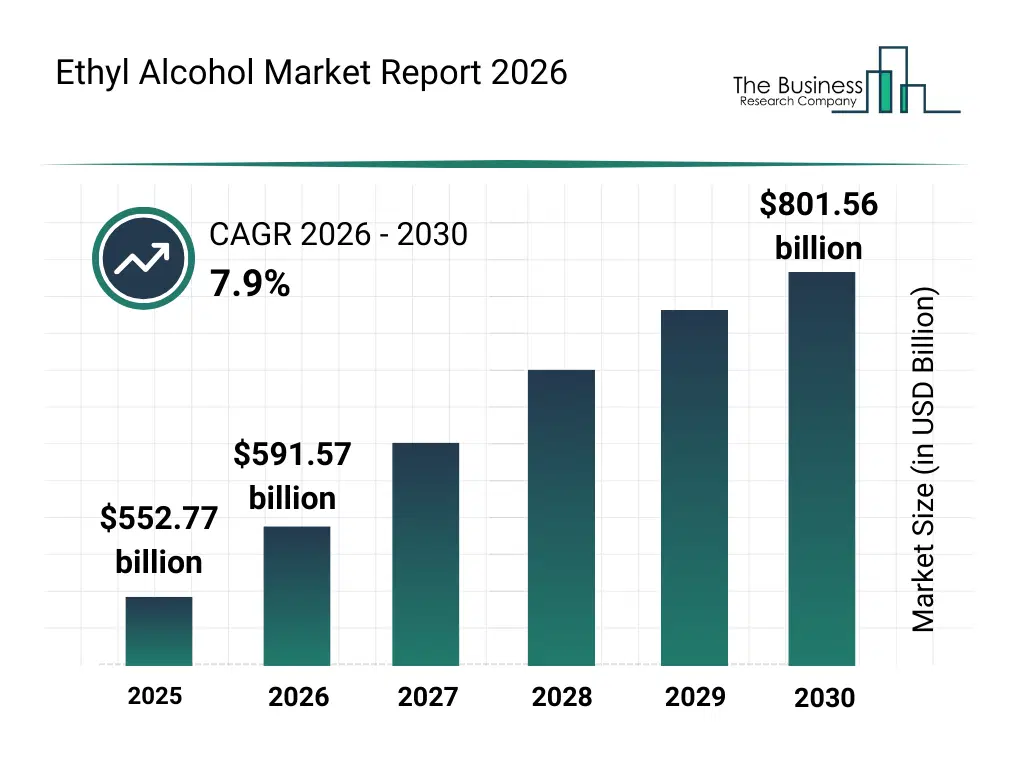
What Is The Ethyl Alcohol Market Size and Share 2026?
The ethyl alcohol market size has grown strongly in recent years. It will grow from $552.77 billion in 2025 to $591.57 billion in 2026 at a compound annual growth rate (CAGR) of 7.0%. The growth in the historic period can be attributed to growth of alcoholic beverage consumption, use of ethanol as industrial solvent, adoption of ethanol in pharmaceuticals, expansion of chemical synthesis applications, availability of fermented feedstocks.What Is The Ethyl Alcohol Market Growth Forecast?
The ethyl alcohol market size is expected to see strong growth in the next few years. It will grow to $801.56 billion in 2030 at a compound annual growth rate (CAGR) of 7.9%. The growth in the forecast period can be attributed to increasing biofuel blending mandates, rising healthcare disinfectant demand, growth of personal care industry, expansion of green chemical manufacturing, investments in ethanol capacity expansion. Major trends in the forecast period include rising use of ethanol as biofuel additive, growing demand for pharmaceutical grade ethanol, expansion of ethanol based disinfectants, increased adoption in personal care formulations, focus on high purity industrial solvents.
Global Ethyl Alcohol Market Segmentation
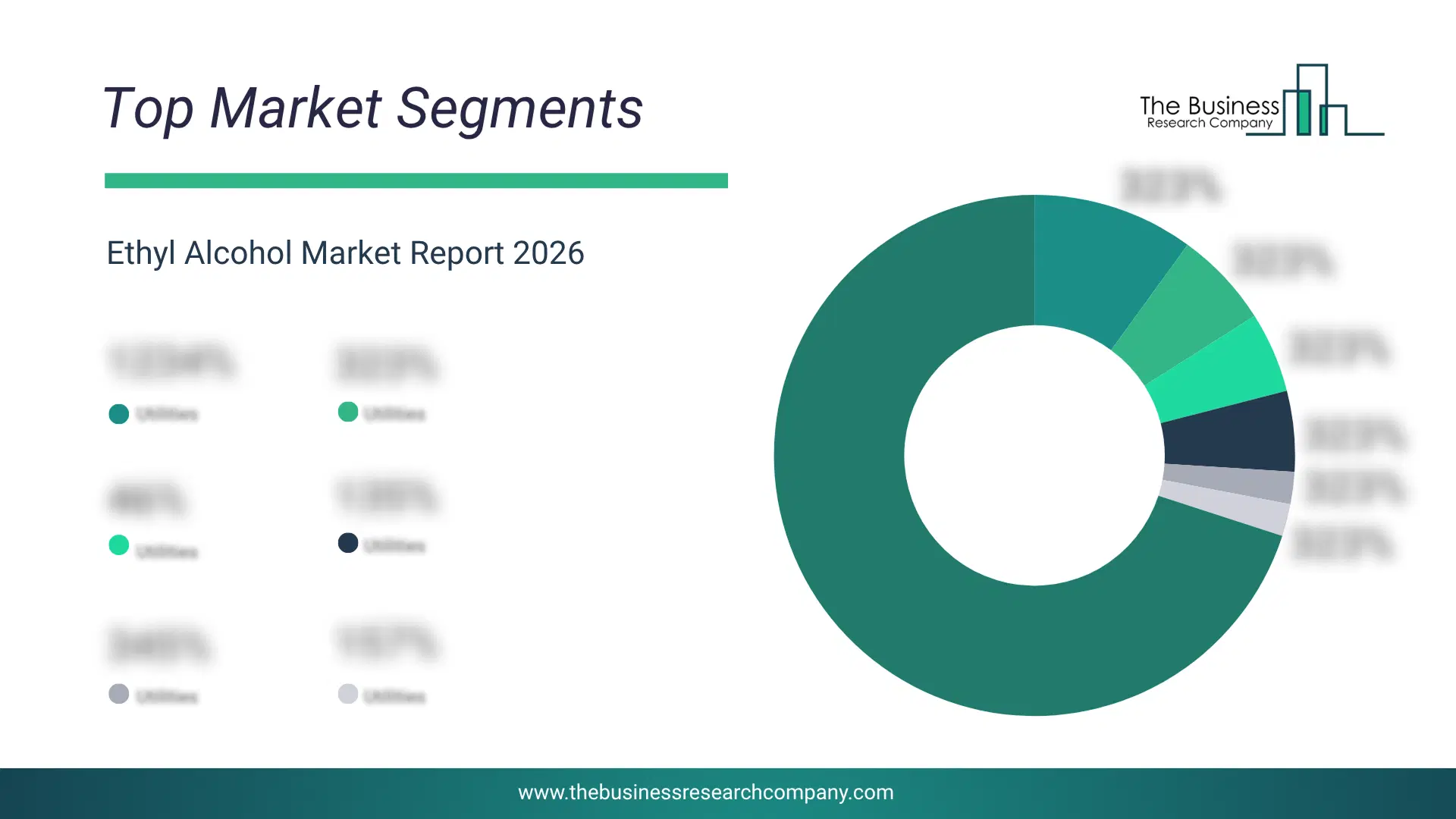
1) By Type: Synthetic, Fermented 2) By Application: Industrial Solvent, Fuel Or Fuel Additive, Bacteriacide Or Disinfectant, Beverages, Personal Care, Other Applications 3) By End User Industry: Automotive, Food And Beverages, Pharmaceutical, Personal Care, Other End Use Industries Subsegments: 1) By Synthetic: Petroleum-Based Ethyl Alcohol, Coal-Based Ethyl Alcohol 2) By Fermented: Grain-Based Ethyl Alcohol, Sugarcane-Based Ethyl Alcohol, Fruit-Based Ethyl Alcohol, Corn-Based Ethyl AlcoholWhat Is The Driver Of The Ethyl Alcohol Market?
Rising demand for personal care products is expected to propel the growth of the ethyl alcohol market going forward. Personal care products encompass a range of self-care items used for personal hygiene, cleaning, and grooming, including items such as shampoos, conditioners, toothpaste, creams, cosmetics, and household products. Ethyl alcohol (ethanol) is a versatile ingredient in personal care products, offering several useful properties that contribute to the effectiveness and performance of these products. For instance, in July 2024, according to a report, THE VALUE OF BEAUTY, published by the British Beauty Council, a UK-based beauty industry organization, the personal care industry contributed £27.2 billion to GDP in 2023, marking an 11% increase over 2022. In 2024, this contribution is expected to reach £28.1 billion, reflecting a 3% rise from 2023 and a 15% increase since 2022. Therefore, rising demand for personal care products is driving the growth of the ethyl alcohol industry.Key Players In The Global Ethyl Alcohol Market
Major companies operating in the ethyl alcohol market are Advanced Bioenergy LLC, The Andersons Ethanol Group (The Andersons, Inc.), Archer Daniels Midland Company, Braskem S.A., BP p.l.c., Cargill, Incorporated, Green Plains Inc., Kirin Holdings Company, Limited, LyondellBasell Industries N.V., Mitsubishi Chemical Corporation, Alto Ingredients, Inc., Saudi Basic Industries Corporation (SABIC), Sasol Limited, Solvay S.A., Valero Energy Corporation, INEOS Group Holdings S.A., Midwest Renewable Energy, LLC, CJ Chemicals, LLC, Aemetis, Inc., Greenfield Global Inc., ECSA Chemicals S.A., Ethanol US LLC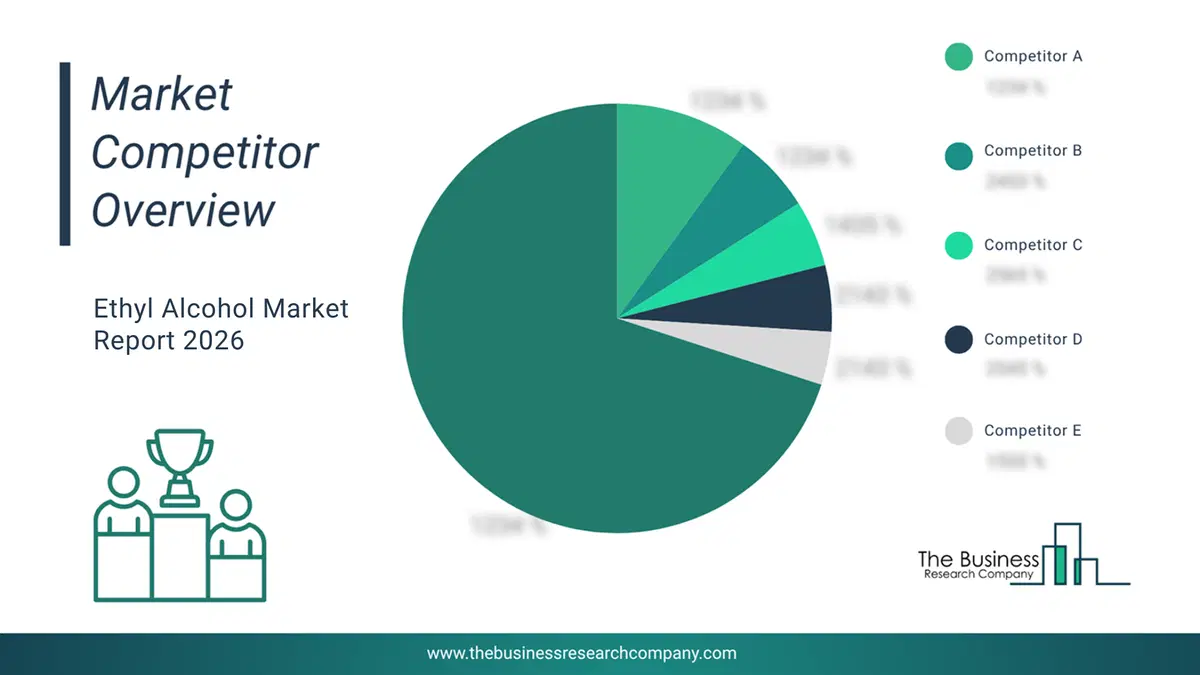
This chart is for illustrative purposes; the full report includes a detailed competitor analysis and comprehensive overview of the top 10 companies in the market.
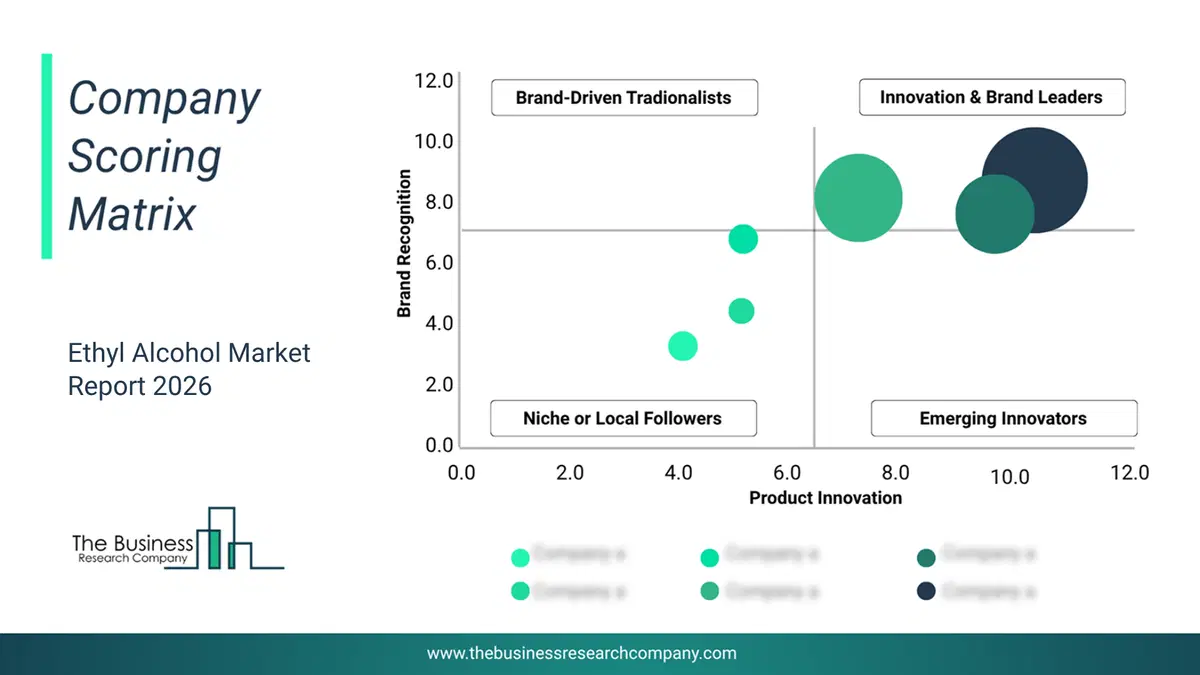
This chart maps companies by product innovation and brand strength, with bubble size indicating relative revenue, helping identify market leaders, challengers, and niche players. This is an illustrative chart; the full report provides a complete and accurate competitive analysis.
Global Ethyl Alcohol Market Trends and Insights
Major companies operating in the ethyl alcohol market are focusing on developing innovative technology, such as sustainable aviation fuel technology, to preserve an upper hand in the market. Sustainable Aviation Fuel (SAF) technology refers to the development and production of aviation fuels that are more environmentally friendly and have a lower carbon footprint compared to traditional aviation fuels derived from fossil sources. For instance, in September 2023, Lummus Technology LLC, a US-based producer of both conventional and renewable transportation fuels, launched Sustainable Aviation Fuel Technology based on ethanol. This technology plays a crucial role in diminishing greenhouse gas emissions within the aviation sector, offering a dependable and sustainable alternative to conventional aviation fuels. The process seamlessly incorporates ethanol into ethylene (EtE), incorporates olefin oligomerization, and employs other refining techniques to generate sustainable aviation fuel (SAF).What Are Latest Mergers And Acquisitions In The Ethyl Alcohol Market?
In August 2024, Dairy Distillery Alliance LLC, a Canada-based producer of innovative dairy-based products, is building a plant to produce ethyl alcohol (ethanol) from milk permeate, a dairy byproduct, and partnered with the Michigan Milk Producers Association (MMPA) to launch a new ethanol production facility in Constantine, Michigan. The partnership aims to convert milk permeate, a byproduct of dairy processing, into ethanol. The facility is expected to produce approximately 2.2 million gallons of ethanol annually, providing a sustainable, low-carbon fuel source and directly linking to the production of ethyl alcohol, expanding both the technological footprint and the sustainable output of the partners in the biofuel sector. Michigan Milk Producers Association (MMPA) is a US-based cooperative of dairy farmers.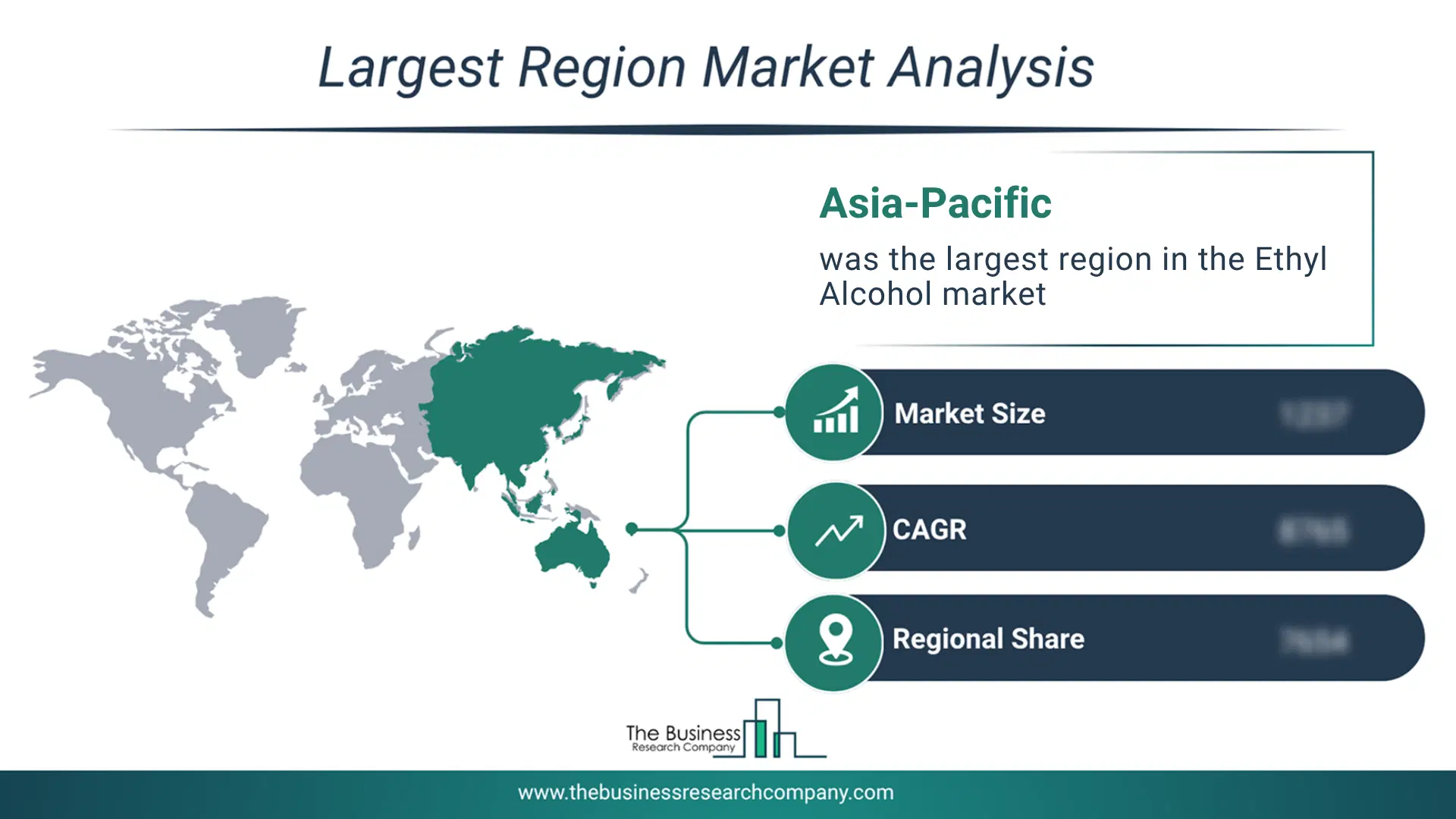
Regional Insights
Asia-Pacific was the largest region in the ethyl alcohol market in 2025. North America was the second-largest region in the global ethyl alcohol market. The regions covered in this market report are Asia-Pacific, South East Asia, Western Europe, Eastern Europe, North America, South America, Middle East, Africa The countries covered in this market report are China, India, Japan, Australia, Indonesia, South Korea, Bangladesh, Thailand, Vietnam, Malaysia, Singapore, Philippines, Hong Kong, Taiwan, New Zealand, UK, Germany, France, Italy, Spain, Austria, Belgium, Denmark, Finland, Ireland, Netherlands, Norway, Portugal, Sweden, Switzerland, Russia, Czech Republic, Poland, Romania, Ukraine, USA, Canada, Mexico, Brazil, Chile, Argentina, Colombia, Peru, Saudi Arabia, Israel, Iran, Turkey, UAE, Egypt, Nigeria, South Africa.What Defines the Ethyl Alcohol Market?
The ethyl alcohol market consists of the sales of ethyl alcohol used in products such as perfumes, aftershaves, beverages, liniments, colognes, medicinal liquids, mouthwashes, and rubbing alcohols. Values in this market are factory gate values, that is the value of goods sold by the manufacturers or creators of the goods, whether to other entities (including downstream manufacturers, wholesalers, distributors, and retailers) or directly to end customers. The value of goods in this market includes related services sold by the creators of the goods.How is Market Value Defined and Measured?
The market value is defined as the revenues that enterprises gain from the sale of goods and/or services within the specified market and geography through sales, grants, or donations in terms of the currency (in USD unless otherwise specified). The revenues for a specified geography are consumption values that are revenues generated by organizations in the specified geography within the market, irrespective of where they are produced. It does not include revenues from resales along the supply chain, either further along the supply chain or as part of other products.
This chart presents market attractiveness based on a quantitative evaluation of growth, competition, strategic alignment, and risk, offering a clear view of opportunity areas for decision-making. This chart is for illustrative purposes; the full report contains the complete analysis.

This chart highlights the Total Addressable Market (TAM) by estimating the maximum revenue opportunity using an assumption-driven approach, supporting strategic planning and opportunity sizing across markets. The chart is illustrative; the full report provides a more comprehensive analysis.
What Key Data and Analysis Are Included in the Ethyl Alcohol Market Report 2026?
The ethyl alcohol market research report is one of a series of new reports from The Business Research Company that provides market statistics, including industry global market size, regional shares, competitors with the market share, detailed market segments, market trends and opportunities, and any further data you may need to thrive in the ethyl alcohol industry. The market research report delivers a complete perspective of everything you need, with an in-depth analysis of the current and future state of the industry.Ethyl Alcohol Market Report Forecast Analysis
| Report Attribute | Details |
|---|---|
| Market Size Value In 2026 | $591.57 billion |
| Revenue Forecast In 2030 | $801.56 billion |
| Growth Rate | CAGR of 7.0% from 2026 to 2030 |
| Base Year For Estimation | 2025 |
| Actual Estimates/Historical Data | 2020-2025 |
| Forecast Period | 2026 - 2030 |
| Market Representation | Revenue in USD Billion and CAGR from 2026 to 2030 |
| Segments Covered | Type, Application, End User Industry |
| Regional Scope | Asia-Pacific, Western Europe, Eastern Europe, North America, South America, Middle East, Africa |
| Country Scope | The countries covered in this market report are Australia, Brazil, China, France, Germany, India, Indonesia, Japan, Taiwan, Russia, South Korea, UK, USA, Canada, Italy, Spain |
| Key Companies Profiled | Advanced Bioenergy LLC, The Andersons Ethanol Group (The Andersons, Inc.), Archer Daniels Midland Company, Braskem S.A., BP p.l.c., Cargill, Incorporated, Green Plains Inc., Kirin Holdings Company, Limited, LyondellBasell Industries N.V., Mitsubishi Chemical Corporation, Alto Ingredients, Inc., Saudi Basic Industries Corporation (SABIC), Sasol Limited, Solvay S.A., Valero Energy Corporation, INEOS Group Holdings S.A., Midwest Renewable Energy, LLC, CJ Chemicals, LLC, Aemetis, Inc., Greenfield Global Inc., ECSA Chemicals S.A., Ethanol US LLC |
| Customization Scope | Request for Customization |
| Pricing And Purchase Options | Explore Purchase Options |