
EV Battery Recycling Market Report 2026
Global Outlook – By Recycling Process (Pyrometallurgical Process, Hydrometallurgical Process, Direct Recycling Or Physical Separation ), By Battery Chemistry (Lithium-Ion (NMC, NCA), Lithium Iron Phosphate (LFP), Lithium-Manganese Oxide (LMO), Nickel-Metal Hydride (NiMH), Emerging EV Battery Chemistries), By Vehicle Type (Passenger Electric Vehicles, Commercial Electric Vehicles (LCVs, trucks, buses)), By Source of Batteries (End-of-Life EV Batteries, Manufacturing Scrap (Gigafactory Waste), Warranty & Recall Batteries) – Market Size, Trends, Strategies, and Forecast to 2030
EV Battery Recycling Market Overview
• EV Battery Recycling market size has reached to $3.82 billion in 2025 • Expected to grow to $12.77 billion in 2030 at a compound annual growth rate (CAGR) of 27.2% • Growth Driver: Surge In Electric Vehicle Sales Sparks Growth In EV Battery Recycling Market • Market Trend: Strategic Partnership For Advanced Lithium-Ion Battery Recycling Solutions • Asia-Pacific was the largest region in 2025.What Is Covered Under EV Battery Recycling Market?
The EV battery recycling refers to the process of recycling the batteries of electric vehicles. Lithium-ion batteries are the common type of batteries that are used in electric vehicles (EVs), and recycling of these batteries is done to reclaim the crucial minerals such as lithium, cobalt, manganese, and nickel. These minerals are further used to produce new batteries. The main types of EV battery recycling are lead-acid batteries, lithium-based batteries, and others. The lead-acid battery refers to rechargeable batteries that have a small energy-to-volume ratio and a very low energy-to-weight ratio. They have a low energy density, a long life, and are cost-effective. The recycling of these batteries involves the extraction of lead metal from the batteries and is a rigorous process. Advanced high-power lead-acid batteries are being developed for use in commercial electric vehicles. The various processes include pyrometallurgical, hydrometallurgical, and others, which are used in various vehicle types such as passenger cars and commercial vehicles. The various applications include electric cars, electric buses, energy storage systems, and others.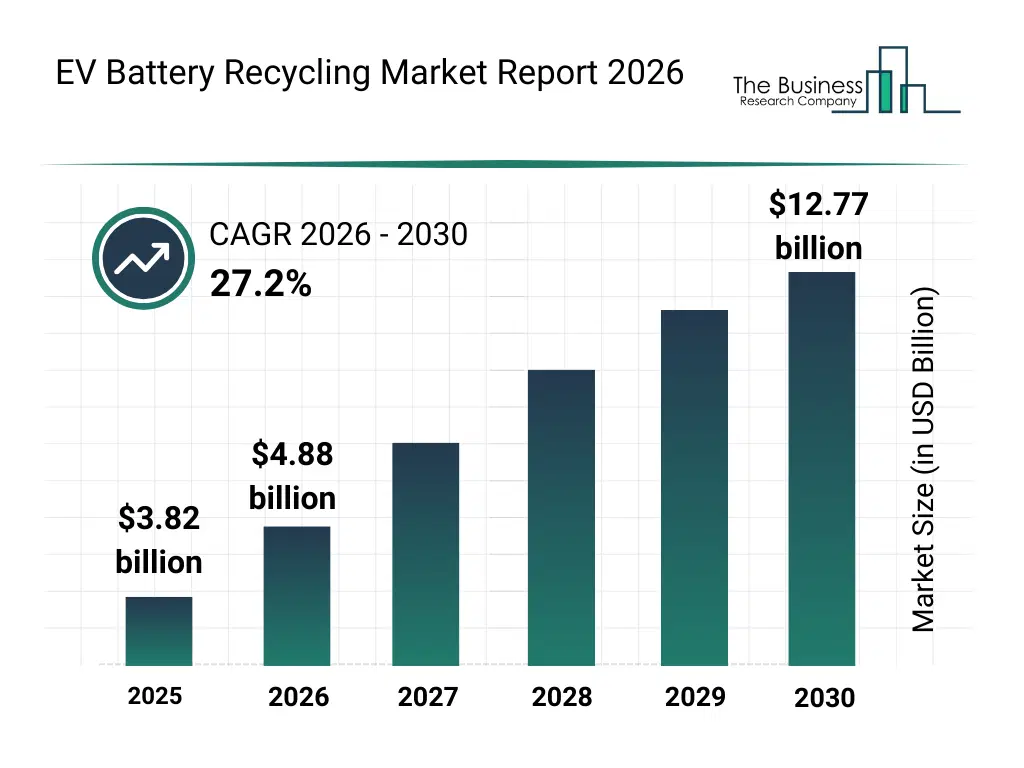
What Is The EV Battery Recycling Market Size and Share 2026?
The ev battery recycling market size has grown exponentially in recent years. It will grow from $3.82 billion in 2025 to $4.88 billion in 2026 at a compound annual growth rate (CAGR) of 27.7%. The growth in the historic period can be attributed to ev adoption growth, lithium-ion battery commercialization, raw material scarcity, early recycling regulations, battery waste generation.What Is The EV Battery Recycling Market Growth Forecast?
The ev battery recycling market size is expected to see exponential growth in the next few years. It will grow to $12.77 billion in 2030 at a compound annual growth rate (CAGR) of 27.2%. The growth in the forecast period can be attributed to stricter recycling mandates, supply security for critical minerals, growth in end-of-life ev batteries, investment in recycling infrastructure, circular economy targets. Major trends in the forecast period include expansion of lithium-ion battery recycling capacity, adoption of hydrometallurgical processes, rising focus on critical mineral recovery, integration of automation in recycling plants, growth of closed-loop battery supply chains.
Global EV Battery Recycling Market Segmentation
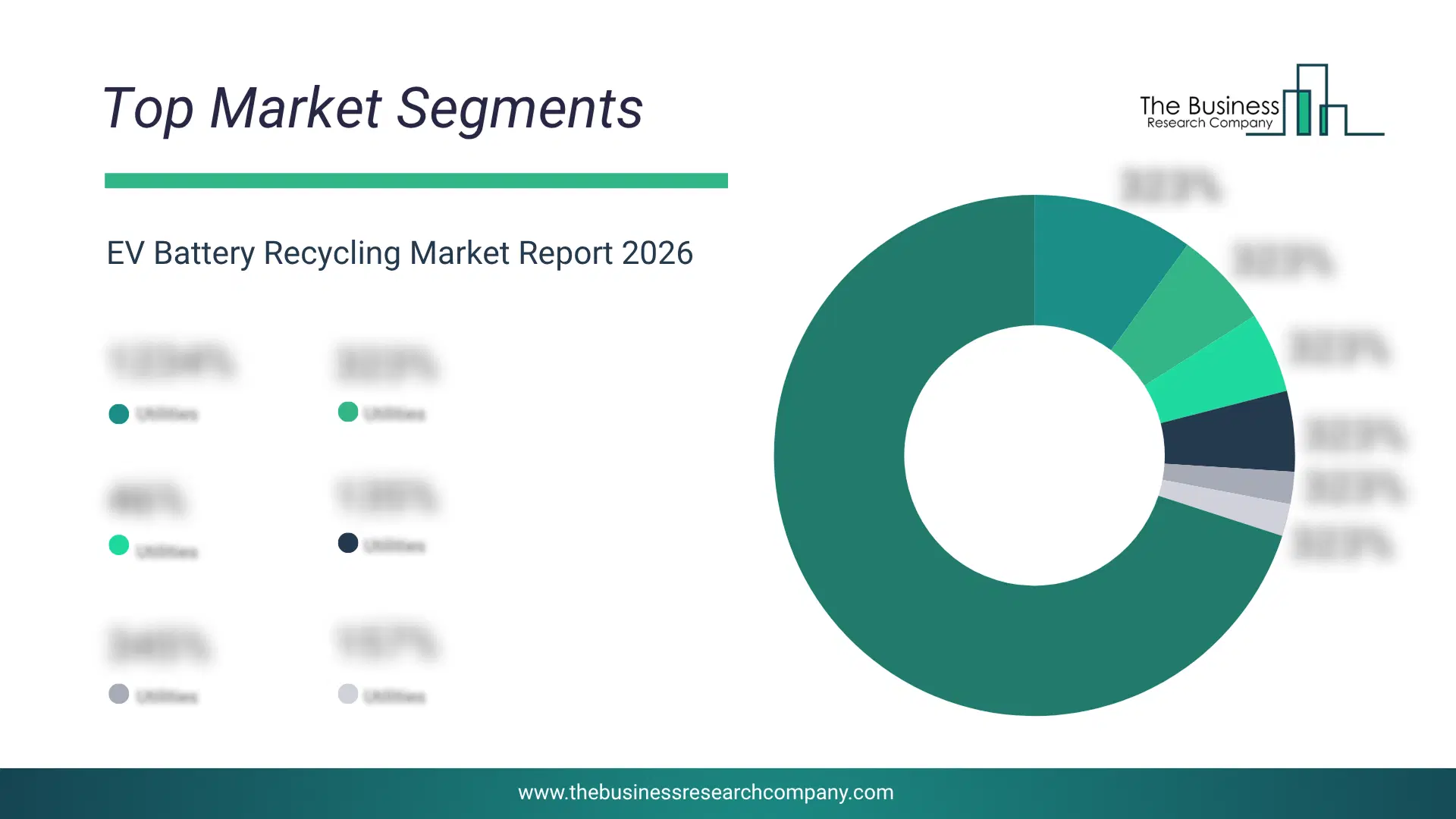
1) By Recycling Process: Pyrometallurgical Process, Hydrometallurgical Process, Direct Recycling Or Physical Separation 2) By Battery Chemistry: Lithium-Ion (NMC, NCA), Lithium Iron Phosphate (LFP), Lithium-Manganese Oxide (LMO), Nickel-Metal Hydride (NiMH), Emerging EV Battery Chemistries 3) By Vehicle Type: Passenger Electric Vehicles, Commercial Electric Vehicles (LCVs, trucks, buses) 4) By Source of Batteries: End-of-Life EV Batteries, Manufacturing Scrap (Gigafactory Waste), Warranty & Recall Batteries Subsegments: 1) By Pyrometallurgical Process: High-Temperature Smelting And Roasting, Metal Alloy Recovery, Ash And Slag Management 2) By Hydrometallurgical Process: Acid Leaching, Solvent Extraction, Precipitation And Purification, Electrowinning 3) By Direct Recycling And Physical Separation: Mechanical Crushing And Shredding, Electrode Material Recovery, Cathode Rejuvenation And Reuse, Sorting And Screening of Battery ComponentsWhat Is The Driver Of The EV Battery Recycling Market?
An increase in the sales of electric vehicles (EV) is expected to propel the growth of the EV battery recycling market going forward. EVs are vehicles that are either partially or fully powered by electricity and contain a battery that powers an electric motor. EV batteries contain critical minerals that can be reclaimed through recycling of end-of-life EV batteries and used for manufacturing new batteries that are used in electric vehicles. For instance, according to Global Electric Vehicle (EV) Outlook 2023, published by the International Energy Agency (IEA), a France-based autonomous intergovernmental organization, the total number of EVs will increase from about 30 million in 2022 to around 240 million in 2030, representing an average annual growth rate of roughly 30%. EV sales will account for more than 20 million vehicles overall in 2025 and more than 40 million in 2030 or more than 20% and 30% of all vehicle sales, respectively. Therefore, the increase in the sales of electric vehicles is driving the demand for the growth of the EV battery recycling industry.Key Players In The Global EV Battery Recycling Market
Major companies operating in the ev battery recycling market report include Glencore plc, Umicore NV/SA, Li‑Cycle Corp., Redwood Materials Inc., ACCUREC‑Recycling GmbH, American Manganese Inc., Cirba Solutions, Fortum Oyj, Ecobat Solutions, Neometals Ltd., Recyclico Battery Materials Inc., Ascend Elements, TES‑Amm, Attero Recycling, LOHUM Cleantech, BatX Energies, LICO Materials, G & P Batteries Limited, NavPrakriti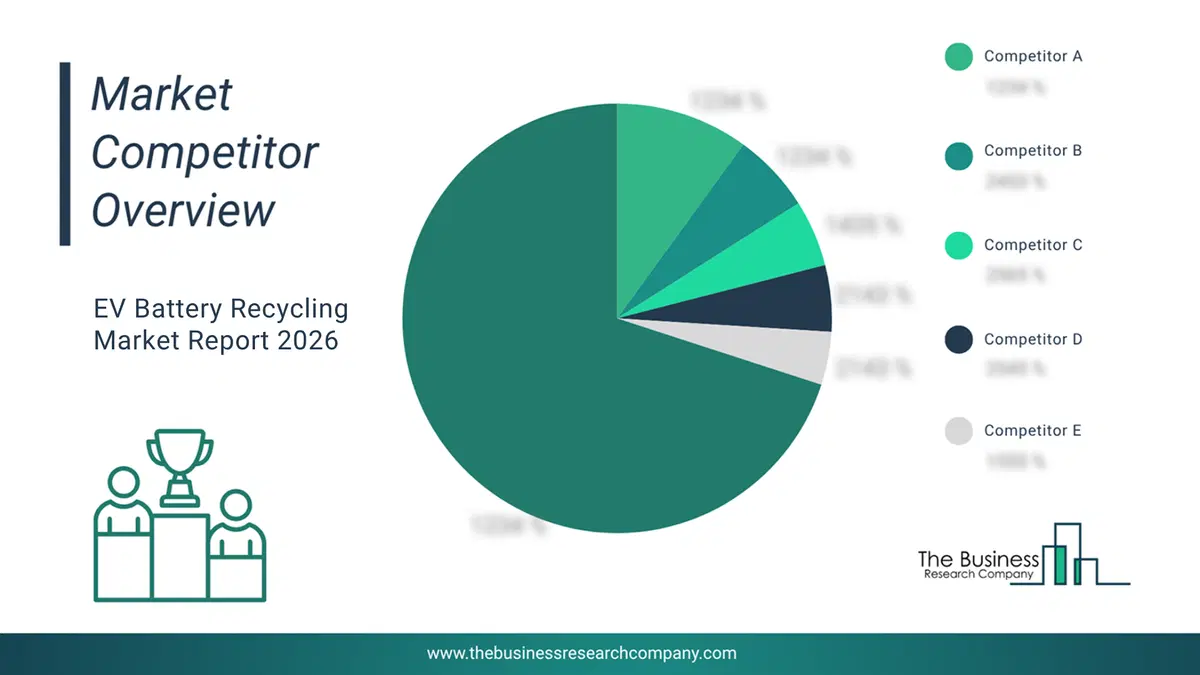
This chart is for illustrative purposes; the full report includes a detailed competitor analysis and comprehensive overview of the top 10 companies in the market.
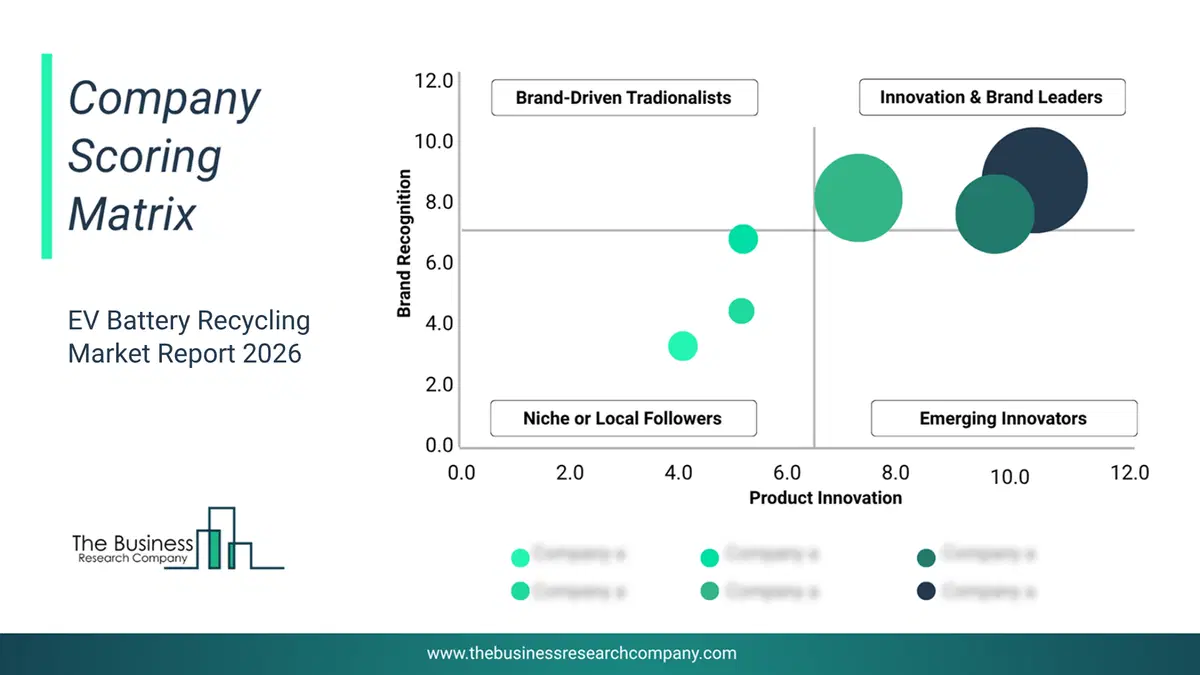
This chart maps companies by product innovation and brand strength, with bubble size indicating relative revenue, helping identify market leaders, challengers, and niche players. This is an illustrative chart; the full report provides a complete and accurate competitive analysis.
Global EV Battery Recycling Market Trends and Insights
Major companies operating in the EV battery recycling market are focusing on strategic collaboration, to provide reliable services to customers. Strategic collaboration refers to a mutually beneficial partnership between two or more independent entities who work together to achieve shared goals aligned with their individual strategic objectives. For instance, in July 2023, li-cycle private limited, a Canada-based global lithium-ion battery resource recovery company, and Eve Energy Co., Ltd., a China-based largest primary lithium battery manufacturer, have entered a memorandum of understanding (MOU) to explore lithium-ion battery recycling solutions. The partnership will extend to recycling battery manufacturing scrap from EVE's upcoming facilities in Malaysia and Hungary. The initiative aligns with EVE's environmental goals and Li-Cycle's commitment to providing efficient, low-emission recycling solutions for lithium-ion batteries.What Are Latest Mergers And Acquisitions In The EV Battery Recycling Market?
In August 2025, Glencore plc, a Switzerland-based commodities trading and mining company, acquired Li-Cycle Holdings Corp. for approximately $40 million. Through this acquisition, Glencore aims to expand its presence across the lithium-ion battery supply chain by integrating Li-Cycle’s recycling assets and leveraging its established spoke facilities to enhance recovery of critical battery materials. Li-Cycle Holdings Corp. is a Canada-based lithium-ion battery recycling company that operated recycling facilities across the U.S., Canada, and Germany, specializing in recovering battery-grade materials such as lithium, nickel, and cobalt from end-of-life batteries and battery manufacturing scrap.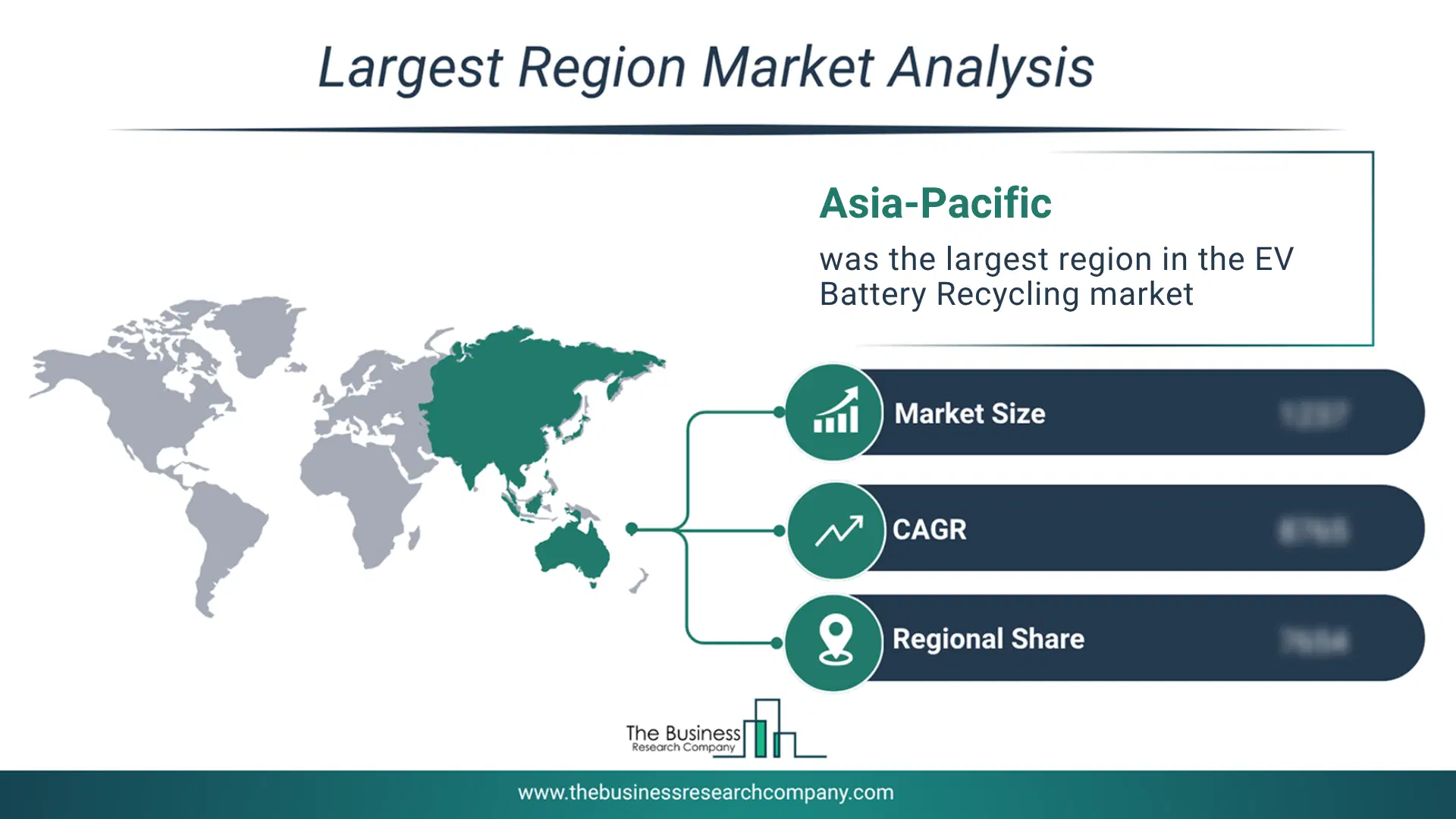
Regional Outlook
Asia-Pacific was the largest region in the EV battery recycling market in 2025. The regions covered in this market report include Asia-Pacific, South East Asia, Western Europe, Eastern Europe, North America, South America, Middle East, Africa. The countries covered in this market report include Australia, Brazil, China, France, Germany, India, Indonesia, Japan, Taiwan, Russia, South Korea, UK, USA, Canada, Italy, SpainWhat Defines the EV Battery Recycling Market?
The EV battery recycling market includes revenues earned by entities by nickel-metal hydride batteries and ultracapacitors. The market value includes the value of related goods sold by the service provider or included within the service offering. Only goods and services traded between entities or sold to end consumers are included.How is Market Value Defined and Measured?
The market value is defined as the revenues that enterprises gain from the sale of goods and/or services within the specified market and geography through sales, grants, or donations in terms of the currency (in USD unless otherwise specified). The revenues for a specified geography are consumption values that are revenues generated by organizations in the specified geography within the market, irrespective of where they are produced. It does not include revenues from resales along the supply chain, either further along the supply chain or as part of other products.
This chart presents market attractiveness based on a quantitative evaluation of growth, competition, strategic alignment, and risk, offering a clear view of opportunity areas for decision-making. This chart is for illustrative purposes; the full report contains the complete analysis.

This chart highlights the Total Addressable Market (TAM) by estimating the maximum revenue opportunity using an assumption-driven approach, supporting strategic planning and opportunity sizing across markets. The chart is illustrative; the full report provides a more comprehensive analysis.
What Key Data and Analysis Are Included in the EV Battery Recycling Market Report 2026?
The ev battery recycling market research report is one of a series of new reports from The Business Research Company that provides market statistics, including industry global market size, regional shares, competitors with the market share, detailed market segments, market trends and opportunities, and any further data you may need to thrive in the ev battery recycling industry. The market research report delivers a complete perspective of everything you need, with an in-depth analysis of the current and future state of the industry.EV Battery Recycling Market Report Forecast Analysis
| Report Attribute | Details |
|---|---|
| Market Size Value In 2026 | $4.88 billion |
| Revenue Forecast In 2030 | $12.77 billion |
| Growth Rate | CAGR of 27.7% from 2026 to 2030 |
| Base Year For Estimation | 2025 |
| Actual Estimates/Historical Data | 2020-2025 |
| Forecast Period | 2026 - 2030 - 2030 |
| Market Representation | Revenue in USD Billion and CAGR from 2026 to 2030 |
| Segments Covered | Recycling Process, Battery Chemistry, Vehicle Type, Source of Batteries |
| Regional Scope | Asia-Pacific, Western Europe, Eastern Europe, North America, South America, Middle East, Africa |
| Country Scope | The countries covered in the report are Australia, Brazil, China, France, Germany, India, Indonesia, Japan, Taiwan, Russia, South Korea, UK, USA, Canada, Italy, Spain. |
| Key Companies Profiled | Glencore plc, Umicore NV/SA, Li‑Cycle Corp., Redwood Materials Inc., ACCUREC‑Recycling GmbH, American Manganese Inc., Cirba Solutions, Fortum Oyj, Ecobat Solutions, Neometals Ltd., Recyclico Battery Materials Inc., Ascend Elements, TES‑Amm, Attero Recycling, LOHUM Cleantech, BatX Energies, LICO Materials, G & P Batteries Limited, NavPrakriti |
| Customization Scope | Request for Customization |
| Pricing And Purchase Options | Explore Purchase Options |