
Event-Based Display-Processing Market Report 2026
Global Outlook – By Component ( Hardware, Software, Services), By Technology ( Neuromorphic, Complementary Metal Oxide Semi Conductor (CMOS)), By Application ( Consumer Electronics, Automotive, Industrial, Healthcare, Security And Surveillance, Robotics), By End-User ( Enterprises, Individuals, Government) – Market Size, Trends, Strategies, and Forecast to 2030
Event-Based Display-Processing Market Overview
• Event-Based Display-Processing market size has reached to $1.73 billion in 2025 • Expected to grow to $5.37 billion in 2030 at a compound annual growth rate (CAGR) of 25.4% • Growth Driver: Rising Demand For Autonomous Vehicles Driving The Growth Of The Market Due To The Need For Ultra-Fast, Low-Latency Visual Perception • Market Trend: Advancements In Ultra-Low-Latency Event-Driven Vision Sensors For Real-Time Applications • North America was the largest region in 2025.What Is Covered Under Event-Based Display-Processing Market?
Event-based display-processing is a method where a system updates the visual output only in response to significant events, such as motion or brightness changes, rather than continuously refreshing the entire display. This approach improves efficiency, reduces latency, and lowers power consumption, making it ideal for real-time vision systems, robotics, and neuromorphic devices. The main components of event-based display-processing are hardware, software, and services. Event-based display-processing hardware refers to specialized computing and display hardware designed to capture, process, and render visual information based on asynchronous events rather than traditional frame-based methods. The platform leverages various technologies, including neuromorphic sensors and Complementary Metal-oxide-semiconductor (CMOS) devices, to enable low-latency, high-speed, and power-efficient processing. The applications of event-based display-processing span multiple domains, including consumer electronics, automotive, industrial automation, healthcare, security and surveillance, and robotics. These solutions are utilized by enterprises, individual users, and government organizations to deliver real-time, high-fidelity visual experiences and analytics.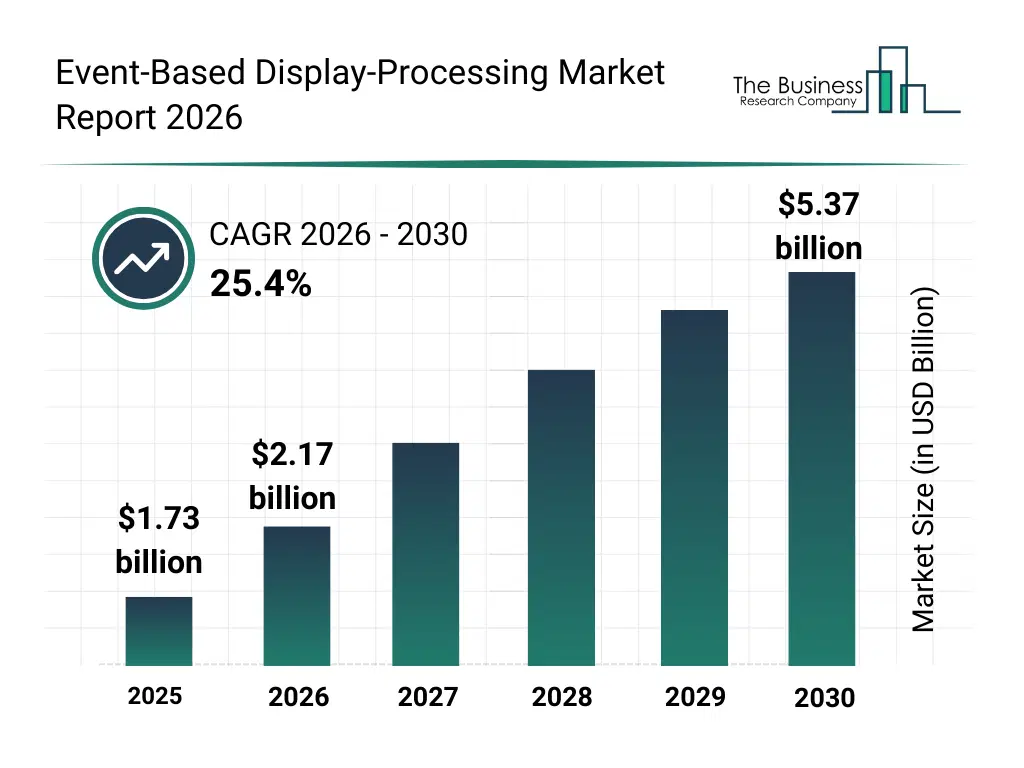
What Is The Event-Based Display-Processing Market Size 2026 And Growth Rate?
The event-based display-processing market size has grown exponentially in recent years. It will grow from $1.73 billion in 2025 to $2.17 billion in 2026 at a compound annual growth rate (CAGR) of 25.7%. The growth in the historic period can be attributed to early adoption of motion detection systems, limitations of frame-based displays, growth of robotics in industrial applications, advances in CMOS sensors, need for energy-efficient processing.What Is The Event-Based Display-Processing Market Growth Forecast?
The event-based display-processing market size is expected to see exponential growth in the next few years. It will grow to $5.37 billion in 2030 at a compound annual growth rate (CAGR) of 25.4%. The growth in the forecast period can be attributed to expansion of autonomous vehicles, increased deployment of industrial automation, growth of smart city infrastructure, adoption of AI-enabled vision systems, rising demand for wearable and mobile vision devices. Major trends in the forecast period include event-based vision processing, low-latency real-time systems, energy-efficient display technologies, neuromorphic computing integration, intelligent sensor fusion.
Global Event-Based Display-Processing Market Segmentation
1) By Component: Hardware, Software, Services 2) By Technology: Neuromorphic, Complementary Metal Oxide Semi Conductor (CMOS) 3) By Application: Consumer Electronics, Automotive, Industrial, Healthcare, Security And Surveillance, Robotics 4) By End-User: Enterprises, Individuals, Government Subsegments: 1) By Hardware: Event-Based Vision Sensors, Neuromorphic Processors, Integrated Sensor-Processor Modules, Development Kits And Evaluation Boards 2) By Software: Event-Based Data Processing Software, Neuromorphic Vision Algorithms, Simulation And Modeling Tools, AI (Artificial Intelligence) And Machine Learning Integration Platforms 3) By Services: System Integration Services, Consulting And Custom Development, Maintenance And Support Services, Training And Technical AssistanceWhat Is The Driver Of The Event-Based Display-Processing Market?
The rising demand for autonomous vehicles is expected to propel the growth of the event-based display-processing market going forward. Autonomous vehicles refer to self-driving cars or trucks that use sensors, cameras, and artificial intelligence to navigate and operate without human intervention. The rising demand for autonomous vehicles is driven by increasing concerns over road safety, as self-driving technology can help reduce accidents caused by human error. Event-based display processing enhances autonomous vehicle performance by enabling ultra-fast visual perception, allowing vehicles to detect and respond to changes in their environment in real time. This low-latency, high-efficiency sensing improves safety and decision-making, which are crucial for reliable self-driving operation. For instance, in April 2025, according to the World Economic Forum (WEF), a Switzerland-based nonprofit organization focused on public–private cooperation and global economic development, Mid-distance hub-to-hub autonomous trucks are projected to account for approximately 26% of new truck sales by 2035, signalling a significant shift toward automated freight transport. Therefore, rising demand for autonomous vehicles is driving the growth of the event-based display-processing industry.Key Players In The Global Event-Based Display-Processing Market
Major companies operating in the event-based display-processing market are Prophesee, iniVation, FRAMOS, Sony Corporation, Samsung Electronics, Intel Corporation, IBM, NVIDIA Corporation, Apple Inc., Google LLC, Microsoft Corporation, Panasonic Corporation, SynSense (aiCTX), BrainChip Holdings Ltd., GrAI Matter Labs, Qualcomm Technologies, Inc., CEA-Leti, Xilinx (AMD), OmniVision Technologies, Teledyne Technologies Incorporated, Lucid Vision Labs, Basler AG, uEye (IDS Imaging Development Systems), Himax Technologies, Inc., STMicroelectronics
This chart is for illustrative purposes; the full report includes a detailed competitor analysis and comprehensive overview of the top 10 companies in the market.
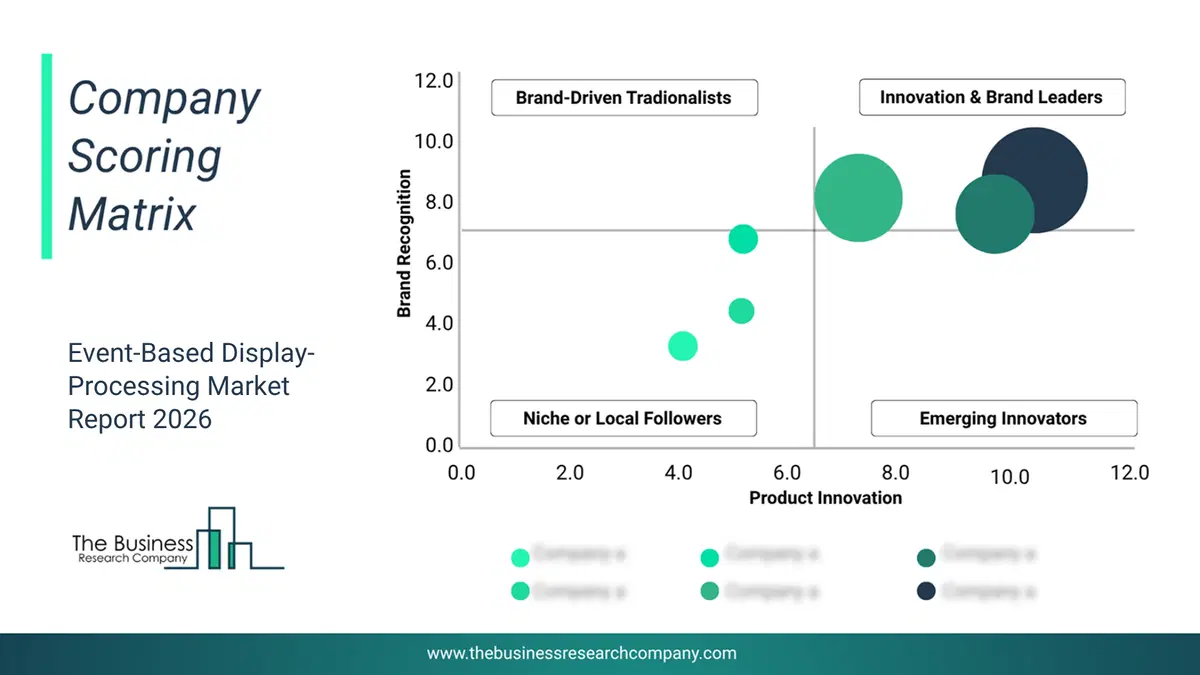
This chart maps companies by product innovation and brand strength, with bubble size indicating relative revenue, helping identify market leaders, challengers, and niche players. This is an illustrative chart; the full report provides a complete and accurate competitive analysis.
Global Event-Based Display-Processing Market Trends and Insights
Major companies operating in the event-based display-processing market are advancing neuromorphic engineering with event-based sensor to improve ultra-low-latency, event-driven vision sensors that detect pixel-level brightness changes instead of capturing full frames. An event-based sensor (often called a dynamic vision sensor or neuromorphic sensor) is a type of imaging device that detects and reports changes in a scene rather than capturing full frames at fixed intervals such as traditional cameras. For instance, in August 2025, Prophesee, a France-based neuromorphic vision systems company, launched the GenX320 Starter Kit for Raspberry Pi 5, featuring a compact 320 × 320 event-based sensor with ultra-high dynamic range (>140 dB), a ~10,000 fps equivalent event rate, sub-millisecond latency, and low power consumption (<50 mW). This platform enables real-time applications in robotics, industrial IoT, and autonomous systems, making event-based vision more accessible for developers and accelerating prototyping and integration into smart devices.What Are Latest Mergers And Acquisitions In The Event-Based Display-Processing Market?
In February 2024, SynSense, a Switzerland-based electronics company, acquired iniVation for an undisclosed amount. With this acquisition, SynSense aimed to combine its complementary strengths in neuromorphic technology and create the world’s first fully neuromorphic, end-to-end sensing and processing company. iniVation is a Switzerland-based electronics manufacturer that develops event-based display-processing technology.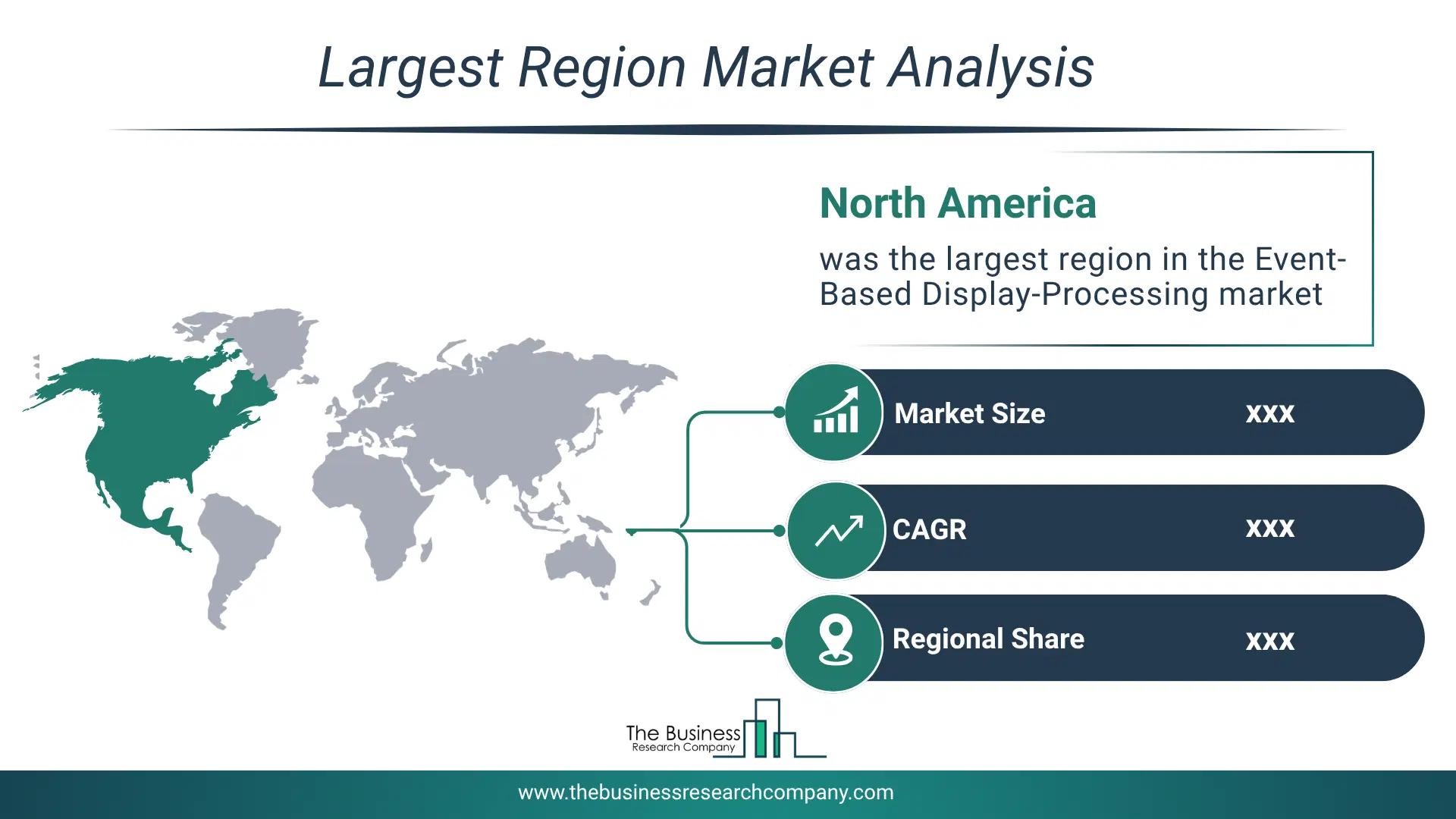
Regional Outlook
North America was the largest region in the event-based display-processing market in 2025. The regions covered in this market report are Asia-Pacific, South East Asia, Western Europe, Eastern Europe, North America, South America, Middle East, Africa. The countries covered in this market report are Australia, Brazil, China, France, Germany, India, Indonesia, Japan, Taiwan, Russia, South Korea, UK, USA, Canada, Italy, Spain.What Defines the Event-Based Display-Processing Market?
The event-based display-processing market consists of revenues earned by entities by providing services such as designing and developing event-driven display systems, offering real-time visual processing solutions, integrating hardware and software for low-latency imaging, and providing consulting or support. The market value includes the value of related goods sold by the service provider or included within the service offering. The event-based display-processing market also consists of sales of products including event-based cameras and sensors, neuromorphic processors, low-latency display units, and integrated display processing. Values in this market are ‘factory gate’ values, that is, the value of goods sold by the manufacturers or creators of the goods, whether to other entities (including downstream manufacturers, wholesalers, distributors, and retailers) or directly to end customers. The value of goods in this market includes related services sold by the creators of the goods.How is Market Value Defined and Measured?
The market value is defined as the revenues that enterprises gain from the sale of goods and/or services within the specified market and geography through sales, grants, or donations in terms of the currency (in USD unless otherwise specified). The revenues for a specified geography are consumption values that are revenues generated by organizations in the specified geography within the market, irrespective of where they are produced. It does not include revenues from resales along the supply chain, either further along the supply chain or as part of other products.
This chart presents market attractiveness based on a quantitative evaluation of growth, competition, strategic alignment, and risk, offering a clear view of opportunity areas for decision-making. This chart is for illustrative purposes; the full report contains the complete analysis.

This chart highlights the Total Addressable Market (TAM) by estimating the maximum revenue opportunity using an assumption-driven approach, supporting strategic planning and opportunity sizing across markets. The chart is illustrative; the full report provides a more comprehensive analysis.
What Key Data and Analysis Are Included in the Event-Based Display-Processing Market Report 2026?
The event-based display-processing market research report is one of a series of new reports from The Business Research Company that provides market statistics, including industry global market size, regional shares, competitors with the market share, detailed market segments, market trends and opportunities, and any further data you may need to thrive in the event-based display-processing industry. The market research report delivers a complete perspective of everything you need, with an in-depth analysis of the current and future state of the industry.Event-Based Display-Processing Market Report Forecast Analysis
| Report Attribute | Details |
|---|---|
| Market Size Value In 2026 | $2.17 billion |
| Revenue Forecast In 2030 | $5.37 billion |
| Growth Rate | CAGR of 25.4% from 2026 to 2030 |
| Base Year For Estimation | 2025 |
| Actual Estimates/Historical Data | 2020-2025 |
| Forecast Period | 2026 - 2030 |
| Market Representation | Revenue in USD Billion and CAGR from 2026 to 2030 |
| Segments Covered | Component, Technology, Application, End-User |
| Regional Scope | Asia-Pacific, Western Europe, Eastern Europe, North America, South America, Middle East, Africa |
| Country Scope | The countries covered in the report are Australia, Brazil, China, France, Germany, India, Indonesia, Japan, Taiwan, Russia, South Korea, UK, USA, Canada, Italy, Spain. |
| Key Companies Profiled | Prophesee, iniVation, FRAMOS, Sony Corporation, Samsung Electronics, Intel Corporation, IBM, NVIDIA Corporation, Apple Inc., Google LLC, Microsoft Corporation, Panasonic Corporation, SynSense (aiCTX), BrainChip Holdings Ltd., GrAI Matter Labs, Qualcomm Technologies, Inc., CEA-Leti, Xilinx (AMD), OmniVision Technologies, Teledyne Technologies Incorporated, Lucid Vision Labs, Basler AG, uEye (IDS Imaging Development Systems), Himax Technologies, Inc., STMicroelectronics |
| Customization Scope | Request for Customization |
| Pricing And Purchase Options | Explore Purchase Options |