

Event Camera Module Market Report 2026
Global Outlook – By Type ( Monochrome, Color Event Cameras, Neuromorphic Sensors, Dynamic Vision Sensor (DVS)), By Resolution ( Standard, High), By Application ( Automotive And Mobility, Industrial Automation And Robotics, Consumer Electronics, Security And Surveillance, Healthcare And Biomedical Imaging, Other Applications) – Market Size, Trends, Strategies, and Forecast to 2030
Event Camera Module Market Overview
• Event Camera Module market size has reached to $4.53 billion in 2025 • Expected to grow to $10.41 billion in 2030 at a compound annual growth rate (CAGR) of 18.1% • Growth Driver: Rising Industrial Automation Fueling The Growth Of The Market Due To Need For Enhance Productivity And Real-Time Visual Monitoring • Market Trend: New Camera Module Enhances Motion Detection In Low-Light And Dynamic Scenes • North America was the largest region in 2025 and Asia-Pacific is the fastest growing region.What Is Covered Under Event Camera Module Market?
An event camera module is a vision sensor that asynchronously detects and records changes in a scene at the pixel level, enabling ultra-fast and efficient motion capture with low latency and high dynamic range. An event camera module is utilized to capture dynamic scenes by detecting pixel-level brightness changes in real time, making it ideal for applications requiring fast motion tracking, low latency, and high dynamic range imaging. The main types of event camera modules are monochrome, color event cameras, neuromorphic sensors, and dynamic vision sensors (DVS). Monochrome refers to images or sensors using a single color or shades of one color, enhancing light sensitivity and motion detection for faster and more efficient event-based vision. They can also be categorized by resolution as standard or high and are used in applications such as automotive and mobility, industrial automation and robotics, consumer electronics, security and surveillance, healthcare and biomedical imaging, and other applications.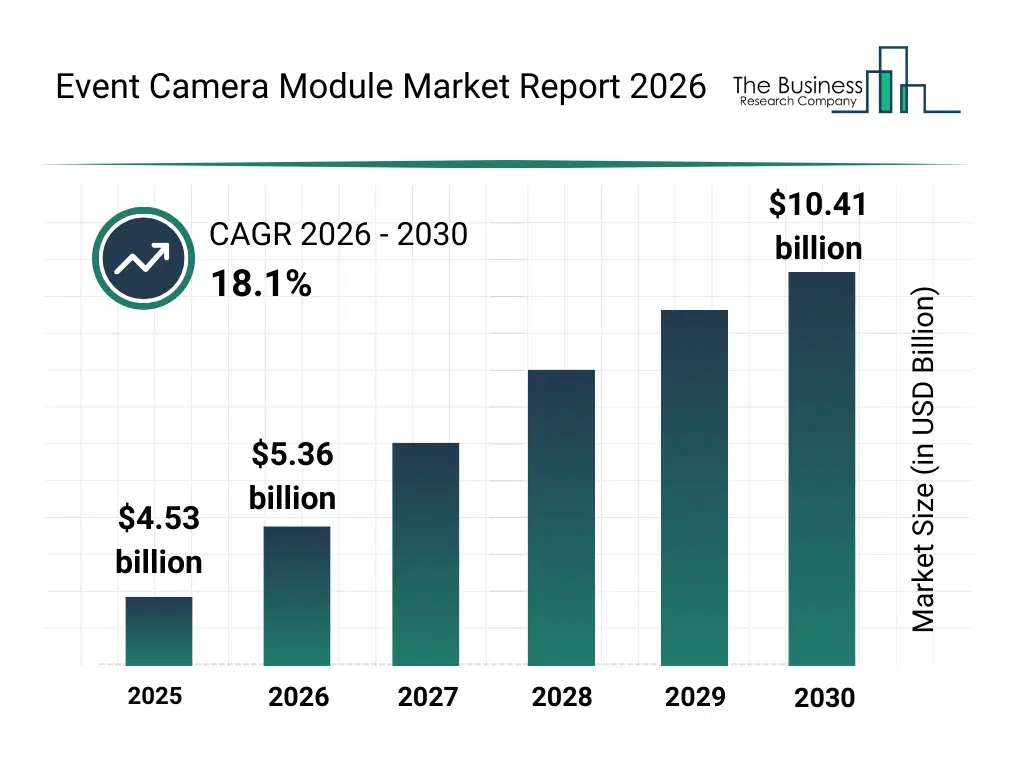
What Is The Event Camera Module Market Size 2026 And Growth Rate?
The event camera module market size has grown rapidly in recent years. It will grow from $4.53 billion in 2025 to $5.36 billion in 2026 at a compound annual growth rate (CAGR) of 18.3%. The growth in the historic period can be attributed to rise in demand for advanced imaging sensors, growth of robotics and industrial automation, increased adoption in automotive safety systems, early investments in neuromorphic technologies, expansion of surveillance infrastructure.What Is The Event Camera Module Market Growth Forecast?
The event camera module market size is expected to see rapid growth in the next few years. It will grow to $10.41 billion in 2030 at a compound annual growth rate (CAGR) of 18.1%. The growth in the forecast period can be attributed to growing integration in autonomous vehicles, increasing adoption in consumer electronics, expansion of industrial IoT applications, advancements in neuromorphic sensor technology, rising demand for healthcare and biomedical imaging. Major trends in the forecast period include ultra-fast motion detection, low-latency imaging, high dynamic range imaging, real-time scene analysis, compact & energy-efficient designs.
Global Event Camera Module Market Segmentation
1) By Type: Monochrome, Color Event Cameras, Neuromorphic Sensors, Dynamic Vision Sensor (DVS) 2) By Resolution: Standard, High 3) By Application: Automotive And Mobility, Industrial Automation And Robotics, Consumer Electronics, Security And Surveillance, Healthcare And Biomedical Imaging, Other Applications Subsegments: 1) By Monochrome: High-Speed Monochrome, Low-Power Monochrome, High-Resolution Monochrome, Compact Monochrome 2) By Color Event Cameras: High-Speed Color, Low-Power Color, High-Resolution Color, Compact Color 3) By Neuromorphic Sensors: Asynchronous Neuromorphic, Synchronous Neuromorphic, Low-Power Neuromorphic, High-Performance Neuromorphic 4) By Dynamic Vision Sensor (DVS): High-Speed Dynamic Vision, Low-Power Dynamic Vision, High-Resolution Dynamic Vision, Compact Dynamic VisionWhat Is The Driver Of The Event Camera Module Market?
The increasing demand for industrial automation is expected to propel the growth of event camera module market going forward. Industrial automation refers to the use of control systems such as computers, robots, and information technologies to operate and manage industrial processes with minimal human intervention. The increasing demand for industrial automation is primarily driven by the need for higher efficiency, as businesses aim to reduce production time, minimize errors, and optimize resource utilization to lower costs and improve output quality. Rising demand for industrial automation drives the adoption of event camera modules, as these cameras enable faster, more precise motion detection and real-time monitoring essential for automated industrial processes. For instance, in April 2024, according to the International Federation of Robotics (IFR), a Germany-based non-profit organization, in 2023, total industrial robot installations increased by 12%, reaching 44,303 units. Within the automotive segment, sales grew by 1%, with a record 14,678 robots installed. This follows a substantial 47% surge in automotive installations in 2022, which reached 14,472 units. Therefore, the increasing demand for industrial automation is driving the growth of the event camera module industry.Key Players In The Global Event Camera Module Market
Major companies operating in the event camera module market are Samsung Electronics Co. Ltd., Sony Corporation, Northrop Grumman Corporation, STMicroelectronics N.V., Pepperl+Fuchs SE, Melexis NV, Himax Technologies Inc., Lucid Vision Labs, IDS Imaging Development Systems, Prophesee S.A, SynSense AG, Imago Technologies GmbH, LIPS Corporation, iniLabs AG, CenturyArks Co. Ltd., AlpsenTek, Artilux, OpenMV LLC, CenturyArks Co. Ltd., Basler AG
This chart is for illustrative purposes; the full report includes a detailed competitor analysis and comprehensive overview of the top 10 companies in the market.
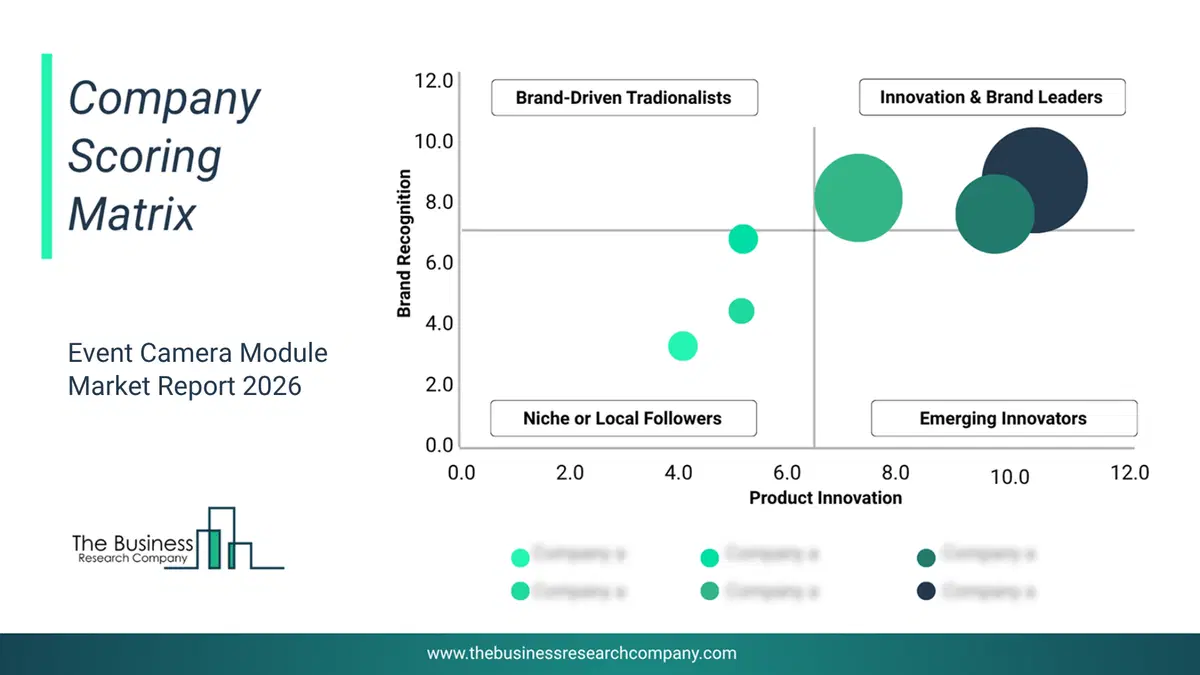
This chart maps companies by product innovation and brand strength, with bubble size indicating relative revenue, helping identify market leaders, challengers, and niche players. This is an illustrative chart; the full report provides a complete and accurate competitive analysis.
Global Event Camera Module Market Trends and Insights
Major companies operating in the event camera module market are focusing on developing advanced solutions such as event-based vision sensing to enhance motion detection efficiency, reduce data latency, and improve performance in dynamic and low-light environments. Event-based vision sensing refers to a technology where each pixel in an image sensor independently detects changes in brightness over time, enabling high-speed, low-latency, and low-power motion detection without capturing full image frames. For instance, in February 2025, OpenMV LLC, a US-based technology company, launched the Prophesee GenX320 camera module, integrating event-based vision sensing into its embedded platform. The module features asynchronous pixel-level operation for efficient motion detection with minimal data rates and power consumption starting at just 3mW. It boasts a dynamic range exceeding 140dB, operates in illumination as low as 0.05 lux, and supports customizable analogue bias presets through the OpenMV IDE. Designed for high-speed and low-light applications, it offers compact dimensions, a 104° field of view, and seamless compatibility with the OpenMV Cam RT1062 and H7 plus platforms.What Are Latest Mergers And Acquisitions In The Event Camera Module Market?
In February 2024, SynSense AG, a Switzerland-based neuromorphic computing company, acquired iniVation AG for an undisclosed amount. With this acquisition, SynSense aims to create the world’s first fully neuromorphic, end-to-end sensing and processing company by combining its ultra-low-power neuromorphic processing expertise with iniVation’s high-performance neuromorphic vision systems, enabling the SynSense Group to deliver advanced intelligent vision solutions across industrial and consumer markets. IniVation AG is a Switzerland-based neuromorphic vision systems company that specialises in providing event camera modules.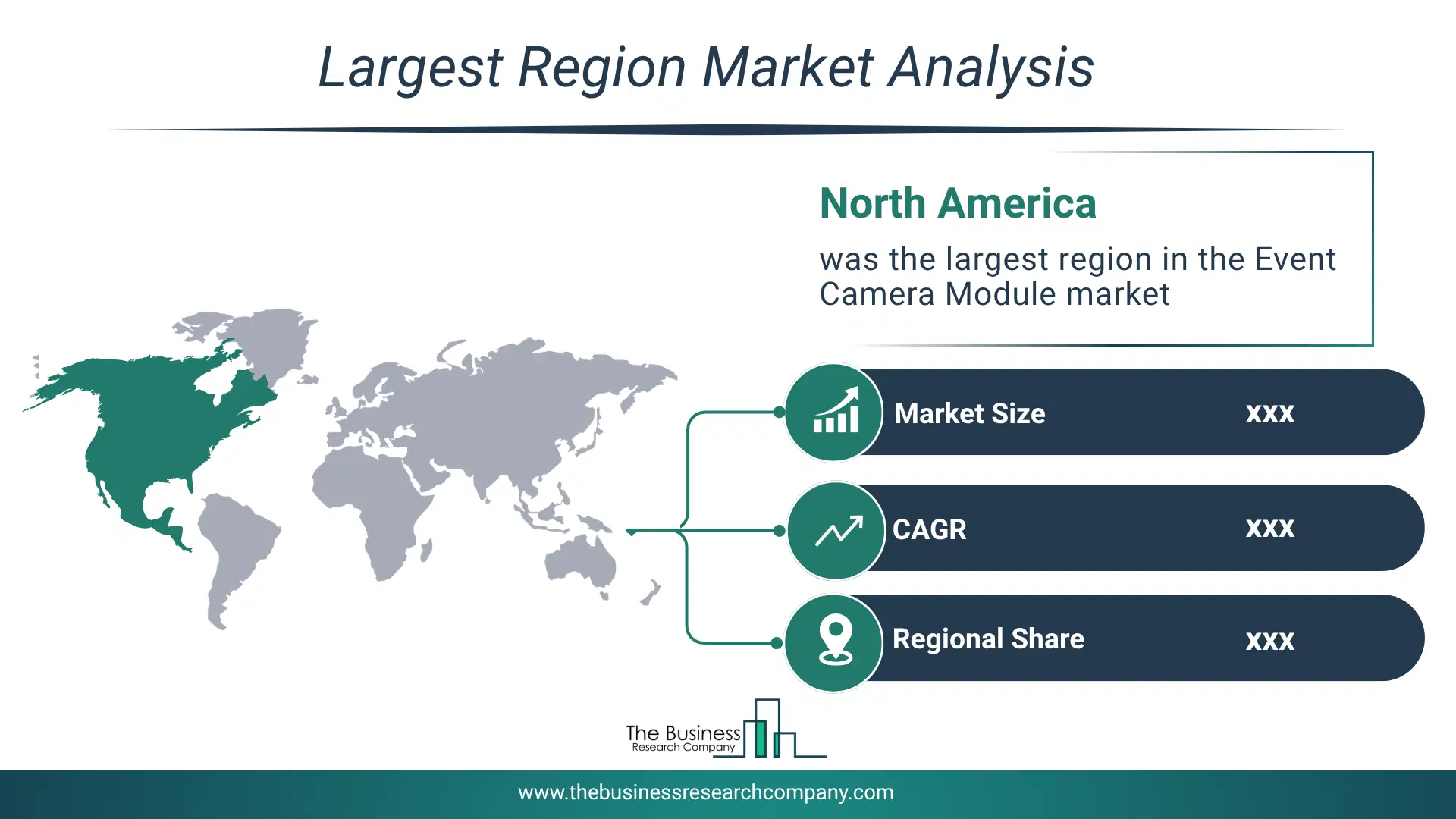
Regional Outlook
North America was the largest region in the event camera module market in 2025. Asia-Pacific is expected to be the fastest-growing region in the forecast period. The regions covered in this market report are Asia-Pacific, South East Asia, Western Europe, Eastern Europe, North America, South America, Middle East, Africa. The countries covered in this market report are Australia, Brazil, China, France, Germany, India, Indonesia, Japan, Taiwan, Russia, South Korea, UK, USA, Canada, Italy, Spain.What Defines the Event Camera Module Market?
The event camera module market consists of revenues earned by entities providing services such as real-time motion detection, high-speed object tracking, gesture recognition, autonomous navigation support, and low-latency visual monitoring. The market value includes the value of related goods sold by the service provider or included within the service offering. The event camera module market also includes sales of neuromorphic vision sensors, event-based cameras, data processing units, camera development kits, and embedded vision systems. Values in this market are ‘factory gate’ values, that is the value of goods sold by the manufacturers or creators of the goods, whether to other entities (including downstream manufacturers, wholesalers, distributors and retailers) or directly to end customers. The value of goods in this market includes related services sold by the creators of the goods.How is Market Value Defined and Measured?
The market value is defined as the revenues that enterprises gain from the sale of goods and/or services within the specified market and geography through sales, grants, or donations in terms of the currency (in USD unless otherwise specified). The revenues for a specified geography are consumption values that are revenues generated by organizations in the specified geography within the market, irrespective of where they are produced. It does not include revenues from resales along the supply chain, either further along the supply chain or as part of other products.
This chart presents market attractiveness based on a quantitative evaluation of growth, competition, strategic alignment, and risk, offering a clear view of opportunity areas for decision-making. This chart is for illustrative purposes; the full report contains the complete analysis.

This chart highlights the Total Addressable Market (TAM) by estimating the maximum revenue opportunity using an assumption-driven approach, supporting strategic planning and opportunity sizing across markets. The chart is illustrative; the full report provides a more comprehensive analysis.
What Key Data and Analysis Are Included in the Event Camera Module Market Report 2026?
The event camera module market research report is one of a series of new reports from The Business Research Company that provides market statistics, including industry global market size, regional shares, competitors with the market share, detailed market segments, market trends and opportunities, and any further data you may need to thrive in the event camera module industry. The market research report delivers a complete perspective of everything you need, with an in-depth analysis of the current and future state of the industry.Event Camera Module Market Report Forecast Analysis
| Report Attribute | Details |
|---|---|
| Market Size Value In 2026 | $5.36 billion |
| Revenue Forecast In 2030 | $10.41 billion |
| Growth Rate | CAGR of 18.1% from 2026 to 2030 |
| Base Year For Estimation | 2025 |
| Actual Estimates/Historical Data | 2020-2025 |
| Forecast Period | 2026 - 2030 |
| Market Representation | Revenue in USD Billion and CAGR from 2026 to 2030 |
| Segments Covered | Type, Resolution, Application |
| Regional Scope | Asia-Pacific, Western Europe, Eastern Europe, North America, South America, Middle East, Africa |
| Country Scope | The countries covered in the report are Australia, Brazil, China, France, Germany, India, Indonesia, Japan, Taiwan, Russia, South Korea, UK, USA, Canada, Italy, Spain. |
| Key Companies Profiled | Samsung Electronics Co. Ltd., Sony Corporation, Northrop Grumman Corporation, STMicroelectronics N.V., Pepperl+Fuchs SE, Melexis NV, Himax Technologies Inc., Lucid Vision Labs, IDS Imaging Development Systems, Prophesee S.A, SynSense AG, Imago Technologies GmbH, LIPS Corporation, iniLabs AG, CenturyArks Co. Ltd., AlpsenTek, Artilux, OpenMV LLC, CenturyArks Co. Ltd., Basler AG |
| Customization Scope | Request for Customization |
| Pricing And Purchase Options | Explore Purchase Options |