

Event-Driven Audio Edge Chip Market Report 2026
Global Outlook – By Product Type (Low-Power Audio Edge Chips, High-Performance Audio Edge Chips, Integrated Audio Edge Solutions, Other Product Types), By Distribution Channel (Direct Sales, Distributors, Online Retail, Other Distribution Channels), By Application (Smart Home Devices, Wearables, Automotive, Industrial IoT, Consumer Electronics, Other Applications), By End-User (Consumer Electronics, Automotive, Industrial, Healthcare, Other End-Users) – Market Size, Trends, Strategies, and Forecast to 2030
Event-Driven Audio Edge Chip Market Overview
• Event-Driven Audio Edge Chip market size has reached to $1.73 billion in 2025 • Expected to grow to $4.06 billion in 2030 at a compound annual growth rate (CAGR) of 18.6% • Growth Driver: Rising Proliferation Of Voice Assistants Fueling The Growth Of The Market Due To Increasing Consumer Adoption Of Smart Speaker Technologies • Market Trend: Technological Innovations in Neuromorphic Microcontrollers for Sensor Edge Applications • Asia-Pacific was the largest region in 2025 and North America is the fastest growing region.What Is Covered Under Event-Driven Audio Edge Chip Market?
An event-driven audio edge chip is a specialized low-power processor that analyzes and responds to sound events directly on the device. It activates processing only when relevant audio patterns occur, making it highly efficient for continuous listening applications. These chips are commonly used in smart devices, wearables, and IoT systems that require real-time audio awareness without cloud dependence. The main product types of the event-driven audio edge chip include low-power audio edge chips, high-performance audio edge chips, integrated audio edge solutions, and others. Low-power audio edge chips are designed to process audio signals efficiently at the edge with minimal energy consumption, making them suitable for always-on listening, wake-word detection, and event-triggered audio processing. There are distribution channels such as direct sales, distributors, online retail, and others. The main include smart home devices, wearables, automotive, industrial IoT, consumer electronics, and others, and the key end-users include consumer electronics, automotive, industrial, healthcare, and others.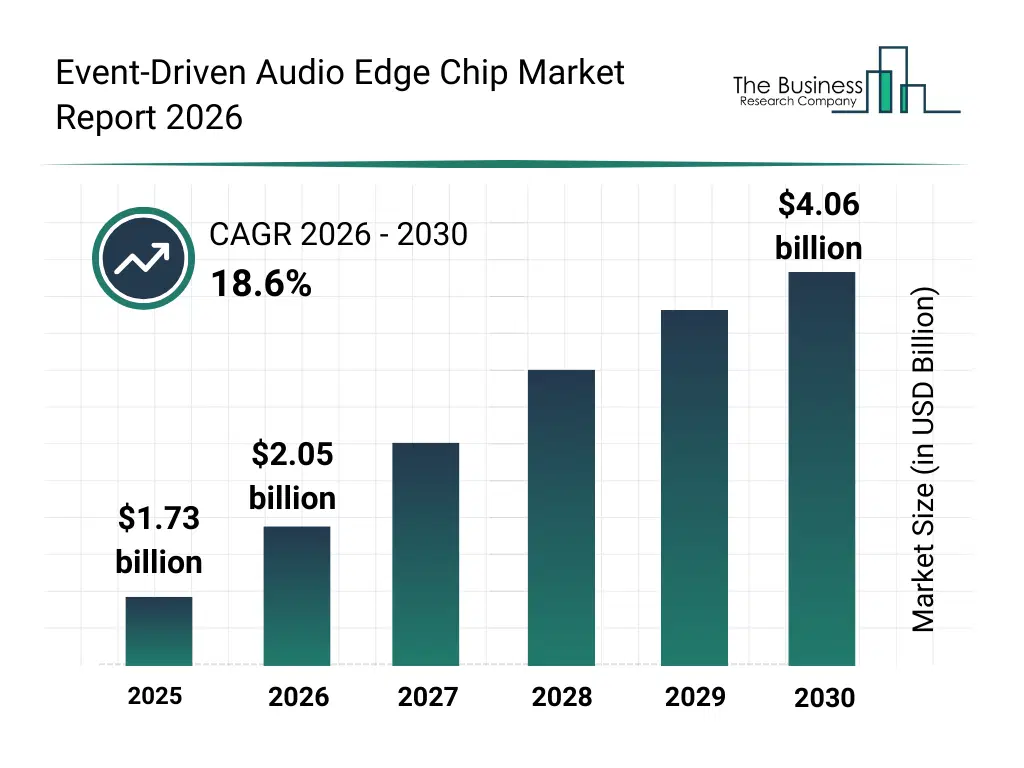
What Is The Event-Driven Audio Edge Chip Market Size and Share 2026?
The event-driven audio edge chip market size has grown rapidly in recent years. It will grow from $1.73 billion in 2025 to $2.05 billion in 2026 at a compound annual growth rate (CAGR) of 18.9%. The growth in the historic period can be attributed to increasing adoption of voice-enabled devices, growing demand for low-power audio processing, rising integration of edge AI in consumer electronics, expansion of smart home ecosystems, and increasing need for real-time sound detection.What Is The Event-Driven Audio Edge Chip Market Growth Forecast?
The event-driven audio edge chip market size is expected to see rapid growth in the next few years. It will grow to $4.06 billion in 2030 at a compound annual growth rate (CAGR) of 18.6%. The growth in the forecast period can be attributed to growing deployment of audio edge chips in IoT devices, rising demand for ultra-low-latency audio processing, increasing adoption of event-driven AI architectures, expansion of edge computing in industrial applications, and growing need for on-device voice analytics. Major trends in the forecast period include technology advancements in neuromorphic audio processing, innovations in event-driven sound recognition models, developments in ultra-low-power chip architectures, research and developments in edge AI audio frameworks, and advancements in multimodal edge sensing systems.
Global Event-Driven Audio Edge Chip Market Segmentation
1) By Product Type: Low-Power Audio Edge Chips, High-Performance Audio Edge Chips, Integrated Audio Edge Solutions, Other Product Types 2) By Distribution Channel: Direct Sales, Distributors, Online Retail, Other Distribution Channels 3) By Application: Smart Home Devices, Wearables, Automotive, Industrial IoT, Consumer Electronics, Other Applications 4) By End-User: Consumer Electronics, Automotive, Industrial, Healthcare, Other End-Users Subsegments: 1) By Low-Power Audio Edge Chips: Ultra Low Power Audio Processors, Battery Optimized Audio Processing Units, Always Listening Audio Detection Chips, Minimal Energy Consumption Sound Processing Chips 2) By High-Performance Audio Edge Chips: High Speed Neural Audio Processing Units, Advanced Acoustic Event Recognition Chips, Multi Core Audio Analysis Processors, Real Time High Accuracy Sound Processing Chips 3) By Integrated Audio Edge Solutions: Combined Hardware and Software Audio Edge Modules, Pre-Trained Artificial Intelligence Audio Solution Kits, Embedded Audio Analytics System-on-Chip Solutions, Modular Audio Intelligence Integration Platforms 4) By Other Product Types: Specialized Acoustic Sensing Chips, Custom Audio Edge Processing Components, Niche Event Driven Audio Solutions, Emerging Audio Intelligence Device TypesWhat Is The Driver Of The Event-Driven Audio Edge Chip Market?
The rising proliferation of voice assistants is expected to propel the growth of the event-driven audio edge chip market going forward. Voice assistants are digital interfaces that use voice recognition, natural language processing, and speech synthesis to listen to specific commands and perform tasks for users. The adoption of smart home devices is rising, as consumers increasingly seek hands-free convenience and seamless integration for controlling appliances, lighting, and media. Event-driven audio edge chips help enable efficient voice assistants by allowing devices to remain in a low-power state until a specific sound or wake word triggers them, significantly reducing energy consumption while ensuring rapid response times. For instance, according to the Australian Communications and Media Authority (ACMA), an Australia-based government statutory authority, 20% of Australians had a voice-controlled smart speaker connected to the internet in 2023, which increased to 23% in 2024, representing a 3-percentage-point year-on-year increase. Therefore, the rising proliferation of voice assistants is driving the growth of the event-driven audio edge chip industry.Key Players In The Global Event-Driven Audio Edge Chip Market
Major companies operating in the event-driven audio edge chip market are Intel Corporation, Qualcomm Incorporated, Texas Instruments Incorporated, Infineon Technologies AG, STMicroelectronics N.V., NXP Semiconductors N.V., Microchip Technology Incorporated, CEVA Inc., XMOS Ltd., SynSense AG, Innatera Nanosystems B.V., Syntiant Corporation, Ambiq Micro Inc., Sensory Inc., Applied Brain Research Inc., Blumind Inc., AON Devices Inc., BrainChip Holdings Ltd., GrAI Matter Labs SAS, Eta Compute Inc.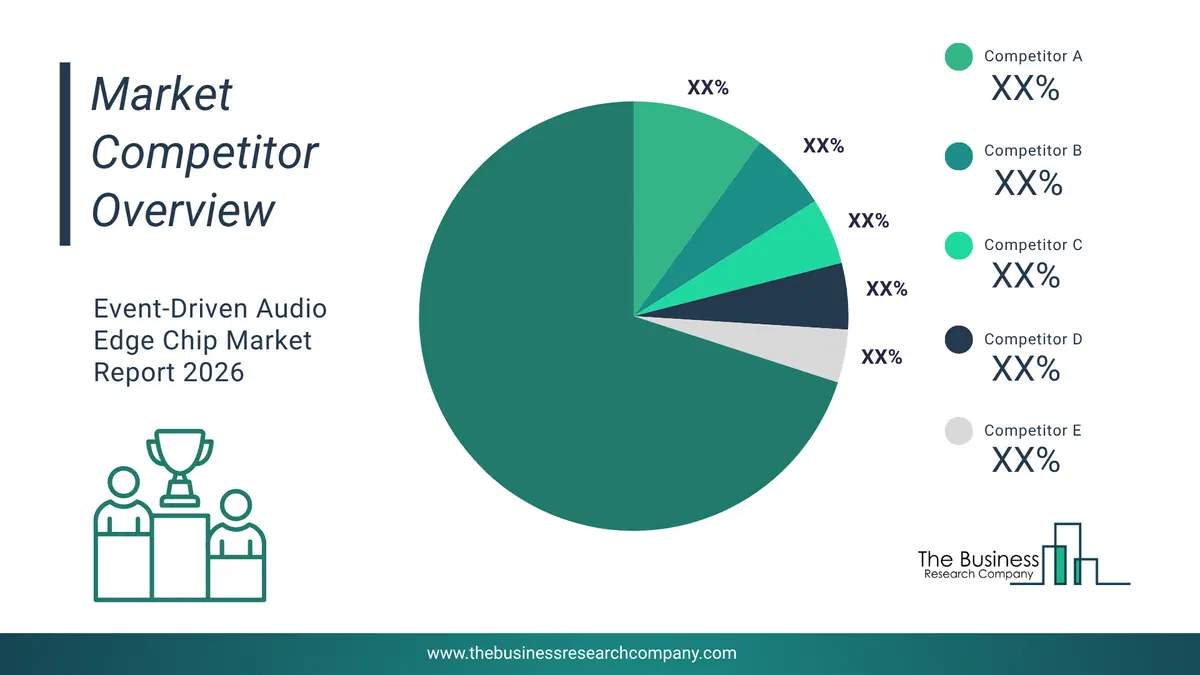
This chart is for illustrative purposes; the full report includes a detailed competitor analysis and comprehensive overview of the top 10 companies in the market.
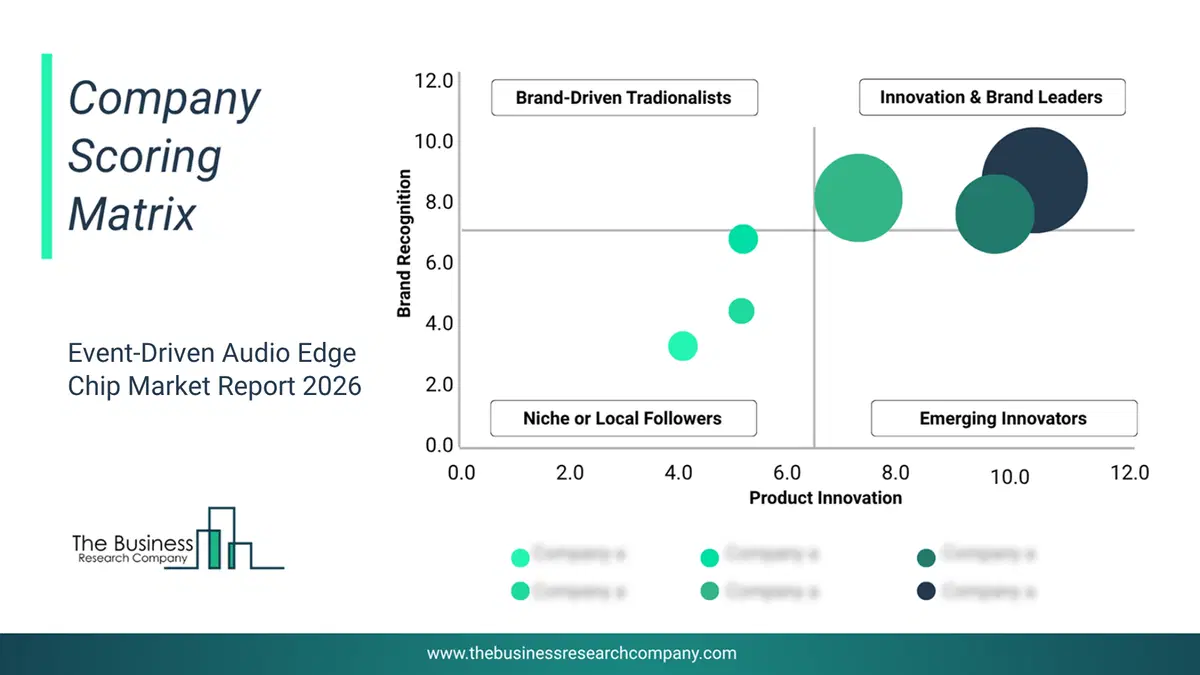
This chart maps companies by product innovation and brand strength, with bubble size indicating relative revenue, helping identify market leaders, challengers, and niche players. This is an illustrative chart; the full report provides a complete and accurate competitive analysis.
Global Event-Driven Audio Edge Chip Market Trends and Insights
Major companies operating in the event-driven audio edge chip market are increasingly prioritizing advancements in neuromorphic microcontroller technology to enhance on-device sound processing efficiency and reduce power consumption. Neuromorphic microcontrollers refer to specialized low-power chips designed to mimic the structure and functioning of the human brain, using spiking neural networks to process data more efficiently than traditional processors. For instance, in February 2024, Innatera, a Netherlands-based developer of neuromorphic processors, unveiled its Pulsar microcontroller. The platform is designed as the first mass-market neuromorphic microcontroller, combining a proprietary SNN-based processing architecture with a high-performance RISC-V CPU and accelerators for Convolutional Neural Networks (CNNs), offering a combination of ultra-low power consumption and short response latency for real-time decision-making in voice recognition, sound classification, and other sensor-edge AI applications.What Are Latest Mergers And Acquisitions In The Event-Driven Audio Edge Chip Market?
In January 2024, BrainChip, an Australia-based developer of ultra-low power neuromorphic AI IP, partnered with MYWAI deliver next-generation edge AI Solutions. With this partnership, BrainChip sought to expand its event-driven audio edge chip capabilities and strengthen its presence in industrial AI applications through the integration of neuromorphic computing with equipment as a service (EaaS) platforms. MYWAI is an Italy-based provider of AIoT solutions and edge intelligence platforms for industrial and manufacturing sectors, including event-driven audio edge chip.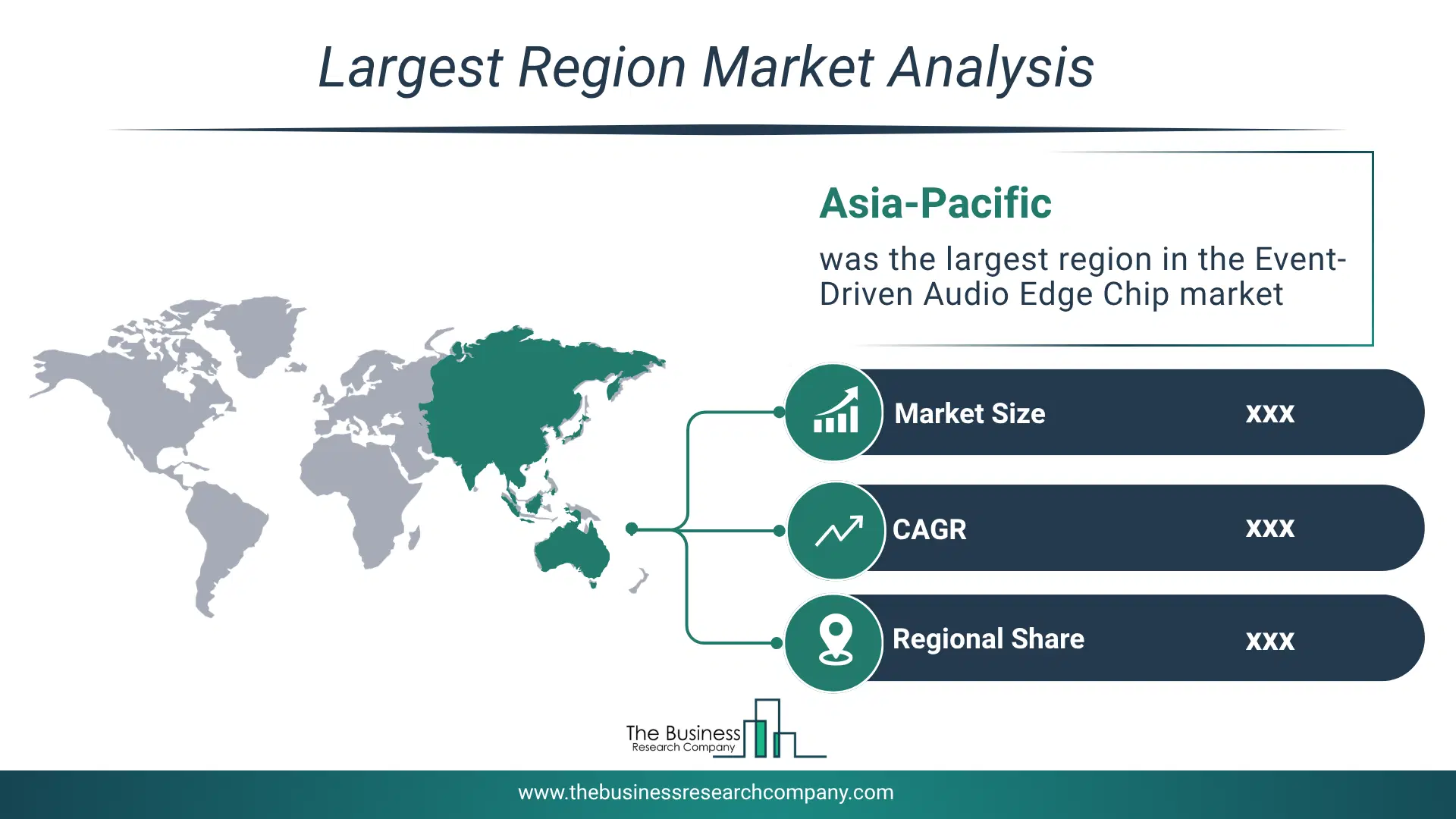
Regional Insights
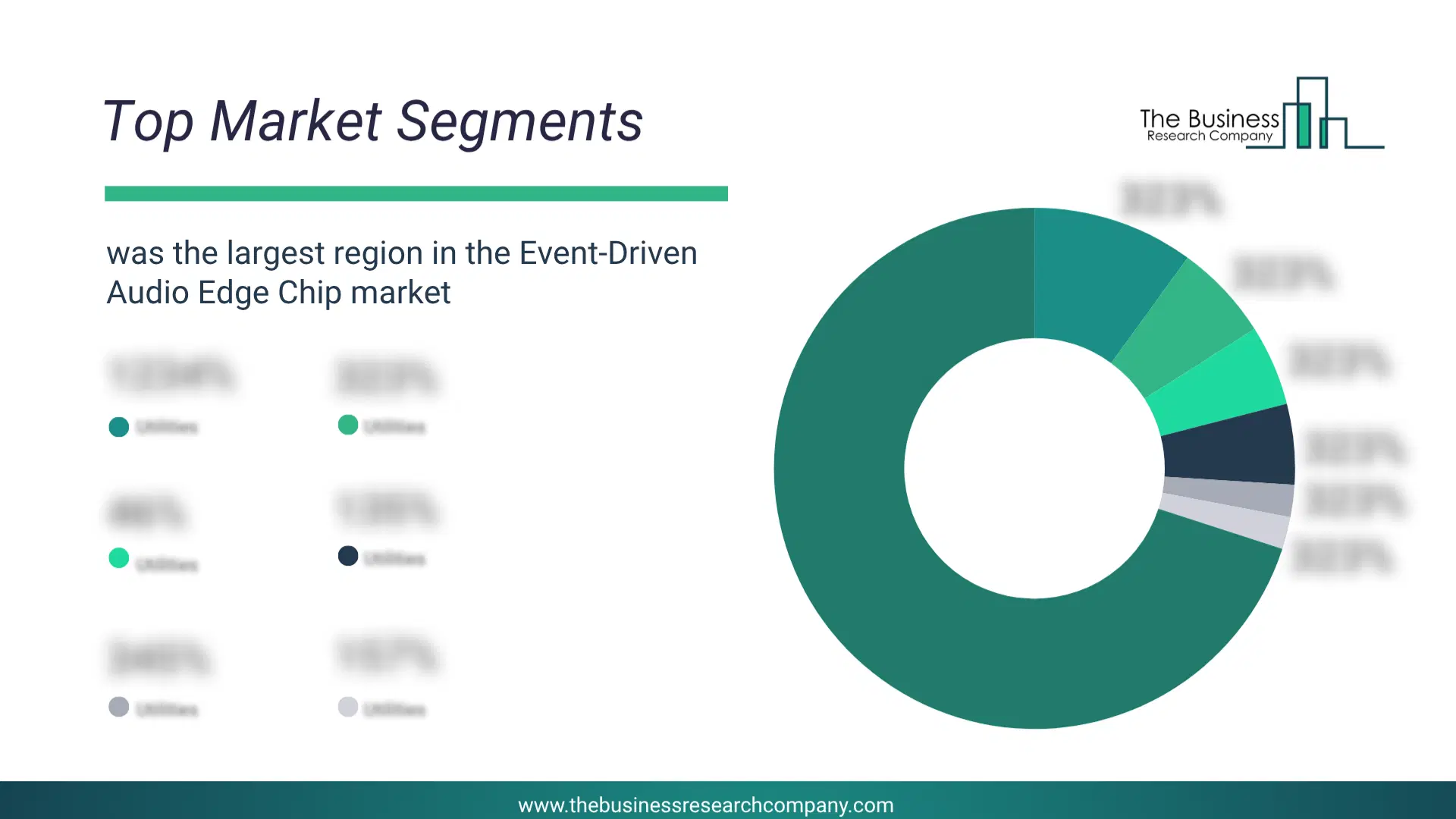
Asia-Pacific was the largest region in the event-driven audio edge chip market in 2025. North America is expected to be the fastest-growing region in the forecast period. The regions covered in this market report are Asia-Pacific, South East Asia, Western Europe, Eastern Europe, North America, South America, Middle East, Africa. The countries covered in this market report are Australia, Brazil, China, France, Germany, India, Indonesia, Japan, Taiwan, Russia, South Korea, UK, USA, Canada, Italy, Spain.What Defines the Event-Driven Audio Edge Chip Market?
The event-driven audio edge chip market consists of sales of ultra-low-power wake-word detection chips, neuromorphic audio processing chips, real-time sound event recognition chips, edge AI audio inference chips, and multimodal audio-sensor fusion chips. Values in this market are ‘factory gate’ values, that is, the value of goods sold by the manufacturers or creators of the goods, whether to other entities (including downstream manufacturers, wholesalers, distributors, and retailers) or directly to end customers. The value of goods in this market includes related services sold by the creators of the goods.How is Market Value Defined and Measured?
The market value is defined as the revenues that enterprises gain from the sale of goods and/or services within the specified market and geography through sales, grants, or donations in terms of the currency (in USD unless otherwise specified). The revenues for a specified geography are consumption values that are revenues generated by organizations in the specified geography within the market, irrespective of where they are produced. It does not include revenues from resales along the supply chain, either further along the supply chain or as part of other products.
This chart presents market attractiveness based on a quantitative evaluation of growth, competition, strategic alignment, and risk, offering a clear view of opportunity areas for decision-making. This chart is for illustrative purposes; the full report contains the complete analysis.

This chart highlights the Total Addressable Market (TAM) by estimating the maximum revenue opportunity using an assumption-driven approach, supporting strategic planning and opportunity sizing across markets. The chart is illustrative; the full report provides a more comprehensive analysis.
What Key Data and Analysis Are Included in the Event-Driven Audio Edge Chip Market Report 2026?
The event-driven audio edge chip market research report is one of a series of new reports from The Business Research Company that provides market statistics, including industry global market size, regional shares, competitors with the market share, detailed market segments, market trends and opportunities, and any further data you may need to thrive in the event-driven audio edge chip industry. The market research report delivers a complete perspective of everything you need, with an in-depth analysis of the current and future state of the industry.Event-Driven Audio Edge Chip Market Report Forecast Analysis
| Report Attribute | Details |
|---|---|
| Market Size Value In 2026 | $2.05 billion |
| Revenue Forecast In 2030 | $4.06 billion |
| Growth Rate | CAGR of 18.9% from 2026 to 2030 |
| Base Year For Estimation | 2025 |
| Actual Estimates/Historical Data | 2020-2025 |
| Forecast Period | 2026 - 2030 |
| Market Representation | Revenue in USD Billion and CAGR from 2026 to 2030 |
| Segments Covered | Product Type, Distribution Channel, Application, End-User |
| Regional Scope | Asia-Pacific, Western Europe, Eastern Europe, North America, South America, Middle East, Africa |
| Country Scope | The countries covered in the report are Australia, Brazil, China, France, Germany, India, Indonesia, Japan, Taiwan, Russia, South Korea, UK, USA, Canada, Italy, Spain. |
| Key Companies Profiled | Intel Corporation, Qualcomm Incorporated, Texas Instruments Incorporated, Infineon Technologies AG, STMicroelectronics N.V., NXP Semiconductors N.V., Microchip Technology Incorporated, CEVA Inc., XMOS Ltd., SynSense AG, Innatera Nanosystems B.V., Syntiant Corporation, Ambiq Micro Inc., Sensory Inc., Applied Brain Research Inc., Blumind Inc., AON Devices Inc., BrainChip Holdings Ltd., GrAI Matter Labs SAS, Eta Compute Inc. |
| Customization Scope | Request for Customization |
| Pricing And Purchase Options | Explore Purchase Options |