
Excitation Systems Market Report 2026
Global Outlook – By Type (Rotational, Static, Brushless), By Controller Type (Analog, Digital), By Application (Synchronous Generator, Synchronous Motor), By End User (Power Generation Industry, Heavy Industries, Original Equipment Manufacturer (OEMs), Other End Users) – Market Size, Trends, Strategies, and Forecast to 2030
Excitation Systems Market Overview
• Excitation Systems market size has reached to $2.76 billion in 2025 • Expected to grow to $3.3 billion in 2030 at a compound annual growth rate (CAGR) of 3.6% • Growth Driver: Solar And Wind Power Growth Driving The Excitation System Market • North America was the largest region in 2025 and Asia-Pacific is the fastest growing region.What Is Covered Under Excitation Systems Market?
An excitation system refers to a control system that provides the necessary field current to the rotor winding of a synchronous generator, producing the magnetic field required to generate electrical power. It is essential for regulating the generator's output voltage and reactive power, ensuring reliable operation, stability, and quick transient response during power generation. The main types of excitation systems are rotational, static, and brushless. A rotational excitation system utilizes rotating components, like a generator or motor, to produce the magnetic field required for power generation and is commonly employed in traditional synchronous generators to regulate voltage output. The controller type is categorized into analog and digital, which are used in several applications, such as synchronous generators and synchronous motors. These are used by several end-users, including the power generation industry, heavy industries, original equipment manufacturers (OEMs), and others.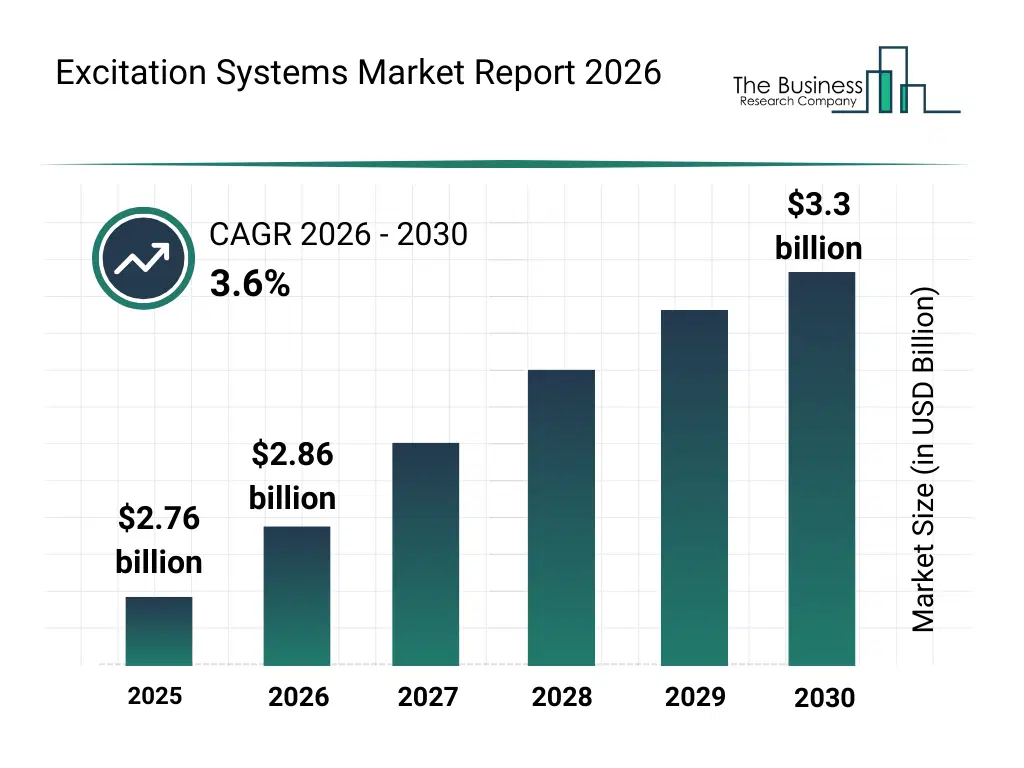
What Is The Excitation Systems Market Size and Share 2026?
The excitation systems market size has grown steadily in recent years. It will grow from $2.76 billion in 2025 to $2.86 billion in 2026 at a compound annual growth rate (CAGR) of 3.5%. The growth in the historic period can be attributed to growth in power generation infrastructure, adoption of synchronous generators in heavy industries, development of brushless and static excitation systems, increasing demand for reliable voltage regulation, expansion of industrial and utility power applications.What Is The Excitation Systems Market Growth Forecast?
The excitation systems market size is expected to see steady growth in the next few years. It will grow to $3.3 billion in 2030 at a compound annual growth rate (CAGR) of 3.6%. The growth in the forecast period can be attributed to rising deployment of digital excitation and control systems, increased focus on energy efficiency and sustainability, growing adoption of predictive maintenance solutions, integration with smart grid and iot infrastructure, innovations in reactive power management and voltage stabilization. Major trends in the forecast period include integration of digital excitation control systems, advancements in brushless and rotational exciters, improved voltage regulation and reactive power management, expansion of predictive maintenance and monitoring solutions, adoption of energy-efficient excitation technologies.
Global Excitation Systems Market Segmentation
1) By Type: Rotational, Static, Brushless 2) By Controller Type: Analog, Digital 3) By Application: Synchronous Generator, Synchronous Motor 4) By End User: Power Generation Industry, Heavy Industries, Original Equipment Manufacturer (OEMs), Other End Users Subsegments: 1) By Rotational: Synchronous Rotational Exciters, Permanent Magnet Rotational Exciters 2) By Static: Thyristor-Controlled Static Exciters, Capacitor-Excited Static Exciters 3) By Brushless: Brushless Alternators, Self-Excited Brushless SystemsWhat Are The Drivers Of The Excitation Systems Market?
Increasing popularity of solar and wind power is expected to propel the growth of the excitation system market going forward. Solar and wind power refer to renewable energy sources that harness the energy of sunlight and wind, respectively, to generate electricity. Growing awareness of climate change and the environmental impacts of fossil fuel combustion has led to a shift towards cleaner energy sources like solar and wind power, which produce minimal greenhouse gas emissions and reduce air pollution. Synchronous generators are commonly used in solar and wind power plants to convert mechanical energy from wind turbines or steam turbines (in concentrated solar power plants) into electrical energy. For instance, in January 2024, according to the U.S. Energy Information Administration, a US-based government agency, U.S. solar power generation is projected to increase by 75%, rising from 163 billion kilowatt-hours (kWh) in 2023 to 286 billion kWh in 2025, while wind power generation is expected to grow by 11%, from 430 billion kWh in 2023 to 476 billion kWh in 2025. Therefore, increasing popularity of solar and wind power is driving the excitation system industry. The growing integration of renewable energy sources, such as solar and wind, is expected to propel the growth of the excitation system market going forward. Renewable energy sources are variable and connected to the grid through power electronics rather than traditional synchronous generators, which reduces system inertia and can create voltage fluctuations, frequency instability, and reactive power imbalances. The increasing share of renewables in electricity grids is driven by global decarbonization efforts, government incentives, and the push for sustainable energy. Grid operators rely on excitation systems to provide voltage regulation, reactive power support, and dynamic stability, ensuring reliable and continuous electricity supply. For instance, in December 2024, according to Eurostat, a Luxembourg-based government agency, in 2023, renewable energy accounted for 24.5% of the energy consumed in the EU, an increase from 23.0% in 2022. Therefore, the growing integration of renewable energy sources is driving the growth of the excitation system industry.Key Players In The Global Excitation Systems Market
Major companies operating in the excitation systems market are General Electric Company, Mitsubishi Electric Corporation, Siemens Energy AG, ABB Ltd, Nidec Corporation, Rolls-Royce Holdings plc, Emerson Electric Co., ANDRITZ AG, Fuji Electric Co Ltd, WEG S.A. (WEG Industries), Voith Group, KONČAR - Electrical Industry Inc., Basler Electric Company, L & S Electric Inc., Amtech Power Limited, NR Electric Co Ltd (NARI Group), Excitation & Engineering Services Ltd, SVEA Power AB, Altex Electric GmbH, Birr Machines AG, Tenel s.r.o.
This chart is for illustrative purposes; the full report includes a detailed competitor analysis and comprehensive overview of the top 10 companies in the market.
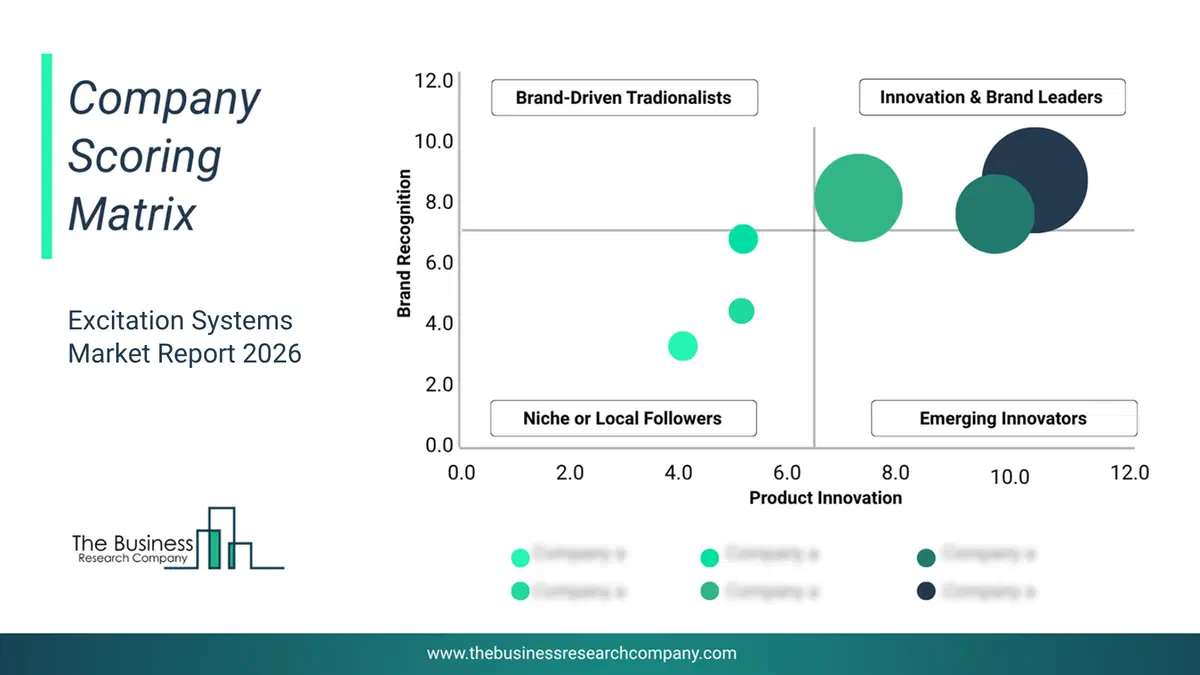
This chart maps companies by product innovation and brand strength, with bubble size indicating relative revenue, helping identify market leaders, challengers, and niche players. This is an illustrative chart; the full report provides a complete and accurate competitive analysis.
What Are Latest Mergers And Acquisitions In The Excitation Systems Market?
In December 2025, WEG S.A., a Brazil-based electrical equipment and power systems company, acquired Sanelec Excitation Systems Private Limited for US $5.2 million. Through this acquisition, WEG aims to enhance its excitation systems portfolio by integrating Sanelec’s expertise in automatic voltage regulators and excitation control solutions for generators and synchronous motors. Sanelec Excitation Systems Private Limited is an India-based company specializing in the design and manufacture of voltage regulators and excitation systems for power generation equipment, which are critical for maintaining generator performance and grid stability.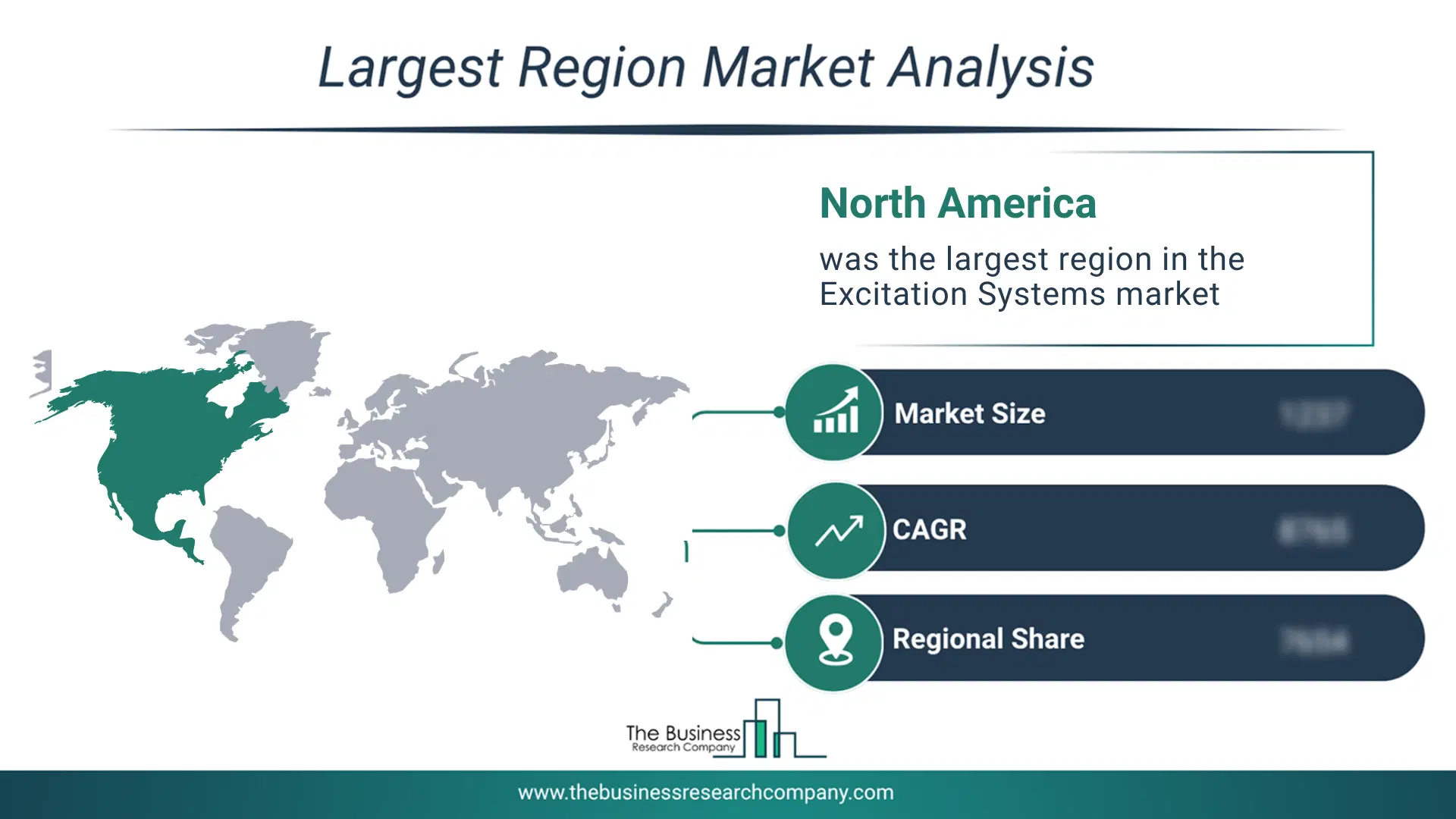
Regional Outlook
North America was the largest region in the excitation systems market in 2025. Asia-Pacific is expected to be the fastest-growing region in the forecast period. The regions covered in this market report are Asia-Pacific, South East Asia, Western Europe, Eastern Europe, North America, South America, Middle East, Africa. The countries covered in this market report are Australia, Brazil, China, France, Germany, India, Indonesia, Japan, Taiwan, Russia, South Korea, UK, USA, Canada, Italy, SpainWhat Defines the Excitation Systems Market?
The excitation systems market consists of sales of voltage regulators, automatic voltage regulators, excitation transformers, field discharge resistors, control systems, and sensors and feedback devices. Values in this market are ‘factory gate’ values, that is the value of goods sold by the manufacturers or creators of the goods, whether to other entities (including downstream manufacturers, wholesalers, distributors and retailers) or directly to end customers. The value of goods in this market includes related services sold by the creators of the goods.How is Market Value Defined and Measured?
The market value is defined as the revenues that enterprises gain from the sale of goods and/or services within the specified market and geography through sales, grants, or donations in terms of the currency (in USD unless otherwise specified). The revenues for a specified geography are consumption values that are revenues generated by organizations in the specified geography within the market, irrespective of where they are produced. It does not include revenues from resales along the supply chain, either further along the supply chain or as part of other products.
This chart presents market attractiveness based on a quantitative evaluation of growth, competition, strategic alignment, and risk, offering a clear view of opportunity areas for decision-making. This chart is for illustrative purposes; the full report contains the complete analysis.

This chart highlights the Total Addressable Market (TAM) by estimating the maximum revenue opportunity using an assumption-driven approach, supporting strategic planning and opportunity sizing across markets. The chart is illustrative; the full report provides a more comprehensive analysis.
What Key Data and Analysis Are Included in the Excitation Systems Market Report 2026?
The excitation systems market research report is one of a series of new reports from The Business Research Company that provides market statistics, including Market Report 2026?global market size, regional shares, competitors with the market share, detailed market segments, market trends and opportunities, and any further data you may need to thrive in the excitation systems Market Report 2026? The market research report delivers a complete perspective of everything you need, with an in-depth analysis of the current and future state of the Market Report 2026?Excitation Systems Market Report Forecast Analysis
| Report Attribute | Details |
|---|---|
| Market Size Value In 2026 | $2.86 billion |
| Revenue Forecast In 2030 | $3.3 billion |
| Growth Rate | CAGR of 3.5% from 2026 to 2030 |
| Base Year For Estimation | 2025 |
| Actual Estimates/Historical Data | 2020-2025 |
| Forecast Period | 2026 - 2030 - 2030 |
| Market Representation | Revenue in USD Billion and CAGR from 2026 to 2030 |
| Segments Covered | Type, Controller Type, Application, End User |
| Regional Scope | Asia-Pacific, Western Europe, Eastern Europe, North America, South America, Middle East, Africa |
| Country Scope | The countries covered in the report are Australia, Brazil, China, France, Germany, India, Indonesia, Japan, Taiwan, Russia, South Korea, UK, USA, Canada, Italy, Spain. |
| Key Companies Profiled | General Electric Company, Mitsubishi Electric Corporation, Siemens Energy AG, ABB Ltd, Nidec Corporation, Rolls-Royce Holdings plc, Emerson Electric Co., ANDRITZ AG, Fuji Electric Co Ltd, WEG S.A. (WEG Industries), Voith Group, KONČAR - Electrical Industry Inc., Basler Electric Company, L & S Electric Inc., Amtech Power Limited, NR Electric Co Ltd (NARI Group), Excitation & Engineering Services Ltd, SVEA Power AB, Altex Electric GmbH, Birr Machines AG, Tenel s.r.o. |
| Customization Scope | Request for Customization |
| Pricing And Purchase Options | Explore Purchase Options |