
Exhaust Heat Recovery System Market Report 2026
Global Outlook – By Type (Heat Recovery Steam Generators, Heat Exchangers, Steam Turbines, Condensing Units), By Component (Turbine, Thermoelectric Generator (TEG) Module, Evaporator, Condenser, Other Components), By Vehicle Type (Passenger Car, Light Commercial Vehicle (LCV), Heavy Commercial Vehicle (HCV)), By Application (Industrial, Power Generation, Automotive), By End-User (Manufacturing, Oil And Gas, Food And Beverage, Utility, Transportation) – Market Size, Trends, Strategies, and Forecast to 2030
Exhaust Heat Recovery System Market Overview
• Exhaust Heat Recovery System market size has reached to $20.79 billion in 2025 • Expected to grow to $30.04 billion in 2030 at a compound annual growth rate (CAGR) of 7.7% • Growth Driver: Tightening Emission Regulations Are Driving The Market Due To Enhanced Sustainability And Efficiency • Market Trend: Introduction Of High-Efficiency Energy Recovery Technologies • North America was the largest region in 2025 and Asia-Pacific is the fastest growing region.Market Gains By 2030 – Top Opportunities By Segment
Market Gain identifies the most promising market opportunities by highlighting the segments or products expected to generate the highest incremental revenue growth over the next five years.
What Is Covered Under Exhaust Heat Recovery System Market?
An exhaust heat recovery system is a technology used in vehicles and industrial engines to capture waste heat from exhaust gases and convert it into useful energy, such as electrical power or additional propulsion. This system improves overall energy efficiency, reduces fuel consumption, and lowers emissions by utilizing heat that would otherwise be lost. The main types of exhaust heat recovery system are heat recovery steam generators, heat exchangers, steam turbines, condensing units, and chillers. Heat recovery steam generators (HRSGs) refer to energy recovery devices that capture exhaust heat from gas turbines or other industrial processes and convert it into steam, which is then used to drive steam turbines for power generation or for industrial heating applications. The key components of this system include turbine, thermoelectric generator (TEG) module, compressor, evaporator, exhaust gas recirculation (EGR) valve and cooler, condenser, and others, and are used in various vehicle types, such as passenger cars, light commercial vehicles (LCVs), and heavy commercial vehicles (HCVs). It finds application in industrial, commercial, residential, power generation, and automotive, serving end-users such as manufacturing, oil and gas, food and beverage, utilities, and transportation.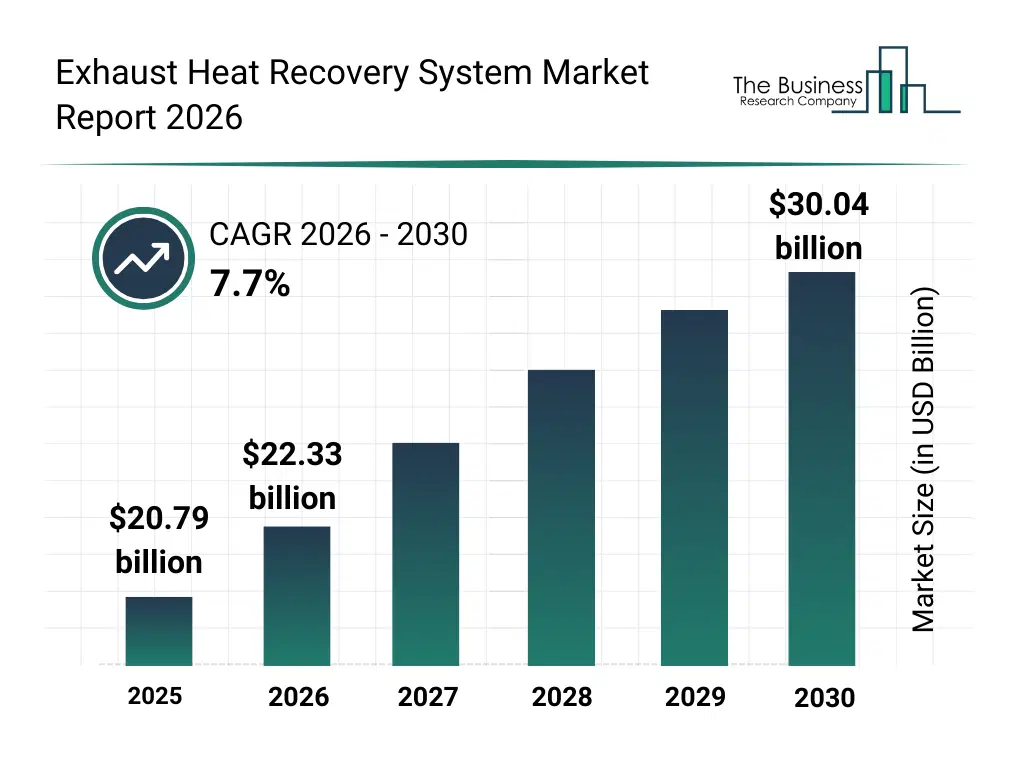
What Is The Exhaust Heat Recovery System Market Size and Share 2026?
The exhaust heat recovery system market size has grown strongly in recent years. It will grow from $20.79 billion in 2025 to $22.33 billion in 2026 at a compound annual growth rate (CAGR) of 7.4%. The growth in the historic period can be attributed to increasing fuel efficiency requirements, growth in heavy-duty vehicle production, expansion of industrial power generation, rising focus on emission reduction technologies, availability of advanced heat exchangers.What Is The Exhaust Heat Recovery System Market Growth Forecast?
The exhaust heat recovery system market size is expected to see strong growth in the next few years. It will grow to $30.04 billion in 2030 at a compound annual growth rate (CAGR) of 7.7%. The growth in the forecast period can be attributed to increasing electrification of powertrains, rising adoption of hybrid systems, expansion of industrial energy recovery solutions, growing regulatory pressure on emissions, increasing investments in energy efficiency technologies. Major trends in the forecast period include integration of waste heat recovery technologies, rising use of thermoelectric generators, expansion of exhaust heat recovery in commercial vehicles, growing adoption in industrial engines, enhanced system efficiency designs.
Global Exhaust Heat Recovery System Market Segmentation
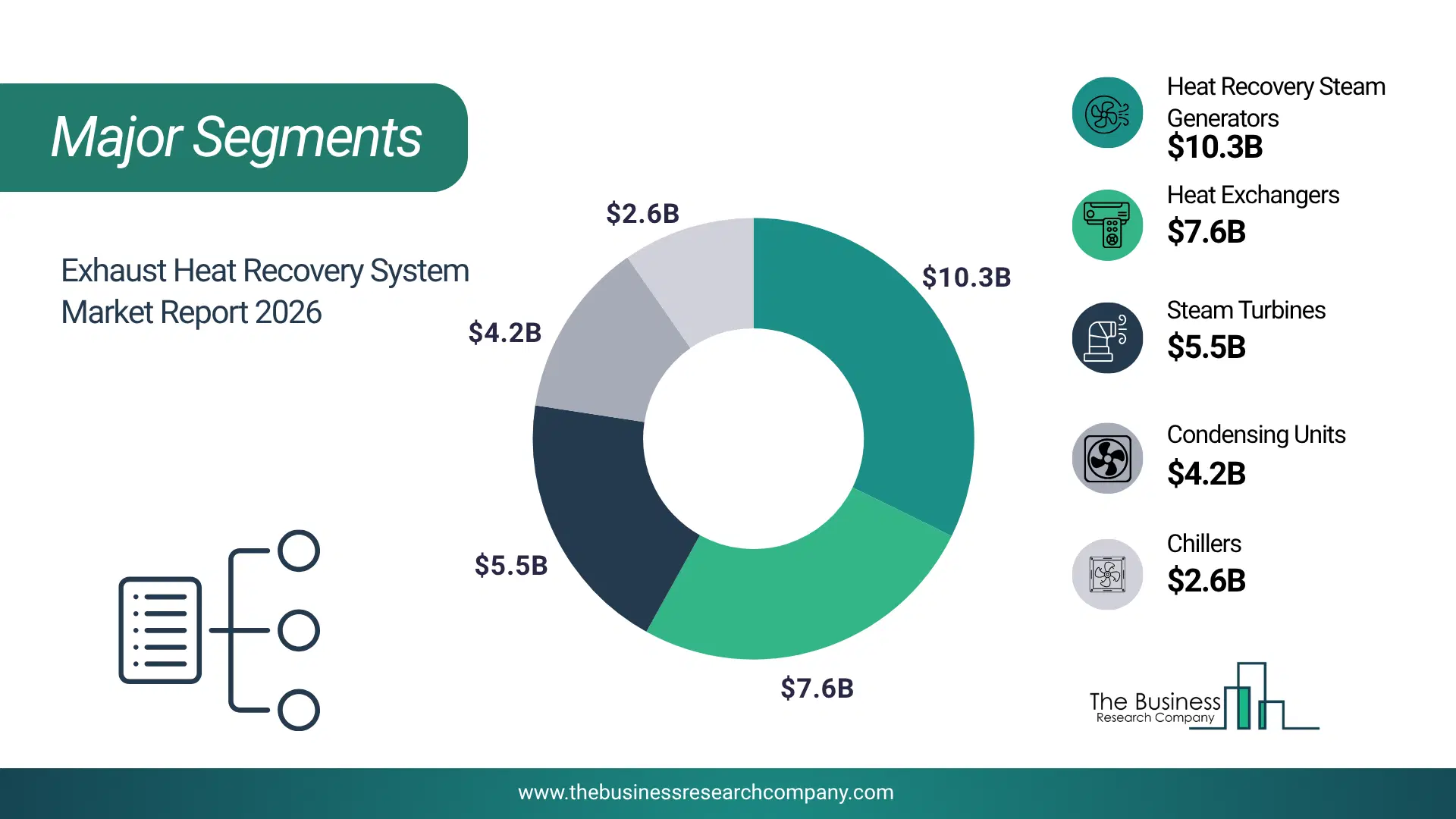
1) By Type: Heat Recovery Steam Generators, Heat Exchangers, Steam Turbines, Condensing Units 2) By Component: Turbine, Thermoelectric Generator (TEG) Module, Evaporator, Condenser, Other Components 3) By Vehicle Type: Passenger Car, Light Commercial Vehicle (LCV), Heavy Commercial Vehicle (HCV) 4) By Application: Industrial, Power Generation, Automotive 5) By End-User: Manufacturing, Oil And Gas, Food And Beverage, Utility, Transportation Subsegments: 1) By Heat Recovery Steam Generators: Waste Heat Boilers, Once-Through Steam Generators, Firetube Steam Generators, Watertube Steam Generators 2) By Heat Exchangers: Shell And Tube Heat Exchangers, Plate Heat Exchangers, Air Cooled Heat Exchangers, Finned Tube Heat Exchangers 3) By Steam Turbines: Back Pressure Steam Turbines, Condensing Steam Turbines, Extraction Steam Turbines, Reheat Steam Turbines 4) By Condensing Units: Air Cooled Condensers, Water Cooled Condensers, Evaporative Condensers, Hybrid Condensers The top segments in the exhaust heat recovery system market will be: • Heat Recovery Steam Generators will reach $10.23 billion by 2030. • Heat Exchangers will reach $7.56 billion by 2030. • Steam Turbines will reach $5.47 billion by 2030. • Condensing Units will reach $4.19 billion by 2030. • Chillers will reach $2.58 billion by 2030.What Is The Driver Of The Exhaust Heat Recovery System Market?
The tightening of emission regulations is expected to propel the growth of the exhaust heat recovery system market going forward. Emission regulations are legally established standards and guidelines set by governmental and regulatory authorities to control and limit the release of harmful pollutants and greenhouse gases from industrial processes, transportation systems, and other sources, in order to protect public health and the environment. The primary factor driving stricter emission regulations is the increasing emphasis on environmental sustainability, as heightened awareness of the long-term ecological and societal impacts of pollution compels regulators to adopt measures that encourage cleaner technologies. Exhaust heat recovery systems help meet these stricter requirements by capturing and reusing waste heat from exhaust streams, thereby improving energy efficiency, reducing fuel consumption, and lowering harmful emissions. For instance, in March 2024, the U.S. Environmental Protection Agency (EPA), a US-based federal agency, finalized national pollution standards for passenger cars, light-duty trucks, and medium-duty vehicles for model years 2027 through 2032 and beyond. These standards are projected to prevent over 7 billion tons of carbon emissions and generate nearly $100 billion in annual net societal benefits, including $13 billion from improved public health due to cleaner air and $62 billion from reduced fuel, maintenance, and repair costs for drivers. Therefore, tightening emission regulations are driving the growth of the exhaust heat recovery system industry.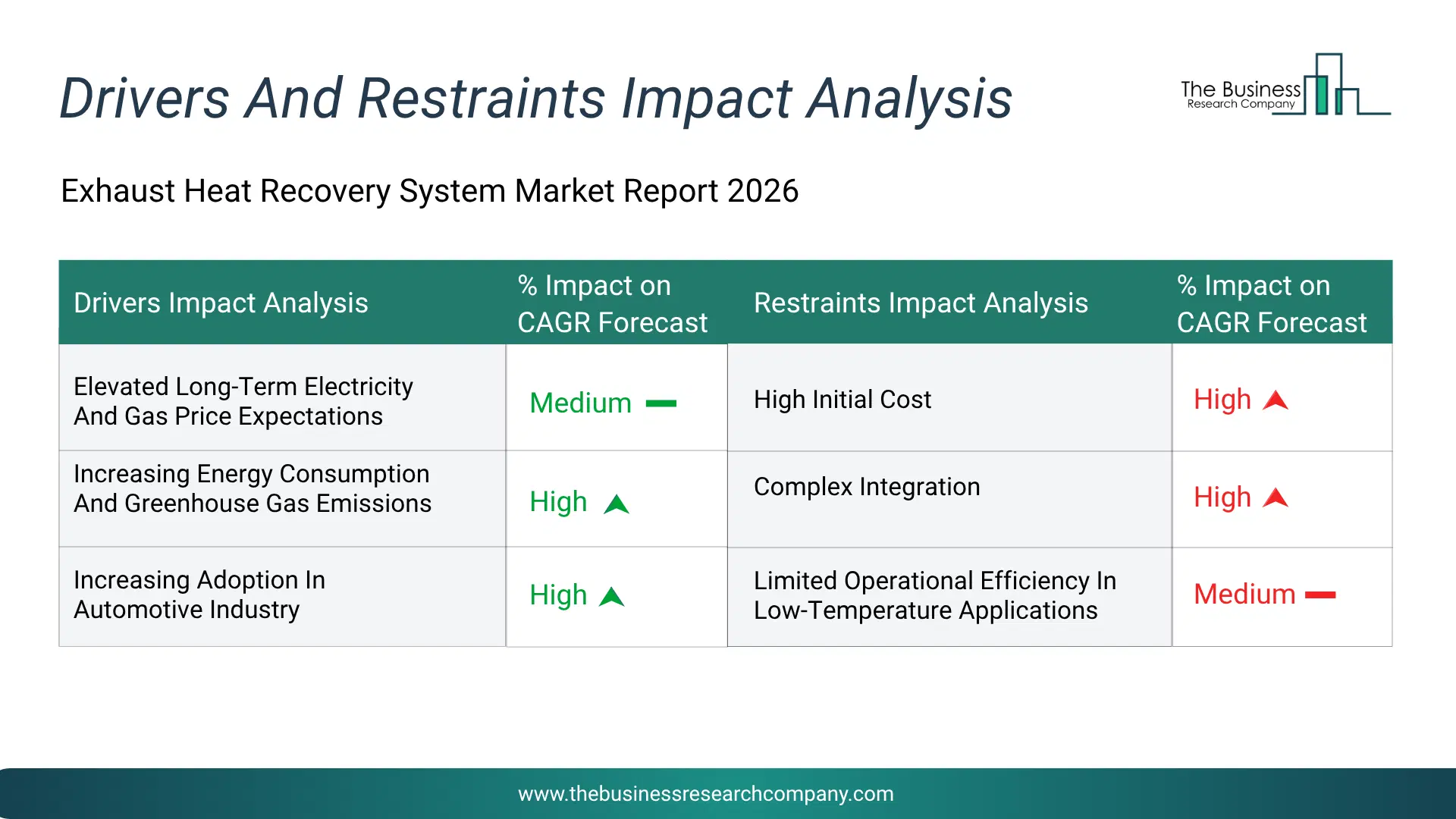
Infographic Chart Showing Key Market Drivers Analysis And Restraints For Exhaust Heat Recovery System Market
The chart presents an impact analysis of key drivers and restraints, quantifying their relative influence on the market's growth rate and helping assess the balance between growth enablers and limiting factors. This chart offers a high-level perspective; the full report contains more detailed insights.
How Will The Drivers Impact Growth In The Global Exhaust Heat Recovery System Market?
• Elevated Long-Term Electricity And Gas Price Expectations (Medium) – During the forecast period, the elevated long-term electricity and gas price expectations is expected to become a key growth driver for the exhaust heat recovery system market by 2030. One of the key drivers behind the adoption of exhaust heat recovery systems is the increasing cost of energy. As fuel and electricity prices continue to rise, industrial facilities and commercial establishments are seeking solutions to reduce overall energy expenditures. Exhaust heat recovery systems help address this challenge by capturing and reusing waste heat from exhaust gases that would otherwise be released into the atmosphere. By improving overall energy efficiency, these systems significantly lower operational costs and enhance long-term cost savings. • Increasing Energy Consumption And Greenhouse Gas Emissions (High) – During the forecast period, the increasing energy consumption and greenhouse gas emissions is expected to emerge as a major factor driving the expansion of the exhaust heat recovery system market by 2030. Rising energy consumption and growing greenhouse gas (ghg) emissions are major factors driving the exhaust heat recovery system (ehrs) market. With global energy demand increasing, industries and the automotive sector are under significant pressure to enhance fuel efficiency and minimize energy losses. Exhaust heat recovery systems address this need by capturing waste heat from engines and industrial operations and converting it into usable power or thermal energy, thereby improving overall system efficiency. This leads to reduced fuel usage and lower operating expenses. Furthermore, stringent environmental regulations and emission standards imposed by governments worldwide are encouraging the adoption of ehrs to help reduce carbon emissions and support sustainability goals. • Increasing Adoption In Automotive Industry (High) – During the forecast period, the increasing adoption in automotive industry is expected to act as a key growth catalyst for the exhaust heat recovery system market by 2030. The growing integration of exhaust heat recovery systems (ehrs) in the automotive sector is a significant driver of market growth, as manufacturers aim to improve fuel economy and lower emissions. Automakers are incorporating ehrs into conventional, hybrid, and electric vehicles to comply with strict environmental standards and advance sustainability objectives. These systems recover waste heat from exhaust gases and transform it into usable energy, enhancing overall vehicle efficiency and performance. As demand for fuel -efficient vehicles increases and the transition toward cleaner technologies accelerates, the adoption of ehrs continues to expand steadily.How Will The Restraints Impact Growth In The Global Exhaust Heat Recovery System Market?
• High Initial Cost (High) – During the forecast period, the one of the biggest hurdles in adopting an exhaust heat recovery system is the significant initial investment required. These systems use innovative technology and equipment to capture and utilize waste heat from exhaust fumes. The expenditures include the purchase and installation of components such as heat exchangers, pumps, and control systems. • Complex Integration (High) – During the forecast period, the integrating an ehrs into current industrial processes or heating systems can be complicated. The system must be carefully developed to fit into the existing configuration without disrupting activities. This entails not only technological changes but also meticulous planning to guarantee that the recovered heat is efficiently employed in the facility's processes. • Limited Operational Efficiency In Low-Temperature Applications (Medium) – During the forecast period, the exhaust heat recovery systems often face performance limitations when dealing with low-temperature exhaust streams, as the available thermal energy may not be sufficient for effective recovery and reuse. This reduces the overall efficiency and economic viability of the system in certain industrial and automotive applications. In such cases, the energy recovery output may not justify the operational and maintenance costs involved. As a result, end-users may hesitate to deploy these systems in processes where waste heat quality is inconsistent or relatively low-grade.Key Players In The Global Exhaust Heat Recovery System Market
Major companies operating in the exhaust heat recovery system market are MAHLE GmbH, Denso Corporation, Forvia Faurecia SE, Continental AG, Robert Bosch GmbH, Mitsubishi Heavy Industries,Ltd., Valeo SE, Tenneco Inc., Eberspächer Gruppe GmbH & Co. KG, Schaeffler AG, Marelli Holdings Co.,Ltd., Siemens AG, Bosal International N.V., Dana Incorporated, GE Vernova, IHI Corporation, Schneider Electric SE, Viessmann Group, Babcock & Wilcox, Senior Flexonics, EnviroKinetics,Inc., Exergy International SRL, GEA Group, Anguil Environmental Systems, Ormat Technologies,Inc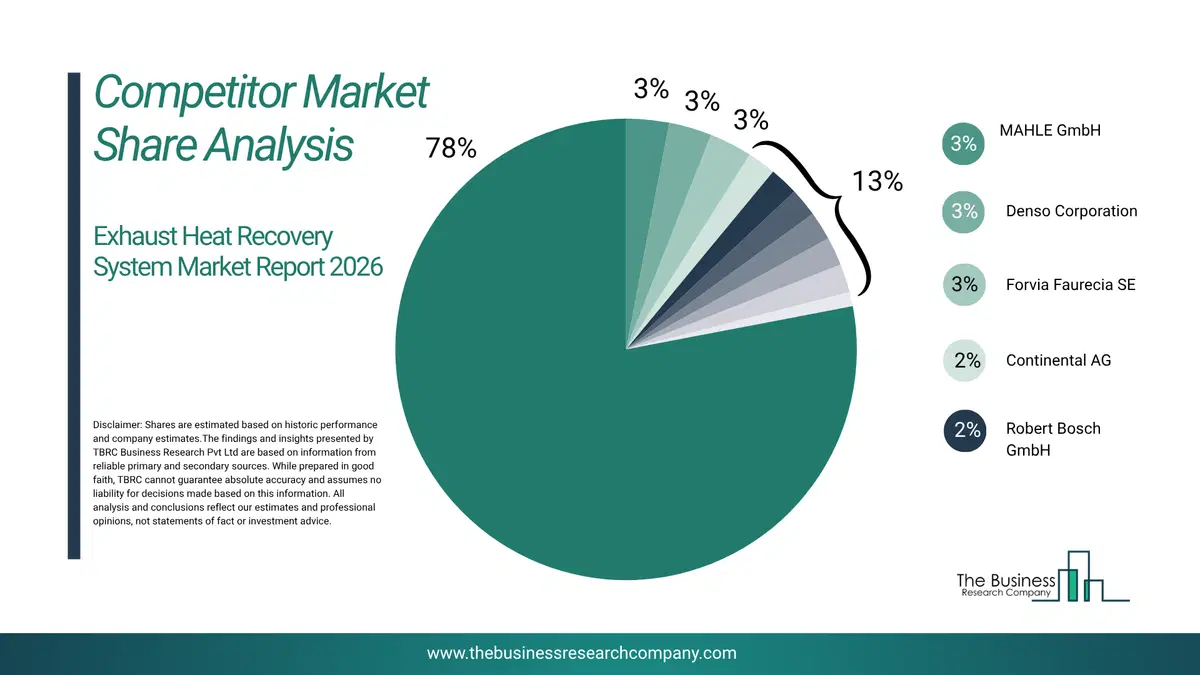
This chart is for illustrative purposes; the full report includes a detailed competitor analysis and comprehensive overview of the top 10 companies in the market.
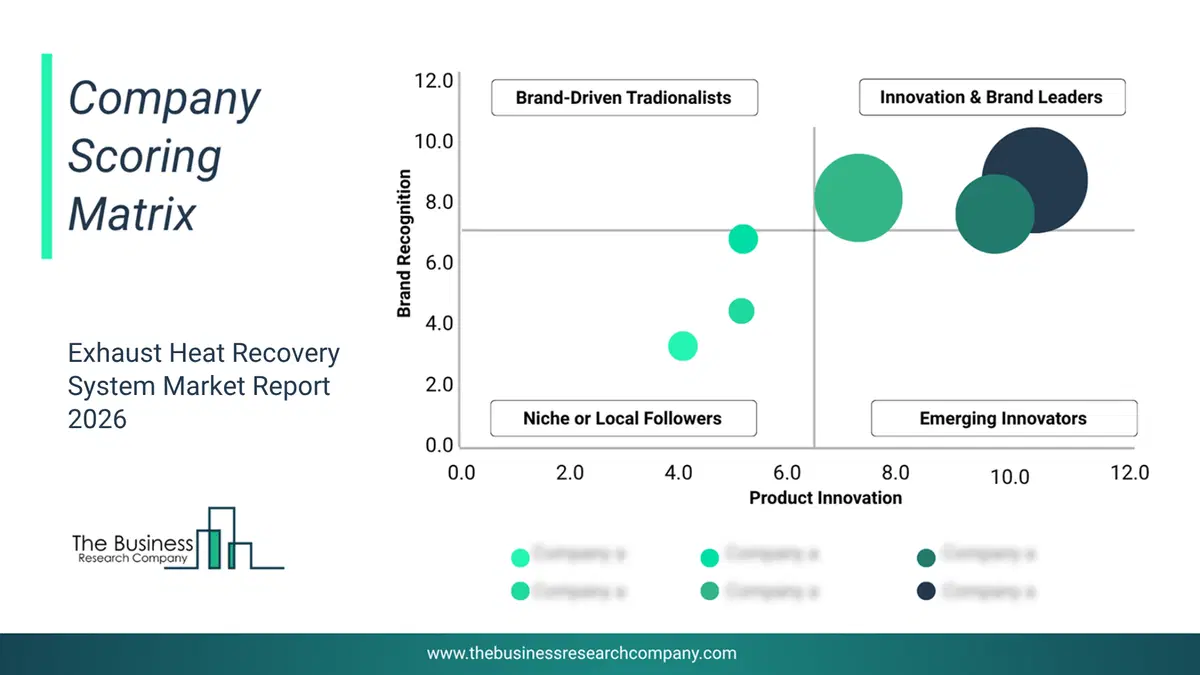
This chart maps companies by product innovation and brand strength, with bubble size indicating relative revenue, helping identify market leaders, challengers, and niche players. This is an illustrative chart; the full report provides a complete and accurate competitive analysis.
Global Exhaust Heat Recovery System Market Trends and Insights
Major companies operating in the exhaust heat recovery system market are focusing on leveraging government initiatives such as the electric program investment charge (EPIC) to enhance sustainable energy adoption and infrastructure development. The electric program investment charge (EPIC) is a government-funded initiative that supports research, development, and demonstration of innovative clean energy technologies to accelerate sustainable energy solutions and drive low-carbon advancements. For instance, in January 2025, the California Energy Commission (CEC), a US-based state government agency, developed a low-temperature waste heat recovery system at Searles Valley Minerals in Trona, California, capturing vented low-pressure steam to dry V-BOR and reduce natural gas use. The project also conserved water by recycling cold condensate through a storage tank, addressing critical water-resource needs. This system achieved a 15% reduction in natural gas consumption.What Are Latest Mergers And Acquisitions In The Exhaust Heat Recovery System Market?
In April 2024, Mutares SE & Co. KGaA, a Germany-based private equity holding company, acquired a majority stake in Sofinter Group for an undisclosed amount. With this acquisition, Mutares aims to strengthen its engineering and technology segment and create synergies in the industrial boiler and Heat Recovery Steam Generation (HRSG) market. Sofinter Group is an Italy-based industrial boiler manufacturing company specializing in exhaust heat recovery systems.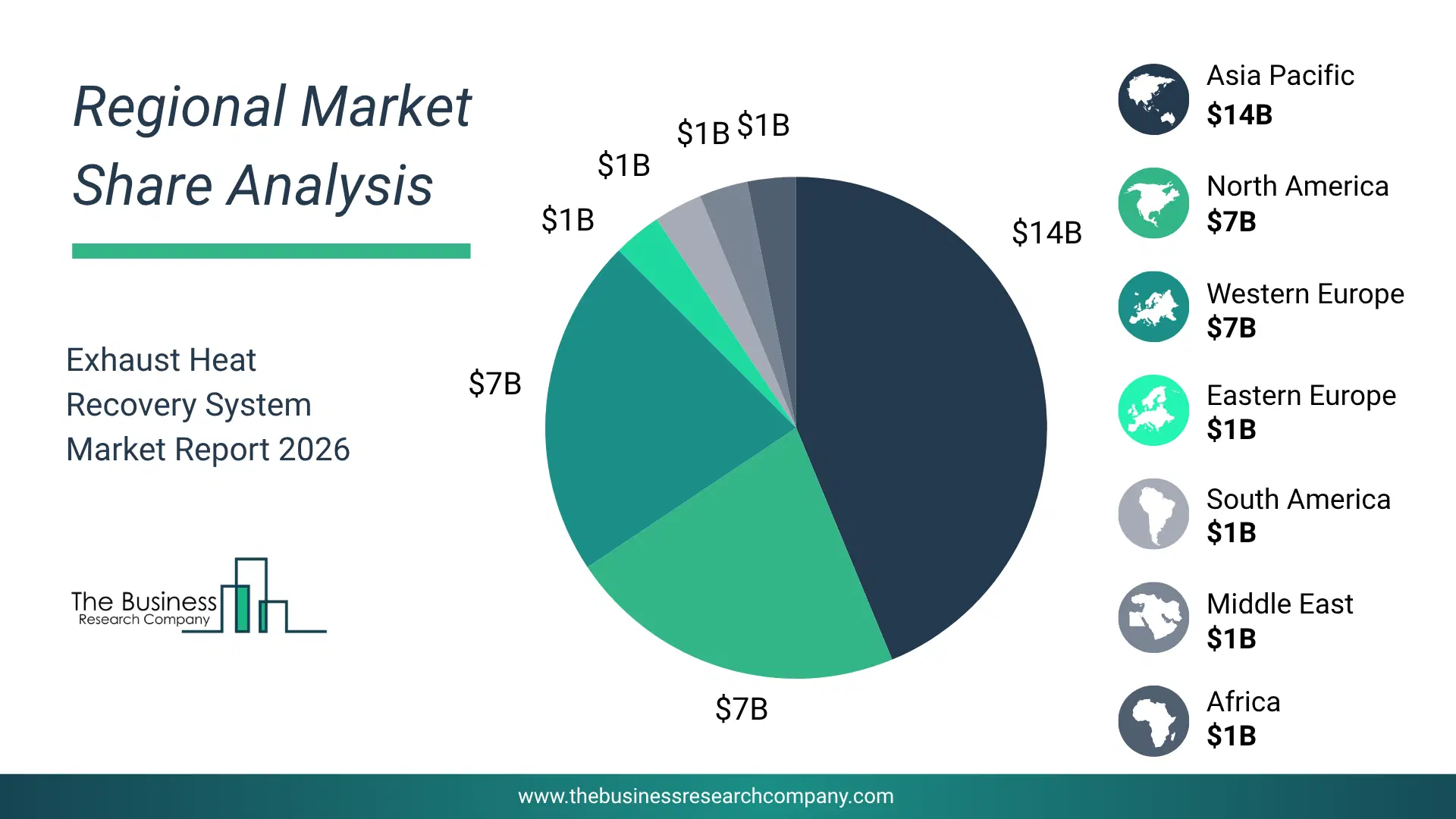
Regional Outlook
North America was the largest region in the exhaust heat recovery system market in 2025. Asia-Pacific is expected to be the fastest-growing region in the forecast period. The regions covered in this market report are Asia-Pacific, South East Asia, Western Europe, Eastern Europe, North America, South America, Middle East, Africa The countries covered in this market report are Australia, Brazil, China, France, Germany, India, Indonesia, Japan, Taiwan, Russia, South Korea, UK, USA, Canada, Italy, Spain.What Defines the Exhaust Heat Recovery System Market?
The exhaust heat recovery system market consists of sales of exhaust gas recirculation (EGR) coolers, thermoelectric generators, Rankine cycle waste heat recovery units, hybrid exhaust heat recovery modules, and after-treatment heat recovery systems. Values in this market are ‘factory gate’ values, that is, the value of goods sold by the manufacturers or creators of the goods, whether to other entities (including downstream manufacturers, wholesalers, distributors, and retailers) or directly to end customers. The value of goods in this market includes related services sold by the creators of the goods.How is Market Value Defined and Measured?
The market value is defined as the revenues that enterprises gain from the sale of goods and/or services within the specified market and geography through sales, grants, or donations in terms of the currency (in USD unless otherwise specified). The revenues for a specified geography are consumption values that are revenues generated by organizations in the specified geography within the market, irrespective of where they are produced. It does not include revenues from resales along the supply chain, either further along the supply chain or as part of other products.
This chart presents market attractiveness based on a quantitative evaluation of growth, competition, strategic alignment, and risk, offering a clear view of opportunity areas for decision-making. This chart is for illustrative purposes; the full report contains the complete analysis.

This chart highlights the Total Addressable Market (TAM) by estimating the maximum revenue opportunity using an assumption-driven approach, supporting strategic planning and opportunity sizing across markets. The chart is illustrative; the full report provides a more comprehensive analysis.
What Key Data and Analysis Are Included in the Exhaust Heat Recovery System Market Report 2026?
The exhaust heat recovery system market research report is one of a series of new reports from The Business Research Company that provides market statistics, including industry global market size, regional shares, competitors with the market share, detailed market segments, market trends and opportunities, and any further data you may need to thrive in the exhaust heat recovery system industry. The market research report delivers a complete perspective of everything you need, with an in-depth analysis of the current and future state of the industry.Exhaust Heat Recovery System Market Report Forecast Analysis
| Report Attribute | Details |
|---|---|
| Market Size Value In 2026 | $22.33 billion |
| Revenue Forecast In 2030 | $30.04 billion |
| Growth Rate | CAGR of 7.7% from 2026 to 2030 |
| Base Year For Estimation | 2025 |
| Actual Estimates/Historical Data | 2020-2025 |
| Forecast Period | 2026 - 2030 |
| Market Representation | Revenue in USD Billion and CAGR from 2026 to 2030 |
| Segments Covered | Type, Component, Vehicle Type, Application, End-User |
| Regional Scope | Asia-Pacific, Western Europe, Eastern Europe, North America, South America, Middle East, Africa |
| Country Scope | The countries covered in the report are Australia, Brazil, China, France, Germany, India, ... |
| Key Companies Profiled | MAHLE GmbH, Denso Corporation, Forvia Faurecia SE, Continental AG, Robert Bosch GmbH, Mitsubishi Heavy Industries,Ltd., Valeo SE, Tenneco Inc., Eberspächer Gruppe GmbH & Co. KG, Schaeffler AG, Marelli Holdings Co.,Ltd., Siemens AG, Bosal International N.V., Dana Incorporated, GE Vernova, IHI Corporation, Schneider Electric SE, Viessmann Group, Babcock & Wilcox, Senior Flexonics, EnviroKinetics,Inc., Exergy International SRL, GEA Group, Anguil Environmental Systems, Ormat Technologies,Inc |
| Customization Scope | Request for Customization |
| Pricing And Purchase Options | Explore Purchase Options |