
Extended Reality (XR) Hardware Market Report 2026
Global Outlook – By Solution ( Consumer Engagement, Business Engagement), By Application ( Virtual Reality (VR), Augmented Reality (AR), Mixed Reality (MR)), By End-User ( Education, Retail, Industrial And Manufacturing, Healthcare, Media And Entertainment, Other End-Users) – Market Size, Trends, Strategies, and Forecast to 2030
Extended Reality (XR) Hardware Market Overview
• Extended Reality (XR) Hardware market size has reached to $190.01 billion in 2025 • Expected to grow to $928.04 billion in 2030 at a compound annual growth rate (CAGR) of 36.4% • Growth Driver: Growth in the Video Gaming Sector Spurs Expansion of Extended Reality (XR) Hardware Market • Market Trend: Advancing Natural Sight Vision In XR Hardware For Enhanced Industrial Applications • North America was the largest region in 2025 and Asia-Pacific is the fastest growing region.What Is Covered Under Extended Reality (XR) Hardware Market?
Extended reality (XR) hardware refer to devices that aim to provide immersive experiences by combining real and virtual worlds, enhancing user interactions and perceptions. These devices aim to integrate digital content into the user's physical environment, enabling novel forms of interaction, visualization, and entertainment. The main solutions in the extended reality (XR) hardware are consumer engagement and business engagement. Consumer engagement refers to the emotional connection and level of involvement that a consumer has with a brand, product, or company. The various applications include virtual reality (VR), augmented reality (AR), and mixed reality (MR), and several end users including education, retail, industrial and manufacturing, healthcare, media and entertainment, and others.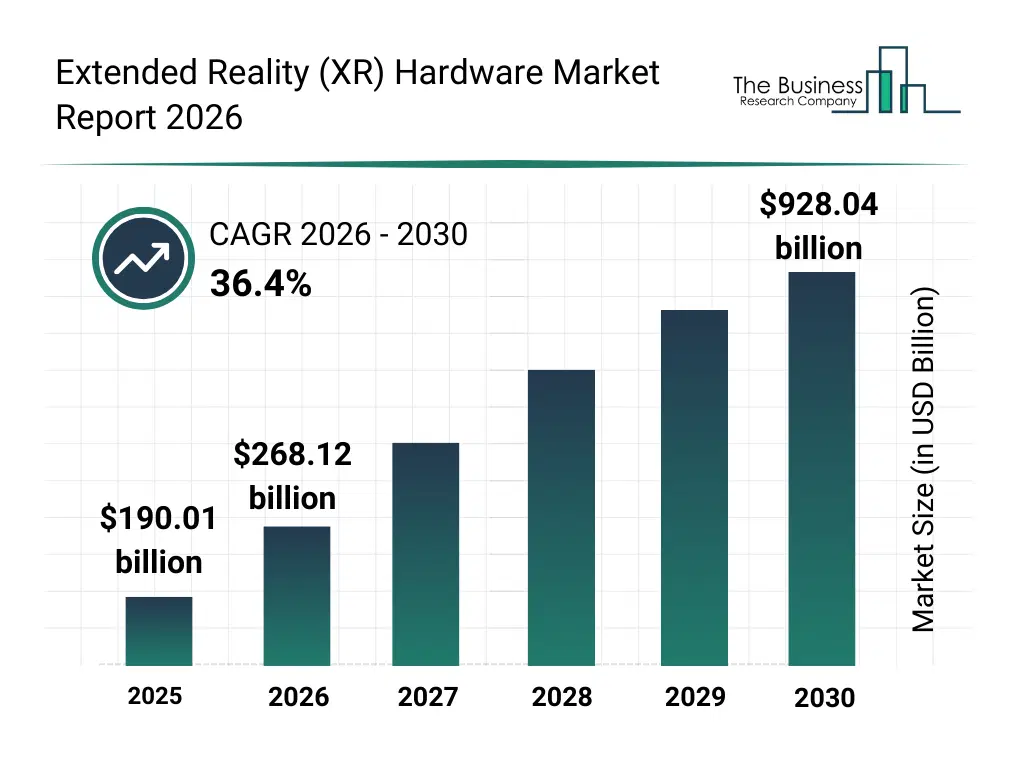
What Is The Extended Reality (XR) Hardware Market Size 2026 And Growth Rate?
The extended reality (xr) hardware market size has grown exponentially in recent years. It will grow from $190.01 billion in 2025 to $268.12 billion in 2026 at a compound annual growth rate (CAGR) of 41.1%. The growth in the historic period can be attributed to early adoption of vr gaming devices, advancements in display and optics technology, growth of digital content platforms, increased investment in immersive technologies, rising demand for interactive user experiences.What Is The Extended Reality (XR) Hardware Market Growth Forecast?
The extended reality (xr) hardware market size is expected to see exponential growth in the next few years. It will grow to $928.04 billion in 2030 at a compound annual growth rate (CAGR) of 36.4%. The growth in the forecast period can be attributed to expansion of metaverse related applications, growing enterprise demand for immersive training, advancements in spatial computing, rising adoption of mixed reality solutions, increased investments in xr hardware innovation. Major trends in the forecast period include growing adoption of xr headsets for consumer entertainment, increasing use of xr hardware in enterprise training programs, rising demand for lightweight and ergonomic xr devices, expansion of xr hardware in remote collaboration, growing integration of advanced sensors in xr devices.
Global Extended Reality (XR) Hardware Market Segmentation
1) By Solution: Consumer Engagement, Business Engagement 2) By Application: Virtual Reality (VR), Augmented Reality (AR), Mixed Reality (MR) 3) By End-User: Education, Retail, Industrial And Manufacturing, Healthcare, Media And Entertainment, Other End-Users Subsegments: 1) By Consumer Engagement: Gaming And Entertainment, Virtual Tours, Social Media Experiences, Retail And E-commerce, Education And E-learning 2) By Business Engagement: Employee Training And Development, Remote Collaboration, Product Design And Prototyping, Sales And Marketing, Customer Support And ServiceWhat Is The Driver Of The Extended Reality (XR) Hardware Market?
The expansion of the video gaming sector is expected to propel the growth of the extended reality (XR) hardware market going forward. The video gaming industry encompasses developing, marketing, and monetizing video games. The internet has revolutionized the gaming industry, enabling online multiplayer experiences, game streaming, and digital distribution platforms that have transformed business models and player engagement. Extended Reality (XR) hardware enhances the video gaming sector by providing immersive and interactive experiences, enabling realistic graphics and innovative game mechanics, and promoting social interaction and physical activity. For instance, in February 2024, according to the Entertainment Software Association, a US-based trade association, and Circana, a US-based media company, in US total video game sales reached $57.2 billion in 2023, rising from $56.6 billion in 2022. Additionally, spending on video game content increased to $48.0 billion from $47.5 billion, driven by a 13% rise in digital download spending on console platforms and an 11% increase in digital premium downloads on PC, cloud, and non-console VR platforms. Therefore, the expansion of the video gaming sector is driving the growth of the extended reality (XR) hardware industry.Key Players In The Global Extended Reality (XR) Hardware Market
Major companies operating in the extended reality (xr) hardware market are Apple Inc., Google LLC, Samsung Electronics Co. Ltd., Microsoft Corporation, Dell Technologies Inc., Sony Group Corporation, Lenovo Group Limited, Intel Corporation, Qualcomm Incorporated, ASUSTeK Computer Inc., Epson America Inc., Acer Inc., SoftServe Inc., Unity Software Inc., Dynabook Inc., Tata Elxsi, Magic Leap Inc., High Tech Computer Corporation (HTC), Varjo Technologies Oy, SphereGen Technologies LLC, Vuzix Corporation, Xreal Inc
This chart is for illustrative purposes; the full report includes a detailed competitor analysis and comprehensive overview of the top 10 companies in the market.
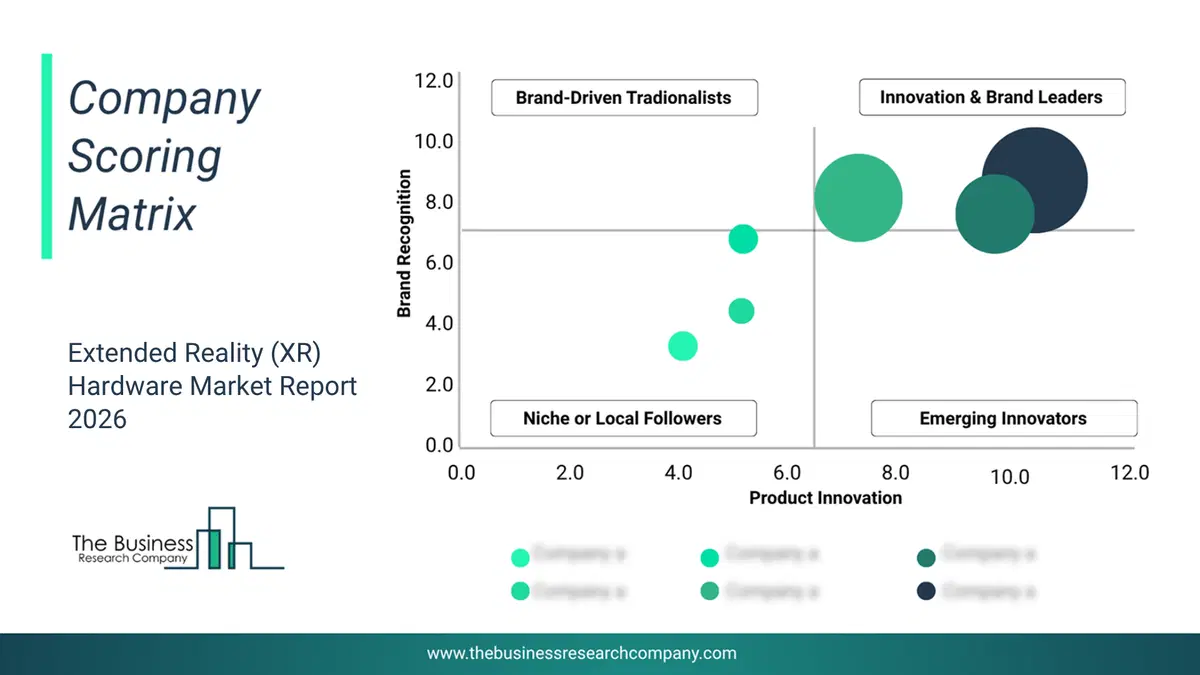
This chart maps companies by product innovation and brand strength, with bubble size indicating relative revenue, helping identify market leaders, challengers, and niche players. This is an illustrative chart; the full report provides a complete and accurate competitive analysis.
Global Extended Reality (XR) Hardware Market Trends and Insights
Major companies operating in the XR hardware market are developing innovative products with advanced technologies, such as natural sight vision technologies, to enhance the user experience in virtual and augmented environments. Natural sight vision technologies are focused on delivering higher resolution and better clarity, strengthening the XR experience's realism and immersion. For instance, in November 2023, Varjo, a Finland-based manufacturer of virtual reality, augmented reality, and mixed reality headsets launched the XR-4 series, including XR-4, XR-4 Focal Edition, and XR-4 Secure Edition, featuring high-resolution displays, foveated capture, advanced LiDAR depth sensing, and gaze-directed autofocus cameras. The XR-4 series aims to deliver mixed reality experiences nearly indistinguishable from natural sight, targeting industrial applications.What Are Latest Mergers And Acquisitions In The Extended Reality (XR) Hardware Market?
In January 2025, Google LLC, a US-based technology company, acquired HTC Corporation’s XR unit for $250 million. With this acquisition, Google LLC aims to strengthen its presence in the enterprise extended reality (XR) market, accelerate development of immersive hardware and software solutions, enhance its portfolio of virtual and augmented reality technologies, and expand its capabilities in next-generation enterprise applications. HTC Corporation’s XR unit, a Taiwan-based extended reality division, specializes in developing virtual reality (VR) and augmented reality (AR) hardware and software solutions.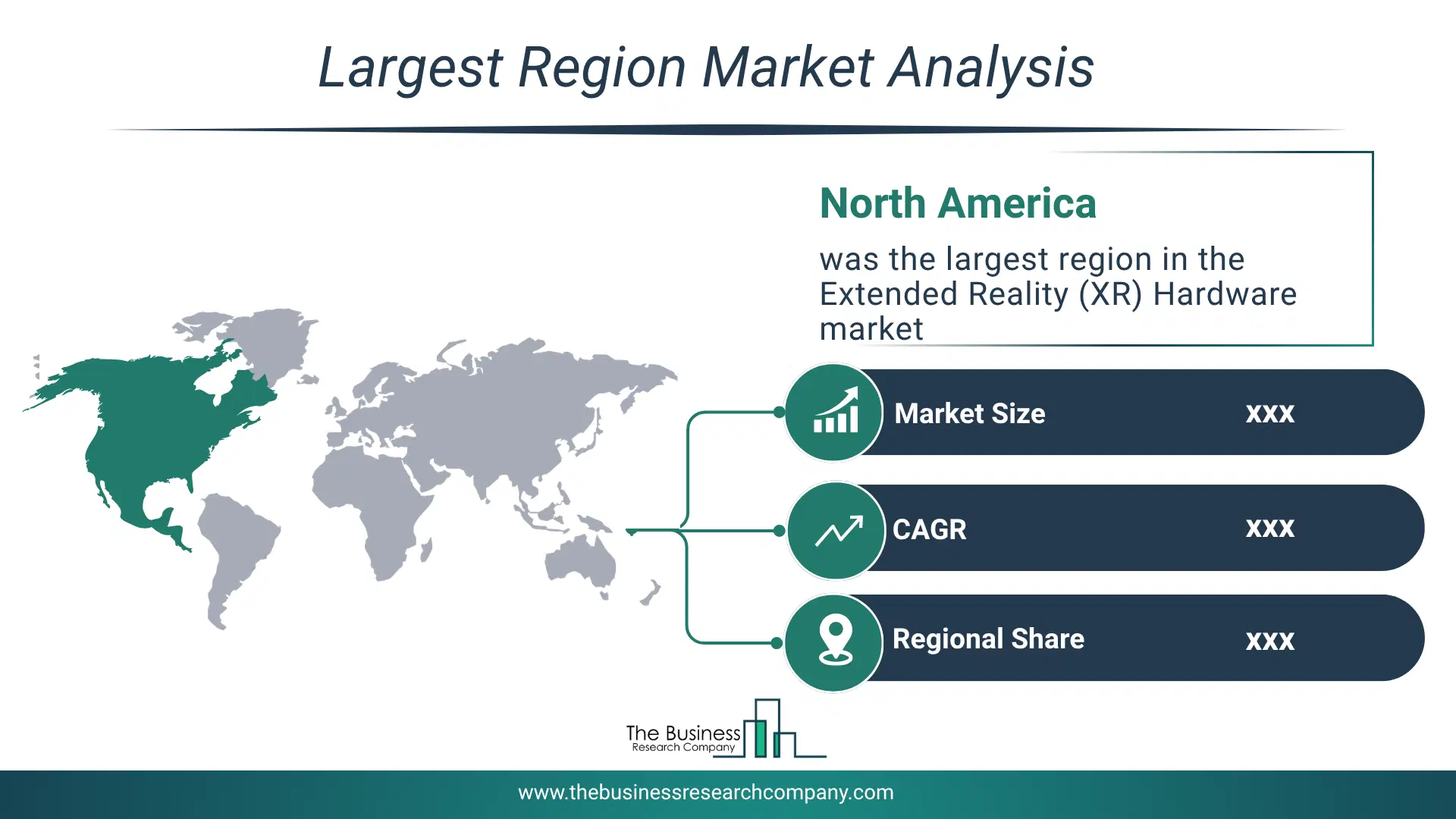
Regional Outlook
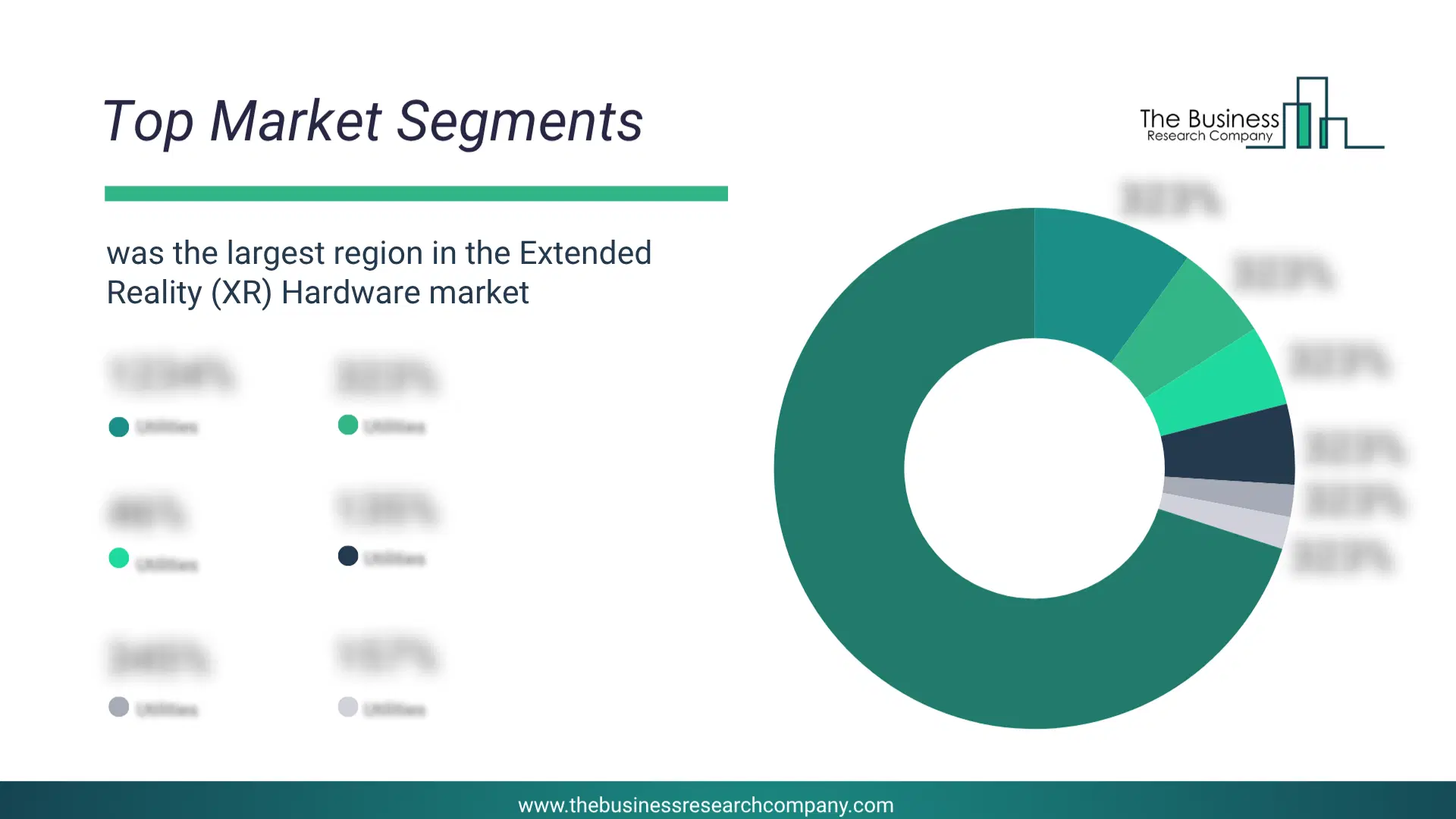
North America was the largest region in the extended reality (XR) hardware market in 2025. Asia-Pacific is expected to be the fastest-growing region in the forecast period. The regions covered in this market report are Asia-Pacific, South East Asia, Western Europe, Eastern Europe, North America, South America, Middle East, Africa. The countries covered in this market report are Australia, Brazil, China, France, Germany, India, Indonesia, Japan, Taiwan, Russia, South Korea, UK, USA, Canada, Italy, Spain.What Defines the Extended Reality (XR) Hardware Market?
The XR hardware market includes revenues earned by entities by providing services such as hardware and software sales, maintenance and support, training and education, leasing and rentals, research and development, and advertising and marketing. The market value includes the value of related goods sold by the service provider or included within the service offering. The XR hardware market also includes sales of products such as virtual reality (VR) headsets, augmented reality (AR) glasses, mixed reality devices, controllers, sensors, cameras, and associated accessories. Values in this market are ‘factory gate’ values, that is the value of goods sold by the manufacturers or creators of the goods, whether to other entities (including downstream manufacturers, wholesalers, distributors and retailers) or directly to end customers. The value of goods in this market includes related services sold by the creators of the goods.How is Market Value Defined and Measured?
The market value is defined as the revenues that enterprises gain from the sale of goods and/or services within the specified market and geography through sales, grants, or donations in terms of the currency (in USD unless otherwise specified). The revenues for a specified geography are consumption values that are revenues generated by organizations in the specified geography within the market, irrespective of where they are produced. It does not include revenues from resales along the supply chain, either further along the supply chain or as part of other products.
This chart presents market attractiveness based on a quantitative evaluation of growth, competition, strategic alignment, and risk, offering a clear view of opportunity areas for decision-making. This chart is for illustrative purposes; the full report contains the complete analysis.

This chart highlights the Total Addressable Market (TAM) by estimating the maximum revenue opportunity using an assumption-driven approach, supporting strategic planning and opportunity sizing across markets. The chart is illustrative; the full report provides a more comprehensive analysis.
What Key Data and Analysis Are Included in the Extended Reality (XR) Hardware Market Report 2026?
The extended reality (xr) hardware market research report is one of a series of new reports from The Business Research Company that provides market statistics, including industry global market size, regional shares, competitors with the market share, detailed market segments, market trends and opportunities, and any further data you may need to thrive in the extended reality (xr) hardware industry. The market research report delivers a complete perspective of everything you need, with an in-depth analysis of the current and future state of the industry.Extended Reality (XR) Hardware Market Report Forecast Analysis
| Report Attribute | Details |
|---|---|
| Market Size Value In 2026 | $268.12 billion |
| Revenue Forecast In 2030 | $928.04 billion |
| Growth Rate | CAGR of 36.4% from 2026 to 2030 |
| Base Year For Estimation | 2025 |
| Actual Estimates/Historical Data | 2020-2025 |
| Forecast Period | 2026 - 2030 |
| Market Representation | Revenue in USD Billion and CAGR from 2026 to 2030 |
| Segments Covered | Solution, Application, End-User |
| Regional Scope | Asia-Pacific, Western Europe, Eastern Europe, North America, South America, Middle East, Africa |
| Country Scope | The countries covered in the report are Australia, Brazil, China, France, Germany, India, Indonesia, Japan, Taiwan, Russia, South Korea, UK, USA, Canada, Italy, Spain. |
| Key Companies Profiled | Apple Inc., Google LLC, Samsung Electronics Co. Ltd., Microsoft Corporation, Dell Technologies Inc., Sony Group Corporation, Lenovo Group Limited, Intel Corporation, Qualcomm Incorporated, ASUSTeK Computer Inc., Epson America Inc., Acer Inc., SoftServe Inc., Unity Software Inc., Dynabook Inc., Tata Elxsi, Magic Leap Inc., High Tech Computer Corporation (HTC), Varjo Technologies Oy, SphereGen Technologies LLC, Vuzix Corporation, Xreal Inc |
| Customization Scope | Request for Customization |
| Pricing And Purchase Options | Explore Purchase Options |