
Extraterrestrial Biodiversity Study Market Report 2026
Global Outlook – By Research Method (Remote Sensing, Space Missions, Laboratory Simulations), By Organism Type (Microbial Life, Plant Life, Animal Life), By Study Focus (Astrobiology, Exoplanetary Ecosystems, Space Ecology) – Market Size, Trends, Strategies, and Forecast to 2030
Extraterrestrial Biodiversity Study Market Overview
• Extraterrestrial Biodiversity Study market size has reached to $1.84 billion in 2025 • Expected to grow to $3.19 billion in 2030 at a compound annual growth rate (CAGR) of 11.7% • Growth Driver: Increasing Space Exploration Missions Fuel Market Growth Due To Growing Scientific Curiosity And The Need For Advanced Space Technologies • North America was the largest region in 2025 and Asia-Pacific is the fastest growing region.What Is Covered Under Extraterrestrial Biodiversity Study Market?
Extraterrestrial biodiversity study refers to the scientific investigation of the potential existence, forms, and distribution of life beyond Earth, including microbial organisms, complex life forms, and ecosystems that may exist on other planets, moons, or celestial bodies. This field combines astrobiology, planetary science, and environmental modeling to understand how life might originate, evolve, and survive in extreme extraterrestrial environments, guiding future space exploration and the search for life in the universe. The main research methods in the extraterrestrial biodiversity study are remote sensing, space missions, and laboratory simulations. Remote sensing is the process of collecting information about an object or area from a distance, typically using satellites or aircraft-based sensors. The multiple organism types include microbial life, plant life, and animal life, and the study focuses on astrobiology, exoplanetary ecosystems, and space ecology.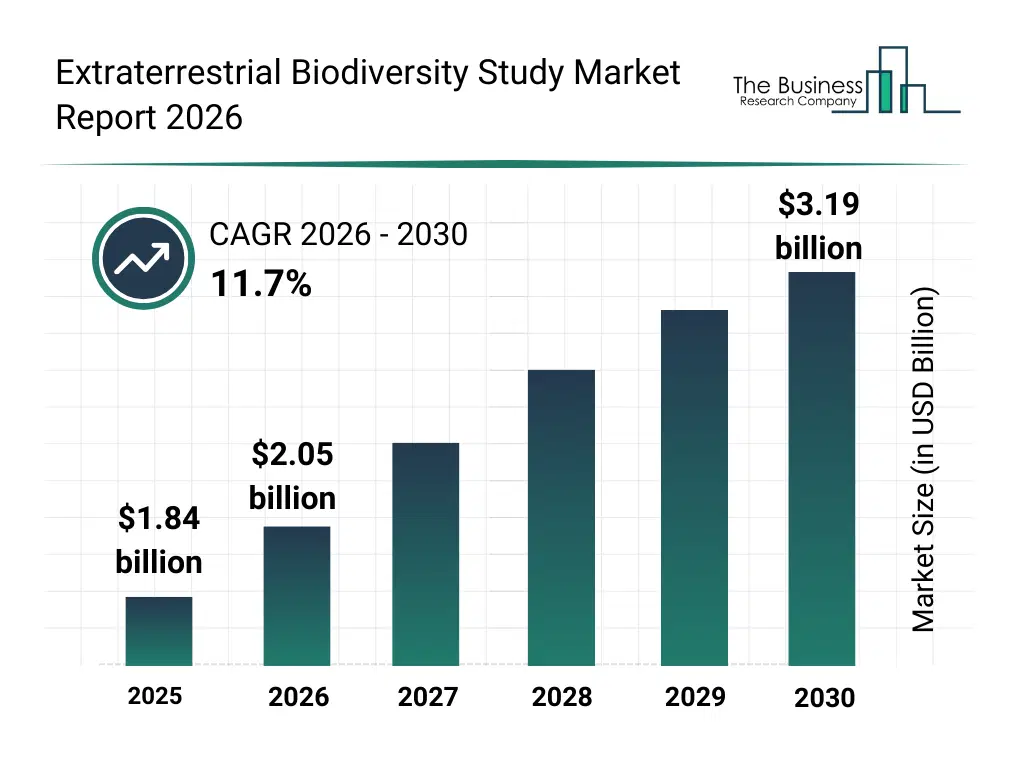
What Is The Extraterrestrial Biodiversity Study Market Size and Share 2026?
The extraterrestrial biodiversity study market size has grown rapidly in recent years. It will grow from $1.84 billion in 2025 to $2.05 billion in 2026 at a compound annual growth rate (CAGR) of 11.4%. The growth in the historic period can be attributed to advancements in planetary science missions enabling collection of environmental and chemical data from extraterrestrial bodies, development of bioinformatics and genetic sequencing tools supporting analysis of potential biosignatures, increasing use of environmental monitoring instruments on space probes to assess habitability conditions, early adoption of data analysis and modeling platforms to simulate extraterrestrial life scenarios, expansion of planetary protection protocols driving demand for contamination control services.What Is The Extraterrestrial Biodiversity Study Market Growth Forecast?
The extraterrestrial biodiversity study market size is expected to see rapid growth in the next few years. It will grow to $3.19 billion in 2030 at a compound annual growth rate (CAGR) of 11.7%. The growth in the forecast period can be attributed to growing investment in missions targeting icy moons and mars for potential biological sampling, rising need for advanced modeling tools to interpret complex extraterrestrial environmental datasets, increasing development of specialized sample collection and preservation technologies for future return missions, expansion of genetic and biochemical detection systems aimed at identifying non-terrestrial life forms, development of integrated astrobiology research platforms combining remote sensing, simulation, and laboratory experimentation. Major trends in the forecast period include intensifying planetary protection and contamination control protocols, shift toward multi-mission, long-duration astrobiology programs, growing collaboration among space agencies, academia, and private space firms, increasing emphasis on analog environment field campaigns (mars, polar, deep-sea), emergence of standardized extraterrestrial biosignature detection frameworks.
Global Extraterrestrial Biodiversity Study Market Segmentation
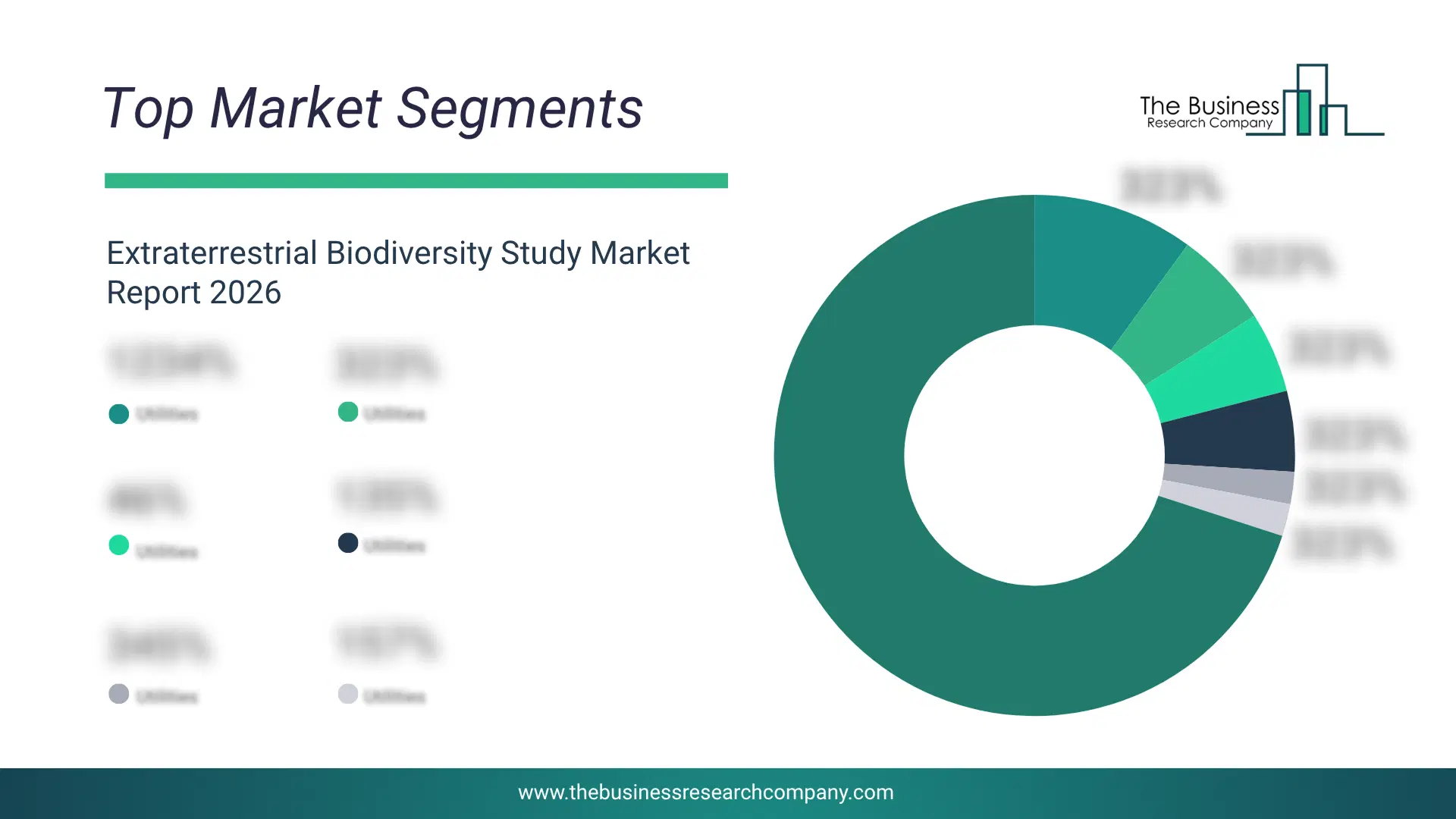
1) By Research Method: Remote Sensing, Space Missions, Laboratory Simulations 2) By Organism Type: Microbial Life, Plant Life, Animal Life 3) By Study Focus: Astrobiology, Exoplanetary Ecosystems, Space Ecology Subsegments: 1) By Remote Sensing: Satellite-Based Imaging, Spectral Analysis, Thermal Mapping, Radar And Lidar Sensing, Hyperspectral Remote Sensing 2) By Space Missions: Robotic Missions, Crewed Missions, Orbital Platforms, Lander And Rover Missions, Sample Return Missions 3) By Laboratory Simulations: Simulated Martian Environment, Vacuum Chamber Testing, Radiation Exposure Experiments, Cryogenic Life Survival Studies, Simulated Planetary Soil ExperimentsWhat Is Driver Of The Extraterrestrial Biodiversity Study Market?
The supportive government policies and funding initiatives are expected to propel the extraterrestrial biodiversity study market going forward. The government policies and funding initiatives refer to actions taken by governments to encourage or assist specific sectors, industries, or goals through favorable laws, regulations, programs, or financial support. The rise of supportive government policy frameworks is due to the need to create a regulated and collaborative environment that facilitates safe, responsible, and innovative space exploration efforts. Government policies and initiatives support extraterrestrial biodiversity by promoting responsible space exploration, planetary protection, and contamination prevention protocols. For instance, in October 2024, according to the Organisation for Economic Co-operation and Development, a France-based intergovernmental organization, the Australian International Space Investment program provides $10 million to support strategic space projects that expand the Australian space industry and foster international collaboration in the space sector. Therefore, the supportive government policies and funding are driving the growth of the extraterrestrial biodiversity study industry.Key Players In The Global Extraterrestrial Biodiversity Study Market
Major companies operating in the extraterrestrial biodiversity study market are Northrop Grumman Corporation, Maxar Technologies Holdings Inc., European Space Agency (ESA), OroraTech GmbH, Max Planck Institute For Astronomy, Paragon Space Development Corporation, Seti Institute, Space Tango LLC, Eco Astronomy Inc., SpaceBorn United, Blue Marble Space Institute of Science, NASA Astrobiology Institute, Carl Sagan Institute.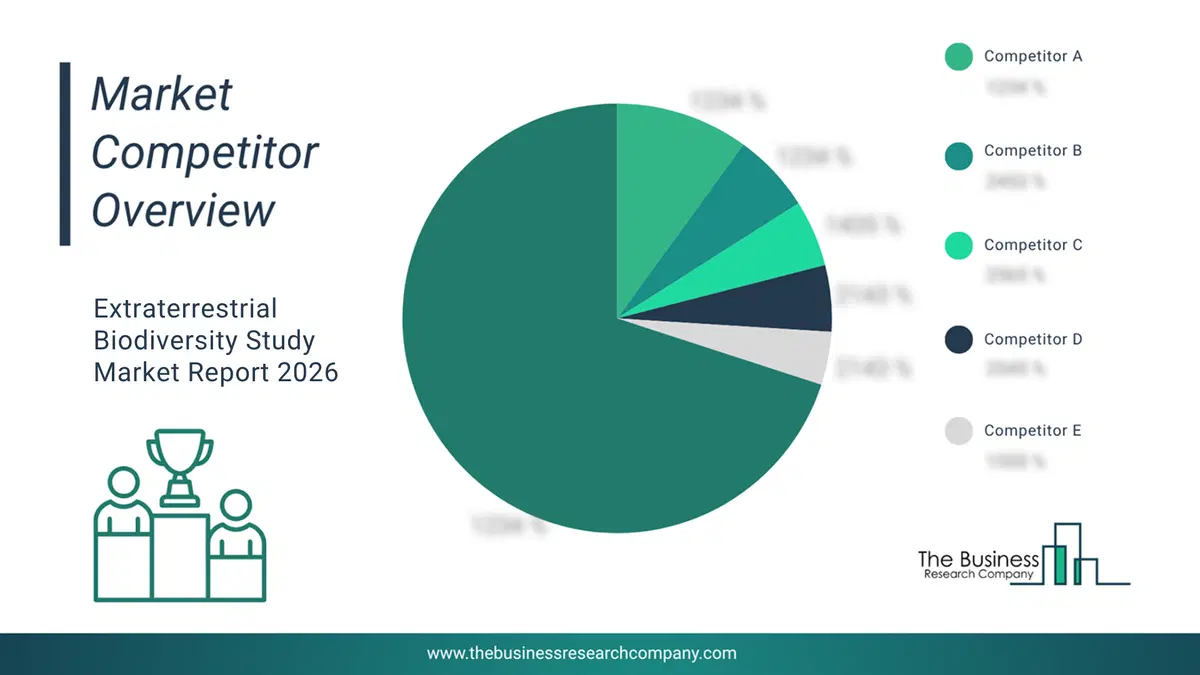
This chart is for illustrative purposes; the full report includes a detailed competitor analysis and comprehensive overview of the top 10 companies in the market.
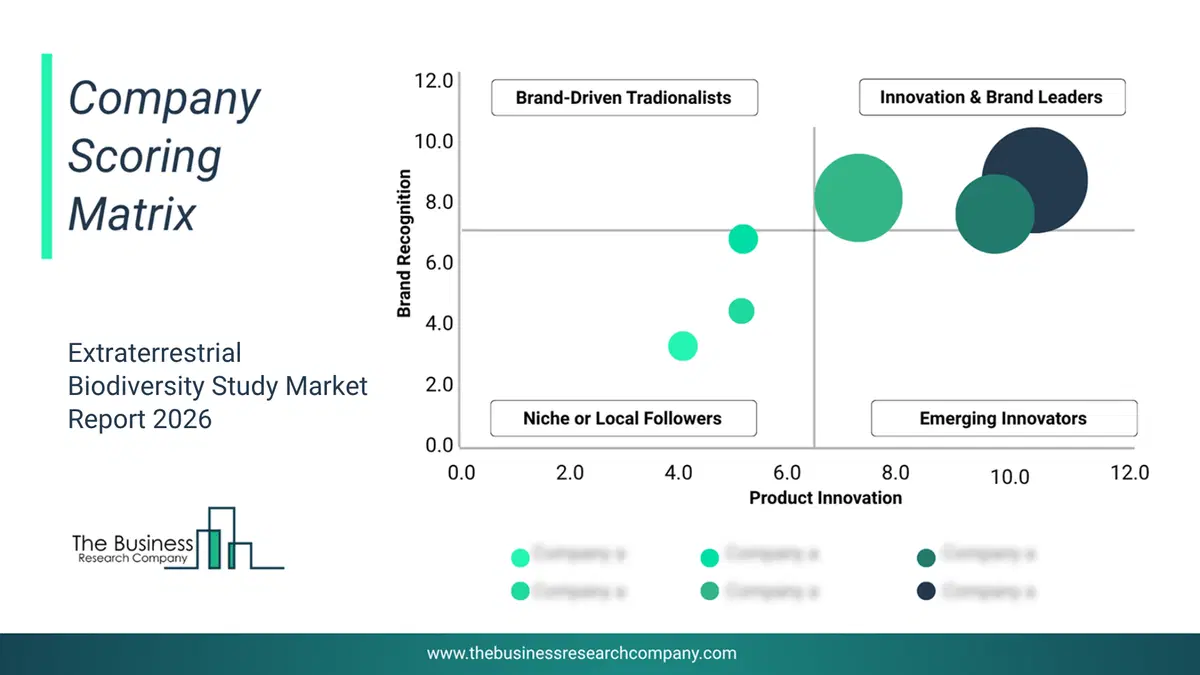
This chart maps companies by product innovation and brand strength, with bubble size indicating relative revenue, helping identify market leaders, challengers, and niche players. This is an illustrative chart; the full report provides a complete and accurate competitive analysis.
Regional Insights
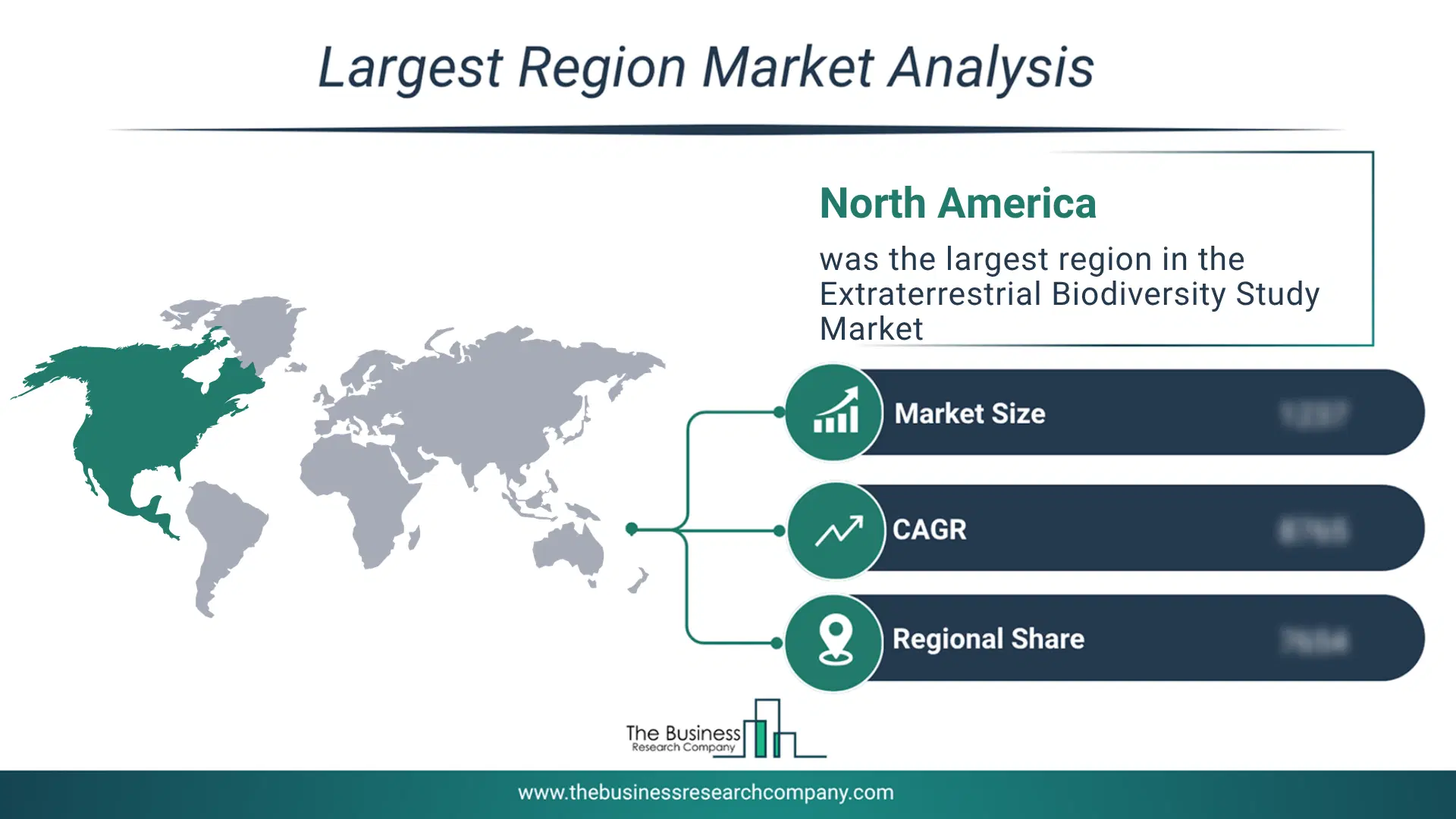
North America was the largest region in the extraterrestrial biodiversity study market in 2025. Asia-Pacific is expected to be the fastest-growing region in the forecast period. The regions covered in this market report are Asia-Pacific, South East Asia, Western Europe, Eastern Europe, North America, South America, Middle East, Africa. The countries covered in this market report are Australia, Brazil, China, France, Germany, India, Indonesia, Japan, Taiwan, Russia, South Korea, UK, USA, Canada, Italy, SpainWhat Defines the Extraterrestrial Biodiversity Study Market?
The extraterrestrial biodiversity study market consists of revenues earned by entities by providing services such as data analysis and modeling, sample collection and preservation, bioinformatics and genetic sequencing, environmental monitoring, and planetary protection and contamination control. The market value includes the value of related goods sold by the service provider or included within the service offering. Only goods and services traded between entities or sold to end consumers are included.How is Market Value Defined and Measured?
The market value is defined as the revenues that enterprises gain from the sale of goods and/or services within the specified market and geography through sales, grants, or donations in terms of the currency (in USD unless otherwise specified). The revenues for a specified geography are consumption values that are revenues generated by organizations in the specified geography within the market, irrespective of where they are produced. It does not include revenues from resales along the supply chain, either further along the supply chain or as part of other products.
This chart presents market attractiveness based on a quantitative evaluation of growth, competition, strategic alignment, and risk, offering a clear view of opportunity areas for decision-making. This chart is for illustrative purposes; the full report contains the complete analysis.

This chart highlights the Total Addressable Market (TAM) by estimating the maximum revenue opportunity using an assumption-driven approach, supporting strategic planning and opportunity sizing across markets. The chart is illustrative; the full report provides a more comprehensive analysis.
What Key Data and Analysis Are Included in the Extraterrestrial Biodiversity Study Market Report 2026?
The extraterrestrial biodiversity study market research report is one of a series of new reports from The Business Research Company that provides market statistics, including industry global market size, regional shares, competitors with the market share, detailed market segments, market trends and opportunities, and any further data you may need to thrive in the extraterrestrial biodiversity study industry. The market research report delivers a complete perspective of everything you need, with an in-depth analysis of the current and future state of the industry.Extraterrestrial Biodiversity Study Market Report Forecast Analysis
| Report Attribute | Details |
|---|---|
| Market Size Value In 2026 | $2.05 billion |
| Revenue Forecast In 2030 | $3.19 billion |
| Growth Rate | CAGR of 11.7% from 2026 to 2030 |
| Base Year For Estimation | 2025 |
| Actual Estimates/Historical Data | 2020-2025 |
| Forecast Period | 2026 - 2030 |
| Market Representation | Revenue in USD Billion and CAGR from 2026 to 2030 |
| Segments Covered | Research Method, Organism Type, Study Focus |
| Regional Scope | Asia-Pacific, Western Europe, Eastern Europe, North America, South America, Middle East, Africa |
| Country Scope | The countries covered in the extraterrestrial biodiversity study market report are Australia, Brazil, China, France, Germany, India, Indonesia, Japan, Taiwan, Russia, South Korea, UK, USA, Canada, Italy, Spain |
| Key Companies Profiled | Northrop Grumman Corporation, Maxar Technologies Holdings Inc., European Space Agency (ESA), OroraTech GmbH, Max Planck Institute For Astronomy, Paragon Space Development Corporation, Seti Institute, Space Tango LLC, Eco Astronomy Inc., SpaceBorn United, Blue Marble Space Institute of Science, NASA Astrobiology Institute, Carl Sagan Institute. |
| Customization Scope | Request for Customization |
| Pricing And Purchase Options | Explore Purchase Options |