
Factory Automation Sensor Market Report 2026
Global Outlook – By Sensors Type ( Temperature Sensors, Vibration Sensors, Humidity Sensors, Proximity Sensors, Pressure Sensors, Vision Sensors, Other Sensor Types), By Type ( Contact, Noncontact), By Application ( Manufacturing, Automotive, Chemicals, Energy And Power, Food And Beverages, Oil And Gas, Aerospace And Defense, Pharmaceuticals, Other Applications) – Market Size, Trends, Strategies, and Forecast to 2030
Factory Automation Sensor Market Overview
• Factory Automation Sensor market size has reached to $17.6 billion in 2025 • Expected to grow to $24.04 billion in 2030 at a compound annual growth rate (CAGR) of 6.2% • Growth Driver: Rise Of Smart Factories And The Factory Automation Sensor Market • Market Trend: Advanced Radar-Level Sensor For Hygienic Factory Automation • North America was the largest region in 2025 and Asia-Pacific is the fastest growing region.What Is Covered Under Factory Automation Sensor Market?
Factory automation sensors are devices used in industrial settings to detect, measure, analyze, and control various parameters and conditions within a manufacturing environment. These sensors are used in automating processes by gathering data about physical variables such as temperature, pressure, position, proximity, flow, level, and presence of objects. The main types of factory automation sensors are temperature sensors, vibration sensors, humidity sensors, proximity sensors, pressure sensors, vision sensors, and others. Temperature sensors are devices used to measure temperature variations in a specific environment and various applications such as weather monitoring, industrial processes, HVAC systems, medical devices, and consumer electronics to ensure proper temperature regulation. They are categorized into contact and noncontact types for use in several applications such as manufacturing, automotive, chemicals, energy and power, food and beverages, oil and gas, aerospace and defense, pharmaceuticals, and others.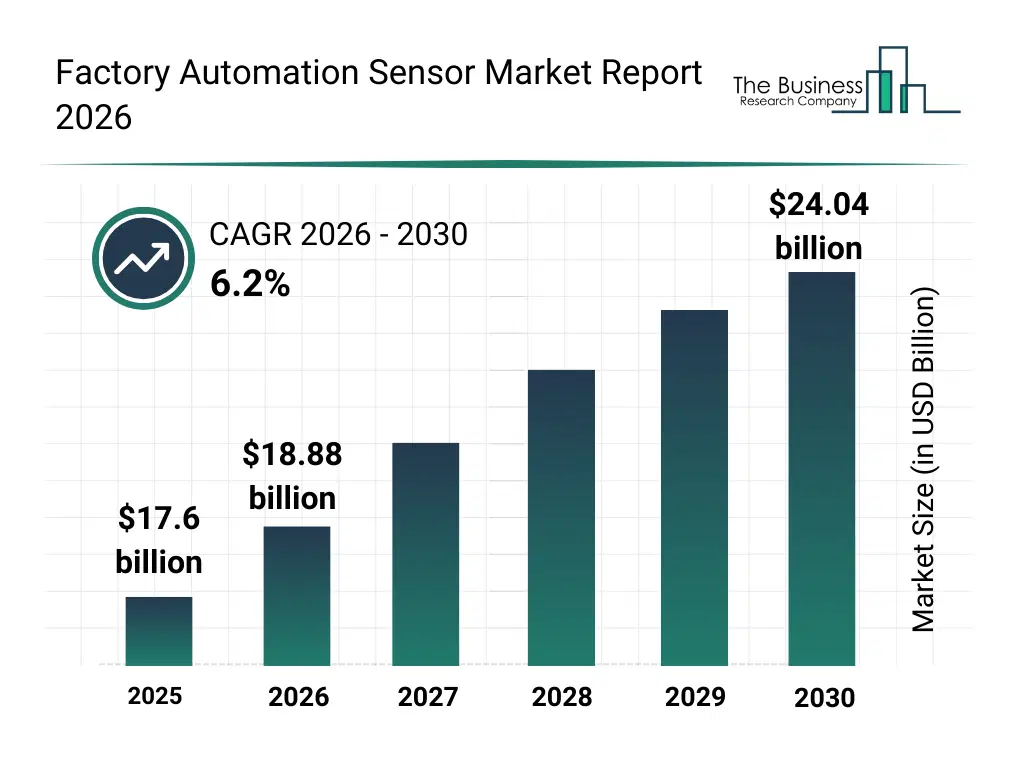
What Is The Factory Automation Sensor Market Size 2026 And Growth Rate?
The factory automation sensor market size has grown strongly in recent years. It will grow from $17.6 billion in 2025 to $18.88 billion in 2026 at a compound annual growth rate (CAGR) of 7.2%. The growth in the historic period can be attributed to early adoption of industrial automation, rising need for process optimization, growing use of sensors in manufacturing lines, increased focus on workplace safety monitoring, expansion of robotics in factories.What Is The Factory Automation Sensor Market Growth Forecast?
The factory automation sensor market size is expected to see strong growth in the next few years. It will grow to $24.04 billion in 2030 at a compound annual growth rate (CAGR) of 6.2%. The growth in the forecast period can be attributed to increasing demand for smart factories, rising shift toward real time data driven operations, growing integration of AI enabled sensors, expansion of remote monitoring systems, increasing focus on energy efficient automation. Major trends in the forecast period include increasing deployment of smart sensing technologies, growing demand for predictive maintenance solutions, rising adoption of high precision sensors, expansion of automated quality inspection systems, increasing integration of multi sensor platforms.
Global Factory Automation Sensor Market Segmentation
1) By Sensors Type: Temperature Sensors, Vibration Sensors, Humidity Sensors, Proximity Sensors, Pressure Sensors, Vision Sensors, Other Sensor Types 2) By Type: Contact, Noncontact 3) By Application: Manufacturing, Automotive, Chemicals, Energy And Power, Food And Beverages, Oil And Gas, Aerospace And Defense, Pharmaceuticals, Other Applications Subsegments: 1) By Temperature Sensors: RTD Sensors (Resistance Temperature Detectors), Thermocouples, Infrared Temperature Sensors 2) By Vibration Sensors: Accelerometers, Displacement Sensors, Velocity Sensors 3) By Humidity Sensors: Capacitive Humidity Sensors, Resistive Humidity Sensors, Thermal Conductivity Sensors 4) By Proximity Sensors: Inductive Proximity Sensors, Capacitive Proximity Sensors, Ultrasonic Proximity Sensors 5) By Pressure Sensors: Piezoelectric Pressure Sensors, Strain Gauge Pressure Sensors, Capacitive Pressure Sensors 6) By Vision Sensors: Machine Vision Sensors, Optical Sensors, Image Processing Sensors 7) By Other Sensor Types: Flow Sensors, Gas Sensors, Level SensorsWhat Is The Driver Of The Factory Automation Sensor Market?
The increasing demand for smart factories is expected to propel the growth of the factory automation sensor market going forward. Smart factories are manufacturing facilities integrating advanced technologies such as IoT, AI, and automation to optimize production processes. The demand for smart factories arises from increased efficiency, flexibility, and competitiveness in manufacturing, driven by the potential to optimize operations, reduce costs, and improve product quality by integrating advanced technologies such as automation, data analytics, and connectivity. Smart factories use factory automation sensors to collect real-time data on machinery performance, production processes, and environmental conditions, enabling proactive monitoring, predictive maintenance, and optimization of manufacturing operations for increased efficiency, productivity, and quality control. For instance, in June 2025, according to a survey conducted by Rockwell Automation, Inc., a US-based industrial automation company, 95% of manufacturers have invested in, or plan to invest in, artificial intelligence and machine learning (AI/ML) over the next five years to navigate uncertainty and accelerate smart manufacturing. Moreover, 81% of manufacturers stated that external and internal pressures are driving faster digital transformation, while 49% plan to deploy AI for cybersecurity in 2025, compared to 40% in 2024. Therefore, increasing demand for smart factories is driving the growth of the factory automation sensor industry.Key Players In The Global Factory Automation Sensor Market
Major companies operating in the factory automation sensor market are Robert Bosch GmbH, Siemens AG, Sony Corporation, Panasonic Corporation, Schneider Electric SE, Honeywell International Inc., ABB Ltd., STMicroelectronics N.V., Infineon Technologies AG, TDK Electronics Co. Ltd., Murata Manufacturing Co. Ltd., TE Connectivity Ltd., Amphenol Corporation, Analog Devices Inc., Seiko Epson Corporation, Alps Electric Co. Ltd., Rockwell Automation Inc., Microchip Technology Inc., Omron Corporation, FANUC Corporation, Texas Instruments Incorporated, Vishay Intertechnology Inc., Stäubli International AG, Pepperl+Fuchs SE, Sensirion AG
This chart is for illustrative purposes; the full report includes a detailed competitor analysis and comprehensive overview of the top 10 companies in the market.
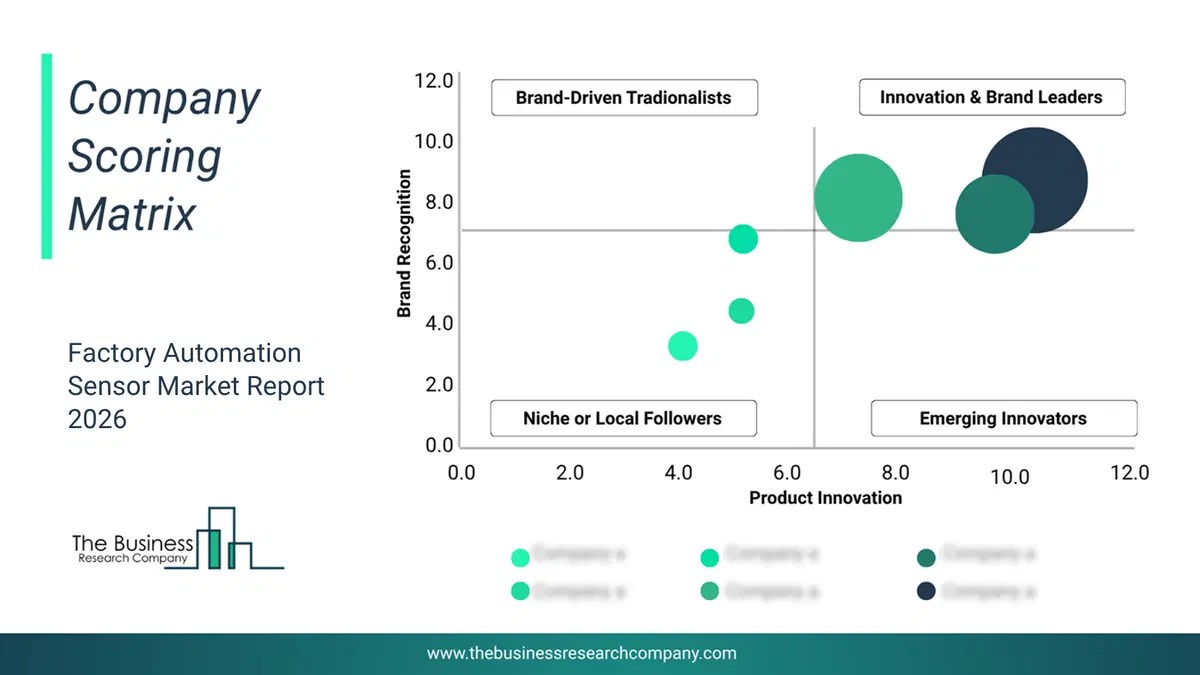
This chart maps companies by product innovation and brand strength, with bubble size indicating relative revenue, helping identify market leaders, challengers, and niche players. This is an illustrative chart; the full report provides a complete and accurate competitive analysis.
Global Factory Automation Sensor Market Trends and Insights
Major companies operating in the factory automation sensor market are focusing on innovation in sensor technologies such as radar-level sensor technology designed for highly automated processes with stringent demands on hygiene. Radar-level sensors are versatile and reliable, providing high accuracy, reliability, and low maintenance with no moving parts. They are ideal for a wide range of industrial and commercial-level measurement applications. In March 2023, VEGA Grieshaber KG, a Germany-based manufacturing company, launched a new radar-level sensor technology, VEGAPULS 42. It is designed for non-contact level measurement in factory automation, particularly in food and pharmaceutical applications. The sensor is equipped with IO-Link and versatile hygienic adapters, meeting the key requirements of factory automation, which include performing complex measuring tasks faster, being simple to use, and being more cost-effective.What Are Latest Mergers And Acquisitions In The Factory Automation Sensor Market?
In November 2023, YAGEO Corporation, a Taiwan-based electronic component manufacturing company, acquired Telemecanique Sensors for an undisclosed amount. This acquisition is part of YAGEO's strategic focus on the premium segment and aims to broaden the high-end product portfolio as a premium component solution provider. Telemecanique Sensors is a France-based factory automation sensor manufacturer specializing in designing, developing, and delivering mission-critical electromechanical and electronic sensors.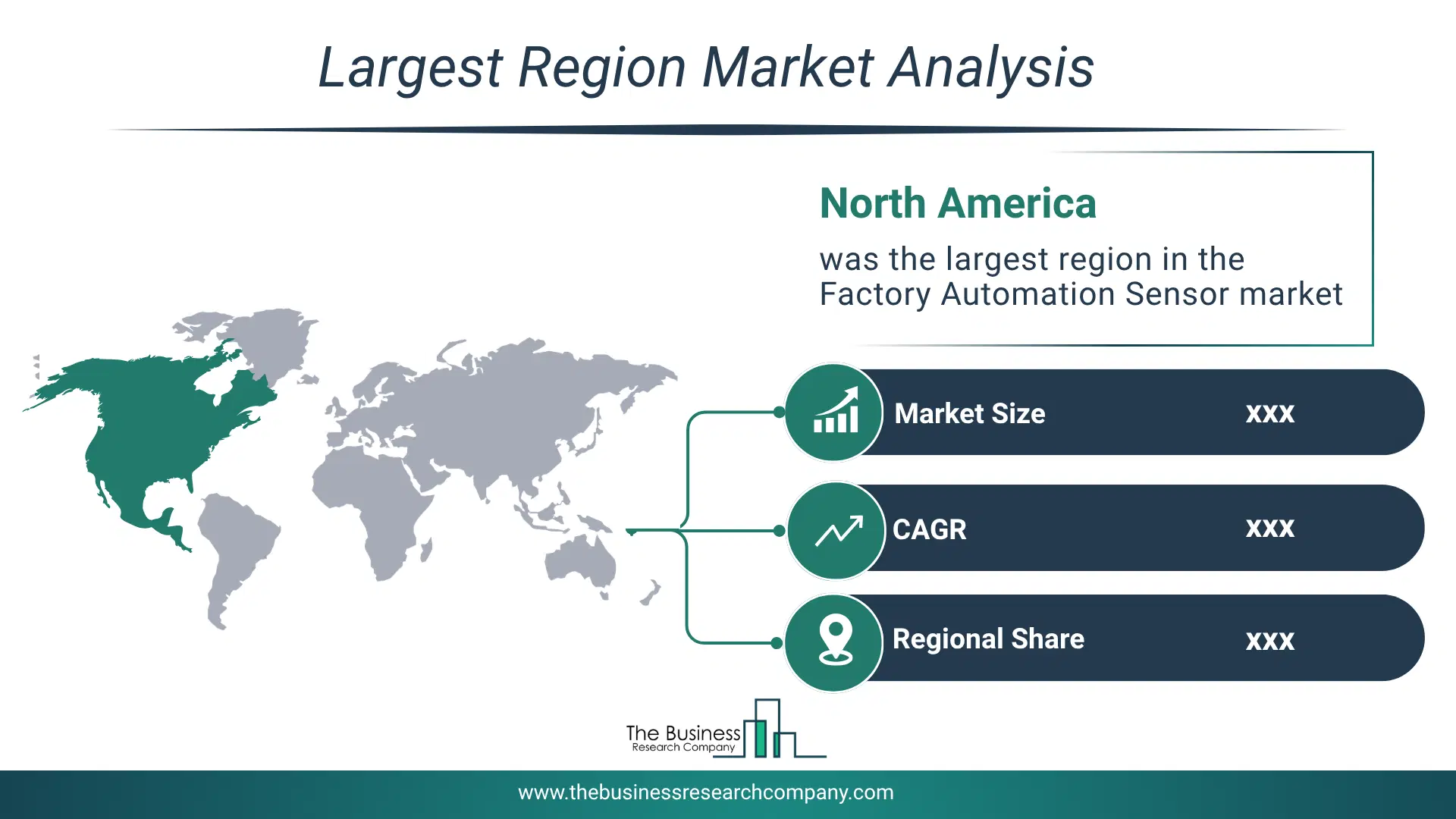
Regional Outlook
North America was the largest region in the factory automation sensor market in 2025. Asia-Pacific is expected to be the fastest-growing region in the forecast period. The regions covered in this market report are Asia-Pacific, South East Asia, Western Europe, Eastern Europe, North America, South America, Middle East, Africa. The countries covered in this market report are Australia, Brazil, China, France, Germany, India, Indonesia, Japan, Taiwan, Russia, South Korea, UK, USA, Canada, Italy, Spain.What Defines the Factory Automation Sensor Market?
The factory automation sensor market consists of revenues earned by entities by providing services such as consulting, subscription-based models for software services and integration. The market value includes the value of related goods sold by the service provider or included within the service offering. The factory automation sensor market also includes sales of controllers, transmitters, signal conditioners, and actuators. Values in this market are ‘factory gate’ values, that is the value of goods sold by the manufacturers or creators of the goods, whether to other entities (including downstream manufacturers, wholesalers, distributors and retailers) or directly to end customers. The value of goods in this market includes related services sold by the creators of the goods.How is Market Value Defined and Measured?
The market value is defined as the revenues that enterprises gain from the sale of goods and/or services within the specified market and geography through sales, grants, or donations in terms of the currency (in USD unless otherwise specified). The revenues for a specified geography are consumption values that are revenues generated by organizations in the specified geography within the market, irrespective of where they are produced. It does not include revenues from resales along the supply chain, either further along the supply chain or as part of other products.
This chart presents market attractiveness based on a quantitative evaluation of growth, competition, strategic alignment, and risk, offering a clear view of opportunity areas for decision-making. This chart is for illustrative purposes; the full report contains the complete analysis.

This chart highlights the Total Addressable Market (TAM) by estimating the maximum revenue opportunity using an assumption-driven approach, supporting strategic planning and opportunity sizing across markets. The chart is illustrative; the full report provides a more comprehensive analysis.
What Key Data and Analysis Are Included in the Factory Automation Sensor Market Report 2026?
The factory automation sensor market research report is one of a series of new reports from The Business Research Company that provides market statistics, including industry global market size, regional shares, competitors with the market share, detailed market segments, market trends and opportunities, and any further data you may need to thrive in the factory automation sensor industry. The market research report delivers a complete perspective of everything you need, with an in-depth analysis of the current and future state of the industry.Factory Automation Sensor Market Report Forecast Analysis
| Report Attribute | Details |
|---|---|
| Market Size Value In 2026 | $18.88 billion |
| Revenue Forecast In 2030 | $24.04 billion |
| Growth Rate | CAGR of 6.2% from 2026 to 2030 |
| Base Year For Estimation | 2025 |
| Actual Estimates/Historical Data | 2020-2025 |
| Forecast Period | 2026 - 2030 |
| Market Representation | Revenue in USD Billion and CAGR from 2026 to 2030 |
| Segments Covered | Sensors Type, Type, Application |
| Regional Scope | Asia-Pacific, Western Europe, Eastern Europe, North America, South America, Middle East, Africa |
| Country Scope | The countries covered in the report are Australia, Brazil, China, France, Germany, India, Indonesia, Japan, Taiwan, Russia, South Korea, UK, USA, Canada, Italy, Spain. |
| Key Companies Profiled | Robert Bosch GmbH, Siemens AG, Sony Corporation, Panasonic Corporation, Schneider Electric SE, Honeywell International Inc., ABB Ltd., STMicroelectronics N.V., Infineon Technologies AG, TDK Electronics Co. Ltd., Murata Manufacturing Co. Ltd., TE Connectivity Ltd., Amphenol Corporation, Analog Devices Inc., Seiko Epson Corporation, Alps Electric Co. Ltd., Rockwell Automation Inc., Microchip Technology Inc., Omron Corporation, FANUC Corporation, Texas Instruments Incorporated, Vishay Intertechnology Inc., Stäubli International AG, Pepperl+Fuchs SE, Sensirion AG |
| Customization Scope | Request for Customization |
| Pricing And Purchase Options | Explore Purchase Options |