
Fast Healthcare Interoperability Resources (FHIR) Integration Services Market Report 2026
Global Outlook – By Component (Software, Services), By Integration Type (Fast Healthcare Interoperability Resources Application Programming Interface Integration, Electronic Health Record Integration, Health Information Exchange Integration, Cloud Based Fast Healthcare Interoperability Resources Integration, Mobile Health Application Integration, Clinical Data Repository Integration), By Deployment Mode (On-Premises, Cloud-Based), By Application (Clinical Data Exchange, Patient Management, Population Health Management, Other Applications), By End-User (Healthcare Providers, Payers, Pharmacies, Other End-Users) – Market Size, Trends, Strategies, and Forecast to 2030
Fast Healthcare Interoperability Resources (FHIR) Integration Services Market Overview
• Fast Healthcare Interoperability Resources (FHIR) Integration Services market size has reached to $1.53 billion in 2025 • Expected to grow to $3.91 billion in 2030 at a compound annual growth rate (CAGR) of 20.7% • Growth Driver: The Growing Adoption Of Electronic Health Records (EHRs) Driving Growth Due To Enhanced Patient Data Security And Streamlined Healthcare Management • Market Trend: Advancements In Healthcare Information Technology Enhance Seamless Patient Data Sharing And Electronic Health Record Connectivity Across Providers • North America was the largest region in 2025 and Asia-Pacific is the fastest growing region.What Is Covered Under Fast Healthcare Interoperability Resources (FHIR) Integration Services Market?
Fast healthcare interoperability resources (FHIR) integration services enable the seamless exchange of healthcare data between different systems, applications, and devices using standardized FHIR protocols. These services facilitate real-time access, interoperability, and secure sharing of patient information to improve clinical decision-making and care coordination. The main components of fast healthcare interoperability resources integration services include software and services. Software refers to platforms that enable standardized data exchange and interoperability across healthcare systems using fast healthcare interoperability resources protocols. These solutions support integration types such as fast healthcare interoperability resources application programming interface integration, electronic health record integration, health information exchange integration, cloud based fast healthcare interoperability resources integration, mobile health application integration, and clinical data repository integration, and are deployed through on-premises and cloud-based models. The various applications involved are clinical data exchange, patient management, population health management, and other applications, and they are used by several end users such as healthcare providers, payers, Pharmacies, and other end-users.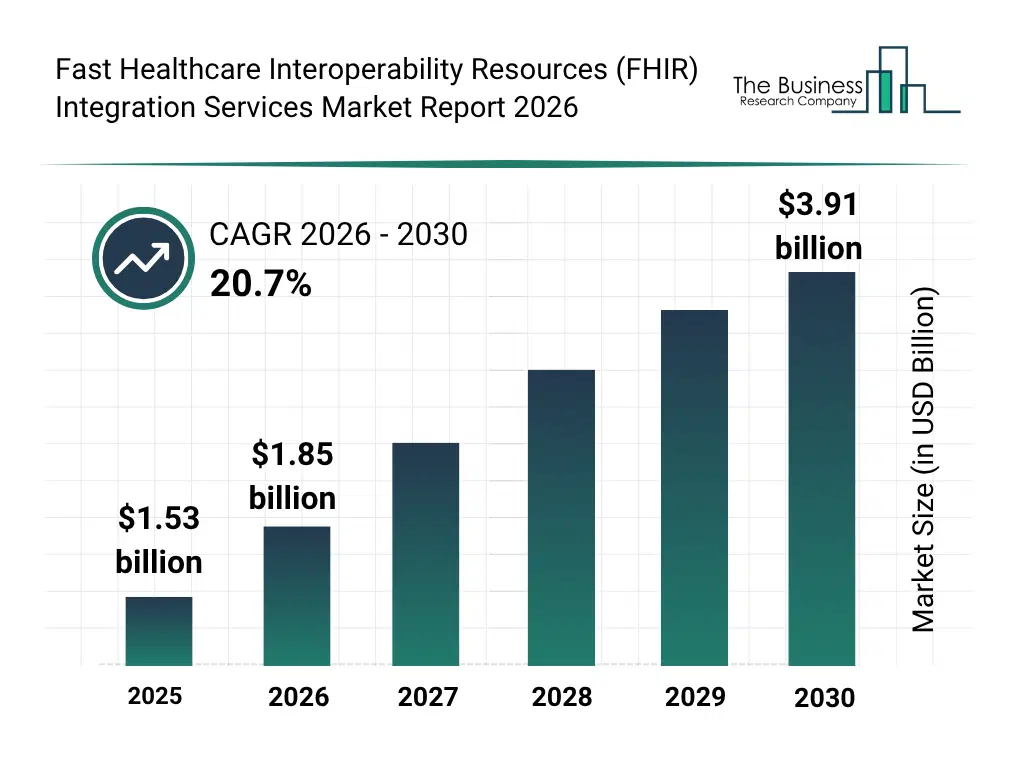
What Is The Fast Healthcare Interoperability Resources (FHIR) Integration Services Market Size and Share 2026?
The fast healthcare interoperability resources (FHIR) integration services market size has grown exponentially in recent years. It will grow from $1.53 billion in 2025 to $1.85 billion in 2026 at a compound annual growth rate (CAGR) of 20.4%. The growth in the historic period can be attributed to increasing digitization of healthcare records, growing adoption of electronic health record systems, rising need for healthcare data standardization, government mandates for interoperability compliance, expansion of health information exchange networks.What Is The Fast Healthcare Interoperability Resources (FHIR) Integration Services Market Growth Forecast?
The fast healthcare interoperability resources (FHIR) integration services market size is expected to see exponential growth in the next few years. It will grow to $3.91 billion in 2030 at a compound annual growth rate (CAGR) of 20.7%. The growth in the forecast period can be attributed to growing adoption of cloud-native healthcare platforms, increasing integration of ai-driven clinical decision support, rising demand for patient-centric care models, expansion of telehealth and remote monitoring services, increasing investment in healthcare data analytics. Major trends in the forecast period include increasing adoption of fhir-based api integration, rising demand for real-time clinical data exchange, growing implementation of ehr interoperability solutions, expansion of cloud-based fhir deployment models, increasing focus on secure patient data sharing.
Global Fast Healthcare Interoperability Resources (FHIR) Integration Services Market Segmentation
1) By Component: Software, Services 2) By Integration Type: Fast Healthcare Interoperability Resources Application Programming Interface Integration, Electronic Health Record Integration, Health Information Exchange Integration, Cloud Based Fast Healthcare Interoperability Resources Integration, Mobile Health Application Integration, Clinical Data Repository Integration 3) By Deployment Mode: On-Premises, Cloud-Based 4) By Application: Clinical Data Exchange, Patient Management, Population Health Management, Other Applications 5) By End-User: Healthcare Providers, Payers, Pharmacies, Other End-Users Subsegments: 1) By Software: Fast Healthcare Interoperability Resources Engine Software, Interface Engine Software, Data Mapping Software, Application Programming Interface Management Software, Clinical Data Integration Software 2) By Services: Implementation Services, Consulting Services, Training Services, Support And Maintenance Services, Data Migration ServicesWhat Is The Driver Of The Fast Healthcare Interoperability Resources (FHIR) Integration Services Market?
The growing adoption of electronic health records is expected to propel the growth of the fast healthcare interoperability resources (FHIR) integration services market going forward. Electronic health records (EHRs) are digital versions of patients’ medical histories that are maintained by healthcare providers and can include information such as diagnoses, medications, treatment plans, immunization dates, allergies, radiology images, and laboratory test results. The growing adoption of electronic health records is due to their ability to improve patient care and safety by providing accurate, real-time access to comprehensive medical information, reducing errors, and enabling better-informed clinical decisions. Electronic health records streamline fast healthcare interoperability resources (FHIR) integration services by providing standardized, structured patient data that enables seamless exchange, real-time accessibility, and improved interoperability across healthcare systems. For instance, in March 2024, according to the Department of Health and Social Care, a UK-based government department, in UK the percentage of national health services trusts with electronic health records increased from 90% in December 2023 to 100% in March 2025. Therefore, growing adoption of electronic health records is driving the growth of the fast healthcare interoperability resources (FHIR) integration services industry.Key Players In The Global Fast Healthcare Interoperability Resources (FHIR) Integration Services Market
Major companies operating in the fast healthcare interoperability resources (FHIR) integration services market are Google LLC, Microsoft Corporation, Salesforce Inc., Tata Consultancy Services Limited, Cognizant Technology Solutions Corporation, Infosys Limited, InterSystems Corporation, Eclinical Works LLC, Medical Information Technology Inc., Veradigm Inc., 1upHealth Inc., Epic Systems Corporation, Mindbowser Inc., DreamSoft4U Private Limited, Health Gorilla Inc., Taction Software LLC, BM Coder LLC, CapMinds Technologies Private Limited, Edenlab LLC, Firely B.V., Health Samurai Inc., Healthcare Integrations LLC, Smile Digital Health Inc., and Techbit Solutions Pvt. Ltd.
This chart is for illustrative purposes; the full report includes a detailed competitor analysis and comprehensive overview of the top 10 companies in the market.
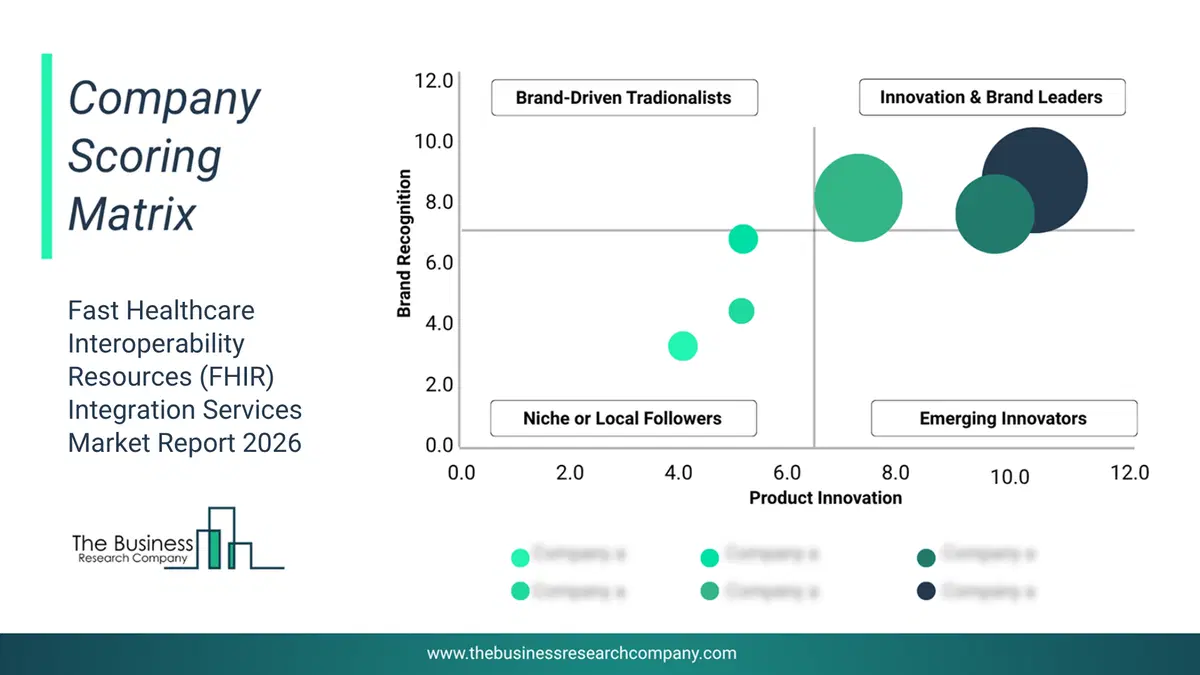
This chart maps companies by product innovation and brand strength, with bubble size indicating relative revenue, helping identify market leaders, challengers, and niche players. This is an illustrative chart; the full report provides a complete and accurate competitive analysis.
Global Fast Healthcare Interoperability Resources (FHIR) Integration Services Market Trends and Insights
Major companies operating in the fast healthcare interoperability resources (FHIR) integration services market are focusing on developing innovative platforms such as interoperability engine platforms to enhance seamless data exchange, improve EHR integration, and ensure compliance with healthcare interoperability standards. An interoperability engine is a software platform that enables different healthcare systems, applications, and devices to exchange, interpret, and use data seamlessly. For instance, in July 2025, EMR Direct Inc., a US-based health information technology software company, launched the enhanced HL7 FHIR services for its Interoperability Engine 2026, targeting health IT developers. The update enables secure patient access and business-to-business data exchange while ensuring compliance with ONC Health IT certification criteria and the medicare promoting interoperability program. These enhancements aim to streamline healthcare data interoperability, improve information sharing across providers, and support the growing demand for standardized, efficient health IT solutions.What Are Latest Mergers And Acquisitions In The Fast Healthcare Interoperability Resources (FHIR) Integration Services Market?
In June 2024, Healwell AI Inc., a Canada-based healthcare technology company, acquired VeroSource Solutions Inc. for an undisclosed amount. With this acquisition, Healwell AI aims to expand its fast healthcare interoperability resources integration services capabilities by incorporating VeroSource’s cloud-based health data interoperability platform, enhancing secure data exchange, electronic medical record connectivity, and FHIR-enabled infrastructure to support population health management, analytics, and artificial intelligence-driven clinical insights across healthcare ecosystems. VeroSource Solutions Inc. is a Canada-based company that provides fast healthcare interoperability resources (FHIR) integration services through its healthcare interoperability platform.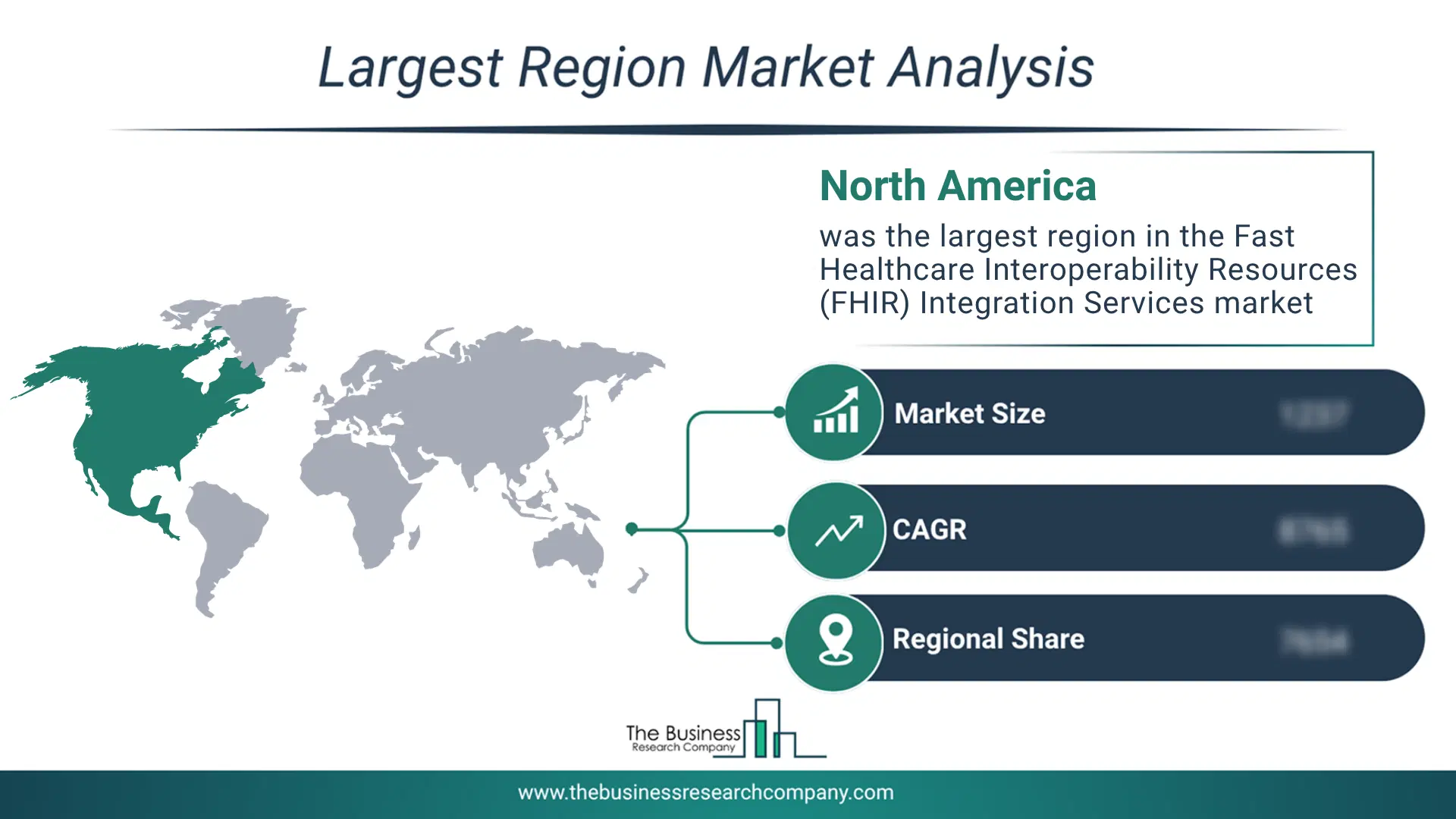
Regional Insights
North America was the largest region in the fast healthcare interoperability resources (FHIR) integration services market in 2025. Asia-Pacific is expected to be the fastest-growing region in the forecast period. The regions covered in this market report are Asia-Pacific, South East Asia, Western Europe, Eastern Europe, North America, South America, Middle East, Africa. The countries covered in this market report are Australia, Brazil, China, France, Germany, India, Indonesia, Japan, Taiwan, Russia, South Korea, UK, USA, Canada, Italy, Spain.What Defines the Fast Healthcare Interoperability Resources (FHIR) Integration Services Market?
The fast healthcare interoperability resources (FHIR) integration services market includes revenues earned by entities through implementation and deployment services, consulting and advisory services, maintenance and support services, data migration services, and third-party app integration services. The market value includes the value of related goods sold by the service provider or included within the service offering. Only goods and services traded between entities or sold to end consumers are included.How is Market Value Defined and Measured?
The market value is defined as the revenues that enterprises gain from the sale of goods and/or services within the specified market and geography through sales, grants, or donations in terms of the currency (in USD unless otherwise specified). The revenues for a specified geography are consumption values that are revenues generated by organizations in the specified geography within the market, irrespective of where they are produced. It does not include revenues from resales along the supply chain, either further along the supply chain or as part of other products.
This chart presents market attractiveness based on a quantitative evaluation of growth, competition, strategic alignment, and risk, offering a clear view of opportunity areas for decision-making. This chart is for illustrative purposes; the full report contains the complete analysis.

This chart highlights the Total Addressable Market (TAM) by estimating the maximum revenue opportunity using an assumption-driven approach, supporting strategic planning and opportunity sizing across markets. The chart is illustrative; the full report provides a more comprehensive analysis.
What Key Data And Analysis Are Included In The Fast Healthcare Interoperability Resources (FHIR) Integration Services Market Report 2026?
The fast healthcare interoperability resources (fhir) integration services market research report is one of a series of new reports from The Business Research Company that provides market statistics, including industry global market size, regional shares, competitors with the market share, detailed market segments, market trends and opportunities, and any further data you may need to thrive in the fast healthcare interoperability resources (fhir) integration services industry. The market research report delivers a complete perspective of everything you need, with an in-depth analysis of the current and future state of the industry.Fast Healthcare Interoperability Resources (FHIR) Integration Services Market Report Forecast Analysis
| Report Attribute | Details |
|---|---|
| Market Size Value In 2026 | $1.85 billion |
| Revenue Forecast In 2030 | $3.91 billion |
| Growth Rate | CAGR of 20.7% from 2026 to 2030 |
| Base Year For Estimation | 2025 |
| Actual Estimates/Historical Data | 2020-2025 |
| Forecast Period | 2026 - 2030 |
| Market Representation | Revenue in USD Billion and CAGR from 2026 to 2030 |
| Segments Covered | Component, Integration Type, Deployment Mode, Application, End-User |
| Regional Scope | Asia-Pacific, Western Europe, Eastern Europe, North America, South America, Middle East, Africa |
| Country Scope | The countries covered in the report are Australia, Brazil, China, France, Germany, India, Indonesia, Japan, Taiwan, Russia, South Korea, UK, USA, Canada, Italy, Spain |
| Key Companies Profiled | Google LLC, Microsoft Corporation, Salesforce Inc., Tata Consultancy Services Limited, Cognizant Technology Solutions Corporation, Infosys Limited, InterSystems Corporation, Eclinical Works LLC, Medical Information Technology Inc., Veradigm Inc., 1upHealth Inc., Epic Systems Corporation, Mindbowser Inc., DreamSoft4U Private Limited, Health Gorilla Inc., Taction Software LLC, BM Coder LLC, CapMinds Technologies Private Limited, Edenlab LLC, Firely B.V., Health Samurai Inc., Healthcare Integrations LLC, Smile Digital Health Inc., and Techbit Solutions Pvt. Ltd. |
| Customization Scope | Request for Customization |
| Pricing And Purchase Options | Explore Purchase Options |