

Fat-Based Injectable Fillers Market Report 2026
Global Outlook – By Type (Autologous Fat Injections, Allogeneic Fat Injections, Other Types), By Material (Micronized Fat, Nanofat, Macrofat), By Gender (Female, Male), By Application (Facial Line Correction, Lip Enhancement, Breast Augmentation, Buttock Augmentation, Other Applications), By End User (Hospitals, Cosmetic Clinics, Ambulatory Surgical Centers, Other End-Users) – Market Size, Trends, Strategies, and Forecast to 2035
Fat-Based Injectable Fillers Market Overview
• Fat-Based Injectable Fillers market size has reached to $0.7 billion in 2025 • Expected to grow to $1.18 billion in 2030 at a compound annual growth rate (CAGR) of 10.9% • Growth Driver: Growing Demand For Minimally Invasive Aesthetic Procedures Fueling The Growth Of The Market Due To Increasing Preference For Non-Surgical Treatments • Market Trend: Integration of Regenerative Medicine in Aesthetics in the Fat-Based Injectable Fillers Market to Enhance Natural Tissue Regeneration and Long-Lasting Volume Restoration • North America was the largest region in 2025 and Asia-Pacific is the fastest growing region.What Is Covered Under Fat-Based Injectable Fillers Market?
Fat-based injectable fillers are cosmetic treatments in which fat is taken from a person’s own body-usually through liposuction, processed, and then injected into another area to restore volume, smooth wrinkles, or enhance contours. These fillers are commonly used for facial rejuvenation, lip enhancement, and body contouring, and they can provide longer-lasting results compared to many synthetic fillers, although some of the injected fat may be gradually absorbed by the body over time. The main types of fat-based injectable fillers include autologous fat injections, allogeneic fat injections, and other types. Autologous fat injections refer to procedures where fat is harvested from the patient’s own body and re-injected to restore volume and improve aesthetic contouring. These are made by materials such as micronized fat, nanofat, and macrofat and they are categorized by gender such as female and male. The various applications involved are facial line correction, lip enhancement, breast augmentation, buttock augmentation, and other applications, and they are used by several end users such as hospitals, cosmetic clinics, ambulatory surgical centers, and other end-users.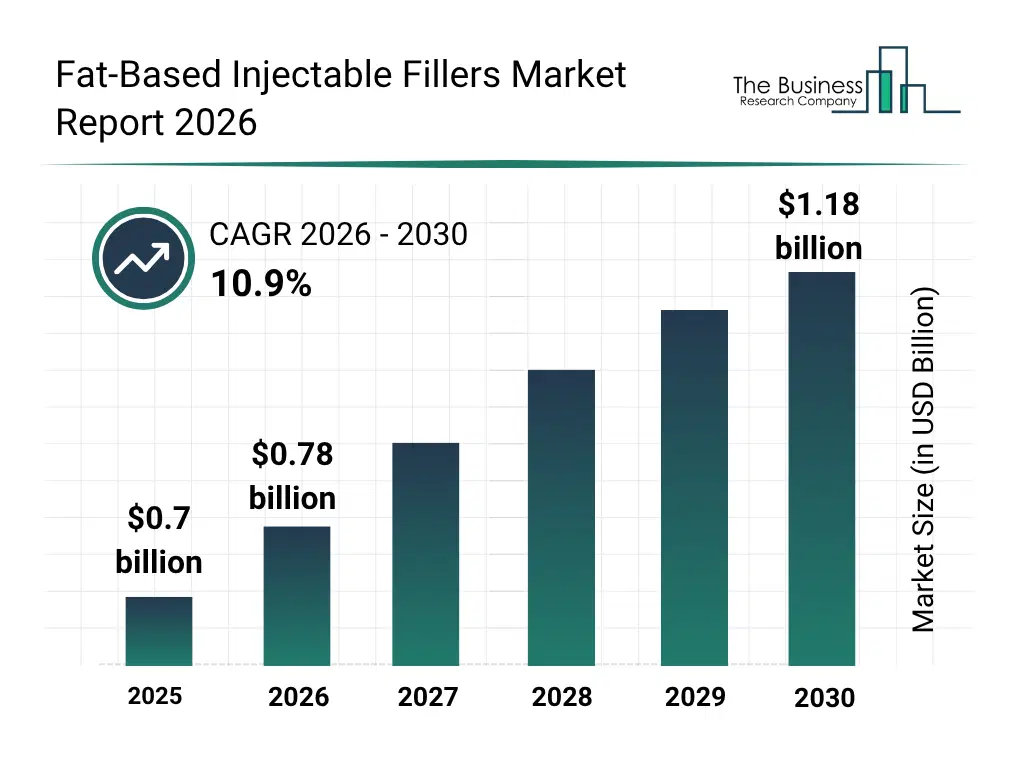
What Is The Fat-Based Injectable Fillers Market Size and Share 2026?
The fat-based injectable fillers market size has grown rapidly in recent years.It will grow from $0.7 billion in 2025 to $0.78 billion in 2026 at a compound annual growth rate (CAGR) of 10.7%. The growth in the historic period can be attributed to rising demand for aesthetic enhancement and facial rejuvenation procedures, increasing popularity of liposuction-based fat transfer techniques, growth in cosmetic surgery clinics and dermatology centers, expanding awareness of minimally invasive cosmetic treatments, increasing disposable income supporting elective aesthetic procedures.What Is The Fat-Based Injectable Fillers Market Growth Forecast?
The fat-based injectable fillers market size is expected to see rapid growth in the next few years.It will grow to $1.18 billion by 2030 at a compound annual growth rate (CAGR) of 10.9%. The growth in the forecast period can be attributed to advancements in regenerative medicine and stem cell enriched fat grafting, rising demand for long-lasting and natural aesthetic solutions, growth in personalized cosmetic treatment planning, increasing adoption of improved fat processing technologies, expansion of medical tourism for cosmetic procedures.Major trends in the forecast period include increasing demand for minimally invasive fat grafting procedures, rising preference for natural and autologous aesthetic treatments, growth in combination therapies using fat and regenerative techniques, expansion of outpatient cosmetic surgery centers, increasing adoption of advanced fat processing and purification systems.
Global Fat-Based Injectable Fillers Market Segmentation
1) By Type: Autologous Fat Injections, Allogeneic Fat Injections, Other Types 2) By Material: Micronized Fat, Nanofat, Macrofat 3) By Gender: Female, Male 4) By Application: Facial Line Correction, Lip Enhancement, Breast Augmentation, Buttock Augmentation, Other Applications 5) By End User: Hospitals, Cosmetic Clinics, Ambulatory Surgical Centers, Other End-Users Subsegments: 1) By Autologous Fat Injections: Micro Fat Grafting, Nano Fat Grafting, Structural Fat Grafting, Stem Cell Enriched Fat Grafting 2) By Allogeneic Fat Injections: Processed Donor Fat, Cryopreserved Fat, Decellularized Fat Matrix, Sterilized Fat DerivativesWhat Are The Drivers Of The Fat-Based Injectable Fillers Market?
The growing demand for minimally invasive aesthetic procedures is expected to propel the growth of the fat-based injectable fillers industry going forward.Minimally invasive aesthetic procedures refer to cosmetic treatments that enhance physical appearance with little to no surgery, reduced recovery time, and lower risk compared to traditional surgical methods.The demand for minimally invasive aesthetic procedures is increasing due to the growing preference for quick procedures with minimal downtime.Fat-based injectable fillers support the demand for minimally invasive aesthetic procedures as they provide natural-looking results with lower risk and minimal downtime compared to surgical alternatives.For instance, in June 2024, according to the American Society of Plastic Surgeons, a US-based organization of board-certified plastic surgeons, in 2023, approximately 25.4 million minimally invasive cosmetic procedures were performed in the U.S., showing a 7% increase over 2022, highlighting strong and growing adoption.Therefore, the growing demand for minimally invasive aesthetic procedures is driving the growth of the fat-based injectable fillers industry. The expansion of cosmetic and medical aesthetic clinics is expected to propel the growth of the fat-based injectable fillers industry going forward.Cosmetic and medical aesthetic clinics refer to specialized healthcare facilities that provide non-surgical and minimally invasive cosmetic treatments aimed at enhancing physical appearance and skin health.The expansion of cosmetic and medical aesthetic clinics is increasing due to the rising consumer demand for aesthetic procedures, growing awareness of cosmetic enhancements, and advancements in aesthetic treatment technologies.Fat-based injectable fillers support the expansion of cosmetic and medical aesthetic clinics by offering natural-looking, minimally invasive facial rejuvenation solutions that attract a broader patient base seeking safe and effective aesthetic treatments.For instance, in February 2024, according to the International Society of Aesthetic Plastic Surgery (ISAPS), a US-based professional organization for board-certified aesthetic plastic surgeons, the number of aesthetic procedures performed globally increased by 11.2% in 2023 compared to the previous year.Therefore, the expansion of cosmetic and medical aesthetic clinics is driving the growth of the fat-based injectable fillers industry.Key Players In The Global Fat-Based Injectable Fillers Market
Major companies operating in the fat-based injectable fillers market are Merz Aesthetics, MTF Biologics, Huons Co. Ltd., Dongkook Pharmaceutical, Anika Therapeutics Inc, Daehan New Pharm, Estetique International, MicroAire Surgical Instruments, RegenLab SA, Koru Pharma, SoftFil, Teoxane Laboratories, Cytori Therapeutics, Gana R&D, Nouvag AG, Lipogems International S. p. A., Iskra Medical, Black & Black Surgical Inc., HK Surgical, Marina Medical InstrumentsGlobal Fat-Based Injectable Fillers Market Trends and Insights
Major companies operating in the fat-based injectable fillers market are focusing on the developing innovative products, such as structural adipose allograft fillers, to meet the rising demand for natural-looking, long-lasting, and minimally invasive aesthetic treatments. Structural adipose allograft fillers are injectable products derived from processed human adipose (fat) tissue that retain extracellular matrix components, growth factors, and proteins, enabling volumization and tissue regeneration. For instance, in September 2025, Tiger Aesthetics, a US-based medical aesthetics company, launched alloClae, an innovative structural adipose injectable designed for body contouring applications. The product is composed of purified, donor-derived adipose tissue processed to preserve regenerative elements such as collagen and growth factors, allowing it to integrate with host tissue and promote natural fat regeneration. It is a ready-to-use, shelf-stable injectable that eliminates the need for liposuction required in traditional autologous fat grafting, thereby reducing procedure time and invasiveness.Regional Insights
North America was the largest region in the fat-based injectable fillers market in 2025. Asia-Pacific is expected to be the fastest-growing region in the forecast period. The regions covered in this market report are Asia-Pacific, South East Asia, Western Europe, Eastern Europe, North America, South America, Middle East and Africa. The countries covered in this market report are Australia, Brazil, China, France, Germany, India, Indonesia, Japan, Taiwan, Russia, South Korea, UK, USA, Canada, Italy, Spain.What Defines the Fat-Based Injectable Fillers Market?
The fat-based injectable fillers market includes revenues earned by entities by providing services such as fat harvesting, purification, processing, and reinjection procedures, along with aesthetic treatment planning and post-procedure care. The market value includes the value of related goods sold by the service provider or included within the service offering. The fat-based injectable fillers consists of sales of fat grafting systems, processing equipment, injectable fat-based products, and regenerative aesthetic solutions. Values in this market are ‘factory gate’ values, that is the value of goods sold by the manufacturers or creators of the goods, whether to other entities (including clinics, hospitals, aesthetic centers, and distributors) or directly to end customers. The value of goods in this market includes related services sold by the creators of the goods.What is the Market Assessment and Strategic Outlook for the Fat-Based Injectable Fillers Industry?
The fat-based injectable fillers market research report is one of a series of new reports from The Business Research Company that provides market statistics, including industry global market size, regional shares, competitors with the market share, detailed market segments, market trends and opportunities, and any further data you may need to thrive in the fat-based injectable fillers industry. The market research report delivers a complete perspective of everything you need, with an in-depth analysis of the current and future state of the industry.What is the Market Assessment and Strategic Outlook for the Fat-Based Injectable Fillers Market Report 2026?
The fat-based injectable fillers market research report is one of a series of new reports from The Business Research Company that provides fat-based injectable fillers market statistics, including fat-based injectable fillers industry global market size, regional shares, competitors with a fat-based injectable fillers market share, detailed fat-based injectable fillers market segments, market trends and opportunities, and any further data you may need to thrive in the fat-based injectable fillers industry. This fat-based injectable fillers market research report delivers a complete perspective of everything you need, with an in-depth analysis of the current and future scenario of the industry.Fat-Based Injectable Fillers Market Report Forecast Analysis
| Report Attribute | Details |
|---|---|
| Market Size Value In 2026 | $0.78 billion |
| Revenue Forecast In 2035 | $1.18 billion |
| Growth Rate | CAGR of 10.9% from 2026 to 2035 |
| Base Year For Estimation | 2025 |
| Actual Estimates/Historical Data | 2020-2025 |
| Forecast Period | 2026 - 2030 - 2035 |
| Market Representation | Revenue in USD Billion and CAGR from 2026 to 2035 |
| Segments Covered | Type, Material, Gender, Application, End User |
| Regional Scope | Asia-Pacific, Western Europe, Eastern Europe, North America, South America, Middle East, Africa |
| Country Scope | The countries covered in the report are Australia, Brazil, China, France, Germany, India, Indonesia, Japan, Taiwan, Russia, South Korea, UK, USA, Canada, Italy, Spain. |
| Key Companies Profiled | Merz Aesthetics, MTF Biologics, Huons Co. Ltd., Dongkook Pharmaceutical, Anika Therapeutics Inc, Daehan New Pharm, Estetique International, MicroAire Surgical Instruments, RegenLab SA, Koru Pharma, SoftFil, Teoxane Laboratories, Cytori Therapeutics, Gana R&D, Nouvag AG, Lipogems International S. p. A., Iskra Medical, Black & Black Surgical Inc., HK Surgical, Marina Medical Instruments |
| Customization Scope | Request for Customization |
| Pricing And Purchase Options | Explore Purchase Options |