

Fault Detection And Classification Market Report 2026
Global Outlook – By Offering (Software, Hardware, Services), By Fault Type (Dimensional Fault, Process Variability, Surface Defects, Contamination Faults, Other Fault Types), By Technology (Sensor Data Analysis, Statistical Methods, Machine Learning Algorithm, Other Technologies), By Application (Manufacturing, Packaging), By End Use (Automotive, Electronic And Semiconductor, Metals And machinery, Food And packaging, Pharmaceuticals) – Market Size, Trends, Strategies, and Forecast to 2030
Fault Detection And Classification Market Overview
• Fault Detection And Classification market size has reached to $5.35 billion in 2025 • Expected to grow to $7.83 billion in 2030 at a compound annual growth rate (CAGR) of 7.6% • Growth Driver: Automation Driving Growth In The Fault Detection And Classification Market • Market Trend: Innovative AI Technology In Fault Detection And Classification Industry • North America was the largest region in 2025 and Asia-Pacific is the fastest growing region.What Is Covered Under Fault Detection And Classification Market?
Fault detection and classification (FDC) refers to a process used in manufacturing and engineering to identify and categorize abnormalities or faults in systems, processes, or equipment. The goal of FDC is to detect deviations from normal operating conditions, diagnose the root causes of faults, and classify them based on their characteristics or attributes. The main offerings included in fault detection and classification are software, hardware, and services. Software refers to a set of instructions or programs that enable a computer system to perform specific tasks or functions, including data processing, analysis, and system control. It is used to detect various faults, including multidimensional faults, process variability, surface defects, contamination faults, and others, with the help of several technologies, including sensor data analysis, statistical methods, machine learning algorithms, and others. It is used for various applications, including manufacturing and packaging, by several end users, such as automotive, electronics and semiconductors, metals and machinery, food and packaging, and pharmaceuticals.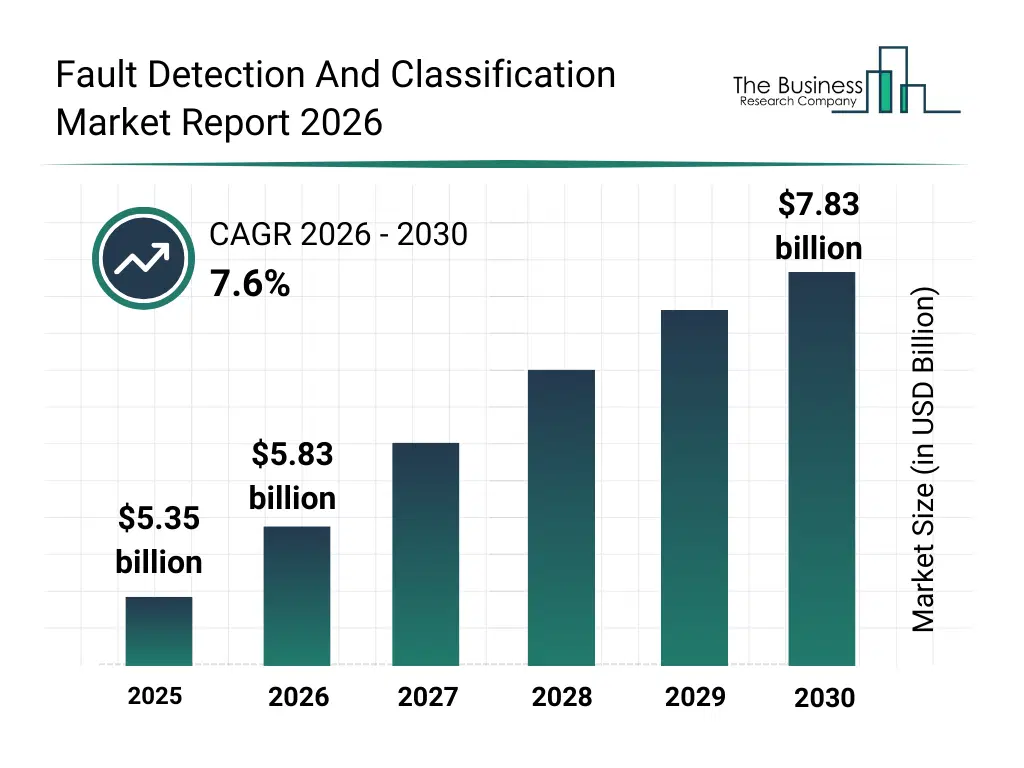
What Is The Fault Detection And Classification Market Size and Share 2026?
The fault detection and classification market size has grown strongly in recent years. It will grow from $5.35 billion in 2025 to $5.83 billion in 2026 at a compound annual growth rate (CAGR) of 9.0%. The growth in the historic period can be attributed to increasing adoption of automated manufacturing, rising equipment downtime costs, early implementation of statistical quality control, growing use of sensors in industrial applications, need for compliance with industry standards.What Is The Fault Detection And Classification Market Growth Forecast?
The fault detection and classification market size is expected to see strong growth in the next few years. It will grow to $7.83 billion in 2030 at a compound annual growth rate (CAGR) of 7.6%. The growth in the forecast period can be attributed to expansion of ai-based fault detection solutions, adoption of iot-enabled predictive maintenance, integration with smart factories, growth in electronics and semiconductor production, investments in advanced diagnostic and monitoring software. Major trends in the forecast period include predictive maintenance implementation, real-time fault monitoring, sensor data analytics optimization, machine learning-based fault classification, integration of fault detection with production systems.
Global Fault Detection And Classification Market Segmentation
1) By Offering: Software, Hardware, Services 2) By Fault Type: Dimensional Fault, Process Variability, Surface Defects, Contamination Faults, Other Fault Types 3) By Technology: Sensor Data Analysis, Statistical Methods, Machine Learning Algorithm, Other Technologies 4) By Application: Manufacturing, Packaging 5) By End Use: Automotive, Electronic And Semiconductor, Metals And machinery, Food And packaging, Pharmaceuticals Subsegments: 1) By Software: Fault Detection Software, Fault Classification Software, Predictive Maintenance Software, Real-Time Monitoring Software, Diagnostic Software 2) By Hardware: Sensors (Temperature Sensors, Pressure Sensors, Vibration Sensors), Data Acquisition Systems, Controllers And Actuators, Embedded Systems, Communication Infrastructure (Wireless Modules) 3) By Services: Consulting Services, Integration And Implementation Services, Maintenance And Support Services, Managed Services, Training And Support ServicesWhat Is The Driver Of The Fault Detection And Classification Market?
The rising demand for automation is expected to propel the growth of the fault detection and classification market going forward. Automation refers to the use of technology, machinery, or systems to perform tasks or processes with minimal human intervention. The demand for automation is increasing due to its ability to enhance efficiency, reduce costs, improve productivity, and meet evolving market demands more effectively. Automation improves fault detection and classification by offering real-time monitoring and predictive insights, enhancing operational efficiency, reliability, and safety across industries. For instance, in October 2024, the International Federation of Robotics (IFR), a Germany?based professional non?profit organization, reported that worldwide sales of professional service robots reached over 205,000 units in 2023 a 30% increase year?on?year. Therefore, the rising demand for automation is driving the growth of the fault detection and classification industry.Key Players In The Global Fault Detection And Classification Market
Major companies operating in the fault detection and classification market are Microsoft Corporation; Amazon Web Services Inc.; Siemens AG; Applied Materials Inc.; Tokyo Electron Limited; Doosan Corporation; KLA Corporation; HyundAI Heavy Industries; OMRON Corporation; Keyence Corporation; Teledyne Technologies; Edwards Limited; Advantest Corporation; LS Electric Co. Ltd.; Cognex Corporation; Datalogic S.P.A; INFICON Holding AG; DWFritz Automation LLC; Chooch Intelligence Technologies; Kili Technology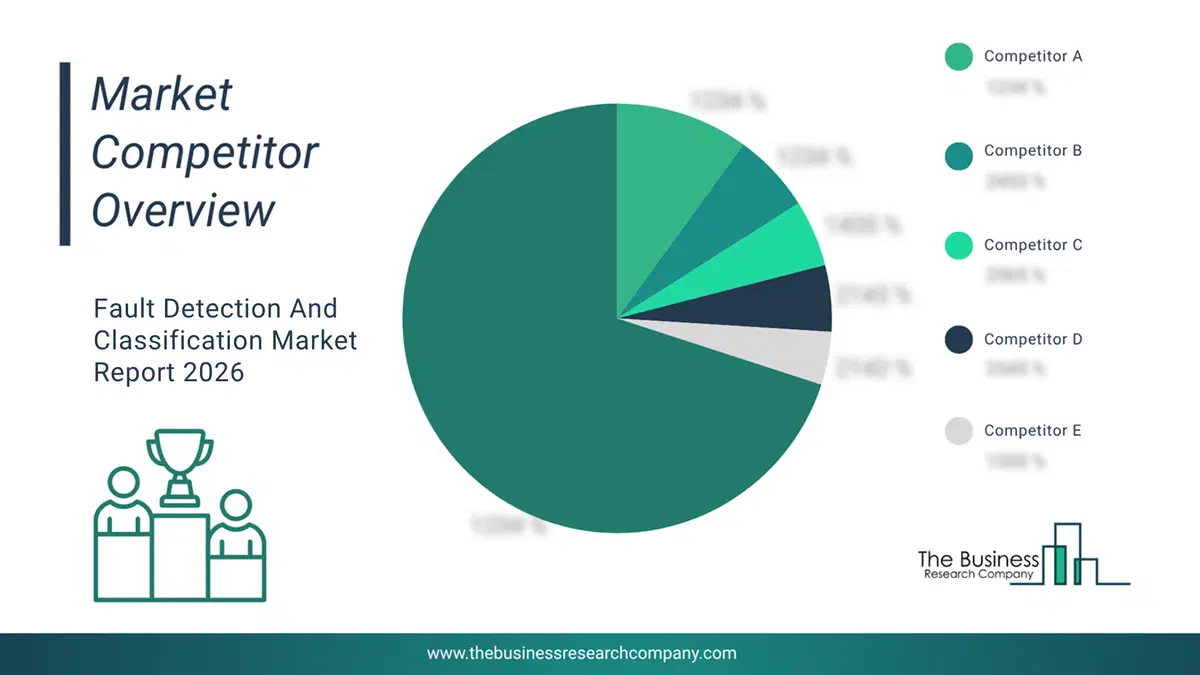
This chart is for illustrative purposes; the full report includes a detailed competitor analysis and comprehensive overview of the top 10 companies in the market.
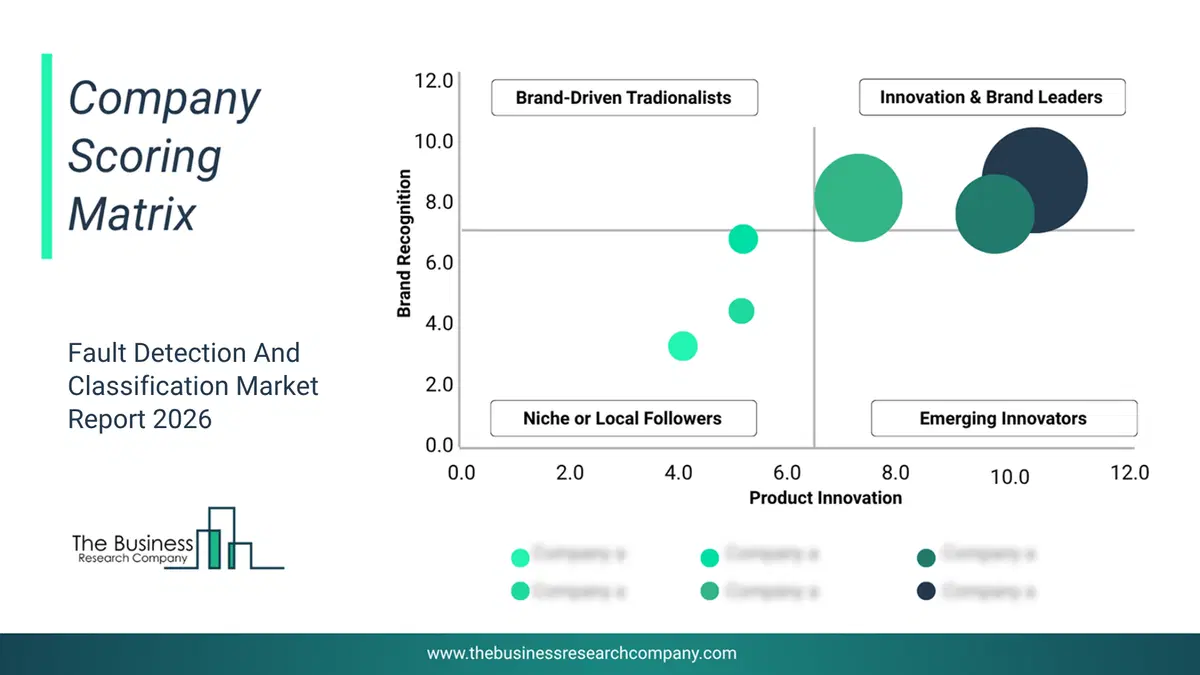
This chart maps companies by product innovation and brand strength, with bubble size indicating relative revenue, helping identify market leaders, challengers, and niche players. This is an illustrative chart; the full report provides a complete and accurate competitive analysis.
Global Fault Detection And Classification Market Trends and Insights
Major companies operating in the fault detection and classification market are focused on integrating advanced technologies, such as the integration of AI technologies into FDC Solutions, to enhance accuracy and optimize operational efficiency. AI-based fault detection is a system that uses artificial intelligence (AI) algorithms and techniques to automatically identify and diagnose faults or anomalies in systems, equipment, or processes. For instance, in August 2023, Lucy Electric UK Ltd., a UK-based electrical and electronic manufacturing company, introduced SYNAPS, a revolutionary AI technology to revolutionize fault detection and asset management for underground cables. This integrated solution merges cutting-edge grid monitoring with AI and machine learning to minimize faults on the LV network. This pioneering technology has the capacity to improve fault management, facilitate proactive maintenance, diminish customer outages, and yield significant cost reductions for network operators.What Are Latest Mergers And Acquisitions In The Fault Detection And Classification Market?
In March 2024, Cisco Systems Inc., a US-based Multinational company, acquired Splunk Inc. for approximately $28 billion. Through this acquisition Cisco aims to enhance capabilities in security and observability, particularly through advanced AI and machine learning technologies. By integrating Splunk's data analytics and threat detection solutions, Cisco plans to improve its AIOps and predictive security offerings, enabling organizations to proactively address potential cybersecurity threats. Splunk Inc. is a US-based company offers a robust solution for Field Force Automation through its Security Orchestration, Automation, and Response (SOAR) capabilities.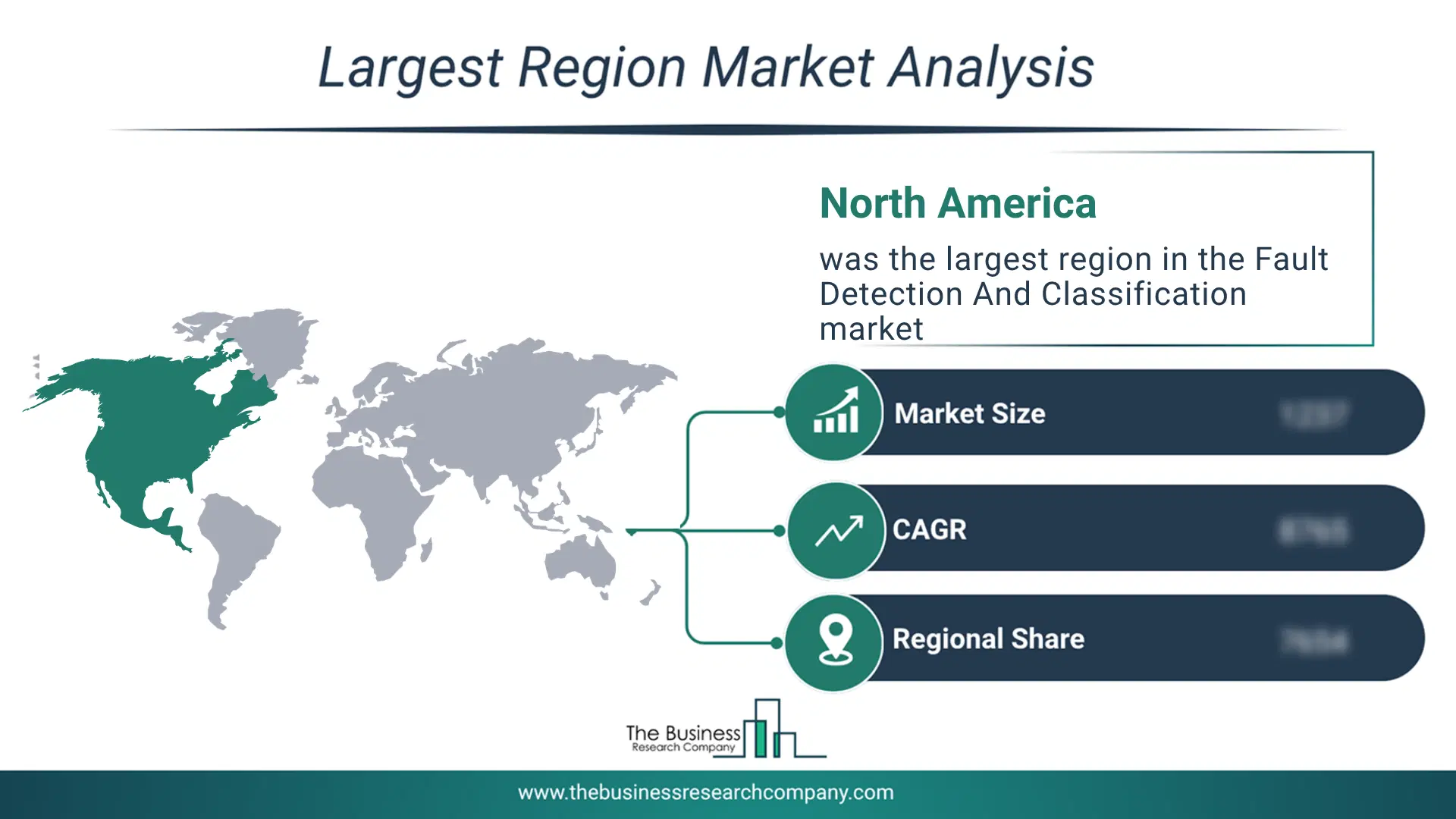
Regional Insights
North America was the largest region in the fault detection and classification market in 2025. Asia-Pacific is expected to be the fastest-growing region in the forecast period. The regions covered in this market report are Asia-Pacific, South East Asia, Western Europe, Eastern Europe, North America, South America, Middle East, Africa. The countries covered in this market report are Australia, Brazil, China, France, Germany, India, Indonesia, Japan, Taiwan, Russia, South Korea, UK, USA, Canada, Italy, SpainWhat Defines the Fault Detection And Classification Market?
The fault detection and classification market consists of revenues earned by entities by providing services such as anomaly detection, root cause analysis, real-time monitoring, and performance optimization, as well as related services. The market value includes the value of related goods sold by the service provider or included within the service offering. The fault detection and classification market also include sales of monitoring and control systems, data acquisition systems, sensors and instruments, communication interfaces, and diagnostic tools. Values in this market are ‘factory gate’ values, that is the value of goods sold by the manufacturers or creators of the goods, whether to other entities (including downstream manufacturers, wholesalers, distributors and retailers) or directly to end customers. The value of goods in this market includes related services sold by the creators of the goods.How is Market Value Defined and Measured?
The market value is defined as the revenues that enterprises gain from the sale of goods and/or services within the specified market and geography through sales, grants, or donations in terms of the currency (in USD unless otherwise specified). The revenues for a specified geography are consumption values that are revenues generated by organizations in the specified geography within the market, irrespective of where they are produced. It does not include revenues from resales along the supply chain, either further along the supply chain or as part of other products.
This chart presents market attractiveness based on a quantitative evaluation of growth, competition, strategic alignment, and risk, offering a clear view of opportunity areas for decision-making. This chart is for illustrative purposes; the full report contains the complete analysis.

This chart highlights the Total Addressable Market (TAM) by estimating the maximum revenue opportunity using an assumption-driven approach, supporting strategic planning and opportunity sizing across markets. The chart is illustrative; the full report provides a more comprehensive analysis.
What Key Data and Analysis Are Included in the Fault Detection And Classification Market Report 2026?
The fault detection and classification market research report is one of a series of new reports from The Business Research Company that provides market statistics, including industry global market size, regional shares, competitors with the market share, detailed market segments, market trends and opportunities, and any further data you may need to thrive in the fault detection and classification industry. The market research report delivers a complete perspective of everything you need, with an in-depth analysis of the current and future state of the industry.Fault Detection And Classification Market Report Forecast Analysis
| Report Attribute | Details |
|---|---|
| Market Size Value In 2026 | $5.83 billion |
| Revenue Forecast In 2030 | $7.83 billion |
| Growth Rate | CAGR of 7.6% from 2026 to 2030 |
| Base Year For Estimation | 2025 |
| Actual Estimates/Historical Data | 2020-2025 |
| Forecast Period | 2026 - 2030 |
| Market Representation | Revenue in USD Billion and CAGR from 2026 to 2030 |
| Segments Covered | Offering, Fault Type, Technology, Application, End Use |
| Regional Scope | Asia-Pacific, Western Europe, Eastern Europe, North America, South America, Middle East, Africa |
| Country Scope | The Countries Covered In This Market Report Are Australia, Brazil, China, France, Germany, India, Indonesia, Japan, Taiwan, Russia, South Korea, Uk, Usa, Canada, Italy, Spain. |
| Key Companies Profiled | Microsoft Corporation, Amazon Web Services Inc., Siemens AG, Applied Materials Inc., Tokyo Electron Limited, Doosan Corporation, KLA Corporation, HyundAI Heavy Industries, OMRON Corporation, Keyence Corporation, Teledyne Technologies, Edwards Limited, Advantest Corporation, LS Electric Co. Ltd., Cognex Corporation, Datalogic S.P.A, INFICON Holding AG, DWFritz Automation LLC, Chooch Intelligence Technologies, Kili Technology |
| Customization Scope | Request for Customization |
| Pricing And Purchase Options | Explore Purchase Options |