
FCC Catalyst Market Report 2026
Global Outlook – By Product (Gasoline Sulfur Reduction, Maximum Bottoms Conversion, Maximum Light Olefins, Maximum Middle Distillates, Other Products), By Application (Residue, Vacuum Gas Oil, Other Applications), By End-User (Refinery, Environmental, Other End-Users) – Market Size, Trends, Strategies, and Forecast to 2030
FCC Catalyst Market Overview
• FCC Catalyst market size has reached to $3.04 billion in 2025 • Expected to grow to $3.97 billion in 2030 at a compound annual growth rate (CAGR) of 5.5% • Growth Driver: Surging Petroleum Demand Fuels Fcc Catalysts Market Growth • Market Trend: Next-Generation FCC Catalysts Improve Metals Tolerance And Conversion Efficiency • Asia-Pacific was the largest region in 2025.What Is Covered Under FCC Catalyst Market?
Fluid catalytic cracking (FCC) is a type of processing unit used in oil refineries to produce additional gasoline while the refining process is being carried out. It is a chemical process that splits long-chain hydrocarbons into shorter-chain hydrocarbons by using a catalyst and heat. Fluid catalytic cracking (FCC) catalyst increases the rate of chemical reaction, which lowers the activation energy in the petroleum refining process. The main products of the FCC catalyst are gasoline sulfur reduction, maximum bottoms conversion, maximum light olefins, maximum middle distillates, and others. Gasoline sulfur reduction includes sulfur, a naturally occurring substance found in crude oil, unless it has been removed. These are used for various applications such as residue, vacuum gas oil, others by refinery, environmental, and other end-users.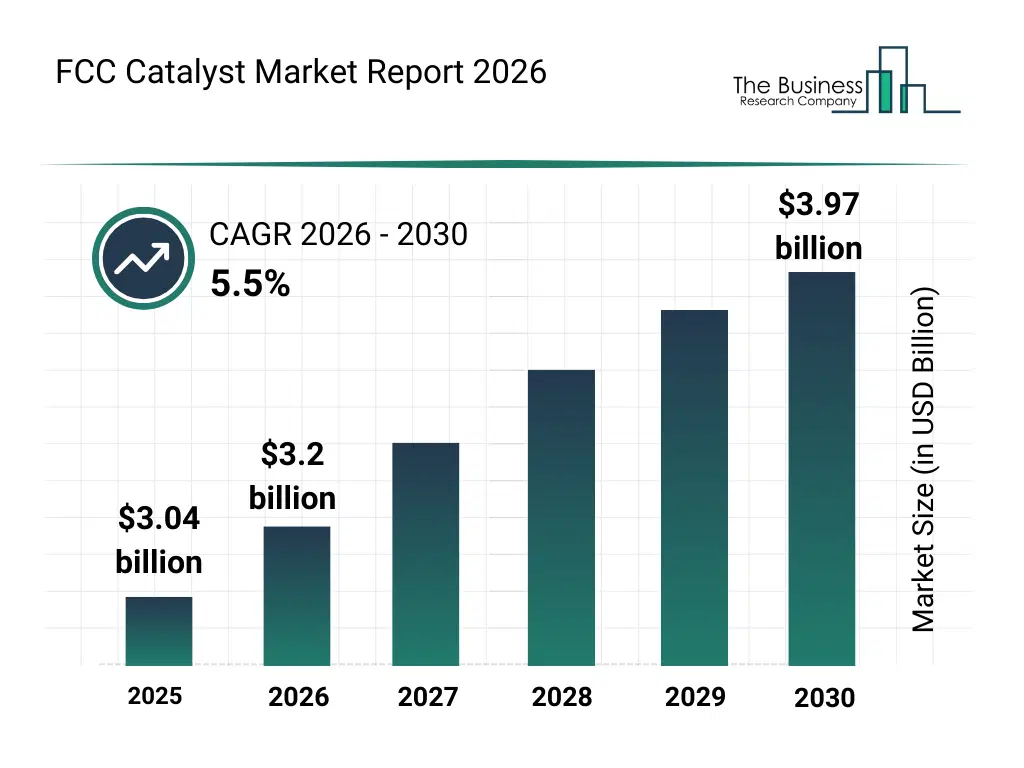
What Is The FCC Catalyst Market Size and Share 2026?
The fcc catalyst market size has grown strongly in recent years. It will grow from $3.04 billion in 2025 to $3.2 billion in 2026 at a compound annual growth rate (CAGR) of 5.5%. The growth in the historic period can be attributed to growth of global refining capacity, rising gasoline consumption worldwide, historical focus on fuel yield maximization, adoption of catalytic cracking technology, expansion of residue upgrading processes.What Is The FCC Catalyst Market Growth Forecast?
The fcc catalyst market size is expected to see strong growth in the next few years. It will grow to $3.97 billion in 2030 at a compound annual growth rate (CAGR) of 5.5%. The growth in the forecast period can be attributed to tightening fuel quality regulations, increasing demand for cleaner gasoline, refinery modernization initiatives, growing complexity of crude oil feedstocks, technological innovation in catalyst design. Major trends in the forecast period include rising demand for high activity FCC catalysts, increasing focus on sulfur reduction catalysts, growing adoption of zeolite based catalyst formulations, shift toward customized catalyst solutions for refineries, rising use of additives for yield optimization.
Global FCC Catalyst Market Segmentation
1) By Product: Gasoline Sulfur Reduction, Maximum Bottoms Conversion, Maximum Light Olefins, Maximum Middle Distillates, Other Products 2) By Application: Residue, Vacuum Gas Oil, Other Applications 3) By End-User: Refinery, Environmental, Other End-Users Subsegments: 1) By Gasoline Sulfur Reduction: Hydrodesulfurization (HDS) Catalysts, Selective Catalytic Reduction (SCR) Catalysts 2) By Maximum Bottoms Conversion: High Activity Catalysts, ZSM-5 Additives 3) By Maximum Light Olefins: Zeolite-Based Catalysts, Non-Zeolite Catalysts 4) By Maximum Middle Distillates: Iso-Merization Catalysts, Hydrocracking Catalysts 5) By Other Products: Specialty Catalysts, Additives For Catalyst Performance EnhancementWhat Is The Driver Of The FCC Catalyst Market?
Rising demand for petroleum-based products is expected to propel the growth of the FCC catalyst market going forward. Petroleum-based products refer to a complex mixture derived from crude oil that shares similar physical and chemical properties and is widely used across fuel, petrochemical, and industrial applications. The increasing demand for petroleum-based products is driven by growing energy consumption, expanding transportation needs, and rising industrial activity worldwide. FCC catalysts support petroleum refining by accelerating chemical reactions and lowering activation energy, enabling refiners to efficiently convert high-boiling, high-molecular-weight hydrocarbon fractions into valuable outputs such as gasoline, olefinic gases, and other refined products. For instance, in September 2023, according to Organization of the Petroleum Exporting Countries (OPEC), an Austria-based intergovernmental organization, in the OECD region, oil demand in 2023 is expected to rise by 120 tb/d to average 46.1 mb/d. Further, in the non-OECD region, total oil demand is expected to rise by about 2.3 mb/d to average 55.9 mb/d in 2023.Therefore, rising demand for petroleum-based products is driving the growth of the FCC catalyst industry.Key Players In The Global FCC Catalyst Market
Major companies operating in the fcc catalyst market are Axens SA, N.E. Chemcat, Porocel Corporation, Yueyang Sciensun Chemical Co. Ltd., DuPont de Nemours Inc., Magma Ceramics & Catalysts, Albemarle Corporation, W.R. Grace Company, Johnson Matthey, Arkema S.A., BASF SE, Clariant AG, Haldor Topsoe, Zeolyst International, Nanjing Lantian Chemical, Qingdao Huadong Catalytic Agent Co. Ltd., Rive Technology, Wuxi Xuelang Chemical Technology, Nippon Ketjen Co. Ltd., Sumitomo Chemical Co. Ltd., Universal Oil Products, PetroChina Catalyst Company, Grace Catalysts Technologies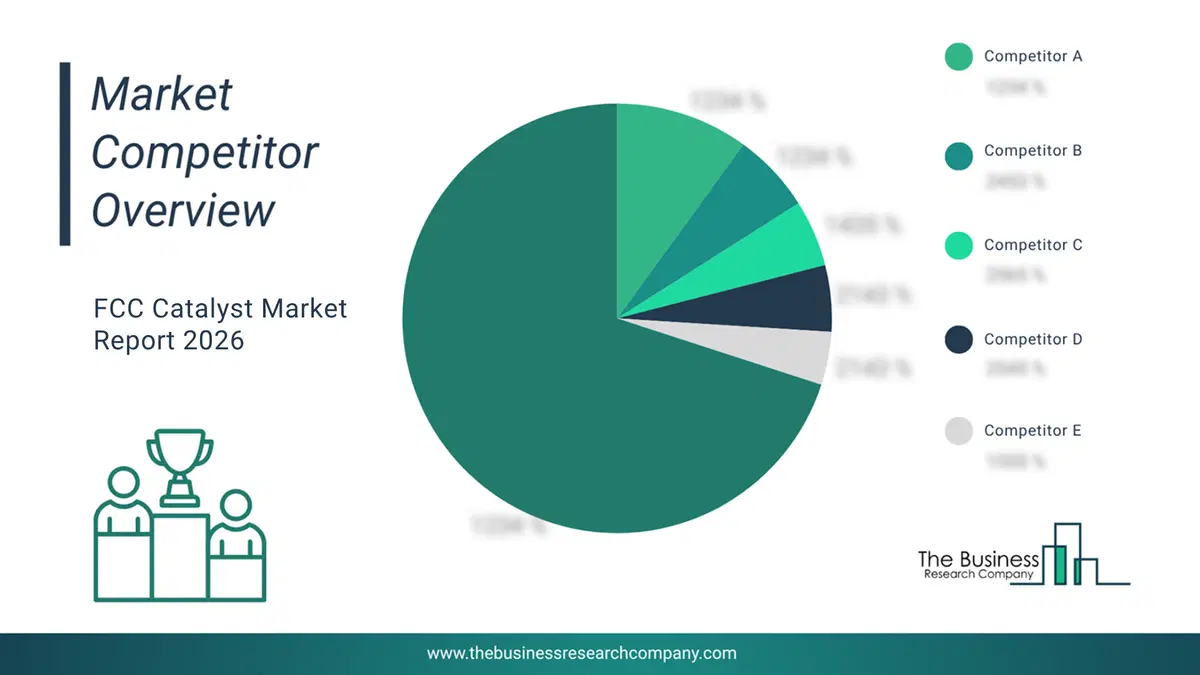
This chart is for illustrative purposes; the full report includes a detailed competitor analysis and comprehensive overview of the top 10 companies in the market.
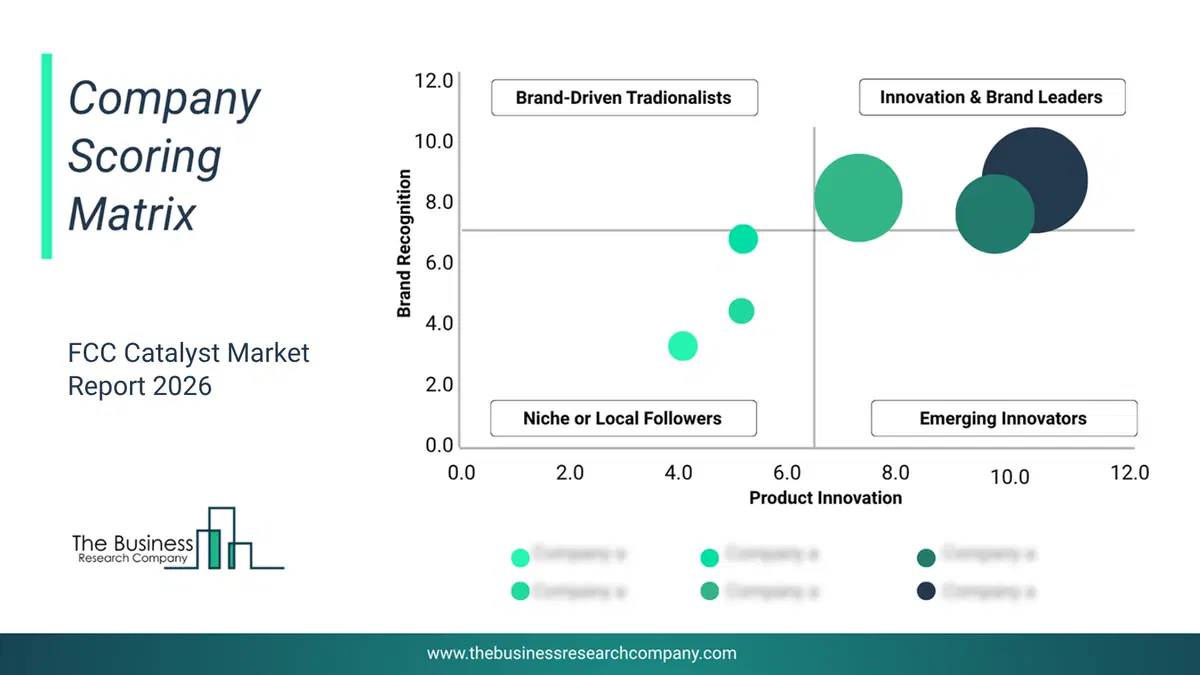
This chart maps companies by product innovation and brand strength, with bubble size indicating relative revenue, helping identify market leaders, challengers, and niche players. This is an illustrative chart; the full report provides a complete and accurate competitive analysis.
Global FCC Catalyst Market Trends and Insights
Major companies operating in the FCC catalyst market are focusing on developing advanced solutions such as rare earth-based vanadium trapping technology to enhance fuel yield efficiency and sustainability. Rare earth-based vanadium trapping technology captures and neutralizes vanadium contaminants in FCC units which improves metals tolerance and supports stable catalyst performance while enabling refiners to process heavier and higher metal laden feedstocks with better conversion. For instance, in October 2023, W. R. Grace & Co, a US-based company, launched the PARAGON FCC catalyst featuring a novel rare earth based vanadium trap integrated into high matrix surface area catalyst solutions. The catalyst widens the FCC operating window and increases feedstock flexibility for refiners. It enables maximum bottoms upgrading while maintaining constant coke yield. The technology improves conversion efficiency and supports higher fuel yields per unit of CO2 emission. It builds on the metals tolerance of Grace’s MIDAS catalyst platform and helps refiners produce transportation fuels in a more sustainable and profitable manner.What Are Latest Mergers And Acquisitions In The FCC Catalyst Market?
In February 2023, Rotating Machinery Services Inc, a US-based company that provides engineering, repair, and maintenance services for rotating machinery, acquired the fluid catalytic cracking unit (FCCU) Hot Gas Expander product line from Siemens Energy Inc. for an undisclosed amount. Through this acquisition, Rotating Machinery Services aims to integrate the intellectual property, inventory, and associated tooling of the FCCU Expander product line into its portfolio, reinforcing its position as the original equipment manufacturer (OEM) service provider for the global installed base of FCCU Hot Gas Expanders. Siemens Energy AG is a Germany-based company that provides hot gas expanders for FCC (fluid catalytic cracking) applications.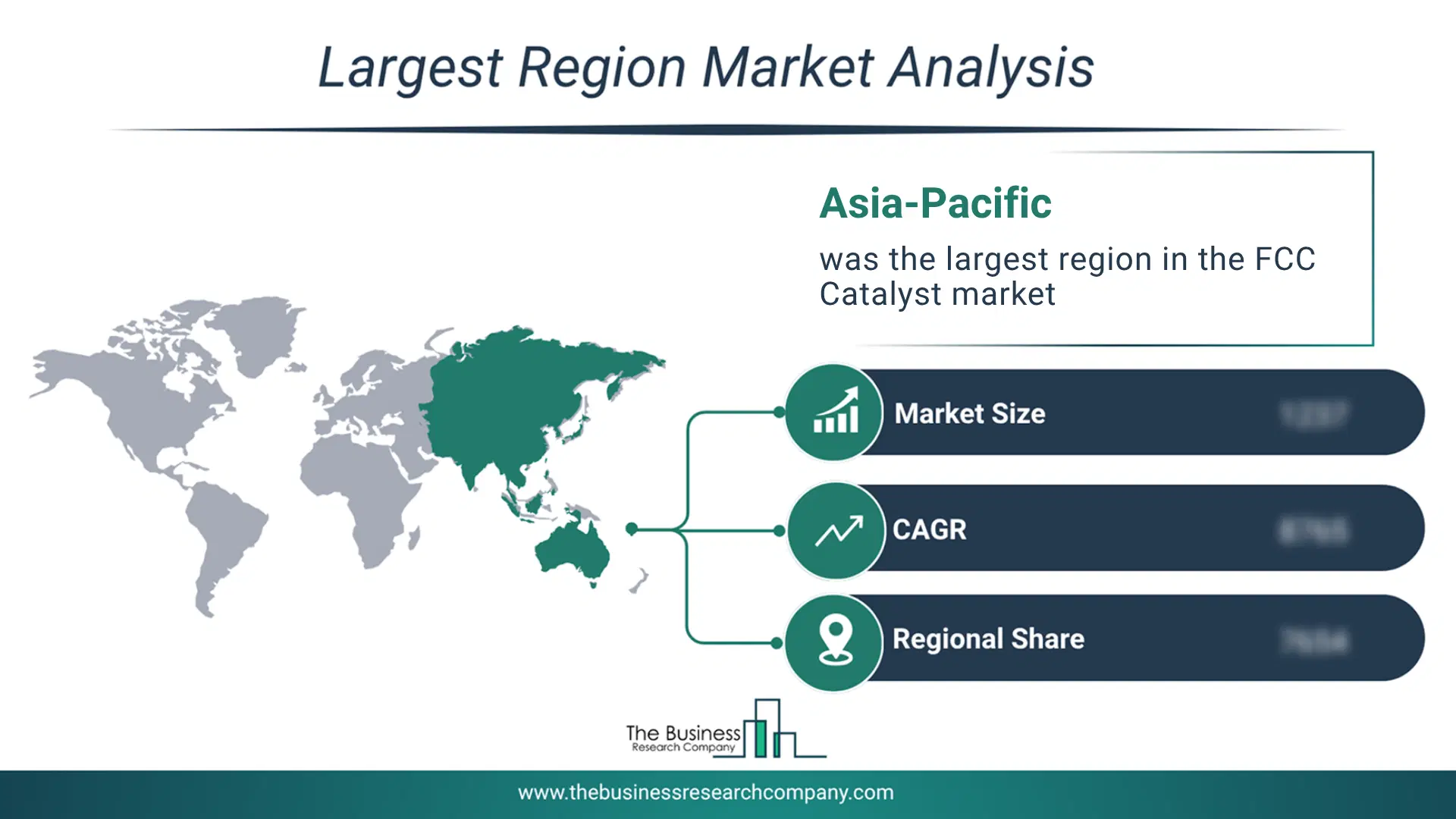
Regional Outlook
Asia-Pacific was the largest region in the FCC catalyst market in 2025. The regions covered in this market report are Asia-Pacific, South East Asia, Western Europe, Eastern Europe, North America, South America, Middle East, Africa. The countries covered in this market report are Australia, Brazil, China, France, Germany, India, Indonesia, Japan, Taiwan, Russia, South Korea, UK, USA, Canada, Italy, SpainWhat Defines the FCC Catalyst Market?
The fluid catalytic cracking (FCC) catalyst market consists of sales of crystalline zeolite, matrix, filler, and binder. Values in this market are ‘factory gate’ values, that is the value of goods sold by the manufacturers or creators of the goods, whether to other entities (including downstream manufacturers, wholesalers, distributors, and retailers) or directly to end customers. The value of goods in this market includes related services sold by the creators of the goods.How is Market Value Defined and Measured?
The market value is defined as the revenues that enterprises gain from the sale of goods and/or services within the specified market and geography through sales, grants, or donations in terms of the currency (in USD unless otherwise specified). The revenues for a specified geography are consumption values that are revenues generated by organizations in the specified geography within the market, irrespective of where they are produced. It does not include revenues from resales along the supply chain, either further along the supply chain or as part of other products.
This chart presents market attractiveness based on a quantitative evaluation of growth, competition, strategic alignment, and risk, offering a clear view of opportunity areas for decision-making. This chart is for illustrative purposes; the full report contains the complete analysis.

This chart highlights the Total Addressable Market (TAM) by estimating the maximum revenue opportunity using an assumption-driven approach, supporting strategic planning and opportunity sizing across markets. The chart is illustrative; the full report provides a more comprehensive analysis.
What Key Data and Analysis Are Included in the FCC Catalyst Market Report 2026?
The fcc catalyst market research report is one of a series of new reports from The Business Research Company that provides market statistics, including industry global market size, regional shares, competitors with the market share, detailed market segments, market trends and opportunities, and any further data you may need to thrive in the fcc catalyst industry. The market research report delivers a complete perspective of everything you need, with an in-depth analysis of the current and future state of the industry.FCC Catalyst Market Report Forecast Analysis
| Report Attribute | Details |
|---|---|
| Market Size Value In 2026 | $3.2 billion |
| Revenue Forecast In 2030 | $3.97 billion |
| Growth Rate | CAGR of 5.5% from 2026 to 2030 |
| Base Year For Estimation | 2025 |
| Actual Estimates/Historical Data | 2020-2025 |
| Forecast Period | 2026 - 2030 |
| Market Representation | Revenue in USD Billion and CAGR from 2026 to 2030 |
| Segments Covered | Product, Application, End-User |
| Regional Scope | Asia-Pacific, Western Europe, Eastern Europe, North America, South America, Middle East, Africa |
| Country Scope | The countries covered in the report are Australia, Brazil, China, France, Germany, India, Indonesia, Japan, Taiwan, Russia, South Korea, UK, USA, Canada, Italy, Spain. |
| Key Companies Profiled | Axens SA, N.E. Chemcat, Porocel Corporation, Yueyang Sciensun Chemical Co. Ltd., DuPont de Nemours Inc., Magma Ceramics & Catalysts, Albemarle Corporation, W.R. Grace Company, Johnson Matthey, Arkema S.A., BASF SE, Clariant AG, Haldor Topsoe, Zeolyst International, Nanjing Lantian Chemical, Qingdao Huadong Catalytic Agent Co. Ltd., Rive Technology, Wuxi Xuelang Chemical Technology, Nippon Ketjen Co. Ltd., Sumitomo Chemical Co. Ltd., Universal Oil Products, PetroChina Catalyst Company, Grace Catalysts Technologies |
| Customization Scope | Request for Customization |
| Pricing And Purchase Options | Explore Purchase Options |