
Ferroelectric Memory-Display Market Report 2026
Global Outlook – By Product Type ( Non-Volatile Ferroelectric Memory, Ferroelectric Display Panels, Integrated Memory-Display Modules, Other Product Types), By Technology Type ( Ferroelectric Random-Access Memory (FeRAM), Ferroelectric Field-Effect Transistor (FeFet), Ferroelectric Liquid Crystal Display (LCD), Other Technologies), By Application ( Consumer Electronics, Automotive, Industrial, Healthcare, Aerospace And Defense, Other Applications), By End-User ( Original Equipment Manufacturers (OEMs), Original Design Manufacturers (ODMs), Research Institutes, Other End-Users) – Market Size, Trends, Strategies, and Forecast to 2030
Ferroelectric Memory-Display Market Overview
• Ferroelectric Memory-Display market size has reached to $1.45 billion in 2025 • Expected to grow to $3.09 billion in 2030 at a compound annual growth rate (CAGR) of 16.3% • Growth Driver: The Expansion Of Internet Of Things (IoT) Devices Driving The Market Growth Due To Increasing Edge Processing Requirements • North America was the largest region in 2025 and Asia-Pacific is the fastest growing region.What Is Covered Under Ferroelectric Memory-Display Market?
Ferroelectric memory-display is a technology that integrates non-volatile ferroelectric memory with display capability in a single material system. It utilizes the polarization states of ferroelectric materials to store data while also controlling visual output. The integration allows the creation of compact and energy-efficient devices that merge memory and display functions, supporting advanced applications in portable electronics, embedded systems, and multifunctional smart technologies. The main product types of ferroelectric memory-display are non-volatile ferroelectric memory, ferroelectric display panels, integrated memory-display modules, and other product types. Non-volatile ferroelectric memory (FeRAM) is a type of memory that uses a ferroelectric layer to store data, providing fast writes, low power consumption, and high endurance. They integrate technologies such as ferroelectric random-access memory (FeRAM), ferroelectric field-effect transistor (FeFET), ferroelectric liquid crystal display (LCD), and other technologies. They are used for applications including consumer electronics, automotive, industrial, healthcare, aerospace and defense, and other applications, and are utilized by end-users including original equipment manufacturers (OEMs), original design manufacturers (ODMs), research institutes, and other organizations.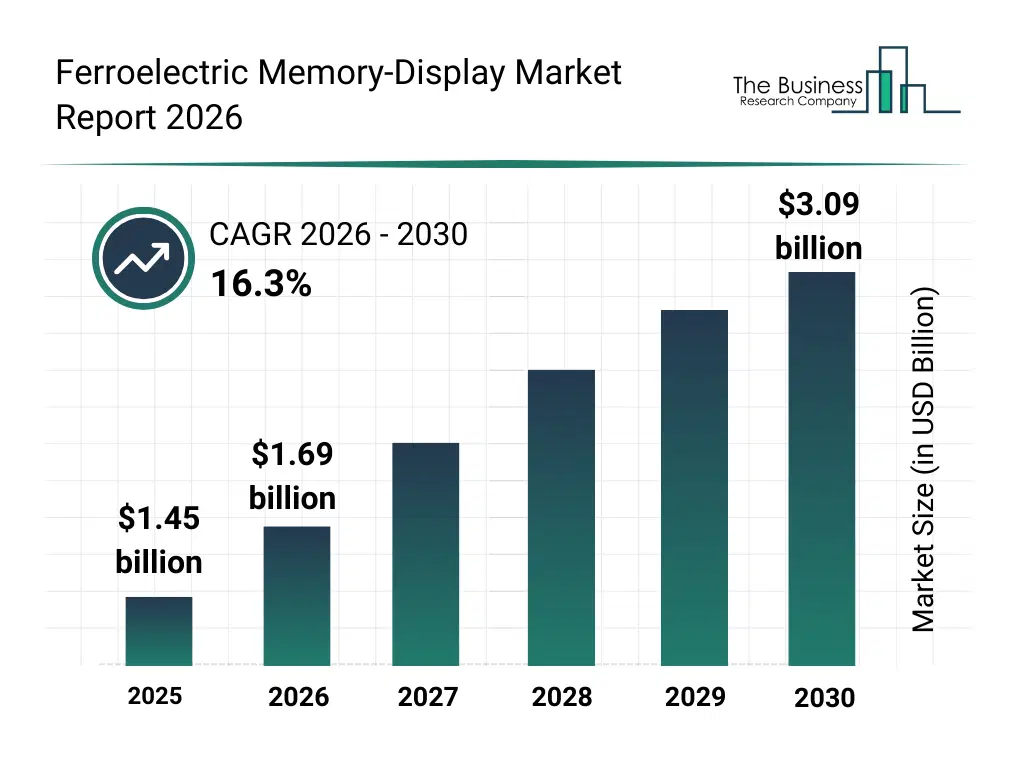
What Is The Ferroelectric Memory-Display Market Size 2026 And Growth Rate?
The ferroelectric memory-display market size has grown rapidly in recent years. It will grow from $1.45 billion in 2025 to $1.69 billion in 2026 at a compound annual growth rate (CAGR) of 16.4%. The growth in the historic period can be attributed to miniaturization of electronic components, early adoption of ferroelectric materials in memory devices, demand for non-volatile memory solutions, growth in portable electronic devices, advancements in thin-film deposition techniques.What Is The Ferroelectric Memory-Display Market Growth Forecast?
The ferroelectric memory-display market size is expected to see rapid growth in the next few years. It will grow to $3.09 billion in 2030 at a compound annual growth rate (CAGR) of 16.3%. The growth in the forecast period can be attributed to rising demand for ultra-low power electronics, increased integration of memory and display systems, growing adoption in automotive human machine interfaces, expansion of smart embedded systems, continuous innovation in ferroelectric material engineering. Major trends in the forecast period include integration of memory and display functionalities in single ferroelectric material systems, growing adoption of non-volatile low-power display-memory architectures, advancements in thin-film ferroelectric materials for higher durability, increasing demand for compact multifunctional electronic components, enhanced data retention and faster switching in ferroelectric memory-displays.
Global Ferroelectric Memory-Display Market Segmentation
1) By Product Type: Non-Volatile Ferroelectric Memory, Ferroelectric Display Panels, Integrated Memory-Display Modules, Other Product Types 2) By Technology Type: Ferroelectric Random-Access Memory (FeRAM), Ferroelectric Field-Effect Transistor (FeFet), Ferroelectric Liquid Crystal Display (LCD), Other Technologies 3) By Application: Consumer Electronics, Automotive, Industrial, Healthcare, Aerospace And Defense, Other Applications 4) By End-User: Original Equipment Manufacturers (OEMs), Original Design Manufacturers (ODMs), Research Institutes, Other End-Users Subsegments: 1) By Non-Volatile Ferroelectric Memory: Capacitor-Based Ferroelectric Memory, Thin-Film Ferroelectric Memory, Polymer Ferroelectric Memory, Hybrid Ferroelectric Memory 2) By Ferroelectric Display Panels: Liquid Crystal Ferroelectric Display Panels, Thin-Film Ferroelectric Display Panels, Active Matrix Ferroelectric Display Panels, Flexible Ferroelectric Display Panels 3) By Integrated Memory-Display Modules: Embedded Ferroelectric Memory Modules, Standalone Memory-Display Integrated Modules, Hybrid Memory-Display Modules, Custom Integrated Ferroelectric Modules 4) By Other Product Types: Ferroelectric Sensor Modules, Ferroelectric Actuator Modules, Ferroelectric Logic Devices, Specialty Ferroelectric ComponentsWhat Is The Driver Of The Ferroelectric Memory-Display Market?
The expansion of internet of things (IoT) devices is expected to propel the growth of the ferroelectric memory-display market going forward. Internet of things (IoT) devices are interconnected physical devices embedded with sensors, software, and connectivity that enable them to collect and exchange data over the internet. The adoption of IoT devices is growing due to digital transformation initiatives that encourage organizations to connect physical assets, automate processes, and make data-driven decisions. Ferroelectric memory-display (fe-memory display) supports IoT devices by providing fast, low-power, and non-volatile visual data storage, enabling real-time monitoring, efficient energy usage, and seamless integration of smart displays into connected systems. For instance, in December 2024, according to Ericsson, a a Sweden-based telecommunications and networking technology company, The total number of global IoT connections is expected to approach 4 billion by the end of 2024. Therefore, the expansion of internet of things (IoT) devices is driving the growth of the ferroelectric memory-display industry.What Is The Driver Of The Ferroelectric Memory-Display Market?
The rising demand for high-speed data processing is expected to propel the growth of the ferroelectric memory-display market going forward. High-speed data processing refers to the capability of computing systems to rapidly analyze, store, and retrieve large volumes of data in real-time or near-real-time. The demand for high-speed data processing is increasing due to the exponential growth in data generation from artificial intelligence applications, which require rapid analysis, real-time decision-making, and efficient handling of massive datasets. Ferroelectric memory-display, with its ultra-fast read and write speeds, low power consumption, and non-volatile storage capabilities, supports high-speed data processing by enabling rapid access to large datasets and efficient real-time computation required for advanced applications such as artificial intelligence and edge computing. For instance, in May 2025, according to Cloudzero, a USA-based cloud cost intelligence and optimization platform that helps companies manage, analyze, and reduce their cloud, SaaS, and AI spending, end-user spending on public cloud services worldwide is forecasted to total $723.4 billion in 2025. This is up from $595.7 billion in 2024, and is driven by the increasing adoption of AI and hybrid cloud strategies. Therefore, the rising demand for high-speed data processing is driving the growth of the ferroelectric memory-display industry.What Is The Driver Of The Ferroelectric Memory-Display Market?
The growth of smart city initiatives is expected to propel the growth of the ferroelectric memory-display market going forward. Smart city initiatives involve the integration of digital technologies and data-driven solutions to enhance urban living, sustainability, and efficiency. Smart city initiatives are rising as cities adopt technology and data-driven solutions to improve efficiency, sustainability, and the quality of urban life, enabling better traffic management, energy optimization, waste reduction, public safety, and enhanced citizen services through connected infrastructure and real-time data analysis. Smart city initiatives support the adoption of ferroelectric memory-displays by creating a demand for energy-efficient, high-performance, and durable display technologies that can reliably manage real-time data visualization, interactive interfaces, and low-power operations across smart transportation, public safety, and utility management systems. For instance, in December 2024, according to the UN-Habitat, a Kenya-based UN agency responsible for promoting sustainable towns and cities with the goal of providing adequate shelter for all, 69% of municipalities globally now have a strategic agenda for smart city development, and 81% of nations have adopted nationwide digital development or e-government plans as of 2024. Therefore, the growth of smart city initiatives is driving the growth of the ferroelectric memory-display industry.Key Players In The Global Ferroelectric Memory-Display Market
Major companies operating in the ferroelectric memory-display market are Samsung Electronics Co. Ltd., Panasonic Corporation, Intel Corporation, Fujitsu Limited, SK Hynix Inc., Toshiba Corporation, Texas Instruments Incorporated, Infineon Technologies AG, Sharp Corporation, Micron Technology Inc., Murata Manufacturing Co. Ltd., Seiko Epson Corporation, GlobalFoundries Inc., Kopin Corporation, ROHM Co. Ltd., Citizen Fine Device Co. Ltd., Ferroelectric Memory Company (FMC), NaMLab gGmbH, Cerfe Labs, Neumonda
This chart is for illustrative purposes; the full report includes a detailed competitor analysis and comprehensive overview of the top 10 companies in the market.
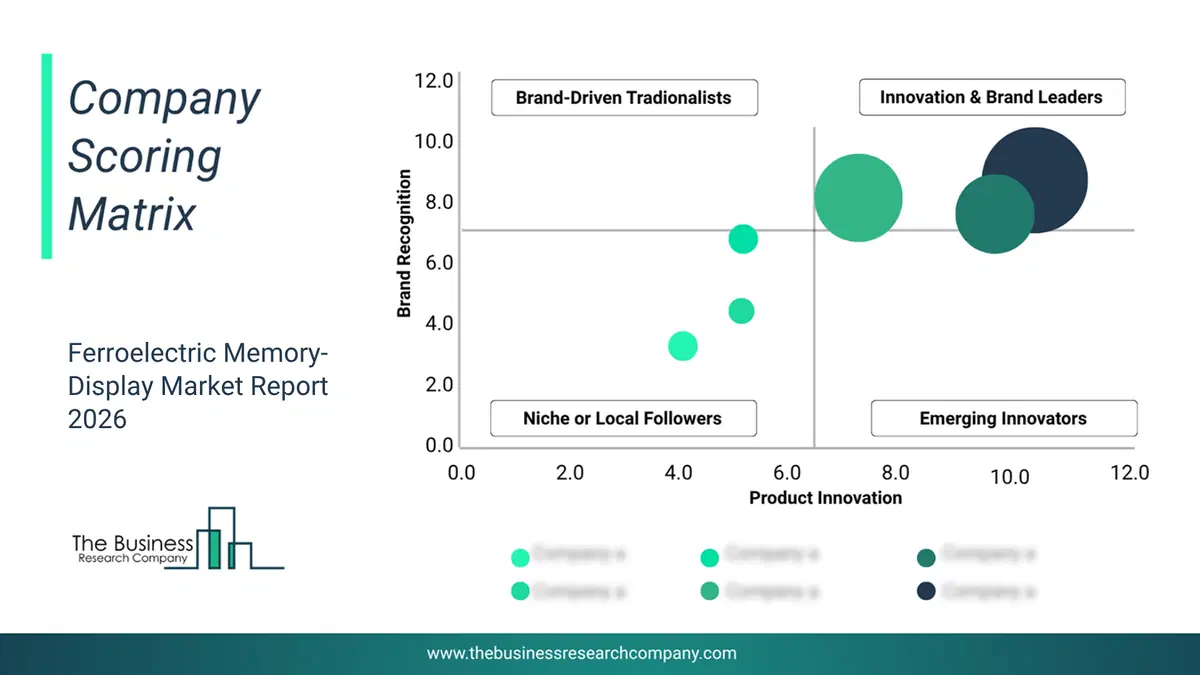
This chart maps companies by product innovation and brand strength, with bubble size indicating relative revenue, helping identify market leaders, challengers, and niche players. This is an illustrative chart; the full report provides a complete and accurate competitive analysis.
Regional Outlook
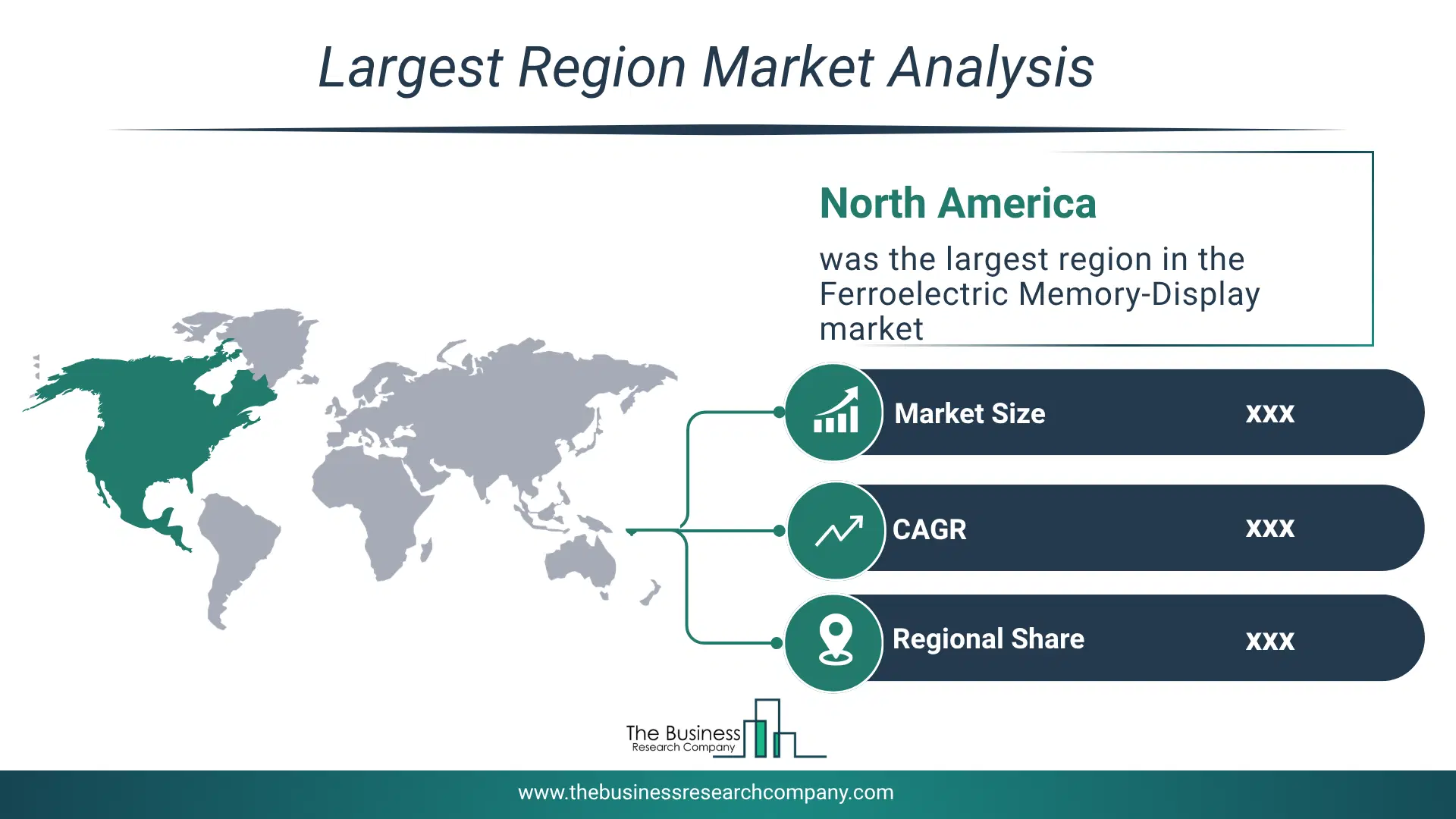
North America was the largest region in the ferroelectric memory-display market in 2025. Asia-Pacific is expected to be the fastest-growing region in the forecast period. The regions covered in this market report are Asia-Pacific, South East Asia, Western Europe, Eastern Europe, North America, South America, Middle East, Africa. The countries covered in this market report are Australia, Brazil, China, France, Germany, India, Indonesia, Japan, Taiwan, Russia, South Korea, UK, USA, Canada, Italy, Spain.What Defines the Ferroelectric Memory-Display Market?
The ferroelectric memory-display market consists of revenues earned by entities by providing services such as design and development, fabrication, material supply, licensing, packaging, assembly, and custom module design. The market value includes the value of related goods sold by the service provider or included within the service offering. The ferroelectric memory-display market also includes sales of ferroelectric materials and thin films, ferroelectric liquid crystal devices, photoferroelectrics imaging media, ferroelectric field-effect transistors (FeFETs) and hybrid devices, ferroelectric sensors and transducers. Values in this market are ‘factory gate’ values, that is the value of goods sold by the manufacturers or creators of the goods, whether to other entities (including downstream manufacturers, wholesalers, distributors and retailers) or directly to end customers. The value of goods in this market includes related services sold by the creators of the goods.How is Market Value Defined and Measured?
The market value is defined as the revenues that enterprises gain from the sale of goods and/or services within the specified market and geography through sales, grants, or donations in terms of the currency (in USD unless otherwise specified). The revenues for a specified geography are consumption values that are revenues generated by organizations in the specified geography within the market, irrespective of where they are produced. It does not include revenues from resales along the supply chain, either further along the supply chain or as part of other products.
This chart presents market attractiveness based on a quantitative evaluation of growth, competition, strategic alignment, and risk, offering a clear view of opportunity areas for decision-making. This chart is for illustrative purposes; the full report contains the complete analysis.

This chart highlights the Total Addressable Market (TAM) by estimating the maximum revenue opportunity using an assumption-driven approach, supporting strategic planning and opportunity sizing across markets. The chart is illustrative; the full report provides a more comprehensive analysis.
What Key Data and Analysis Are Included in the Ferroelectric Memory-Display Market Report 2026?
The ferroelectric memory-display market research report is one of a series of new reports from The Business Research Company that provides market statistics, including industry global market size, regional shares, competitors with the market share, detailed market segments, market trends and opportunities, and any further data you may need to thrive in the ferroelectric memory-display industry. The market research report delivers a complete perspective of everything you need, with an in-depth analysis of the current and future state of the industry.Ferroelectric Memory-Display Market Report Forecast Analysis
| Report Attribute | Details |
|---|---|
| Market Size Value In 2026 | $1.69 billion |
| Revenue Forecast In 2030 | $3.09 billion |
| Growth Rate | CAGR of 16.3% from 2026 to 2030 |
| Base Year For Estimation | 2025 |
| Actual Estimates/Historical Data | 2020-2025 |
| Forecast Period | 2026 - 2030 |
| Market Representation | Revenue in USD Billion and CAGR from 2026 to 2030 |
| Segments Covered | Product Type, Technology Type, Application, End-User |
| Regional Scope | Asia-Pacific, Western Europe, Eastern Europe, North America, South America, Middle East, Africa |
| Country Scope | The countries covered in the report are Australia, Brazil, China, France, Germany, India, Indonesia, Japan, Taiwan, Russia, South Korea, UK, USA, Canada, Italy, Spain. |
| Key Companies Profiled | Samsung Electronics Co. Ltd., Panasonic Corporation, Intel Corporation, Fujitsu Limited, SK Hynix Inc., Toshiba Corporation, Texas Instruments Incorporated, Infineon Technologies AG, Sharp Corporation, Micron Technology Inc., Murata Manufacturing Co. Ltd., Seiko Epson Corporation, GlobalFoundries Inc., Kopin Corporation, ROHM Co. Ltd., Citizen Fine Device Co. Ltd., Ferroelectric Memory Company (FMC), NaMLab gGmbH, Cerfe Labs, Neumonda |
| Customization Scope | Request for Customization |
| Pricing And Purchase Options | Explore Purchase Options |