
Fiber-Laser Naval Close-In Weapon System Market Report 2026
Global Outlook – By Component (Laser Source, Beam Control System, Fire Control System, Power Supply, Cooling System, Other Components), By Platform (Destroyers, Frigates, Corvettes, Aircraft Carriers, Other Platforms), By Range (Short Range, Medium Range, Long Range), By Application (Defense, Homeland Security, Other Applications), By End-User (Naval Forces, Coast Guard, Other End-Users) – Market Size, Trends, Strategies, and Forecast to 2030
Fiber-Laser Naval Close-In Weapon System Market Overview
• Fiber-Laser Naval Close-In Weapon System market size has reached to $1.94 billion in 2025 • Expected to grow to $4.35 billion in 2030 at a compound annual growth rate (CAGR) of 17.4% • Growth Driver: The Rise In Geopolitical Tensions Driving The Growth Of The Market Due To Enhanced Maritime Defense And Strategic Deterrence • Market Trend: Next-Generation Shipboard Laser Technology Promises Rapid, Precise Defense Against Aerial Threats • North America was the largest region in 2025 and Asia-Pacific is the fastest growing region.What Is Covered Under Fiber-Laser Naval Close-In Weapon System Market?
A fiber-laser naval close-in weapon system is a shipboard defense system that employs high-powered fiber lasers to detect, track, and neutralize incoming threats at close range, including missiles, drones, small boats, and aircraft. This system directs a concentrated laser beam with precision to damage or destroy targets rapidly, offering a non-kinetic alternative to traditional gun- or missile-based CIWS. Fiber-laser technology provides high beam quality, long operational life, and reduced logistical demands, enabling efficient, cost-effective, and responsive protection of naval vessels against modern asymmetric and high-speed threats in maritime environments. The main components of a fiber-laser naval close-in weapon system are the laser source, beam control system, fire control system, power supply, cooling system, and other components. The laser source is the subsystem that generates and amplifies coherent laser radiation, typically a high-power fiber-optic laser module providing the directed-energy beam used for target engagement and interception. These systems are deployed on platforms such as destroyers, frigates, corvettes, aircraft carriers, and other platforms and operate across short, medium, and long ranges. Typical applications include defense, homeland security, and other applications. with end users including naval forces, the coast guard, and other end users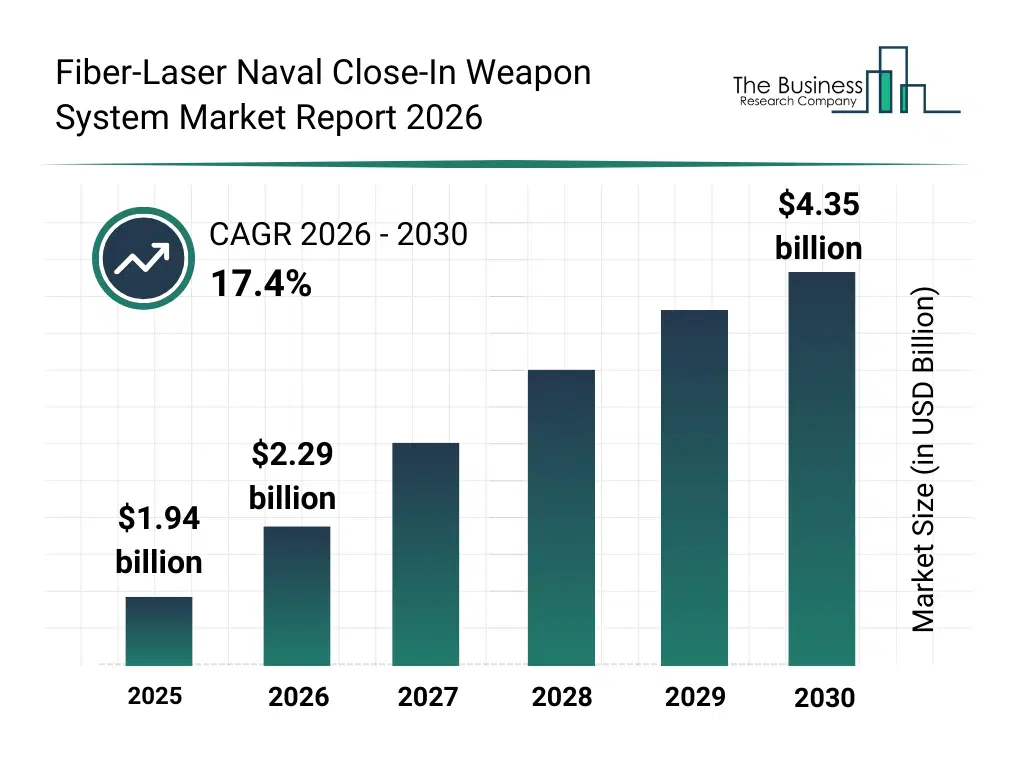
What Is The Fiber-Laser Naval Close-In Weapon System Market Size and Share 2026?
The fiber-laser naval close-in weapon system market size has grown rapidly in recent years. It will grow from $1.94 billion in 2025 to $2.29 billion in 2026 at a compound annual growth rate (CAGR) of 17.7%. The growth in the historic period can be attributed to rising naval threats from small boats and drones, adoption of fiber-laser technology in naval defense, advancements in high-power fiber lasers, need for cost-effective non-kinetic solutions, integration of laser systems with advanced fire control.What Is The Fiber-Laser Naval Close-In Weapon System Market Growth Forecast?
The fiber-laser naval close-in weapon system market size is expected to see rapid growth in the next few years. It will grow to $4.35 billion in 2030 at a compound annual growth rate (CAGR) of 17.4%. The growth in the forecast period can be attributed to increase in power and range of fiber lasers, deployment on new generation naval vessels, integration with autonomous threat detection systems, expansion in global naval modernization programs, improvements in cooling and energy efficiency systems. Major trends in the forecast period include advancements in high-energy fiber-laser power scaling, integration of multi-threat engagement capabilities, enhanced maritime thermal management solutions, miniaturization and modularity of laser ciws components, increased adoption of all-electric ship combat systems.
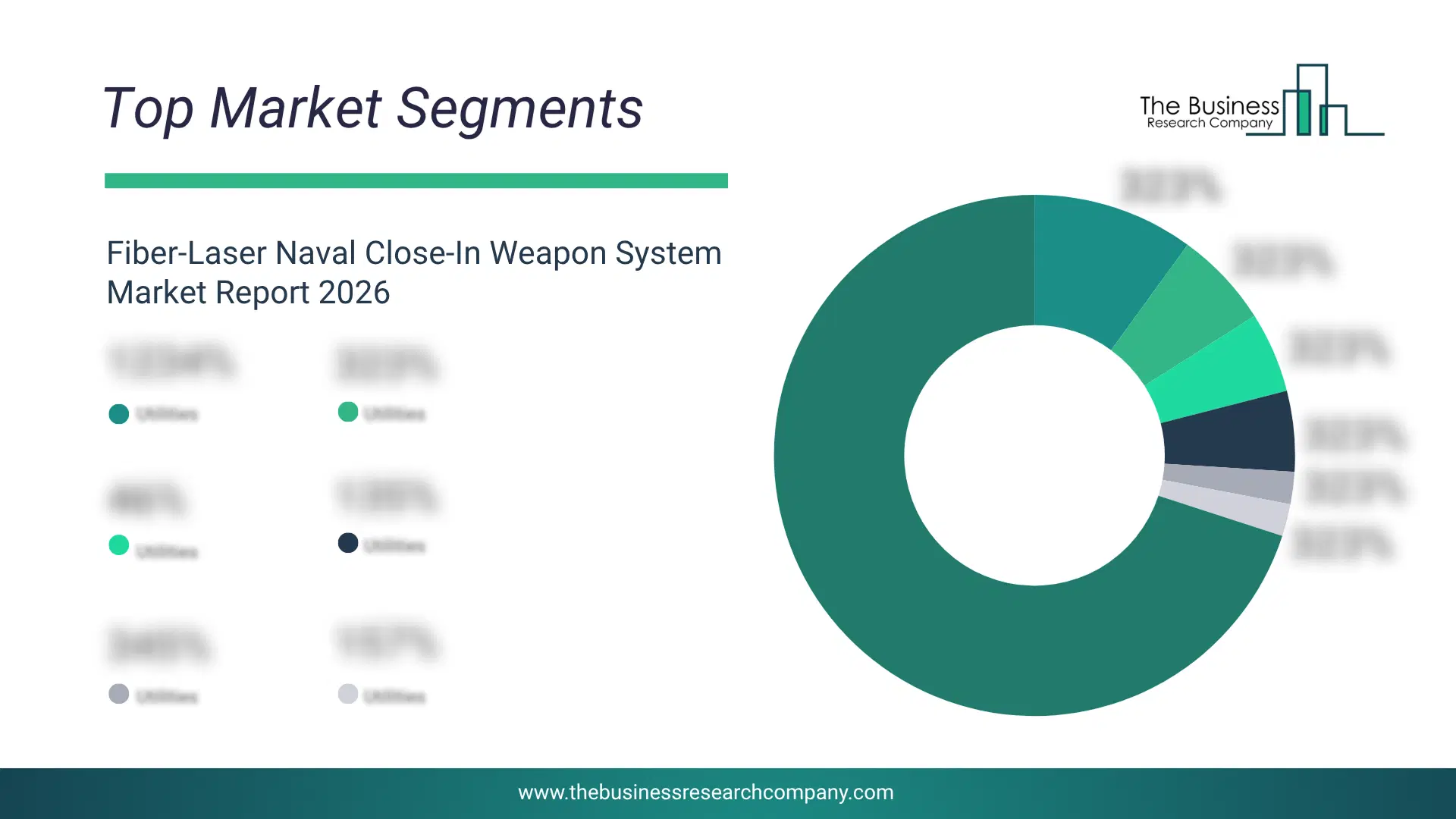
Global Fiber-Laser Naval Close-In Weapon System Market Segmentation
1) By Component: Laser Source, Beam Control System, Fire Control System, Power Supply, Cooling System, Other Components 2) By Platform: Destroyers, Frigates, Corvettes, Aircraft Carriers, Other Platforms 3) By Range: Short Range, Medium Range, Long Range 4) By Application: Defense, Homeland Security, Other Applications 5) By End-User: Naval Forces, Coast Guard, Other End-Users Subsegments: 1) By Laser Source: Solid State Laser, Gas Laser, Semiconductor Laser, Free Electron Laser 2) By Beam Control System: Adaptive Optics System, Beam Steering System, Target Tracking System, Beam Stabilization System 3) By Fire Control System: Target Acquisition System, Weapon Aiming System, Engagement Management System, Sensor Integration System 4) By Power Supply: Battery Power Supply, Generator Power Supply, Capacitor Based Power Supply, Hybrid Power Supply 5) By Cooling System: Liquid Cooling System, Air Cooling System, Cryogenic Cooling System, Thermoelectric Cooling System 6) By Other Components: Safety Mechanisms, Diagnostic Systems, Communication Interfaces, Structural ComponentsWhat Is Driver Of The Fiber-Laser Naval Close-In Weapon System Market?
The rising geopolitical tensions are expected to propel the growth of the fiber-laser naval close-in weapon system market going forward. Geopolitical tensions refer to the strain or conflict between countries or regions arising from political, economic, territorial, or strategic interests that affect international relations and global stability. Rising geopolitical tensions are due to territorial disputes, as competing claims over land or maritime boundaries create conflicts of interest between nations, escalating political and military friction. The fiber-laser naval close-in weapon system enhances a nation’s maritime defense capabilities, serving as a strategic deterrent that helps manage and contain geopolitical tensions. For instance, in January 2025, according to Euronews SA, a France-based television network, in 2024, global conflicts intensified, with political violence increasing by 25% compared to 2023, affecting one in eight people and resulting in around 223,000 deaths, alongside a 37% rise in overall fatalities. Therefore, the rising geopolitical tensions are driving the growth of the fiber-laser naval close-in weapon system industry.Key Players In The Global Fiber-Laser Naval Close-In Weapon System Market
Major companies operating in the fiber-laser naval close-in weapon system market are Boeing Defense Space And Security, Raytheon Technologies Corporation, Lockheed Martin Corporation, China North Industries Group Corporation, Northrop Grumman Corporation, Thales Group, Leonardo Società per Azioni, Rheinmetall AG, Hanwha Aerospace, Elbit Systems Ltd., Saab AB, Naval Group, Coherent Aerospace and Defense Inc., Rafael Advanced Defense Systems Ltd., ASELSAN A.S., MBDA Missile Systems, General Atomics, Hanwha Defense, IPG Photonics Corporation, Jenoptik AG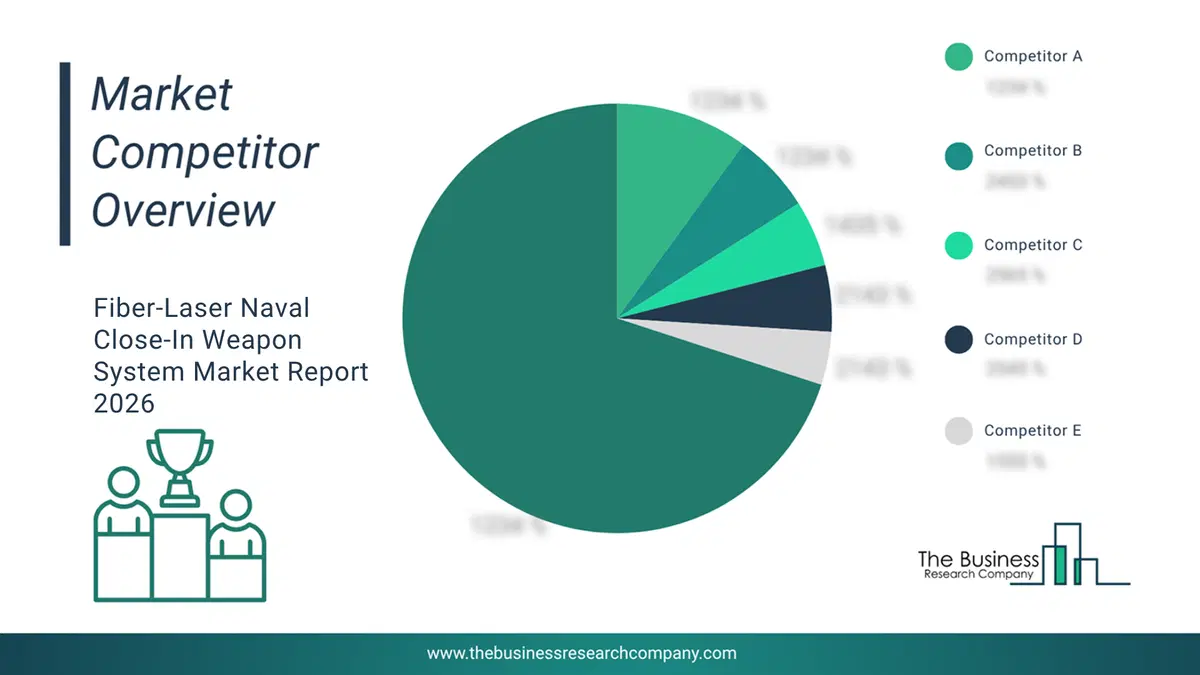
This chart is for illustrative purposes; the full report includes a detailed competitor analysis and comprehensive overview of the top 10 companies in the market.
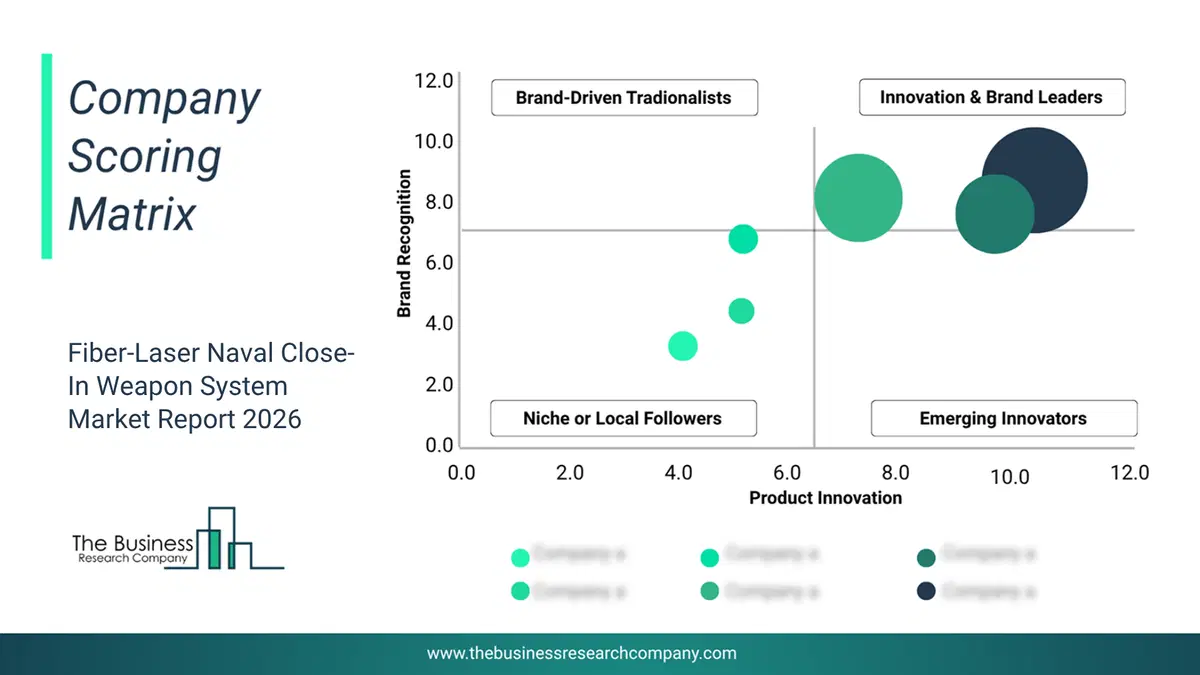
This chart maps companies by product innovation and brand strength, with bubble size indicating relative revenue, helping identify market leaders, challengers, and niche players. This is an illustrative chart; the full report provides a complete and accurate competitive analysis.
Global Fiber-Laser Naval Close-In Weapon System Market Trends and Insights
Major companies operating in the fiber-laser naval close-in weapon system market are focusing on developing innovative solutions, such as high-powered pulsed fiber lasers, to enhance ship defense against drones, missiles, and other aerial threats. High-powered pulsed fiber lasers are advanced lasers that emit intense bursts of light through optical fibers, allowing precise, long-range targeting of fast-moving threats like drones and missiles. For instance, in July 2025, the United States Navy, a US-based military partnered with Coherent Aerospace and Defense Inc., a US-based aerospace and defense company, to launch the SONGBOW project, a shipboard laser system designed to counter drone swarms, cruise missiles, and advanced aerial threats. The system integrates multiple pulsed fiber laser modules into a single precision-guided beam, offering scalable power output, advanced beam control, and continuous operation as long as shipboard power is available. It also supports additional functions such as remote sensing and situational awareness, providing versatile defense capabilities for modern naval vessels.What Are Latest Mergers And Acquisitions In The Fiber-Laser Naval Close-In Weapon System Market? Rheinmetall And MBDA Deutschland Partner To Advance Maritime Laser Weapon Systems For Naval Drone Defense
In September 2024, Rheinmetall AG, a Germany-based arms manufacturer that is developing and testing shipboard high-energy laser weapons, partnered with MBDA Deutschland to continue their successful co-operation in the field of laser weapons. This partnership aims to develop and bring to market a cost-effective maritime laser weapon system within the next five to six years, specifically to enhance drone defense capabilities on naval ships using their complementary laser weapon technologies. MBDA Deutschland GmbH is a Germany-based defense industry company that develops, manufactures, and provides customer and product support for guided missile systems.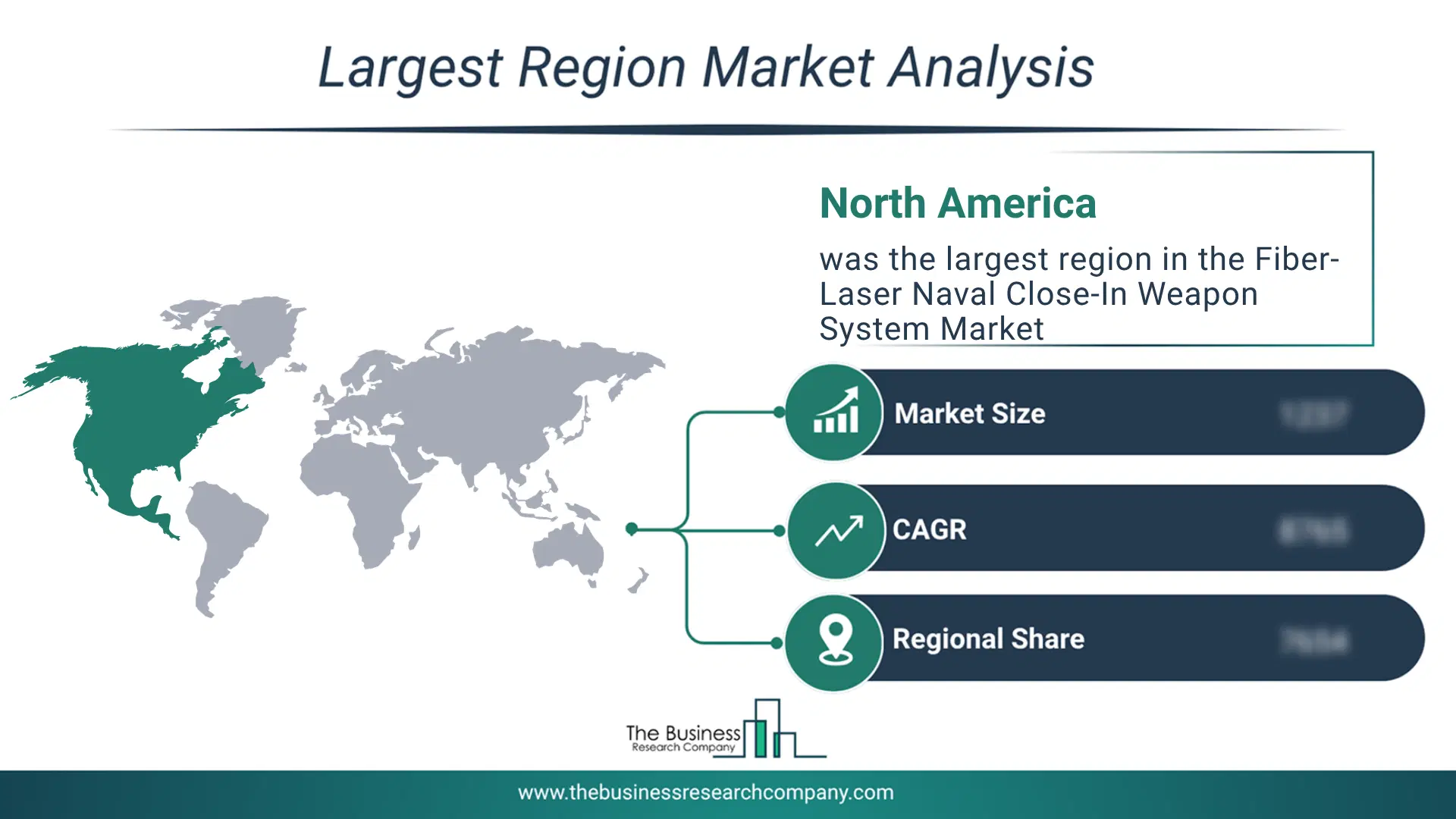
Regional Insights
North America was the largest region in the fiber-laser naval close-in weapon system market in 2025. Asia-Pacific is expected to be the fastest-growing region in the forecast period. The regions covered in this market report are Asia-Pacific, South East Asia, Western Europe, Eastern Europe, North America, South America, Middle East, Africa. The countries covered in this market report are Australia, Brazil, China, France, Germany, India, Indonesia, Japan, Taiwan, Russia, South Korea, UK, USA, Canada, Italy, SpainWhat Defines the Fiber-Laser Naval Close-In Weapon System Market?
The fiber-laser naval close-in weapon system market consists of sales of fiber-laser cannons, fire control systems, power supply units, cooling systems, and ammunition and support modules. Values in this market are ‘factory gate’ values; that is, the value of goods sold by the manufacturers or creators of the goods, whether to other entities (including downstream manufacturers, wholesalers, distributors, and retailers) or directly to end customers. The value of goods in this market includes related services sold by the creators of the goods.How is Market Value Defined and Measured?
The market value is defined as the revenues that enterprises gain from the sale of goods and/or services within the specified market and geography through sales, grants, or donations in terms of the currency (in USD unless otherwise specified). The revenues for a specified geography are consumption values that are revenues generated by organizations in the specified geography within the market, irrespective of where they are produced. It does not include revenues from resales along the supply chain, either further along the supply chain or as part of other products.
This chart presents market attractiveness based on a quantitative evaluation of growth, competition, strategic alignment, and risk, offering a clear view of opportunity areas for decision-making. This chart is for illustrative purposes; the full report contains the complete analysis.

This chart highlights the Total Addressable Market (TAM) by estimating the maximum revenue opportunity using an assumption-driven approach, supporting strategic planning and opportunity sizing across markets. The chart is illustrative; the full report provides a more comprehensive analysis.
What Key Data and Analysis Are Included in the Fiber-Laser Naval Close-In Weapon System Market Report 2026?
The fiber-laser naval close-in weapon system market research report is one of a series of new reports from The Business Research Company that provides market statistics, including industry global market size, regional shares, competitors with the market share, detailed market segments, market trends and opportunities, and any further data you may need to thrive in the fiber-laser naval close-in weapon system industry. The market research report delivers a complete perspective of everything you need, with an in-depth analysis of the current and future state of the industry.Fiber-Laser Naval Close-In Weapon System Market Report Forecast Analysis
| Report Attribute | Details |
|---|---|
| Market Size Value In 2026 | $2.29 billion |
| Revenue Forecast In 2030 | $4.35 billion |
| Growth Rate | CAGR of 17.4% from 2026 to 2030 |
| Base Year For Estimation | 2025 |
| Actual Estimates/Historical Data | 2020-2025 |
| Forecast Period | 2026 - 2030 |
| Market Representation | Revenue in USD Billion and CAGR from 2026 to 2030 |
| Segments Covered | Component, Platform, Range, Application, End-User |
| Regional Scope | Asia-Pacific, Western Europe, Eastern Europe, North America, South America, Middle East, Africa |
| Country Scope | The countries covered in the fiber-laser naval close-in weapon system market report are Australia, Brazil, China, France, Germany, India, Indonesia, Japan, Taiwan, Russia, South Korea, UK, USA, Canada, Italy, Spain |
| Key Companies Profiled | Boeing Defense Space And Security, Raytheon Technologies Corporation, Lockheed Martin Corporation, China North Industries Group Corporation, Northrop Grumman Corporation, Thales Group, Leonardo Società per Azioni, Rheinmetall AG, Hanwha Aerospace, Elbit Systems Ltd., Saab AB, Naval Group, Coherent Aerospace and Defense Inc., Rafael Advanced Defense Systems Ltd., ASELSAN A.S., MBDA Missile Systems, General Atomics, Hanwha Defense, IPG Photonics Corporation, Jenoptik AG |
| Customization Scope | Request for Customization |
| Pricing And Purchase Options | Explore Purchase Options |