
Fiber Optic Components Market Report 2026
Global Outlook – By Type ( Cables, Active Optical Cables, Amplifiers, Splitters, Connectors, Circulators, Transceivers, Other Types), By Fiber Type ( Glass, Plastic), By Application ( Distributed Sensing, Analytical And Medical Equipment, Lighting, Communications) – Market Size, Trends, Strategies, and Forecast to 2035
Fiber Optic Components Market Overview
• Fiber Optic Components market size has reached to $30.14 billion in 2025 • Expected to grow to $48.15 billion in 2030 at a compound annual growth rate (CAGR) of 9.8% • Growth Driver: Rising Internet Demand Fueling The Growth Of The Market Due To Increasing Need For High-Speed Data Transmission And Connectivity • Market Trend: Technology Advancements In Fiber Optic Component Market • Asia-Pacific was the largest region and fastest growing region.What Is Covered Under Fiber Optic Components Market?
Fiber optic components refer to the components that are essential for the construction of a fiber optic cable. They are used in fiber optic cables to transmit information over long distances. The major types of fiber optical components are cables, active optical cables, amplifiers, splitters, connectors, circulators, transceivers, and others. A cable is an assembly of a thick wire or a group of wires that is covered with rubber or plastic. It is a conductor for sending optical or electrical signals for high-performance, long-distance networking, and connectivity. The fibers including glass and plastic are used in several applications such as distributed sensing, analytical and medical equipment, lighting, and communications.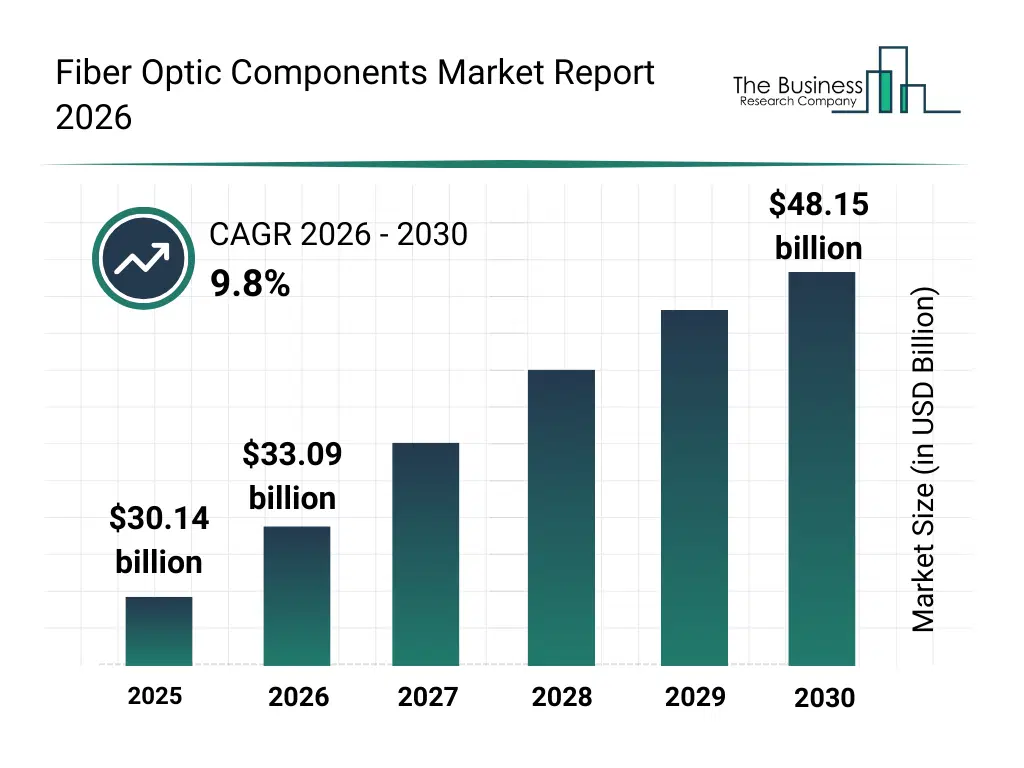
What Is The Fiber Optic Components Market Size 2026 And Growth Rate?
The fiber optic components market size has grown strongly in recent years. It will grow from $30.14 billion in 2025 to $33.09 billion in 2026 at a compound annual growth rate (CAGR) of 9.8%. The growth in the historic period can be attributed to growth in telecommunications infrastructure, rise in long-distance data transmission, early deployment of fiber-to-the-home networks, increased demand for high-speed internet, growing use of optical components in data centers.What Is The Fiber Optic Components Market Growth Forecast?
The fiber optic components market size is expected to see strong growth in the next few years. It will grow to $48.15 billion in 2030 at a compound annual growth rate (CAGR) of 9.8%. The growth in the forecast period can be attributed to increasing adoption of 5g and high-speed connectivity, expansion of hyperscale data centers, development of advanced optical amplification technologies, rising demand for fiber in smart city applications, growth in remote sensing and medical optical systems. Major trends in the forecast period include adoption of IoT-enabled fiber monitoring solutions, expansion of intelligent automated cable manufacturing, development of cloud-integrated optical communication platforms, advancement of AI-driven network optimization, growth of high-bandwidth immersive connectivity systems.
Global Fiber Optic Components Market Segmentation
1) By Type: Cables, Active Optical Cables, Amplifiers, Splitters, Connectors, Circulators, Transceivers, Other Types 2) By Fiber Type: Glass, Plastic 3) By Application: Distributed Sensing, Analytical And Medical Equipment, Lighting, Communications Subsegments: 1) By Cables: Single-Mode Fiber Cables, Multi-Mode Fiber Cables, Active Optical Cables 2) By Active Optical Cables: Fiber Active Optical Cables, Erbium-Doped Fiber Amplifiers (EDFA), Raman Amplifiers 3) Amplifiers: Erbium-Doped Fiber Amplifiers (EDFA), Raman Amplifiers 4) By Splitters: Optical Fiber Splitters (1), PLC Splitters 5) By Connectors: SC Connectors, LC Connectors, ST Connectors 6) By Circulators: 1-Port Circulators, 2-Port Circulators 7) By Transceivers: SFP (Small Form-Factor Pluggable) Transceivers, QSFP (Quad Small Form-Factor Pluggable) Transceivers 8) By Other Types: Patch Panels, Fiber Optic Splice ClosuresWhat Is The Driver Of The Fiber Optic Components Market?
The rising demand for the internet is expected to propel the fiber optic components market. Internet refers to a worldwide connected network system that helps communicate and access data resources. Internet demand is increasing due to the rapid expansion of digital services and online connectivity in daily life. Fiber optic is the backbone of the internet, as it acts as a medium to transmit more information at faster speeds too long distances. For instance, in November 2024, according to a report published by the International Telecommunication Union (ITU), a Switzerland-based specialized UN agency, in 2024 fully 5.5 billion people are online. That represents 68 per cent of the world population, compared with 65 per cent in 2023. The year-on-year growth rate is itself increasing, from 2.7 just one year ago to 3.4 per cent this year.Therefore, the rising demand for the internet is driving the fiber optic components industry.Key Players In The Global Fiber Optic Components Market
Major companies operating in the fiber optic components market are Coherent Corp., Lumentum Holdings Inc., Broadcom Inc., Sumitomo Electric Industries Ltd., Accelink Technologies Corporation, EMCORE Corporation, Fujitsu Optical Components Limited, The Furukawa Electric Co. Ltd., O-Net Technologies (Shenzhen) Group Co. Ltd., Reflex Photonics Inc., TE Connectivity Ltd., Fiber Mountain, MW Technologies LDA, Shenzhen Nokoxin Technology Co. Ltd., Amphenol Corporation, II-VI Incorporated, Prysmian Group, Yangtze Optical Fibre and Cable Joint Stock Limited Company, Fujikura Ltd., Corning Incorporated, FiberHome Telecommunication Technologies Co. Ltd.Global Fiber Optic Components Market Trends and Insights
Major companies operating in the fiber optic component market are concentrating on creating new technology advancements such as photonics analyzer. A photonics analyzer is a piece of optical equipment used to study and measure light waves and optical components. For instance, in February 2023, Santec, a Japan-based manufacturer of advanced optical components, tunable lasers, optical test equipment and OCT systems, launched the Swept Photonics Analyzer (SPA-100). The unique features of SPA-100 involve employing optical frequency domain reflectometry (OFDR) technology to test tiny fiber optic and photonic devices for insertion and return loss with a spatial resolution greater than 5um. The SPA-100 makes the technology ideal for evaluating small devices such as silicon photonic circuits, fiber optic components, and compact fiber optic assemblies.What Are Latest Mergers And Acquisitions In The Fiber Optic Components Market?
In November 2023, Lumentum, a US-based provider of optical and photonic products and subsystems, acquired Cloud Light for $750 million. This acquisition enhances Lumentum’s capabilities in high-speed optical transceivers and photonic components for data centers and AI infrastructure, expands its portfolio with 400G and 800G optical modules, and strengthens its position as a leading provider of fiber-optic components and network interconnect solutions. Cloud Light is a China-based provider of high-speed optical transceivers, active optical cables, and fiber-optic modules used in data center interconnects and optical communication networks.Regional Outlook
Asia-Pacific was the largest region in the fiber optic components market share in 2025, and is expected to be the fastest-growing region in the forecast period. The regions covered in this market report are Asia-Pacific, South East Asia, Western Europe, Eastern Europe, North America, South America, Middle East, Africa. The countries covered in this market report are Australia, Brazil, China, France, Germany, India, Indonesia, Japan, Taiwan, Russia, South Korea, UK, USA, Canada, Italy, Spain.What Defines the Fiber Optic Components Market?
The fiber optic components market consists of sales of cladding, coating, core, cable jacket, and strengthening fibers. Values in this market are ‘factory gate’ values, that is the value of goods sold by the manufacturers or creators of the goods, whether to other entities (including downstream manufacturers, wholesalers, distributors and retailers) or directly to end customers. The value of goods in this market includes related services sold by the creators of the goods.How is Market Value Defined and Measured?
The market value is defined as the revenues that enterprises gain from the sale of goods and/or services within the specified market and geography through sales, grants, or donations in terms of the currency (in USD unless otherwise specified). The revenues for a specified geography are consumption values that are revenues generated by organizations in the specified geography within the market, irrespective of where they are produced. It does not include revenues from resales along the supply chain, either further along the supply chain or as part of other products.What Key Data and Analysis Are Included in the Fiber Optic Components Market Report 2026?
The fiber optic components market research report is one of a series of new reports from The Business Research Company that provides market statistics, including industry global market size, regional shares, competitors with the market share, detailed market segments, market trends and opportunities, and any further data you may need to thrive in the fiber optic components industry. The market research report delivers a complete perspective of everything you need, with an in-depth analysis of the current and future state of the industry.Fiber Optic Components Market Report 2026 Market Report Forecast Analysis
| Report Attribute | Details |
|---|---|
| Market Size Value In 2026 | $33.09 billion |
| Revenue Forecast In 2035 | $48.15 billion |
| Growth Rate | CAGR of 9.8% from 2026 to 2035 |
| Base Year For Estimation | 2025 |
| Actual Estimates/Historical Data | 2020-2025 |
| Forecast Period | 2026 - 2030 - 2035 |
| Market Representation | Revenue in USD Billion and CAGR from 2026 to 2035 |
| Segments Covered | Type, Fiber Type, Application |
| Regional Scope | Asia-Pacific, Western Europe, Eastern Europe, North America, South America, Middle East, Africa |
| Country Scope | The countries covered in the report are Australia, Brazil, China, France, Germany, India, ... |
| Key Companies Profiled | Coherent Corp., Lumentum Holdings Inc., Broadcom Inc., Sumitomo Electric Industries Ltd., Accelink Technologies Corporation, EMCORE Corporation, Fujitsu Optical Components Limited, The Furukawa Electric Co. Ltd., O-Net Technologies (Shenzhen) Group Co. Ltd., Reflex Photonics Inc., TE Connectivity Ltd., Fiber Mountain, MW Technologies LDA, Shenzhen Nokoxin Technology Co. Ltd., Amphenol Corporation, II-VI Incorporated, Prysmian Group, Yangtze Optical Fibre and Cable Joint Stock Limited Company, Fujikura Ltd., Corning Incorporated, FiberHome Telecommunication Technologies Co. Ltd. |
| Customization Scope | Request for Customization |
| Pricing And Purchase Options | Explore Purchase Options |