
Contact Us
  Search
The Business Research Company Logo
Fiber Optic Components Global Market Opportunities And Strategies To 2035
Published :June 2026
Pages :423
Format :PDF
Delivery Time :2-3 Business Days
Why 2-3 days? We update the report with the latest data and news before delivery. Let us know if you need us to expedite.
Report Price :$4,490.00

Fiber Optic Components Global Market Opportunities And Strategies To 2035

By Type (Cables, Active Optical Cables, Amplifiers, Splitters, Connectors, Circulators, Transceivers, Other Types), By Fiber Type (Glass, Plastic), By Application (Distributed Sensing, Analytical And Medical Equipment, Lighting, Communications), And By Region, Opportunities And Strategies – Global Forecast To 2035

Fiber Optic Components Market Definition

Fiber optic components refer to the range of physical devices and materials used to transmit, manipulate, amplify and receive light signals through optical fiber systems. These components form the backbone of fiber optic technology, enabling high-speed data transmission across telecommunications networks, industrial systems, medical devices and sensing applications. The market is used by telecommunications service providers, data center operators, industrial automation companies, healthcare institutions and defense organizations. Fiber optic components are typically used when high bandwidth, low latency and minimal signal loss are required, particularly in long-distance communications, high-performance computing environments and precision sensing systems. Complementary products include network switches, routers, optical networking equipment and electronic components, while substitute technologies include copper-based communication systems and wireless transmission solutions. The fiber optic components market covered in this report includes cables, active optical cables, amplifiers, splitters, connectors, circulators, transceivers and other types. The market consists of revenues generated by entities (organizations, sole traders and partnerships) that manufacture and supply components essential for optical communication and photonic systems. These components are used across telecommunications, industrial, medical and sensing applications for efficient transmission and management of optical signals.
Fiber Optic Components Global Market Opportunities And Strategies To 2035 Market Size and growth rate 2026 to 2030: Graph

Fiber Optic Components Market Size

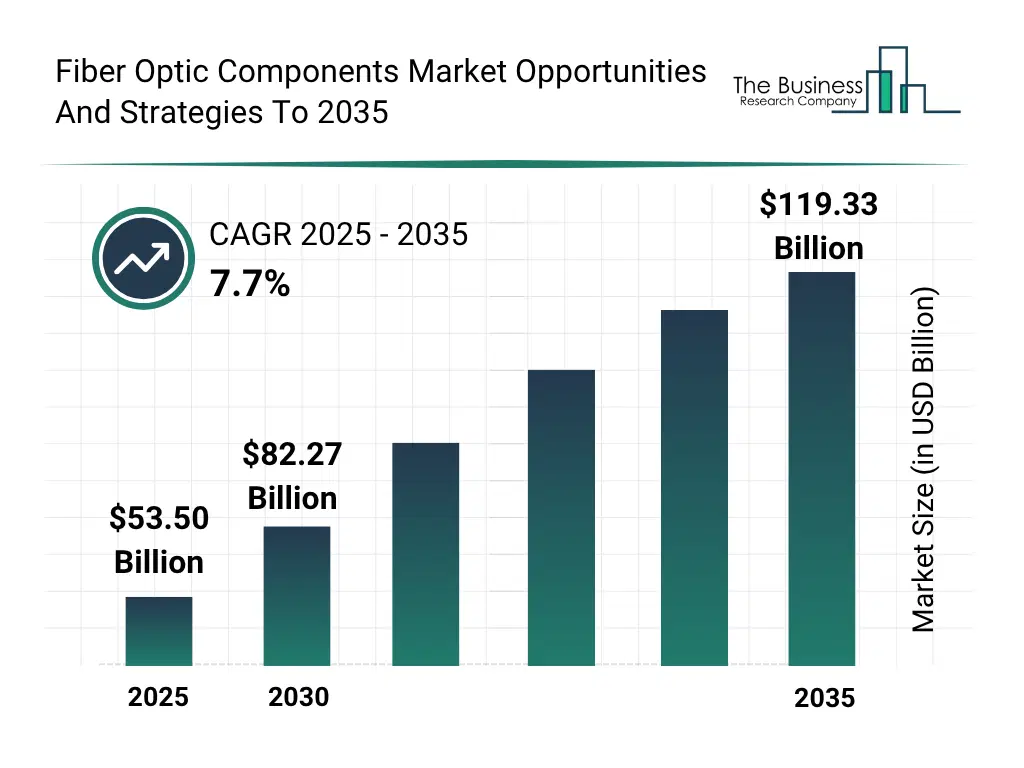
The global fiber optic components market reached a value of nearly $53,496.2 million in 2025, having grown at a compound annual growth rate (CAGR) of 9.3% since 2020. The market is expected to grow from $53,496.2 million in 2025 to $82,267.3 million in 2030 at a rate of 9.0%. The market is then expected to grow at a CAGR of 7.7% from 2030 and reach $119,334.9 million in 2035. Growth in the historic period resulted from rising demand for high-speed internet, increasing adoption of FTTH networks, growing telecommunications infrastructure expansion and rising data center deployments. Factors that negatively affected growth in the historic period were high initial capital investment for fiber network deployment and complex and time-consuming deployment processes. Going forward, expanding enterprise fiber networks, rising demand for high-performance networking in cloud infrastructure, growing adoption of fiber networks in industrial communication systems and increasing global demand for low-latency communication networks will drive the growth. Factors that could hinder the growth of the fiber optic components market in the future include technical complexity in installation and maintenance of optical systems, integration challenges with existing legacy telecom infrastructure and impact of trade wars and tariffs.
Research Expert

Book your 30 minutes free consultation with our research experts

Fiber Optic Components Market Segmentation

The fiber optic components market is segmented by type, by fiber type, by application.

By Type –
The fiber optic components market is segmented by type into:
    • a) Cables
    • b) Active Optical Cables
    • c) Amplifiers
    • d) Splitters
    • e) Connectors
    • f) Circulators
    • g) Transceivers
    • h) Other Types
The cables market was the largest segment of the fiber optic components market segmented by type, accounting for 30.6% or $16,348.3 million of the total in 2025. Going forward, the active optical cables segment is expected to be the fastest-growing segment in the fiber optic components market segmented by type, at a CAGR of 13.1% during 2025-2030.

By Fiber Type –
The fiber optic components market is segmented by fiber type into:
    • a) Glass
    • b) Plastic
The glass market was the largest segment of the fiber optic components market segmented by fiber type, accounting for 85.7% or $45,867.1 million of the total in 2025. Going forward, the plastic segment is expected to be the fastest-growing segment in the fiber optic components market segmented by fiber type, at a CAGR of 9.8% during 2025-2030.

By Application –
The fiber optic components market is segmented by application into:
  1. a) Distributed Sensing
  2. b) Analytical And Medical Equipment
  3. c) Lighting And Communications
The communications market was the largest segment of the fiber optic components market segmented by application, accounting for 52.6% or $28,160.9 million of the total in 2025. Going forward, the analytical and medical equipment segment is expected to be the fastest-growing segment in the fiber optic components market segmented by application, at a CAGR of 14.2% during 2025-2030.

By Geography - The fiber optic components market is segmented by geography into:
      o Asia Pacific
      • China
      • India
      • Japan
      • Australia
      • Indonesia
      • South Korea
      o North America
      • USA
      • Canada
      o South America
      • Brazil
      o Western Europe
      • France
      • Germany
      • UK
      • Italy
      • Spain
      o Eastern Europe
      • Russia
      o Middle East
      o Africa
Asia Pacific was the largest region in the fiber optic components market, accounting for 38.6% or $20,639.9 million of the total in 2025. It was followed by North America, Western Europe and then the other regions. Going forward, the fastest-growing regions in the fiber optic components market will be Asia Pacific and North America where growth will be at CAGRs of 10.1% and 8.6% respectively. These will be followed by Middle East and Western Europe where the markets are expected to grow at CAGRs of 8.3% and 8.3% respectively.

Fiber Optic Components Market Drivers

The key drivers of the fiber optic components market include: Expanding Enterprise Fiber Networks During the forecast period, the expanding enterprise fiber networks are expected to be a key driver propel growth in the fiber optic components market. As enterprises and organizations continue to expand high-capacity fiber networks to support rising data traffic, cloud computing and digital business operations, the deployment of advanced optical communication infrastructure is accelerating. The growing rollout of enterprise fiber networks across corporate campuses, office buildings and data centers is increasing the demand for high-performance optical components capable of supporting high-speed data transmission and reliable connectivity. The expanding adoption of enterprise fiber networks is driving greater demand for fiber optic cables, connectors, transceivers, amplifiers, splitters and related components in the fiber optic components market. The expanding enterprise fiber networks growth contribution during the forecast period in 2025 is 1.3%.

Fiber Optic Components Market Restraints

The key restraints on the fiber optic components market include: Technical Complexity In Installation And Maintenance Of Optical Systems During the forecast period, technical complexity in the installation and maintenance of optical systems is expected to restrict the growth of the fiber optic components market. As the deployment of fiber optic networks expands to support high-speed data transmission and advanced communication infrastructure, network operators and service providers increasingly face challenges related to the precise installation, alignment and configuration of optical components. The integration of fiber optic cables, connectors, transceivers and amplifiers requires specialized tools, skilled technicians and careful handling to ensure efficient signal transmission and minimize signal loss. The need for regular maintenance, fault detection and repair of optical systems further adds to operational difficulties, particularly in large-scale network environments. These technical complexities associated with installing and maintaining fiber optic systems can increase operational costs and deployment timelines, which may limit large-scale network expansion and slow the broader adoption of fiber optic components market. Growth affected by the technical complexity in the installation and maintenance of optical systems during the forecast period in 2025 is -2.0%.

Fiber Optic Components Market Competitive Landscape

Major Competitors are:

  • Corning Inc.
  • Coherent (II-VI Incorporated)
  • Lumentum Holdings Inc.
  • Broadcom Inc.
  • Sumitomo Electric Industries Ltd.
  • Other Competitors Include:

  • Accelink Technologies Co., Ltd.
  • Fujikura Ltd.
  • FiberHome Telecommunication Technologies Co., Ltd.
  • Prysmian S.p.A. (Prysmian Group)
  • The Furukawa Electric Co., Ltd.
  • Oman Fiber Optic Co. SAOG
  • NiaFiber
  • M-TEC (Aberdare Cables Division)
  • CBI Telecom Pty Ltd
  • Benya Cables
  • Yangtze Optics Africa Cable (YOAC)
  • Alfanar Cables
  • Saudi Cable Company
  • Middle East Specialized Cables Co. (MESC)
  • Riyadh Cables Group Company
  • Middle East Fiber Cable Manufacturing Co. (MEFC)
  • Arabian Fiber Optics Company
  • Arabian Fiber Optic Cable Manufacturing LLC (AFOC)
  • Naficon Fiber Optic Manufacturing LLC
  • HFCL Limited
  • Nexans S.A.
  • Corning Incorporated
  • Hexatronic Group AB
  • HUBER+SUHNER AG
  • TKH Group N.V.
  • Furukawa Electric LatAm S.A.
  • Fibracem Teleinformática Ltda.
  • Rosenberger Sudamérica Ltda.
  • HT Cabos e Tecnologia Ltda.
  • TDE – trans data elektronik GmbH
  • Netomnia Limited
  • Adtran Holdings, Inc.
  • Coherent Corp.
  • Ciena Corporation
  • Sterlite Technologies Limited
  • Lumentum Holdings Inc.
  • Broadcom Inc.
  • EMCORE Corporation
  • Fiber Mountain, Inc.
  • MW Technologies LLC
  • Arista Networks, Inc.
  • SENKO Advanced Components, Inc.
  • Chiral Photonics, Inc.
  • OFS Fitel, LLC
  • AFL Telecommunications LLC
  • Panduit Corp.
  • American Cable Assemblies, Inc.
  • Pearlyond Technologies Canada Inc.
  • Infini Fiber Optic Cable Inc.
  • OZ Optics Limited
  • Vinam Canada Inc.
  • Techlogiks Inc.
  • Amphenol Corporation
  • CIK Telecom Inc.
  • Bell Canada
  • FiberTech Optica (FTO) Inc.
  • Sumitomo Electric Industries, Ltd.
  • YOFC (Yangtze Optical Fibre and Cable Joint Stock Limited Company)
  • CommScope Holding Company, Inc.
  • FiberOpto Asia Pte Ltd
  • Datwyler IT Infra GmbH
  • Thai Fiber Optics Co., Ltd.
  • Guangdong Yitong Fiber Optical Cable Co., Ltd.
  • Singapore Telecommunications Limited (Singtel)
  • LS Cable & System Ltd.
  • Taihan Cable & Solution Co., Ltd.
  • FOSTEC Co., Ltd.
  • Hanyo Co., Ltd.
  • FIBERPRO, Inc.
  • FBG Korea Co., Ltd.
  • Optonest Co., Ltd.
  • Fiber Optic Korea Co., Ltd.
  • LG Innotek Co., Ltd.
  • Green Optics Co., Ltd.
  • Wooriro Co., Ltd.
  • OE Solutions Co., Ltd.
  • Fujitsu Optical Components Limited
  • O-Net Technologies (Shenzhen) Group Co., Ltd.
  • TE Connectivity Ltd.
  • Shenzhen Nokoxin Technology Co., Ltd.
  • Optical Fibre Cable Accessories Pvt. Ltd.
  • Eoptolink Technology Inc., Ltd.
  • Zhongji Innolight Co., Ltd.
  • T&S Communications Co., Ltd.
  • AVIC Jonhon Optronic Technology Co., Ltd.
  • CSRayzer Optical Technology Co., Ltd.
  • Seikoh Giken Co., Ltd.
  • Hirose Electric Co., Ltd.
  • KEYENCE CORPORATION
  • Yangtze Optical Electronic Co., Ltd.
  • Santec Holdings Corporation
  • Hakusan Inc.
  • Anritsu Corporation
  • ScaleFibre Communications Pte. Ltd.
  • ZTE Corporation
  • Huawei Technologies Co., Ltd.
  • Need data on a specific region in this market?

    Opportunities And Recommendations In The Fiber Optic Components Market

    Opportunities – The top opportunities in the fiber optic components market segmented by type will arise in the cables segment, which will gain $8,867.8 million of global annual sales by 2030. The top opportunities in the fiber optic components market segmented by fiber type will arise in the glass segment, which will gain $24,210.8 million of global annual sales by 2030. The top opportunities in the fiber optic components market segmented by application will arise in the communications segment, which will gain $11,847.9 million of global annual sales by 2030. The fiber optic components market size will gain the most in the China at $5,701.8 million. Recommendations- To take advantage of the opportunities, The Business Research Company recommends the fiber optic components companies to focus on compact coherent optical modules for capacity expansion in fiber networks, focus on ultra-compact optical connectors for high-density data center growth, focus on high-capacity optical transceivers for dense AI data center networks, focus on coherent and integrated optical component innovation for high-density fiber networks, focus on cost efficient short range optical connectivity for industrial automation networks, focus on high growth active optical cable segment for data center driven demand, focus on cost efficient plastic fiber solutions for short range connectivity growth, focus on direct and digital distribution for fiber optic component expansion, focus on value based and tiered pricing for fiber optic components, focus on technical positioning and industry engagement in promotion, focus on high growth medical and analytical fiber optic applications.
    Chat with us