
Fiber Optical Cable Market Report 2026
Global Outlook – By Fiber Material ( Glass Optical Fiber, Plastic Optical Fiber), By Product Type ( Single-mode Cable, Multi-mode Cable), By Application ( Telecom, Oil And Gas, Military And Aerospace, BFSI, Medical, Imaging, Railway, Other Applications) – Market Size, Trends, Strategies, and Forecast to 2035
Fiber Optical Cable Market Overview
• Fiber Optical Cable market size has reached to $84.15 billion in 2025 • Expected to grow to $115.79 billion in 2030 at a compound annual growth rate (CAGR) of 6.8% • Growth Driver: Growing Demand For Higher Bandwidth And Faster Speed Connections Boosts Fiber Optic Cable Market • Market Trend: HFCL Launches 1728-Fibre IBR Optical Cable To Boost 5G, FTTH, And Data Centre Connectivity • Asia-Pacific was the largest region in 2025 and North America is the fastest growing region.Market Gains By 2030 – Top Opportunities By Segment
Market Gain identifies the most promising market opportunities by highlighting the segments or products expected to generate the highest incremental revenue growth over the next five years.
What Is Covered Under Fiber Optical Cable Market?
Fiber optic cables are network cables containing strands of glass fibers inside an insulated case. These are mainly used as a medium for telecommunications and computer networking. They are also used as light guides, imaging tools, and lasers for medical surgery, and as wiring in aircraft, submarines, and other vehicles. The main types of fiber optic cable are glass optical fiber and plastic optical fiber. Glass optical fibers are typically composed of a core of pure glass (SiO2) and cladding of a less pure glass or plastic. Glass fiber is primarily used in communication, sensor, and measurement systems. They are an excellent choice for long-distance, high-speed communication applications due to their high transmissivity and low loss factor. They are also better suited for use in corrosive environments or at high temperatures. The various products include single-mode cable and multi-mode cable that is used for telecom, oil and gas, military and aerospace, BFSI, medical, imaging, railway, and other applications.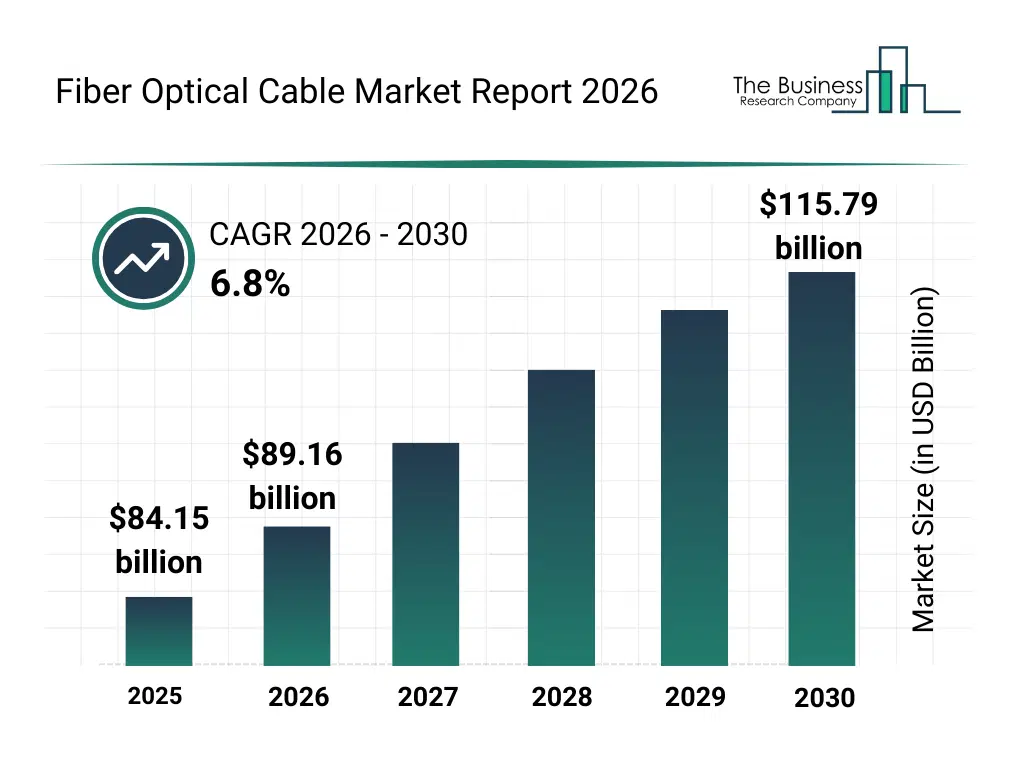
What Is The Fiber Optical Cable Market Size 2026 And Growth Rate?
The fiber optical cable market size has grown strongly in recent years. It will grow from $84.15 billion in 2025 to $89.16 billion in 2026 at a compound annual growth rate (CAGR) of 5.9%. The growth in the historic period can be attributed to growth in telecommunication infrastructure, rising demand for internet and broadband services, early adoption of fiber for long distance communication, increasing need for high bandwidth data transmission, development of multimode and single mode cable technologies.What Is The Fiber Optical Cable Market Growth Forecast?
The fiber optical cable market size is expected to see strong growth in the next few years. It will grow to $115.79 billion in 2030 at a compound annual growth rate (CAGR) of 6.8%. The growth in the forecast period can be attributed to expansion of 5g and future network deployments, increasing demand for fiber connectivity in smart cities, growth in cloud computing and hyperscale data centers, rising adoption of fiber sensors in industrial monitoring, increasing use of fiber optic imaging in healthcare. Major trends in the forecast period include expanding deployment of fiber networks for high speed telecom services, rising adoption of fiber in medical imaging and surgical applications, increasing use of fiber in oil and gas monitoring systems, growing demand for fiber in railway signaling and control, expansion of fiber installation for cloud data center connectivity.
Global Fiber Optical Cable Market Segmentation
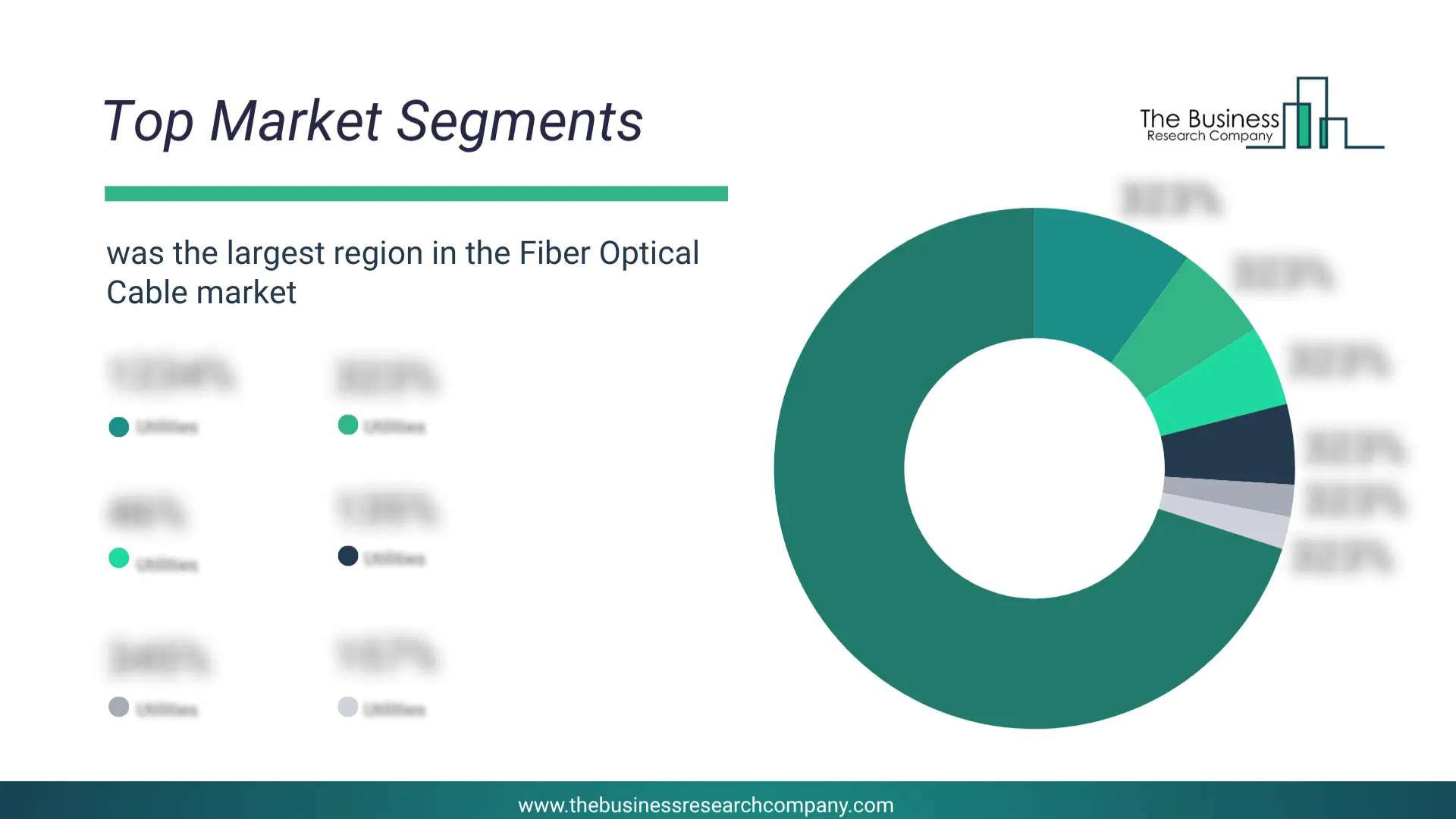
1) By Fiber Material: Glass Optical Fiber, Plastic Optical Fiber 2) By Product Type: Single-mode Cable, Multi-mode Cable 3) By Application: Telecom, Oil And Gas, Military And Aerospace, BFSI, Medical, Imaging, Railway, Other Applications Subsegments: 1) By Glass Optical Fiber: Single-Mode Fiber (SMF), Multi-Mode Fiber (MMF) 2) By Plastic Optical Fiber: Standard Plastic Optical Fiber, Specialty Plastic Optical Fiber The top segments in the fiber optical cable market will be: • Glass Optical Fiber will reach $14528.3 Million by 2025. • Single-mode Cable will reach $10211.8 Million by 2025. • Telecom will reach $9099.6 Million by 2025. • Multi-mode Cable will reach $6136.4 Million by 2025. • Plastic Optical Fiber will reach $1820 Million by 2025.What Is The Driver Of The Fiber Optical Cable Market?
The rising demand for higher bandwidth and faster speed connections is expected to propel the growth of the fiber optic cable market going forward. Higher bandwidth and faster connections allow large volumes of data to be transmitted quickly, enhancing communication, streaming, and overall network efficiency. The demand for higher bandwidth and faster connections is increasing as users seek smoother, uninterrupted online experiences for streaming, communication, and data access. Fiber optic cables enable higher bandwidth and faster connections by using light to transmit data instead of electricity, allowing them to transfer large volumes over long distances with minimal loss and low latency, ensuring reliable, high-speed internet. For instance, in December 2023, according to Ookla, a US-based web service that provides free analysis of Internet access performance, the median global 5G download speed saw a significant 20% rise in Q3 2023, reaching 203.04 Mbps, up from 168.27 Mbps in Q3 2022. Therefore, the rising demand for faster speed connections and higher bandwidth is driving the growth of the fiber optic cable market.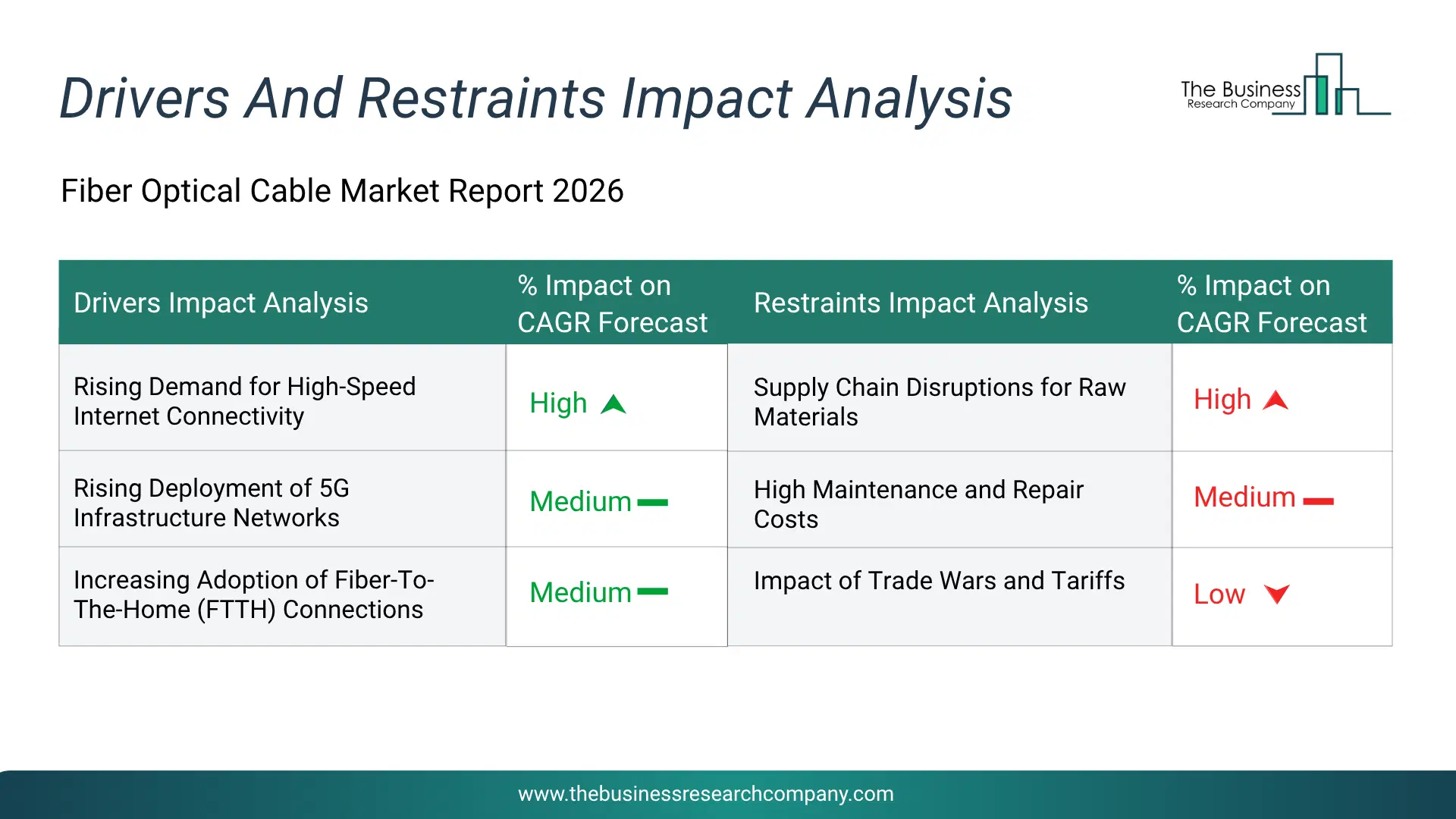
Infographic Chart Showing Key Market Drivers Analysis And Restraints For Fiber Optical Cable Market
The chart presents an impact analysis of key drivers and restraints, quantifying their relative influence on the market's growth rate and helping assess the balance between growth enablers and limiting factors. This chart offers a high-level perspective; the full report contains more detailed insights.
How Will The Drivers Impact Growth In The Global Fiber Optical Cable Market?
• Rising Demand for High-Speed Internet Connectivity (High) – The rising demand for high-speed internet connectivity will become a key driver of growth in the fiber optical cable market by 2030. As businesses and consumers increasingly demand high-speed, reliable internet connectivity to support cloud computing, streaming, remote work, and digital services, network operators and service providers are transforming traditional broadband infrastructures into advanced fiber-optic networks capable of delivering ultra-fast, low-latency, and high-capacity data transmission. The rising demand for high-speed internet connectivity is projected to expand the deployment of fiber optical networks across urban, rural, and enterprise environments, leading to heightened demand for advanced fiber technologies that enable faster data transmission, low-latency communication, and seamless support for cloud, IoT, and digital services. A broader rising demand for high-speed internet connectivity increases the use of cloud computing, streaming services, remote work solutions, and IoT applications, driving sustained demand for advanced fiber optical cable. As a result, the rising demand for high-speed internet connectivity is anticipated to contributing to a 2.0% annual growth in the market. • Rising Deployment of 5G Infrastructure Networks (Medium) – The rising deployment of 5G infrastructure networks will emerge as a major factor driving the expansion of the fiber optical cable market by 2030. As telecommunications providers accelerate the deployment of 5G infrastructure networks, urban and rural service areas are increasingly investing in high-capacity fiber optical backbones, low-latency network nodes, and advanced connectivity infrastructure designed to support ultra-fast data transmission, enhance network reliability, and optimize next-generation digital services. The growing deployment of 5G infrastructure networks is projected to expand the installation of high-capacity fiber optical cables across urban, suburban, and rural areas, driving heightened demand for advanced fiber technologies that support ultra-fast data transmission and low-latency connectivity, and enabling seamless operation of next-generation digital services and 5G applications. A broader rising deployment of 5g infrastructure networks increases the use of cloud computing, IoT applications, high-definition streaming, and real-time data services, driving sustained demand for advanced fiber optical cable. Consequently, the rising deployment of 5G infrastructure networks is projected to contributing to a 1.5% annual growth in the market. • Increasing Adoption of Fiber-To-The-Home (FTTH) Connections (Medium) – The increasing adoption of fiber-to-the-home connections will serve as a key growth catalyst for the fiber optical cable market by 2030. As internet service providers accelerate the expansion of fiber-to-the-home (FTTH) connections, residential and commercial areas are increasingly investing in high-capacity fiber optical infrastructure, advanced network equipment, and low-latency connectivity solutions designed to deliver ultra-fast internet speeds, enhance user experience, and support next-generation digital applications. The growing adoption of fiber-to-the-home (FTTH) connections is projected to expand the deployment of high-capacity fiber optical networks across residential and commercial areas, leading to heightened demand for advanced fiber technologies that support ultra-fast internet speeds, low-latency communication, and seamless delivery of next-generation digital services. A broader increasing adoption of fiber-to-the-home connections increases the use of high-speed internet services, smart home applications, remote work solutions, and digital entertainment platforms, driving sustained demand for advanced fiber optical cable. Therefore, this increasing adoption of fiber-to-the-home connections is projected to supporting to a 1.0% annual growth in the market. • Government-Led Broadband Expansion Programs (Low) – The government-led broadband expansion programs will become a significant driver contributing to the growth of the fiber optical cable market by 2030. As governments increasingly implement broadband expansion programs that combine fiber optical infrastructure, high-capacity network upgrades, and public-private partnerships, urban and rural areas are transforming traditional connectivity networks into advanced digital ecosystems capable of supporting ultra-fast internet, low-latency communication, and next-generation digital services. The rising implementation of government-led broadband expansion programs is projected to expand the deployment of fiber optical networks across urban, suburban, and rural regions, leading to heightened demand for advanced fiber technologies that enable ultra-fast internet speeds, low-latency connectivity, and seamless delivery of digital services and smart infrastructure applications. A broader government-led broadband expansion programs increases the use of high-speed internet services, smart city applications, telemedicine, and cloud-based solutions, driving sustained demand for advanced fiber optical cable. Consequently, the government-led broadband expansion programs is projected to contributing to a 0.5% annual growth in the market.How Will The Restraints Impact Growth In The Global Fiber Optical Cable Market?
• Supply Chain Disruptions for Raw Materials (High) – Supply chain disruptions for raw materials is expected to restrain market growth during the forecast period. It creates operational, financial, regulatory, or commercial challenges that can increase costs, delay projects, reduce investments, or discourage purchasing decisions depending on the market. These challenges can reduce product adoption, affect business confidence, and limit the ability of companies to expand efficiently across key regions. This can reduce operational efficiency, delay expansion plans, and affect the ability of companies to achieve sustainable business growth. • High Maintenance and Repair Costs (Medium) – During the forecast period, high maintenance and repair costs is likely to limit market expansion. It creates operational, financial, regulatory, or commercial challenges that can increase costs, delay projects, reduce investments, or discourage purchasing decisions depending on the market. These challenges can reduce product adoption, affect business confidence, and limit the ability of companies to expand efficiently across key regions. As a result, businesses may face increased cost pressures, slower commercial adoption, and reduced revenue opportunities. • Impact of Trade Wars and Tariffs (Medium) – The market is expected to face challenges due to impact of trade wars and tariffs over the forecast period. It creates operational, financial, regulatory, or commercial challenges that can increase costs, delay projects, reduce investments, or discourage purchasing decisions depending on the market. These challenges can reduce product adoption, affect business confidence, and limit the ability of companies to expand efficiently across key regions. This may discourage new investments, delay strategic expansion initiatives, and weaken the overall competitive position of market participants.Key Players In The Global Fiber Optical Cable Market
Major companies operating in the fiber optical cable market are Corning Incorporated, Prysmian Group, Fujikura Ltd., Sterlite Technologies Limited, Sumitomo Electric Industries, Ltd., LS Cable & System Ltd., Furukawa Electric Co., Ltd., Yangtze Optical Fibre and Cable Joint Stock Limited Company (YOFC), Nexans S.A., CommScope Inc., Hengtong Group Co., Ltd., ZTT International Limited, Belden Inc., FiberHome Telecommunication Technologies Co., Ltd., Finolex Cables Ltd., OFS Fitel, LLC, Draka Communications S.A.S., Optical Cable Corporation, AFL Global, Leoni AG, Amphenol Corporation, HUBER+SUHNER AG, Hitachi Cable America Inc., TE Connectivity, Sumitomo Electric Lightwave Corp., R&M (Reichle & De-Massari), Rosenberger Hochfrequenztechnik GmbH & Co. KG, Molex LLC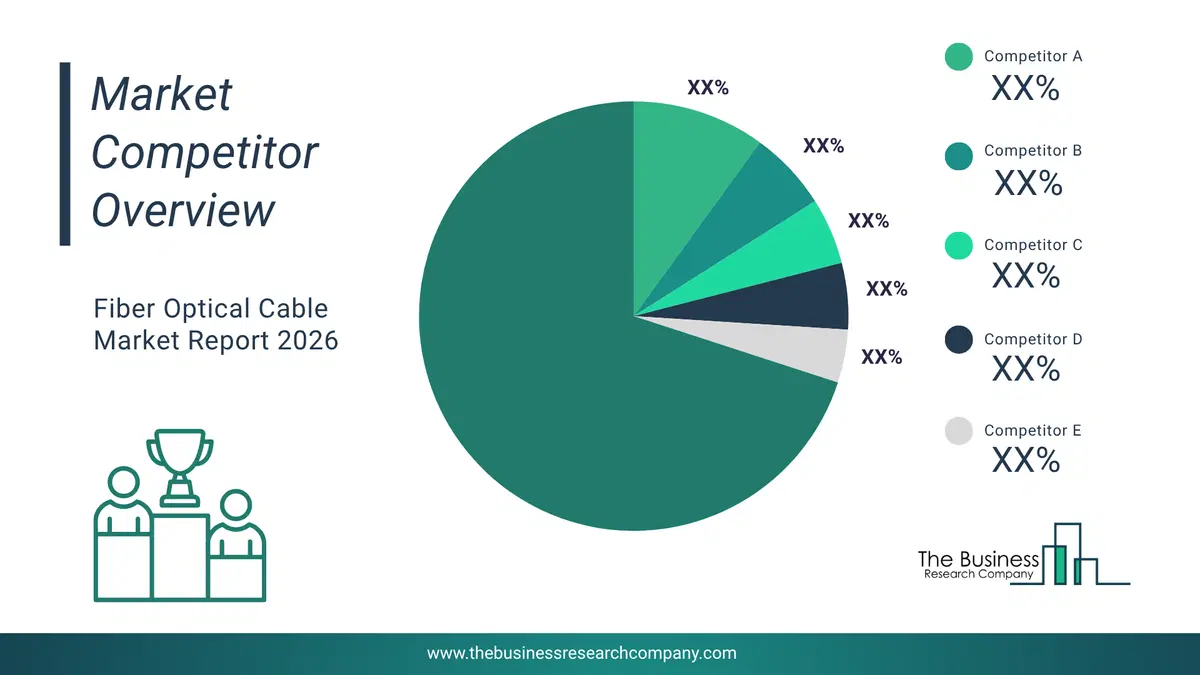
This chart is for illustrative purposes; the full report includes a detailed competitor analysis and comprehensive overview of the top 10 companies in the market.
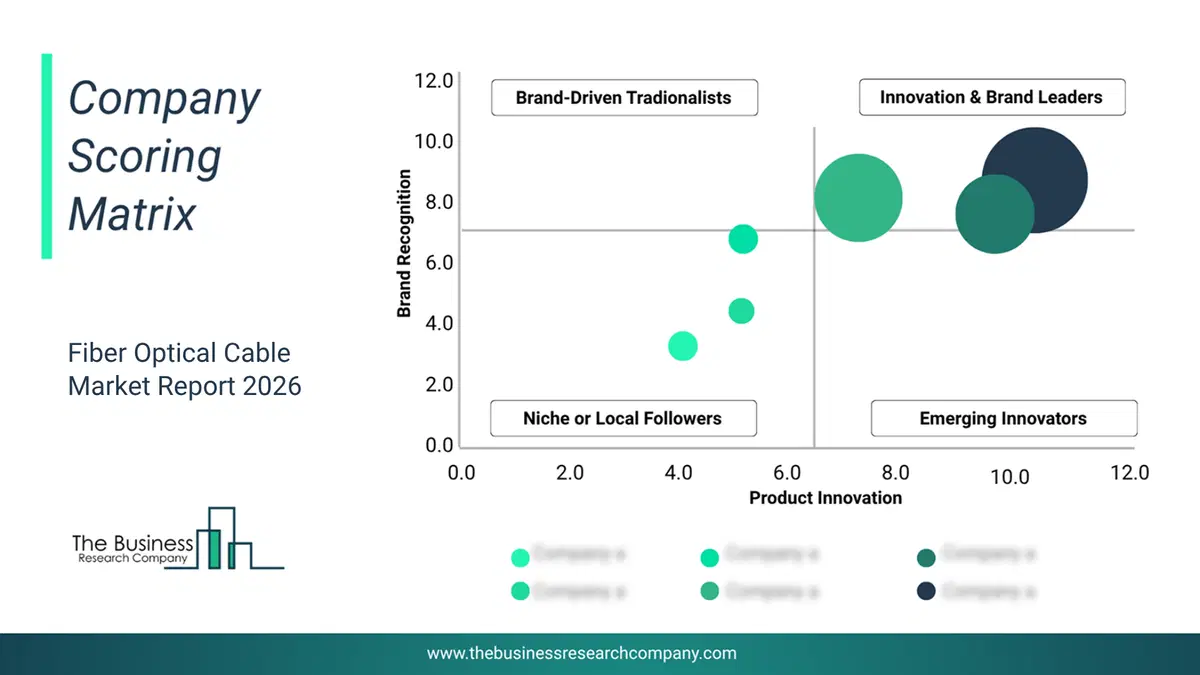
This chart maps companies by product innovation and brand strength, with bubble size indicating relative revenue, helping identify market leaders, challengers, and niche players. This is an illustrative chart; the full report provides a complete and accurate competitive analysis.
Global Fiber Optical Cable Market Trends and Insights
Major companies operating in the fiber optical cable market are focusing on technological innovations, such as 1728 high fibre count intermittently bonded ribbon (IBR) optical cables, to meet the rising demand for expanded fibre to the home (FTTH) deployments, 5G/6G backhaul capacity, and hyperscale data centre connectivity. Intermittently Bonded Ribbon (IBR) cables are designed with fibre ribbons where individual fibres are only intermittently bonded, enabling high fibre density in a compact form while allowing easier access and handling during installation and maintenance compared to traditional tightly bonded ribbon or loose tube cables. For instance, in October 2023, HFCL Limited, an India-based telecom infrastructure and optical cable company, launched a 1728 high fibre count IBR optical fibre cable to accelerate 5G network infrastructure rollout, expand FTTH capabilities, and address growing data centre demand. The product features a gel free construction optimized for high-productivity mass-fusion splicing, a compact form factor for congested ducts, and rapid restoration in case of outage.What Are Latest Mergers And Acquisitions In The Fiber Optical Cable Market?
In March 2023, Hexatronic Group AB, a Sweden based designer and manufacturer of fiber technology and connectivity solutions, acquired Rochester Cable (U.S.) for an undisclosed amount. With this acquisition, Hexatronic aimed to broaden its product offering into high performance electro optical cables for harsh environments (such as defense, oceanographic, and subsea applications), thereby strengthening its technology portfolio and North American footprint in the fiber optic cable market. Rochester Cable is a US based provider specializing in the design and manufacture of armored electro optical cables.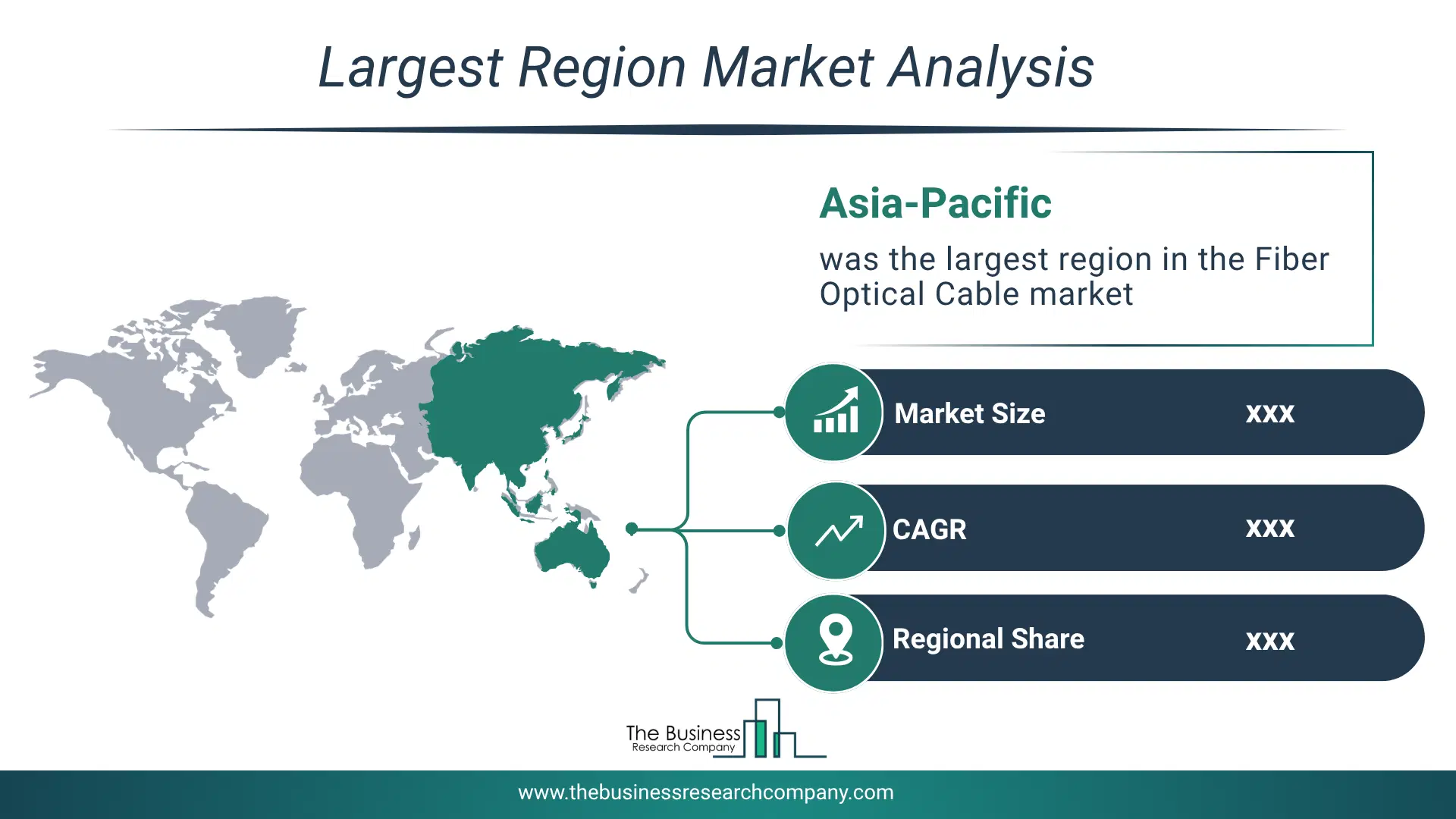
Regional Outlook
Asia-Pacific was the largest region in the fiber optic cable market in 2025. North America was the second-largest region in the global fiber optical cable market analysis. The regions covered in this market report are Asia-Pacific, South East Asia, Western Europe, Eastern Europe, North America, South America, Middle East, Africa. The countries covered in this market report are Australia, Brazil, China, France, Germany, India, Indonesia, Japan, Taiwan, Russia, South Korea, UK, USA, Canada, Italy, Spain.What Defines the Fiber Optical Cable Market?
The fiber optic cable market consists of sales of quartz optical fiber cables, multi-component glass fiber cables, plastic optical fiber cables, step-index multimode fiber, graded index multimode fiber, and other fiber optic cables. Values in this market are factory gate values, that is the value of goods sold by the manufacturers or creators of the goods, whether to other entities (including downstream manufacturers, wholesalers, distributors, and retailers) or directly to end customers. The value of goods in this market includes related services sold by the creators of the goods.How is Market Value Defined and Measured?
The market value is defined as the revenues that enterprises gain from the sale of goods and/or services within the specified market and geography through sales, grants, or donations in terms of the currency (in USD unless otherwise specified). The revenues for a specified geography are consumption values that are revenues generated by organizations in the specified geography within the market, irrespective of where they are produced. It does not include revenues from resales along the supply chain, either further along the supply chain or as part of other products.
This chart presents market attractiveness based on a quantitative evaluation of growth, competition, strategic alignment, and risk, offering a clear view of opportunity areas for decision-making. This chart is for illustrative purposes; the full report contains the complete analysis.

This chart highlights the Total Addressable Market (TAM) by estimating the maximum revenue opportunity using an assumption-driven approach, supporting strategic planning and opportunity sizing across markets. The chart is illustrative; the full report provides a more comprehensive analysis.
What Key Data and Analysis Are Included in the Fiber Optical Cable Market Report 2026?
The fiber optical cable market research report is one of a series of new reports from The Business Research Company that provides market statistics, including industry global market size, regional shares, competitors with the market share, detailed market segments, market trends and opportunities, and any further data you may need to thrive in the fiber optical cable industry. The market research report delivers a complete perspective of everything you need, with an in-depth analysis of the current and future state of the industry.Fiber Optical Cable Market Report 2026 Market Report Forecast Analysis
| Report Attribute | Details |
|---|---|
| Market Size Value In 2026 | $89.16 billion |
| Revenue Forecast In 2035 | $115.79 billion |
| Growth Rate | CAGR of 5.9% from 2026 to 2035 |
| Base Year For Estimation | 2025 |
| Actual Estimates/Historical Data | 2020-2025 |
| Forecast Period | 2026 - 2030 - 2035 |
| Market Representation | Revenue in USD Billion and CAGR from 2026 to 2035 |
| Segments Covered | Fiber Material, Product Type, Application |
| Regional Scope | Asia-Pacific, Western Europe, Eastern Europe, North America, South America, Middle East, Africa |
| Country Scope | The countries covered in the report are Australia, Brazil, China, France, Germany, India, ... |
| Key Companies Profiled | Corning Incorporated, Prysmian Group, Fujikura Ltd., Sterlite Technologies Limited, Sumitomo Electric Industries, Ltd., LS Cable & System Ltd., Furukawa Electric Co., Ltd., Yangtze Optical Fibre and Cable Joint Stock Limited Company (YOFC), Nexans S.A., CommScope Inc., Hengtong Group Co., Ltd., ZTT International Limited, Belden Inc., FiberHome Telecommunication Technologies Co., Ltd., Finolex Cables Ltd., OFS Fitel, LLC, Draka Communications S.A.S., Optical Cable Corporation, AFL Global, Leoni AG, Amphenol Corporation, HUBER+SUHNER AG, Hitachi Cable America Inc., TE Connectivity, Sumitomo Electric Lightwave Corp., R&M (Reichle & De-Massari), Rosenberger Hochfrequenztechnik GmbH & Co. KG, Molex LLC |
| Customization Scope | Request for Customization |
| Pricing And Purchase Options | Explore Purchase Options |